Podcast: Play in new window | Download (Duration: 9:16 — 11.0MB)
Further reading:
Faceless Fish and the deep-sea voyages that found it
Long-Lost ‘Faceless’ Fish Shows Up Near Australia
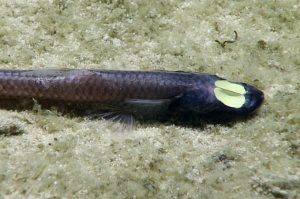
Ipnops:
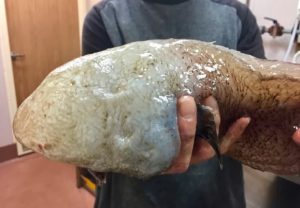
The faceless cusk [photo taken from the second article linked above]:
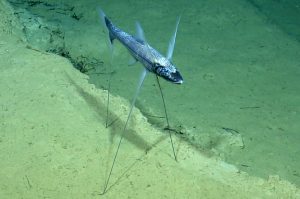
A tripod fish:
Show transcript:
Welcome to Strange Animals Podcast. I’m your host, Kate Shaw.
It’s a fish episode! These are also deep-sea fish, and you know how much I love deep-sea animals.
Let’s talk first about some fish in the family Ipnopidae, including one deep-sea fish with the pleasing name of Ipnops. We know of three species of ipnops so far, but there may be more that scientists just haven’t found yet. Some scientists think there’s actually only one species, since all three species look almost identical but just live in different parts of the deep sea.
Ipnops is sometimes called the grideye spiderfish. If you don’t know what it looks like, you may think the word spider in its name is the weird part. It’s not, and in fact I’m not sure where that comes from. It could be that the fish’s transparent fins look kind of like spiderwebs. Other fish in its family are called spiderfish too but are also sometimes called lizardfish. It feels like someone was in a goofy mood when naming these fish and just started saying random animal names.
Ipnops only grows a little over 6 inches long at most, or 16 cm. It’s slender for its size, although its head is wider than its body. Its head is black but the color fades on the body until the tail is light gray.
No, the weird thing about ipnops is its eyes. It doesn’t precisely have eyes, certainly not eyeballs. Instead it just has a thin layer of retinal cells spread across a divot in the top of its head, also called a photosensitive membrane or plate. These plates show up as yellow against the black head. Researchers think the fish can’t see the way we think of seeing, but it can probably sense bioluminescent light. Since it lives at the bottom of the deep sea where little to no light penetrates from the surface, it makes sense that ipnops doesn’t really need eyes.
We still don’t know very much about ipnops or most of its relatives. It eats small crustaceans and all individuals produce both eggs and sperm. Ipnops eggs hatch into tiny larval fish that live near the surface of the ocean and have extremely large ordinary eyeballs. How these eyeballs transform into a retinal membrane is a mystery known only to ipnops.
The family that ipnops belongs to, Ipnopidae, includes many species that are called tripod fish, and tripod fish are very weird too even though they have regular eyeballs, usually tiny ones. There are quite a few tripodfish known, many of them only discovered recently by deep-sea rovers. Most are no larger than ipnops, but some have fins that are much longer than their body.
This is the case for the tripod spiderfish—look, it’s another spiderfish—that lives at the bottom of the deep sea in many parts of the world. It’s been found at a depth of almost 3 miles, or 4,700 meters, which is so deep that it’s also sometimes called the abyssal spiderfish, although that’s also a name given to a different type of tripod fish that’s closely related. It’s big compared to many of its close relations, up to 17 inches long, or 43 cm, but its fins can grow over a yard long, or about a meter. Its tail and pelvic fins have elongated rays that allow it to stand on the bottom of the ocean, and since the bottom of the ocean is usually pretty oozy and muddy, it needs the fins to be really long so it doesn’t end up sinking into the ooze. It also has little pads on the end of the fins that help keep it from sinking. Scientists think the struts that lengthen the rays can be stiffened so that the fish can stand on them for long periods of time, but when the fish needs to swim, it can loosen the struts so they’re flexible.
If you’re not familiar with the word tripod, it means ‘three feet’ or ‘three legs.’ You’ve probably seen one before because that’s the thing that people use to prop up a camera. A camera tripod has three long legs that you can adjust so that your camera sits at just the right height to take good pictures, and it’s sturdy so the camera won’t shake. This is exactly how the tripodfish uses its elongated fins except that it’s not taking pictures. It’s just trying to find food. It stands motionless facing into the current, and spreads its pectoral fins out. It can’t see in the darkness of its deep-sea home, but it feels small fish or crustaceans that come near and stumble into its fins. It uses the pectoral fins to guide the animal toward its mouth, and then it goes chomp with its needle-like teeth.
Like ipnops, the tripodfish produces both eggs and sperm and can fertilize its own eggs if it can’t find a mate. This is important in the deep sea, especially when your main way of finding food is standing completely still for very long periods of time.
Another weird fish isn’t related to the family Ipnopidae. It’s called the faceless cusk or faceless cusk-eel, because its body is shaped sort of like an eel’s. Like ipnops, its body is slender but its head is larger, and in fact quite a lot larger in the case of the faceless cusk. Its head is rounded and bulbous, and the fish looks at first glance like it doesn’t have any of the ordinary sensory organs we expect to find on a face, except for nostrils.
The faceless cusk’s mouth is tiny and is on the underside of its head, with the head actually drooping down so that it hides the mouth. It has eyes, but they’re covered in skin and only visible in small individuals. It has a pale body but black fins and it can grow more than 18 inches long, or over 46 cm.
The faceless cusk is a deep-sea fish and was discovered in 1874. This was when the HMS Challenger expedition brought one up in its dredging nets from a depth of about two and a half miles down, or over 4 km. After that it wasn’t seen again until 1951, when a different scientific expedition collected five individuals.
In 2017, yet another scientific expedition, this one off the eastern coast of Australia, found a weird-looking fish that looked like it didn’t have a proper face. The scientists could tell it was a type of cusk-eel, but not one they’d ever heard of. It wasn’t until one of the expedition members was flipping through an old book about the Challenger expedition that they realized this fish was already known to science.
We know almost nothing about the faceless cusk. We don’t even know what it eats or how it finds its food. It lives near the bottom of the sea where the water is barely above freezing temperature.
The deepest-living fish ever discovered is a different species of cusk-eel. It’s been found living in the Puerto Rico Trench over 5 miles below the ocean’s surface, or 8 km. It’s called Abyssobrotula galatheae and it typically only grows about 6 inches long, or 15 cm. It resembles the faceless cusk in many ways even though they belong to different genera. It has tiny eyes that are covered with skin and probably don’t function, its mouth is also tiny and is underneath its head, and its head is oversized compared to its slender body and droops to hide the mouth. It’s mostly yellowish in color.
We know a little more about Abyssobrotula than we do the faceless cusk. It eats polychaete worms along with small crustaceans, which it finds on the ocean floor. Even though its mouth is quite small, it has lots of pointy teeth that help keep its prey from escaping once it bites down. Because the faceless cusk is so similar, it’s probable that it eats the same type of food.
The great thing about the fish we’ve talked about today is that they’re not especially spectacular. They’re just regular fish doing regular fish things, they just happen to be adapted to the deep sea. Because the deep sea is such an extreme environment in many ways, the fish evolve to look and act very different from the fish we’re used to seeing. If we lived in the deep sea ourselves, we’d probably look at a trout and think it was the weirdest fish we’d ever seen.
Thanks for your support, and thanks for listening!