Podcast: Play in new window | Download (Duration: 7:54 — 8.0MB)
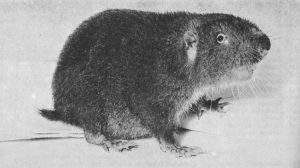
The sewellel is a little rodent:
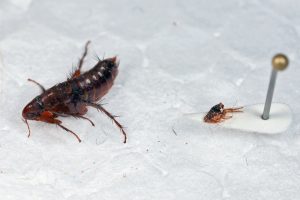
The superflea is a big flea (left, compared to a regular flea, right):
Show transcript:
Welcome to Strange Animals Podcast. I’m your host, Kate Shaw.
Let’s learn about a rodent you may never have heard of, unless you live where it does, and a parasite that makes that rodent its host. It’s not an ordinary parasite, but don’t worry, it’s not icky. You can continue to snack.
The rodent is called the sewellel, Aplodontia rufa. It’s also called the mountain beaver even though it doesn’t always live in the mountains and it isn’t a beaver. It doesn’t even look like a beaver. For one thing, it only has a little nub of a tail and it only grows around 20 inches long, or 50 cm. It has small eyes and ears, short legs, a chunky body, and long claws. This body shape should give you a hint about its lifestyle: the sewellel is a digger, although it can also swim just fine and can even climb small trees to eat young twigs and leaves.
The sewellel is an aplodont, a large group of rodents that have been common in Europe, Asia, and North America for 40 million years. But it’s the only one left. All the other aplodonts went extinct several million years ago at least. We’ve actually talked before about one of the sewellel’s extinct relations, the horned gopher (which was not a gopher), in the Patreon episode about animals with nose horns.
The sewellel itself hasn’t been around all that long, only appearing in the fossil record a few million years ago. It lives in a small area of northwestern North America, in parts of British Columbia, Washington state, Oregon, and a few parts of California. It lives in forests where it doesn’t get too cold in the winter, since it doesn’t hibernate and isn’t as good at keeping itself warm as other rodents are. It also needs to drink more water than other rodents and prefers to live in wet climates as a result.
In fact, the sewellel is sometimes referred to as a living fossil since it lacks many features that all other living rodents have. Its teeth resemble a simpler version of squirrel teeth, so some researchers think it may be most closely related to squirrels, but even if that’s the case, it isn’t very closely related. The sewellel’s ancestors were more adapted to live in trees and a study published in 2018 determined that it had a larger brain than the sewellel. Since the sewellel is nocturnal and spends most of its life underground, it doesn’t need to see very well, and the part of the brain that processes vision is much smaller than in its ancestors.
The sewellel mostly eats ferns, although it also eats other plants, and some of its favorite plants are toxic to other animals. It’s a solitary, mostly nocturnal animal that digs deep, complex burrows, and it stays as close as possible to the burrow entrance so it can hide easily if it needs to. Everything eats the sewellel, from owls to coyotes to bobcats to eagles.
And that brings us to the parasite associated with the sewellel. Many animals have parasites that are specific to that particular species. The Patreon episode about whale lice has some information about how specific this can get. The male sperm whale has a different species of louse than the species that lives on female sperm whales, for instance. Also, the whale louse isn’t a louse, it’s a type of crustacean.
The sewellel’s parasite is a type of flea. Big deal, you say, fleas are all about the same.
Are they, though? Because the sewellel’s flea is actually kind of a big deal. It is, in fact, the largest flea known, called the superflea. It can grow up to 8 mm long (and possibly longer, reports vary). I just measured, and that’s the length of my little fingernail, from the base to the quick. Most species of flea are 3 mm long at most.
The superflea is only found on the sewellel. It looks like an ordinary flea except for its size, meaning it’s laterally flattened with legs that allow it to jump long distances. So why is it so big compared to other fleas, especially considering that it lives on an animal that’s about the size of a chonky cat? No one knows. No one has even the slightest idea why this flea is so big.
There used to be even bigger fleas, some up to two cm long. That’s 20 mm, or just a little more than twice the length of the superflea. Of course, those 20 mm fleas lived 165 million years ago and probably lived on dinosaurs. Also, they couldn’t jump and instead of being flattened laterally, or side to side, like modern fleas, they were flattened dorsoventrally, or top to bottom. So they weren’t very much like modern fleas.
That’s all we know about the superflea, but let’s have one last sewellel fact before we go. With all this talk of the sewellel being a primitive rodent whose closest relations are all extinct, you might think there’s nothing really special about it beyond its giant fleas. You would be wrong, though, because the sewellel’s front paws have opposable thumbs. It’s not as mobile as our opposable thumbs, but it allows the sewellel to manipulate food more easily. It will sometimes sit up on its big round bottom to eat, just like a really weird squirrel.
Thanks for your support, and thanks for listening!