Podcast: Play in new window | Download (Duration: 9:00 — 10.1MB)
Thanks to Emily, Jo, and Alexandra for their suggestions this week!
Further reading:
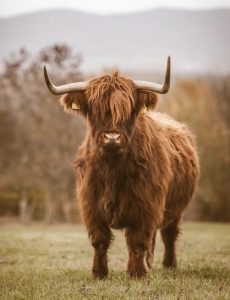
The Highland cow is so cute (picture taken from the first site linked above):
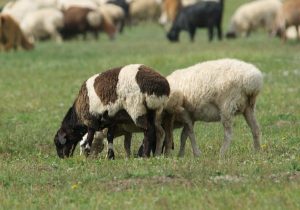
Some fat-tailed sheep (picture taken from the sheep article linked above):
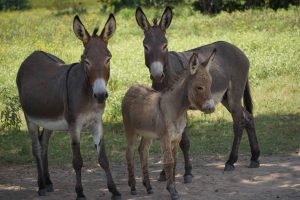
Donkeys:
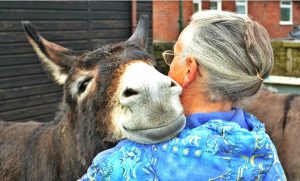
A happy donkey and a happy person (photo taken from the Donkey Sanctuary’s site, linked above):
Show transcript:
Welcome to Strange Animals Podcast. I’m your host, Kate Shaw.
After last week’s giant fish episode, this week we’re going to have a shorter episode of animals you’ve probably seen, especially if you live in the countryside. But first, I forgot to credit two people from last week’s episode, Dylan and Emily, who both wanted to hear about mudskippers along with Arthur! I had so many names I missed some.
This week we’ll talk about some domestic mammals, suggested by Alexandra, Jo, and Emily. Let’s start with Emily’s suggestion, the Highland cow.
Cows are classified in the family Bovidae, which includes not just the domestic cow and its relations but goats, sheep, antelopes, and many other animals with cloven hooves who chew the cud as part of the digestive process–but not deer or giraffes, and not the pronghorn even though people call it an antelope. It is confusing. Many bovids have horns, usually only two but sometimes four or even six, and those horns are never branched. Sometimes only the male has horns, sometimes both the male and female. Bovids don’t have incisors in the front of the upper jaw, only in the lower jaw. Instead, a bovid has a tough dental pad that helps it grab plants.
The Highland cow is a breed of domestic cow that originated in Scotland, although it’s now popular in many other places too. It’s a tough animal with a long outer coat of fur and a short, fuzzy undercoat that helps it survive harsh winters. Most are reddish-brown, but some are black, silvery-white, dun, or other shades. It has long, wide horns and its long fur usually falls over its face, which protects its eyes and also looks incredibly cute.
Not only can the Highland cow thrive on pasture that’s considered poor, meaning the plants aren’t as nutritious, it’s also disease resistant, even-tempered, and intelligent. It’s a compact, relatively small cow, but it’s not a miniature cow. Like, you can’t pick it up like a dog, although you could probably hug one if the farmer says it’s okay. A bull can stand about 5 feet tall at the shoulder, or 1.5 meters, while cows are smaller overall.
The Highland cow is raised for its meat, which is naturally lean and delicious. But because they also happen to be small for cows, and so even-tempered, and so cute, many small farms and petting zoos keep a few just as pets. Since the Highland cow likes eating plants that other cow breeds won’t touch, it’s also helpful for clearing overgrown land.
Next, Alexandra wanted to learn more about the fat-tailed sheep, another bovid. The sheep is one of the oldest domesticated animals in the world, with some experts estimating that it was first domesticated at least 11,000 years ago and possibly over 13,000 years ago, around Asia and the Middle East. Sheep are especially useful to humans because not only can you eat them, they produce wool.
Wool has incredible insulating properties, as you’ll know if you’ve ever worn a wool sweater in the snow. Even if it gets wet, you stay nice and warm. Even better, you don’t have to kill the sheep to get the wool. The sheep just gets a haircut every year to cut its wool short. Wild sheep don’t grow a lot of wool, though. They mostly have hair like goats. Humans didn’t start selecting for domestic sheep that produced wool until around 8,000 years ago.
The fat-tailed sheep isn’t a single breed but a type of sheep, most common in central Asia, northern Africa, and the Middle East. It’s adapted for life in arid conditions, where there isn’t a lot of water. The fat deposits on both sides of the tail act like a camel’s hump, allowing the animal to absorb the stored fat if it can’t find enough food and water.
The fat-tailed sheep can have a really huge tail, so big it can make up almost a third of its body weight. Because the fat mostly collects on either side of the tail bones, the tail’s shape has two lobes, which makes the sheep look like it has an extra butt on its butt. In some breeds, the tail gets wider as the fat deposits grow, while in other breeds, the tail just gets longer, sometimes so long it actually brushes the ground.
The tail fat helps the sheep, but it’s also considered a delicacy to people. Wherever the fat-tailed sheep is raised, there are special recipes to cook the tail. Many breeds of fat-tailed sheep also produce long, coarse wool that’s used to make carpets and felt.
We’ll finish with Jo’s suggestion, the domestic donkey. Donkeys are equids, and instead of cloven hooves like bovids, they have solid hooves. They’re closely related to horses and zebras, and more distantly related to rhinoceroses and tapirs.
The domestic donkey is descended from the African wild ass. Researchers estimate it was domesticated around five to seven thousand years ago by the ancient nomadic peoples of Nubia in Africa, and quickly spread throughout the Middle East and into southern Asia and Europe.
The domestic donkey is a strong, sturdy animal that’s usually fairly small. One of the biggest breeds is the American Mammoth Jackstock, and another is the French Baudet du Poitou, which has long fur. Both breeds can be as big as a horse. Big donkey breeds like these were mostly developed to cross with horses, to produce even larger, stronger mules. Mules are hybrid animals and are infertile, but they’re very strong.
The donkey is usually gray or brown and has long ears. Most have a darker stripe down the spine, called an eel stripe, and another stripe across the shoulders. Many have a lighter-colored nose, belly, and legs. The donkey’s mane is short and stands upright.
The donkey’s small size and big strength has made it a popular working animal throughout the world. It can carry loads, can be ridden, and can pull carts and plows. It’s famously tough and can be stubborn if it doesn’t feel like it’s being treated well, and it can even be dangerous when it kicks and bites. Sometimes farmers keep donkeys with their sheep or other animals, because the donkey will look out for danger and warn the herd by braying if it sees a predator. If the predator gets too close, the donkey will attack it instead of running away.
In many places in the world, the donkey is an important work animal even today. Not everyone is lucky enough to afford a tractor or truck, so donkeys do the same work for people that they’ve done for thousands of years. The problem is that when a donkey gets old or is injured, and can’t work anymore, sometimes they’re killed for meat or just abandoned. Luckily there are donkey rescues who do their best to help as many donkeys as they can, especially the Donkey Sanctuary.
The Donkey Sanctuary started in England in 1969, but it now has sanctuaries throughout Europe, and it runs programs that offer free veterinary care and education about donkeys for people in many parts of the world. One important thing the Donkey Sanctuary does, and other donkey rescues do too, is give a home to elderly donkeys who can’t work anymore. It’s only fair that a hard-working donkey gets to retire and have a peaceful old age.
You can find Strange Animals Podcast at strangeanimalspodcast.blubrry.net. That’s blueberry without any E’s. If you have questions, comments, corrections, or suggestions, email us at strangeanimalspodcast@gmail.com.
Thanks for listening!