Podcast: Play in new window | Download (Duration: 7:11 — 7.9MB)
This week let’s learn about some blue frogs!
Further reading:
Scientists make chance discovery of rare blue skin mutation in Kimberley magnificent tree frog
White’s True-Blue Green Tree Frog
Show transcript:
Welcome to Strange Animals Podcast. I’m your host, Kate Shaw.
When most of us draw a frog, we reach for the green markers, because most frogs are green. That’s true of the magnificent tree frog, also called the splendid tree frog, which is fairly common in the Kimberley region of western Australia. It grows just over 4 inches long, snout to vent, or about 10 and a half cm, and lives in rocky areas. It spends the day hiding in rock crevices, holes in trees, or sometimes in people’s houses, and it comes out at night to hunt for insects and other small invertebrates.
From the name, you might imagine that this is an especially pretty frog, and it is. It’s mostly bright green on top and yellow to white underneath, and it has tiny yellow spots on its head and back. It looks like it has an olive green cap on its head, but that’s actually a large parotoid gland, a skin gland common in frogs and toads that secretes neurotoxins. Most frogs don’t have a parotoid gland at all, and in ones that do you typically will barely notice it, but the magnificent tree frog’s covers the entire top of its head almost to its nostrils and down onto its back.
The skin color of a frog depends on its chemical makeup. Melanophores make black and brown colors, xanthophores make yellow. Blue is different, since it’s not a color that’s actually found in skin pigments. Instead, a green frog’s skin contains iridophores that reflect blue light waves, the same way a bird’s feathers show blue. The combination of yellow and blue makes green, and the addition of melanophore pigments determine how dark or bright the green is.
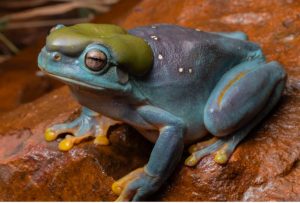
In July of 2024, two land managers were working in the Charnley River-Artesian Range Wildlife Sanctuary. They were in a workshop when one of them noticed a magnificent tree frog sitting on a bench, not that unusual of an occurrence–except that this frog wasn’t green. It was blue!
The condition is called axanthism, where the yellow pigments in the frog’s skin don’t show up the way they should. Most of them time axanthism in frogs means the animal has little patches of blue or bluish coloration, but this specific frog was blue just about everywhere it should have been green. Its parotoid gland was still olive green and it had yellow on its feet, but mainly it was a very attractive dark blue.
The land managers were stunned. They took photos and sent them to pretty much everyone, and frog experts and ecologists hurried to examine the blue frog. But they decided not to keep the frog in captivity. It was released back into the wild to live out its blue froggy life normally.
Some frogs are naturally blue, like some poison dart frogs of South America. The blue poison dart frog’s legs are dark blue and its body a lighter blue with black spots. It grows less than two inches long, or about 4.5 cm. Poison dart frogs collect toxins in their bodies from some of the toxic insects they eat, and the bright coloration signals to predators that this frog will make you really sick if you eat it.
Axanthism is rare but not all that uncommon in frogs. About the same time that the blue magnificent tree frog was hopping into the workshop in Australia, two little girls playing around a pond in Nova Scotia, Canada found a teal-blue frog. Ironically, the frog is actually called the green frog and it’s ordinarily a dark olive-green all over. The girls named the frog Bluey and released it back into the pond. Another blue green frog was found in New Hampshire, in the United States, also in July 2024. In June 2024 a forest ranger spotted a northern leopard frog in Washington state that had splotches of light blue on its head and back. In May of 2024 a light blue Japanese tree frog was found by a couple on a walk.
The Australian green tree frog is closely related to the magnificent tree frog, although it doesn’t have a parotoid gland hat. It’s mostly green with a white or pale gray belly. It’s sometimes called the dumpy tree frog because it’s a little chonk. Actually, for a frog it’s a pretty big chonk, up to 4 and a half inches long, or over 11 cm. It’s also sometimes called White’s tree frog after John White, who described it in 1790. It was the first Australian frog that was ever scientifically described. But that leads us to a little mystery.
John White named the frog Rana caerulea. Its current scientific name is Ranoidea caerulea. But “caerulea” refers to the color blue, not green, as in cerulean blue.
John White collected the frog in 1788, preserved it in alcohol, and finally described it two years later. He refers to it in his writing as a blue frog and the illustration accompanying it shows frogs that are actually blue. But this frog is supposed to be green!
The main suggestion for why a famously green frog was initially described as blue is that the alcohol that White used to preserve the frog’s body actually destroyed the yellow pigment in its skin. This is something that does sometimes happen with frog specimens in museums. But it’s also possible that White ended up with a blue specimen, much like the blue magnificent tree frog we talked about earlier. He wouldn’t have known that the blue frog had a rare color mutation. That would explain why he referred to the frog as blue and gave it a name that means blue.
That might also explain why White described the Australian green tree frog first. Maybe he just thought it was pretty. Everyone likes the color blue.
Thanks for your support, and thanks for listening! I’m at Dragon Con this weekend, where who knows, I might actually see a blue frog. Anything is possible at Dragon Con.