Episode 482: Smoky Mountain Mystery Animals

I took this episode from an article I wrote for Flying Snake magazine, which was published in December 2020 (Vol. 6, #18).

Show transcript:

Welcome to Strange Animals Podcast. I’m your host, Kate Shaw.

The Great Smoky Mountains is a subrange of the Appalachian Mountains, which stretches from the middle of Alabama in the United States north into southeastern Canada. The Appalachians formed when the world’s continents crunched together to form the supercontinent Pangaea. The southern Appalachians formed separately and later than the northern Appalachians, around 270 million years ago.

The Appalachians were once as high as the Rockies or Himalayas, but by the time the dinosaurs went extinct, they had eroded down to the mountain cores. Sediment weathered from the peaks and filled in valleys. But during the Pleistocene, when massive glaciers covered the northern parts of North America, the weight of the ice pushed the North American plate down, causing the southern part of the plate to rise. Eventually the ancient mountains’ roots were a thousand feet (300 m) above sea level again. Rivers that once flowed east into the Atlantic Ocean or west into the remains of the shallow Western Interior Seaway shifted their courses to flow northward. Streams that once meandered across the land now plunged down steep slopes and dug gorges into the rock. And over thousands of years, animals and plants retreating from the ice migrated southward along the mountain range.

When the climate warmed some 11,000 years ago and the ice age glaciers melted, many cold-adapted species were trapped in the peaks of the southern Appalachians. One of the highest peaks is Mount LeConte, with its highest point, High Top, measured at 6,593 ft, or 2,010 meters. I hiked Mount LeConte on 7 May, 2016 when the weather in nearby Knoxville, Tennessee was a warm 82 Fahrenheit, or 27.8 Celcius, but there was snow on the mountain that morning. I wrote my name in it. A spruce-fir forest grows on the upper slopes, a remnant of forest that grew throughout the mountains during the last ice age. The climate at the peak of Mount LeConte is more like that of southern Canada than the warm, humid southeastern United States.

The Great Smoky Mountains National Park was established in 1934 to protect the mountains along the Tennessee/North Carolina border. No one lives in the park’s 800 square miles (2,072 square km), which receives up to 90 inches [2.29 m] of rain a year, some of it from hurricanes that sweep up from the southern Atlantic or the Gulf of Mexico. Large tracts of old-growth forest still remain in the park too.

So as you can see, the Smokies are a biodiversity hotspot. In 2018, the park announced its 1,000th species discovered that is new to science, which by July 2020 had grown to 1,025. Overall, 20,000 known species live in the park as of 2019 and scientists estimate that up to 100,000 more are yet to be discovered.

The Smokies are heavily forested, of course, but some mountain summits and crests have no trees. Instead, native grasses and shrubs grow. They’re called grassy balds and no one is sure why they exist. The prevailing theory is that Pleistocene megaherbivores opened the forests for grazing, and after their extinction, the balds remained open due to bison, elk (wapiti), and deer. When white settlers moved into the area, they used the balds to graze cattle and other livestock. Remains of mammoth and mastodon, musk ox, ground sloth, and other megaherbivores have been excavated from various balds throughout the park.

Amphibian enthusiasts call the Smokies the Salamander Capital of the World, with 30 known species. Largest of these is the hellbender, which we talked about in episode 14, a giant salamander that can grow nearly 2 ½ feet long, or 74 cm, and which lives in swift-moving mountain streams. It’s most closely related to the Chinese and Japanese giant salamanders, which can grow over twice as long as the hellbender. Twenty-seven of the salamanders found in the Smokies are lungless, in the family Plethodontidae. Instead of breathing with lungs or gills, the lungless salamanders absorb oxygen through their skin. Of these, the red-cheeked salamander is endemic to the Smokies—that is, it’s found nowhere else in the world.

The red-cheeked salamander lives in forests in high elevations. It can grow up to seven inches long, or 18 cm, and is gray or black with bright red patches on its face. It spends the day in a burrow, then comes out at night to find insects in the leaf litter. But it’s hard to tell apart from the imitator salamander, although the imitator only grows a little over four inches long, or 11 cm. The imitator has red cheeks but its body is patterned black and brown instead of solid gray or black. Sometimes its cheeks are yellow, too, while the red-cheeked salamander only ever has red cheeks.

Another animal found only in the Smoky Mountains, although it may also be present in mountains outside of the park, is a species of jeweled spider fly called Mary-Alice’s emerald (Eulonchus marialiciae). Mary-Alice’s emerald has a metallic-green body and yellow legs, and the adults eat nectar. But the larvae eat spiders. Specifically, they parasitize spiders. After hatching, the larva goes in search of a spider, especially trapdoor spiders that live in burrows. When it finds one, it works its way into the spider’s body and eats it from the inside out, eventually killing it. Then it pupates in the burrow and emerges as an adult spider fly. It prefers high elevations that are cool and moist.

A less horrific animal found in the Smokies is the Carolina northern flying squirrel. It was one of the species whose ancestors migrated south along the Appalachians during the Pleistocene. Then, after temperatures started to warm, the cold-adapted flying squirrel migrated north again. Some populations remained on mountaintops in the Smoky Mountains and have been isolated for thousands of years, evolving into a subspecies of flying squirrel found only in high elevations of the Smokies. It’s much rarer than the southern flying squirrel that lives throughout the southeastern United States, and prefers spruce forests instead of the hardwood forests that southern flying squirrels like. But the spruce forests are threatened by climate change, the introduced woolly adelgid insect that kills fir trees, and pollution in the form of acid rain and pesticides that travel to the mountains from other states and even other countries.

The Carolina northern flying squirrel has a patagium of furry skin that connects its front and back legs. When it jumps from a branch, it stretches its legs out and uses the patagia to glide to a new perch. It’s clumsy on the ground, though, and spends most of its time in trees. It mostly eats fungi, mushrooms, and lichens, but will also eat nuts, insects, bird eggs and even baby birds, and other plant material like tree sap and buds.

Bobcats still live in the Smokies, but the cougar, or mountain lion, was supposedly killed off in the area by the end of the 19th century. The U.S. Fish and Wildlife Service removed the eastern cougar subspecies from the endangered species list in 2018, since it is supposed to be extinct. The last cougar in what is now the park was supposedly killed in 1920. But sightings continue in the Smokies, close to a dozen a year, and some sightings are compelling, like the 2002 report of a cougar crossing a road in the park, spotted by a veterinarian who treated captive cougars in his practice. Considering how seldom seen the bobcat is despite it being relatively abundant, it’s possible that a small number of cougars still live in the park—either animals that have moved back into the mountains from elsewhere, or a relict population.

The red wolf is native to the eastern United States and was once common in the Smoky Mountains, but was killed off by white settlers throughout most of its range. Where it remained in the wild, it interbred with closely related coyotes, until it was declared extinct in the wild in 1980. Fortunately, by then a captive breeding program was in place. Starting in 1991, 37 red wolves were released in the Great Smoky Mountains National Park in Tennessee, following the release of 63 red wolves into the Alligator River Natural Area in North Carolina a few years earlier. But the release didn’t go well in the Smokies. Wolves are shy and need enormous territories with lots of game. Before long some wolves were leaving the park and attacking livestock. Others died of parvo virus, especially wolf pups.

Worse, this was about the same time that coyotes moved into the area from the west. The wolves started interbreeding with the coyotes, and the coyotes also competed with the wolves for food. In 1998, the Fish and Wildlife Service ended the program and recaptured all but one of the wolves originally released into the park.

The North Carolina release went better, with a population peak in 2006 estimated at nearly 130 wolves. But that program was suspended in 2015, and without management of the wild population, the number has dwindled. As of 2019, only 14 wolves remain in North Carolina—and that’s the entire population of red wolves in the wild.

But sightings of red wolves continue in the Smokies. The trouble is that the red wolf looks very similar to the coyote. It’s taller and larger, with a more pronounced reddish shade to its coat, but even experts can have trouble telling the two species apart if they can’t get a good look at the animal. Most likely people are seeing coyotes, possibly ones descended from red wolf/coyote hybrids born during the reintroduction program.

The biggest mystery in the park is the occasional sighting of a Bigfoot-type creature. Most sightings are probably bears, though. An estimated 1,500 American black bears live in the Smokies, and while some bears get used to hikers and tourists, most are shy and seldom seen. A black bear keeping an eye on hikers or cars will sometimes stand on its hind legs for a better view, and would naturally look like a hulking humanoid if glimpsed. But other sightings aren’t so easy to explain.

In February of 2009, a photographer named Deb Campbell was hiking the Middle Prong Trail in the snow. The Middle Prong Trail passes three major waterfalls and many smaller ones as it follows along a tributary of the Little River. She had the trail almost completely to herself—she says she only saw one person the whole time. Later she reported, “[A]t some point I am photographing along the stream and I start to smell a gawd awful stench. Not really like anything I had ever smelled before. I look around, see nothing, listen intently…nothing. So I finish up at that spot and go further up the trail.” The smell receded behind her but the snow increased, so finally she turned around to hike out. Around the area where she smelled the stink earlier, she started feeling watched. She stopped long enough to secure her camera gear for much faster hiking in slick conditions, when she heard a deep growl that she described as “very low, not like a cat, almost guttural.” Needless to say, she got off the mountain as quickly as possible.

The black bear doesn’t truly hibernate since its body temperature remains normal instead of dropping, but it does find a den in cold weather and will sleep for long stretches. It may emerge from its den occasionally during the winter during warm spells, but for the most part it’s asleep in its den from around November through March in the Smoky Mountains. But Campbell was hiking in February during a snowfall, with snow already on the ground. A bear would most likely not be out of its den in that weather unless it had been disturbed.

And bears don’t actually smell bad. During the winter hibernation most bears don’t defecate at all. Any feces left in a bear’s digestive tract harden to form a fecal plug. If it does feel the need to defecate near the end of the winter, it will do so just outside its den, but the fecal plug has very little odor. Even under ordinary conditions, unless a bear has been eating carrion, it will smell no worse than a dog that needs a bath.

Not only that, black bears don’t actually growl. They make grunty, huffing noises when warning people away or when males fight in the summer, and a frightened bear will moan, but they don’t growl like a dog.

It’s possible that Campbell hiked past a bear that had emerged from its den early and had found and eaten carrion, possibly roadkill, and that she was so close to the bear without seeing it that she smelled its breath. That’s almost more frightening than the thought of passing near a Bigfoot. The growl might have come from a different animal, a coyote or who knows, maybe even a red wolf. Or Campbell might have encountered a creature sometimes called a skunk ape due to its foul odor.

The skunk ape is most commonly reported in Florida swamps, but sightings—or smellings—have come from many other states. The smell is sometimes described as that of rotting food and roadkill on a hot day. A bear or other animal that has been rooting around in garbage bins can pick up this odor, especially in hot weather, but it’s hard to believe that a bear would be actively foraging so much in winter that it would smell like trash. January and February are the depths of winter in East Tennessee. The bears are hibernating, not foraging.

Thanks for your support, and thanks for listening! This is what a couple of fighting bears sound like:

[bear sounds]
Episode 477 Albanerpetontidae

It’s Albert the Albanerpetontid!

Further reading:

Earliest example of a rapid-fire tongue found in ‘weird and wonderful’ extinct amphibians

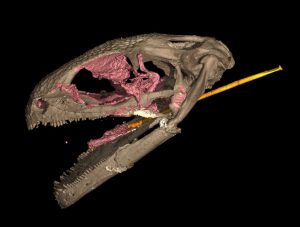
Amphibian skullllll:

Show transcript:

Welcome to Strange Animals Podcast. I’m your host, Kate Shaw.

Let’s learn about a long-extinct amphibian that looked a lot like a reptile. It’s a family of animals called Albanerpetontidae. That’s a mouthful, so instead of talking about Albanerpetontids, I’ll talk about all the various species as though they were not only a single species, but a single individual named Albert.

Albert first appears in the middle Jurassic, around 165 million years ago, and disappears from the fossil record around 2 million years ago. That means it survived the extinction event that killed off the non-avian dinosaurs and many other animals, which is also true for many other amphibians. But Albert wasn’t like the amphibians we have around today. It belonged to its own order, Allocaudata.

There’s a lot of confusion in general as to how amphibians are related to each other and how closely related, for instance, the frogs and the salamanders actually are. The same is true for Albert. What we do know is that Albert was definitely an amphibian, but it was also really different in many respects from modern amphibians.

That’s weird, because only two million years ago Albert was still around and seems to have been fairly common. Albert fossils have been found in Europe, North America, northern Africa, and parts of Asia. Two million years isn’t all that long when you’re talking about big differences between related animal groups. But although Albert appears in the fossil record at about the same time as other amphibians, it seems to have evolved very differently in many ways.

Albert looked like a salamander and was originally classified as a salamander. It was small, its body was slender and elongated, its legs were short, and it had a long tail. It had tiny teeth and seemed to prefer wet environments, which makes sense when you’re talking about an amphibian. But Albert had a lot of traits not found in other amphibians, such as scales. The scales were more fish-like than reptilian and were embedded in Albert’s skin like osteoderms, especially concentrated on the head.

These scales have caused confusion for a whole lot of scientists. In 2016, for instance, scientists identified an unusual lizard found fossilized in amber as a 99-million-year-old chameleon. That’s because it had a weird bone in its jaw shaped like a little rod, which looked like a bone found in the modern chameleon’s tongue.

It turns out that the lizard was no lizard at all but our friend Albert, an amphibian. The chameleon is a reptile and not related to Albert, but they share the same type of elongated tongue bone. When the skull of a second amber specimen was discovered that was even better preserved, including a tongue pad and other soft tissue, scientists were able to evaluate whether Albert used its tongue the same way that a chameleon does.

One trait found in Albert skulls that scientists had long been confused about was how robust and large its skull was. Some scientists suggested that it used its big head to dig burrows, ramming its head into soft mud until it created a hole big enough to hide in. But it also had big eyes, which isn’t typical in an animal that burrows.

Scientists now think that Albert’s head was so strong because it needed to withstand the forces of its own tongue. It could probably shoot its tongue out incredibly fast like a chameleon, much faster even than a frog. It’s referred to as a projectile tongue, ballistic tongue, rapid-fire tongue, or boomerang tongue. The muscles that power a chameleon’s tongue are specialized to store energy when it contracts, then launch the tongue out like someone releasing a stretched-out rubber band. Albert’s similar ability evolved separately from the chameleon’s, and much earlier.

It’s also possible that Albert didn’t undergo a larval stage the way most other amphibians do. Juvenile specimens look like miniature adults, which is unusual in amphibians but ordinary in reptiles. Albert also had lizard-like claws. But we know Albert wasn’t a reptile, and in fact it may have demonstrated one of the most amphibian traits known, breathing through its skin. Many modern salamanders don’t have lungs or gills at all as adults, and instead absorb oxygen directly through the skin, called cutaneous respiration. The specialized bone in Albert’s jaw would have made it hard to breathe in the ordinary way, and we know it didn’t have gills.

The big question is why Albert went extinct when other amphibians are doing just fine. We don’t have an answer for that, or not yet. While Albert did seem to be quite successful, fossils of tiny, delicate animals like two-centimeter-long amphibians are rare, and that means we don’t have the full picture of what happened two million years ago that drove Albert to extinction.

For that matter, some scientists wonder if Albert might not actually be extinct. It might be alive and well in remote rain forests, spending most of its time hidden in damp leaf litter and using its mighty tongue to catch tiny insects. Maybe one day a scientist will turn over a log and make the find of a lifetime.

Thanks for your support, and thanks for listening!

Episode 473: Blue Frogs

This week let’s learn about some blue frogs!

Further reading:

Scientists make chance discovery of rare blue skin mutation in Kimberley magnificent tree frog

White’s True-Blue Green Tree Frog

Show transcript:

Welcome to Strange Animals Podcast. I’m your host, Kate Shaw.

When most of us draw a frog, we reach for the green markers, because most frogs are green. That’s true of the magnificent tree frog, also called the splendid tree frog, which is fairly common in the Kimberley region of western Australia. It grows just over 4 inches long, snout to vent, or about 10 and a half cm, and lives in rocky areas. It spends the day hiding in rock crevices, holes in trees, or sometimes in people’s houses, and it comes out at night to hunt for insects and other small invertebrates.

From the name, you might imagine that this is an especially pretty frog, and it is. It’s mostly bright green on top and yellow to white underneath, and it has tiny yellow spots on its head and back. It looks like it has an olive green cap on its head, but that’s actually a large parotoid gland, a skin gland common in frogs and toads that secretes neurotoxins. Most frogs don’t have a parotoid gland at all, and in ones that do you typically will barely notice it, but the magnificent tree frog’s covers the entire top of its head almost to its nostrils and down onto its back.

The skin color of a frog depends on its chemical makeup. Melanophores make black and brown colors, xanthophores make yellow. Blue is different, since it’s not a color that’s actually found in skin pigments. Instead, a green frog’s skin contains iridophores that reflect blue light waves, the same way a bird’s feathers show blue. The combination of yellow and blue makes green, and the addition of melanophore pigments determine how dark or bright the green is.

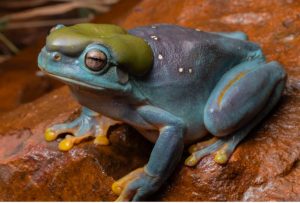
In July of 2024, two land managers were working in the Charnley River-Artesian Range Wildlife Sanctuary. They were in a workshop when one of them noticed a magnificent tree frog sitting on a bench, not that unusual of an occurrence–except that this frog wasn’t green. It was blue!

The condition is called axanthism, where the yellow pigments in the frog’s skin don’t show up the way they should. Most of them time axanthism in frogs means the animal has little patches of blue or bluish coloration, but this specific frog was blue just about everywhere it should have been green. Its parotoid gland was still olive green and it had yellow on its feet, but mainly it was a very attractive dark blue.

The land managers were stunned. They took photos and sent them to pretty much everyone, and frog experts and ecologists hurried to examine the blue frog. But they decided not to keep the frog in captivity. It was released back into the wild to live out its blue froggy life normally.

Some frogs are naturally blue, like some poison dart frogs of South America. The blue poison dart frog’s legs are dark blue and its body a lighter blue with black spots. It grows less than two inches long, or about 4.5 cm. Poison dart frogs collect toxins in their bodies from some of the toxic insects they eat, and the bright coloration signals to predators that this frog will make you really sick if you eat it.

Axanthism is rare but not all that uncommon in frogs. About the same time that the blue magnificent tree frog was hopping into the workshop in Australia, two little girls playing around a pond in Nova Scotia, Canada found a teal-blue frog. Ironically, the frog is actually called the green frog and it’s ordinarily a dark olive-green all over. The girls named the frog Bluey and released it back into the pond. Another blue green frog was found in New Hampshire, in the United States, also in July 2024. In June 2024 a forest ranger spotted a northern leopard frog in Washington state that had splotches of light blue on its head and back. In May of 2024 a light blue Japanese tree frog was found by a couple on a walk.

The Australian green tree frog is closely related to the magnificent tree frog, although it doesn’t have a parotoid gland hat. It’s mostly green with a white or pale gray belly. It’s sometimes called the dumpy tree frog because it’s a little chonk. Actually, for a frog it’s a pretty big chonk, up to 4 and a half inches long, or over 11 cm. It’s also sometimes called White’s tree frog after John White, who described it in 1790. It was the first Australian frog that was ever scientifically described. But that leads us to a little mystery.

John White named the frog Rana caerulea. Its current scientific name is Ranoidea caerulea. But “caerulea” refers to the color blue, not green, as in cerulean blue.

John White collected the frog in 1788, preserved it in alcohol, and finally described it two years later. He refers to it in his writing as a blue frog and the illustration accompanying it shows frogs that are actually blue. But this frog is supposed to be green!

The main suggestion for why a famously green frog was initially described as blue is that the alcohol that White used to preserve the frog’s body actually destroyed the yellow pigment in its skin. This is something that does sometimes happen with frog specimens in museums. But it’s also possible that White ended up with a blue specimen, much like the blue magnificent tree frog we talked about earlier. He wouldn’t have known that the blue frog had a rare color mutation. That would explain why he referred to the frog as blue and gave it a name that means blue.

That might also explain why White described the Australian green tree frog first. Maybe he just thought it was pretty. Everyone likes the color blue.

Thanks for your support, and thanks for listening! I’m at Dragon Con this weekend, where who knows, I might actually see a blue frog. Anything is possible at Dragon Con.

Episode 470: Animals Discovered in 2025

It’s the annual discoveries episode! Thanks to Stephen and Aryeh for their corrections and suggestions this week!

Further reading:

Salinella Salve: The Vanishing Creature That Defied Science for Over a Century

Three new species of the genus Scutiger

Baeticoniscus carmonaensis sp. nov. a new Isopod found in an underground aqueduct from the Roman period located in Southwest Spain (Crustacea, Isopoda, Trichoniscidae)

A new species of supergiant Bathynomus

Giant ‘Darth Vader’ sea bug discovered off the coast of Vietnam

A New Species of easter egg weevil

Bizarre ‘bone collector’ caterpillar discovered by UH scientists

Researchers Discover ‘Death Ball’ Sponge and Dozens of Other Bizarre Deep-Sea Creatures in the Southern Ocean

1,500th Bat Species Discovered in Africa’s Equatorial Guinea

Show transcript:

Welcome to Strange Animals Podcast. I’m your host, Kate Shaw.

This week we’re going to learn about some animals discovered in 2025! We’ll also make this our corrections episode. This is the last new episode we’ll have until the end of August when we reach our 500th episode, but don’t worry, until then there will be rescheduled Patreon episodes every single week as usual.

We’ll start with some corrections. Shortly after episode 452 was published in September, where we talked about the swamp wallaby and some other animals, Stephen emailed to point out that I’d made a major mistake! In that episode I said that not all animals called wallabies were actually members of the family Macropodidae, but that’s actually not the case. All wallabies are macropodids, but they aren’t all members of the same genus in that family. I corrected the episode but I wanted to mention it here too so no one is confused.

Stephen also caught another mistake in episode 458, which is embarrassing. I mentioned that marsupials didn’t just live in Australia, they were found all over the world. That’s not actually the case! Marsupials are found in North and South America, Australia, New Guinea and nearby areas, and that’s it. They were once also found in what is now Asia, but that was millions of years ago. So I apologize to everyone in Africa, Asia, and Europe who were excited about finding out what their local marsupials are. You don’t have any, sorry.

One update that Aryeh asked about specifically is an animal we talked about in episode 445, salinella. Aryeh emailed asking for more information if I could find any, because it’s such a fascinating mystery! I looked for some more recent findings, unfortunately without luck. I do have an article linked in the show notes that goes into detail about everything we covered in that episode, though, dated to mid-January 2026, and it’s a nice clear account.

Now, let’s get into the 2025 discoveries! There are lots more animals that were discovered last year, but I just chose some that I thought were especially interesting. Mostly I chose ones that I thought had funny names.

Let’s start with three new species of frog in the genus Scutiger. Species in this genus are called lazy toads and I couldn’t find out why. Maybe they don’t like to move around too much. Lazy toads live in mountains in some parts of Asia, and we don’t know very much about most of the 31 species described so far. Probably the most common lazy toad is the Sikkim lazy toad that lives along high altitude streams in the Himalaya Mountains. It’s mottled greenish-brown and yellowish in color with lots of warts, and while its feet have webbed toes, it doesn’t have webbed fingers on its little froggy hands. This is your reminder that every toad is a frog but not every frog is a toad. The Sikkim lazy toad grows about two and a half inches long, or about 65 mm, from nose to butt. It seems to be pretty average for a lazy toad.

The three new species of lazy toad are found in Yunnan Province in China, in a mountainous region where several species of lazy toad were already known. Between 2021 and 2024, a team of scientists collected 27 lazy toads from various places, then carefully examined them to see if they were species already known to science. This included genetic analysis. The team compared their findings with other lazy toad species and discovered that not all of the specimens matched any known species. Further comparison with each other revealed that the team had discovered three new species, which they described in December of 2025.

Next, isopods are common crustaceans that live throughout the world. You have undoubtedly seen at least one species of isopod, because an animal with lots of common names, including woodlouse, pill bug, roly-poly, and sowbug, is a terrestrial isopod. That’s right, the roly-poly is not a bug or a centipede but a crustacean. The order Isopoda contains more than 10,000 species, and there are undoubtedly thousands more that haven’t been discovered by scientists yet. About half the species discovered so far live on land and the other half live in water, most in the ocean but some in fresh water. They don’t all look like roly-polies, of course. Many look like their distant crustacean cousins, shrimps and crayfish, while others look more like weird centipedes or fleas or worms. There’s a lot of variation in an animal that’s extremely common throughout the world, so it’s no surprise that more species are discovered almost every year.

In 2021 and 2022, a team of Spanish scientists took a biological survey of an ancient Roman tunnel system beneath Carmona, Spain. The tunnels were built around 2,000 years ago as a water source, since they capture groundwater, but it hasn’t been used in so long that it’s more or less a natural environment these days.

The scientists quickly discovered plenty of life in the tunnels, including an isopod living in cracks in some ancient timbers. It grows about two and a half millimeters long and actually does look a lot like a tiny roly-poly. It has long antennae and its body mostly lacks pigment, but it does have dark eyes. Most animals that live in total darkness eventually evolve to no longer have functioning eyes, since they don’t need them, but that isn’t the case for this new isopod. Scientists think it might take advantage of small amounts of light available near the tunnel entrances.

As far as the scientists can tell, the Carmona isopod only lives in this one tunnel system, so it’s vulnerable to pollutants and human activity that might disrupt its underground home.

Another new isopod species that’s vulnerable to human activity, in this case overfishing, lives off the coast of Vietnam. It’s another isopod that looks a lot like a roly-poly, which I swear is not what every isopod looks like. It’s a deep-sea animal that hunts for food on the ocean floor, and it’s a popular delicacy in Vietnam. Remember, it’s a crustacean, and people say it tastes like another crustacean, lobster. In fact, scientists discovered their specimens in a fish market.

Deep-sea animals sometimes feature what’s called deep-sea gigantism. Most isopods are quite small, no more than a few cm at most, but the new species grows almost 13 inches long, or over 32 cm. It’s almost the largest isopod known. Its head covering made the scientists think of Darth Vader’s helmet, so it’s been named Bathynomus vaderi.

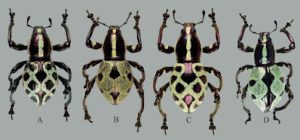
Next we have a new species of Easter egg weevil, a flightless beetle found on many islands in Southeast Asia. Easter egg weevils are beautiful, with every species having a different pattern of spots and stripes. Many are brightly colored and iridescent. The new species shows a lot of variability, but it’s basically a black beetle with a diamond-shaped pattern that can be yellow, gold, or blue. Some individuals have pink spots in the middle of some of the diamonds. It’s really pretty and that is just about all I could find out about it.

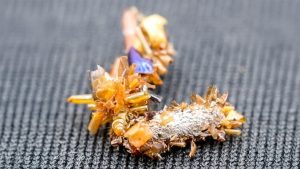
Another new insect is a type of Hawaiian fancy case caterpillar, which metamorphose into moths. They’re only found on the Hawaiian islands, and there are over 350 species known. The new species has been named the bone collector, because of what the caterpillar does.

Fancy case caterpillars spin a sort of shell out of silk, which is called a case, and the caterpillar carries its case around with it as protection. Some of the cases are unadorned but resemble tree bark, while many species will decorate the case with lichens, sand, or other items that help it blend in with its background. Some fancy case caterpillars can live in water as well as on land, and while most caterpillars eat plant material, some fancy case caterpillars eat insects.

That’s the situation with the bone collector caterpillar. It lives in spider webs, which right there is astonishing, and decorates its case with bits and pieces of dead insect it finds in the web. This can include wings, heads, legs, and other body parts.

The bone collector caterpillar eats insects, and it will chew through strands of the spider’s web to get to a trapped insect before the spider does. Sometimes it will eat what’s left of a spider’s meal once the spider is finished.

The bone collector caterpillar has only been found in one tiny part of O’ahu, a 15-square-km area of forest, although researchers think it was probably much more widespread before invasive plants and animals were introduced to the island.

Next, the Antarctic Ocean is one of the least explored parts of the world, and a whole batch of new species was announced in 2025 after two recent expeditions. One of the expeditions explored ocean that was newly revealed after a huge iceberg split off the ice shelf off West Antarctica in early 2025. That’s not where the expedition had planned to go, but it happened to be nearby when the iceberg broke off, and of course the team immediately went to take a look.

Back in episode 199 we talked about some carnivorous sponges. Sponges have been around for more than half a billion years, and early on they evolved a simple but effective body plan that they mostly still retain. Most sponges have a skeleton made of calcium carbonate that forms a sort of dense net that’s covered with soft body tissues. The sponge has lots of open pores in the outside of its body, which generally just resembles a sack or sometimes a tube, with one end attached to something hard like a rock, or just the bottom of the ocean. Water flows into the sponge’s tissues through the pores, and special cells filter out particles of food from the water, much of it microscopic, and release any waste material. The sponge doesn’t have a stomach or any kind of digestive tract. The cells process the food individually and pass on any extra nutrients to adjoining cells.

In 1995, scientists discovered a tiny sponge that wasn’t a regular filter feeder. It had little hooks all over it, and it turns out that when a small animal gets caught on the hooks, the sponge grows a membrane that envelops the animal within a few hours. The cells of the membrane contain bacteria that help digest the animal so the cells can absorb the nutrients.

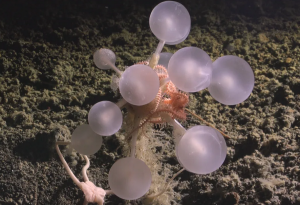
Since then, other carnivorous sponges have been discovered, or scientists have found that some sponges already known to science are actually carnivorous. That’s the case with the ping-pong tree sponge. It looks kind of like a bunch of grapes on a central stem that grows up from the bottom of the ocean, and it can be more than 20 inches tall, or 50 cm. The little balls are actually balloon-like structures that inflate with water and are covered with little hooks. It was discovered off the coast of South America near Easter Island, in deep water where the sea floor is mostly made of hardened lava. It was classified in the genus Chondrocladia, and so far there are more than 30 other species known.

The reason we’re talking about the ping-pong tree sponge is that a new species of Chondrocladia has been discovered in the Antarctic Ocean, and it looks a lot like the ping-pong tree sponge. It’s been dubbed the death-ball sponge, which is hilarious. It was found two and a quarter miles deep on the ocean floor, or 3.6 km, and while scientists have determined it’s a new species of sponge, it hasn’t been described yet. It’s one of 30 new species found so far, and the team says that there are many other specimens collected that haven’t been studied yet.

We haven’t talked about any new mammal discoveries yet, so let’s finish with one of my favorites, a new bat! It was discovered on Bioko Island in Equatorial Guinea, which is part of Africa. During a 2024 biodiversity assessment on the island, a PhD student named Laura Torrent captured a bat that turned out to be not only a brand new species, it is the 1,500th species of bat known to science!

Pipistrellus etula gets its name from the local language, Bantu, since “etula” means both “island” and “god of the island” in that language. The bat was found in forests at elevations over 1,000 meters, on the slopes of a volcano. Back in 1989, a different researcher captured a few of the bats on another volcano, but never got a chance to examine them to determine if they were a new species. When Torrent’s team were studying their bats, one of the things they did was compare them to the preserved specimens from 1989, and they discovered the bats were indeed a match.

P. etula is a type of vesper bat, which is mostly active at dusk and eats insects. It’s brown with black wings and ears. Just like all the other species we’ve talked about today, now that we know it exists, it can be protected and studied in the wild.

That’s what science is really for, after all. It’s not just to satisfy our human curiosity and desire for knowledge, although that’s important too. It’s so we can make this world a better place for everyone to live—humans, animals, plants, isopods, weird caterpillars, and everything else on Earth and beyond.

You can find Strange Animals Podcast at strangeanimalspodcast.blubrry.net. That’s blueberry without any E’s. Thanks for listening! I’ll see you in August.

Episode 469: Axolotl and Friends

Thanks to Aila, Stella, George, Richard from NC, Emilia, Emerson, and Audie for their suggestions this week!

Further reading:

Creature Feature: Snipe Eel

How removing a dam could save North Carolina’s ‘lasagna lizard’

Why Has This North Carolina Town Embraced a Strange Salamander?

Scentists search for DNA of an endangered salamander in Mexico City’s canals

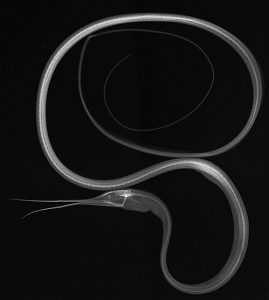
An X-ray of the slender snipe eel:

The head and body of a slender snipe eel. The rest is tail [picture by opencage さん http://ww.opencage.info/pics/ – http://ww.opencage.info/pics/large_17632.asp, CC BY-SA 2.5, https://commons.wikimedia.org/w/index.php?curid=26595467]:

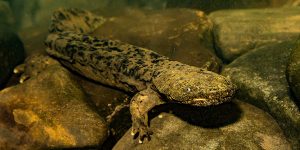
The hellbender:

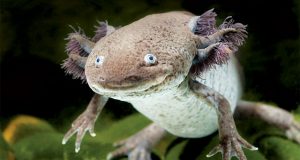
A wild axolotl with its natural coloration:

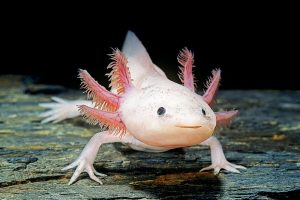
A captive bred axolotl exhibiting leucism:

Show transcript:

Welcome to Strange Animals Podcast. I’m your host, Kate Shaw.

This week we’re going to talk about some amphibians and fish. Thanks to Aila, Stella, George, Richard from NC, Emilia, Emerson, and Audie for their suggestions!

We’ll start with Audie’s suggestion, the sandbar shark. It’s an endangered shark that lives in shallow coastal water in the Atlantic and Indo-Pacific Oceans. A big female can grow over 8 feet long, or 2.5 meters, while males are smaller on average. It can be brown or gray in color, and its dorsal fin is especially big for a shark its size.

The sandbar shark eats fish, crustaceans like crabs, cephalopods like octopuses, and other small animals. It spends a lot of time near the bottom of the seabed, looking for food, and it will also swim into the mouths of rivers. Since it resembles a bull shark, which can live just fine in rivers for quite a while and which can be dangerous to swimmers, people are sometimes afraid of the sandbar shark, but it hardly ever bites people. It just wants to be left alone to find little fish to eat.

Emilia and Emerson both asked to learn more about eels. Eels are fish, but not every animal that’s called an eel is actually an eel. Some are just eel-shaped, meaning they’re long and slender. Electric eels aren’t actually eels, for instance, but are more closely related to catfish.

The longest eel ever reliably measured was a slender giant moray. That was in 1927 in Queensland, Australia. The eel measured just shy of 13 feet long, or 3.94 meters. We talked about some giant eels in episode 401, but this week let’s talk about a much smaller eel, one that Emerson suggested.

That’s the snipe eel, the name for a family of eels consisting of nine species known so far. They live in every ocean in the world, and some species are deep-sea animals but most live a little nearer the surface. The largest species can grow an estimated 5 feet long, or 1.5 meters, but because all species of snipe eel are so incredibly thin, even the longest individual weighs less than a football, either American or regular, take your pick.

The snipe eel gets its name from its mouth, which is long and slightly resembles the beak of a bird called the snipe. The snipe is a wading bird that pokes its long, flexible bill into mud to find small animals like insect larvae, worms, and snails. But unlike the bird’s bill, the snipe eel’s jaws have a bend at the tip. The upper jaw bends upward, the lower jaw bends downward so that the tip of the jaws are separated. It doesn’t look like that would be very helpful for catching food, but scientists think it helps because the fish’s mouth is basically always open. Since it mainly eats tiny crustaceans floating in the water, it doesn’t even need to open its mouth to catch food. It has tiny teeth along the jaws that point backwards, so when a crustacean gets caught on the teeth, it can’t escape.

The slender snipe eel is especially unusual because it can have as many as 750 vertebrae in its backbone. That’s more than any other animal known. Most of its length is basically just an incredibly long, thin tail, with its organs bunched up right behind its head. Even its anus is basically on its throat.

We don’t know a whole lot about the snipe eel, since it lives deep enough that it’s hardly ever seen by humans. Most of the specimens discovered have been found in the stomachs of larger fish.

Now, let’s leave the world of fish behind and look at some amphibians. First, George wanted to learn about the hellbender, and points out that it’s also called the snot otter or lasagna lizard. I don’t understand the lasagna part but it’s funny.

The hellbender is a giant salamander that lives in parts of the eastern United States, especially in the Appalachian Mountains and the Ozarks. It can grow nearly 30 inches long, or 74 cm, and is the fifth heaviest amphibian alive today in the whole world. It spends almost all its life in shallow, fast-moving streams hiding among rocks. As water rushes over and around rocks, it absorbs more oxygen, which is good for the hellbender because as an adult it breathes through its skin. To increase its surface area and help it absorb that much more oxygen, its skin is loose and has folds along the sides.

The hellbender is flattened in shape and is brown with black speckles on its back. It mostly eats crayfish, but it will also eat frogs and other small animals. Its skin contains light-sensitive cells, which means that it can actually sense how much light is shining on its body even if its head is hidden under a rock, so it can hide better.

Aila and Stella suggested we talk about the axolotl, and a few years ago Richard from NC sent me a lot of really good information about this friendly-looking amphibian. I’d been planning to do a deep dive about the axolotl, which we haven’t talked about since episode 275, but sometimes having a lot of information leads to overload and I never did get around to sorting through everything Richard sent me.

Richard also suggested we talk about a rare mudpuppy, so let’s learn about it before we get to the axolotl. It’s called the Neuse river waterdog, although Richard refers to it as the North Carolina axolotl because it resembles the axolotl in some ways, although the two species aren’t very closely related.

The mudpuppy, also called the waterdog, looks a lot like a juvenile hellbender but isn’t as big, with the largest measured adult growing just over 17 inches long, or almost 44 cm. It lives in lakes, ponds, and streams and retains its gills throughout its life.

The mudpuppy is gray, black, or reddish-brown. It has a lot of tiny teeth where you’d expect to find teeth, and more teeth on the roof of its mouth where you would not typically expect to find teeth. It needs all these teeth because it eats slippery food like small fish, worms, and frogs, along with insects and other small animals.

The Neuse River waterdog lives in two watersheds in North Carolina, and nowhere else in the world. It will build a little nest under a rock by using its nose like a shovel, pushing at the sand, gravel, and mud until it has a safe place to rest. If another waterdog approaches its nest, the owner will attack and bite it to drive it away.

The mudpuppy exhibits neoteny, a trait it shares with the axolotl. In most salamanders, the egg hatches into a larval salamander that lives in water, which means it has external gills so it can breathe underwater. It grows and ultimately metamorphoses into a juvenile salamander that spends most of its time on land, so it loses its external gills in the metamorphosis. Eventually it takes on its adult coloration and pattern. But neither the mudpuppy nor the axolotl metamorphose. Even when it matures, the adult still looks kind of like a big larva, complete with external gills, and it lives underwater its whole life.

The axolotl originally lived in wetlands and lakes in the Mexico Central Valley. This is where Mexico City is and it’s been a hub of civilization for thousands of years. A million people lived there in 1521 when the Spanish invaded and destroyed the Aztec Empire with introduced diseases and war. The axolotl was an important food of the Aztecs and the civilizations that preceded them, and if you’ve only ever seen pictures of axolotls you may wonder why. Salamanders are usually small, but a full-grown axolotl can grow up to 18 inches long, or 45 cm, although most are about half that length.

Most wild axolotls are brown, greenish-brown, or gray, often with lighter speckles. They can even change color somewhat to blend in with their surroundings better. Captive-bred axolotls are usually white or pink, or sometimes other colors or patterns. That’s because they’re bred for the pet trade and for medical research, because not only are they cute and relatively easy to keep in captivity, they have some amazing abilities. Their ability to regenerate lost and injured body parts is remarkable even for amphibians. Researchers study axolotls to learn more about how regeneration works, how genetics of coloration work, and much more. They’re so common in laboratory studies that you’d think there’s no way they could be endangered—but they are.

A lot of the wetlands where the axolotl used to live have been destroyed as Mexico City grows. One of the lakes where it lived has been completely filled in. Its remaining habitat is polluted and contains a lot of introduced species, like carp, that eat young axolotls as well as the same foods that axolotls eat. Conservationists have been working hard to improve the water quality in some areas by filtering out pollutants, and putting up special barriers that keep introduced fish species out.

Even if the axolotl’s habitat was pristine, though, it wouldn’t be easy to repopulate the area right away. Axolotls bred for the pet trade and research aren’t genetically suited for life in the wild anymore, since they’re all descended from a small number of individuals caught in 1864, so they’re all pretty inbred by now.

Mexican scientists and conservationists are working with universities and zoos around the world to develop a breeding program for wild-caught axolotls. So far, the offspring of wild-caught axolotls that are raised in as natural a captive environment as possible have done well when introduced into the wild. The hard part is finding wild axolotls, because they’re so rare and so hard to spot.

Scientists have started testing water for traces of axolotl DNA to help them determine if there are any to find in a particular area. If so, they send volunteers into the water with nets and a lot of patience to find them.

The axolotl reproduces quickly and does well in captivity. Hopefully its habitat can be cleaned up soon, which isn’t just good for the axolotl, it’s good for the people of Mexico City too.

You can find Strange Animals Podcast at strangeanimalspodcast.blubrry.net. That’s blueberry without any E’s. If you have questions, comments, corrections, or suggestions, email us at strangeanimalspodcast@gmail.com.

Thanks for listening!

Episode 436: Red-Eyed Tree Frog

Thanks to Trech for suggesting this week’s topic, the red-eyed tree frog!

Further reading:

Tadpoles hatch in seconds to escape predator

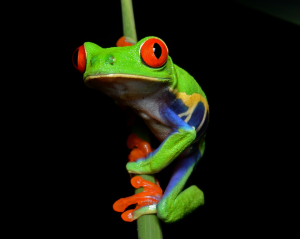
The colorful red-eyed tree frog [photo by Geoff Gallice]:

Show transcript:

Welcome to Strange Animals Podcast. I’m your host, Kate Shaw.

This week we’re going to have a short little episode about a little frog, suggested by Trech.

The frog in question is the red-eyed tree frog, which is native to Central America, including parts of Mexico, and northwestern South America. It lives in forests, always around water. You might be thinking, “of course, frogs live in water,” but remember that this is a tree frog. It lives in trees. But it still needs water for its babies, just not quite in the way most frogs do.

Before we learn about that, let’s learn about the frog itself. A big female can grow about 3 inches long, or 7.5 cm, while males are smaller. It’s a cute frog, of course, because frogs are always cute, but it’s also brightly colored. It’s bright green with red eyes, blue and yellow stripes on its sides, and orange feet.

Ordinarily, a frog with such bright colors would warn potential predators that it’s toxic, but the red-eyed tree frog isn’t toxic at all. Its bright colors have a different purpose. When it’s sitting on a leaf, the bright colors are hidden and only the frog’s smooth green back is showing, which makes it look like just another leaf. Only its eyes are bright, but it closes its eyes when it’s resting. But if a predator approaches, the frog opens its eyes suddenly and jumps up, revealing all those bright colors. The predator is startled, and maybe even hesitates because it thinks the frog might be toxic, and by the time the predator decides it should try eating the frog after all, the frog is long gone.

Oh, and if you’re wondering, the red-eyed tree frog can see through its eyelids. They’re actually not eyelids like we have, but a membrane that it can move over its eyes. The frog is nocturnal and eats insects like mosquitoes, crickets, and moths. It has a good sense of smell, which helps it find insects in the dark.

The tree frog also has suction cups on its toes that help it stay put on smooth leaves. During the day it sticks itself to the underside of a leaf to sleep where it’s more hidden. The female also lays her eggs on the underside of a leaf. This protects them from heavy rain, since the frogs breed during the rainy season, and it also helps hide them from predators. The female chooses a leaf that’s growing above water, and if the leaf isn’t very big she’ll lay eggs on both sides of it and fold the leaf to help hide all the eggs. The eggs stick to the leaf with a type of jelly that also helps keep them from drying out.

The eggs hatch in about a week, but they can hatch a few days early if a predator approaches. The embryonic tadpoles in their eggs can sense vibrations, and if a predator like a snake shakes the leaf as it approaches the eggs, the tadpoles can hatch within seconds. They drop straight down into the water below the leaf.

Hatching early when in danger is called phenotypic plasticity, and it’s really rare. It’s especially unusual because the embryonic tadpoles can actually tell the difference between a typical predator of frog eggs and vibrations caused by other animals or the wind. They can hatch so quickly because the stress reaction causes the pre-tadpoles to secrete an enzyme from their little noses, which weakens the egg wall and allows them to push and wiggle their way out.

Tadpoles stay in the water for several weeks, or sometimes several months depending on conditions, during which time they eat algae and other tiny food in the water. As they grow bigger, the tadpoles can eat bigger food, including other tadpoles. They switch to tiny insects after they metamorphose into froglets.

At some point during its development, a red-eyed tree frog needs to eat enough food containing carotenoids in order to develop properly, and in order to develop brightly colored skin as an adult. The red-eyed tree frog is a popular pet, but captive-bred frogs sometimes aren’t as brightly colored because they didn’t get enough of the right foods as young frogs.

During breeding season, a male will claim a small branch and jump and bounce around on it, both to call attention to himself and to shake other males off the branch. He also croaks loudly to attract a mate. This is what he sounds like:

[frog call]

You can find Strange Animals Podcast at strangeanimalspodcast.blubrry.net. That’s blueberry without any E’s. If you have questions, comments, or suggestions for future episodes, email us at strangeanimalspodcast@gmail.com. We also have a Patreon at patreon.com/strangeanimalspodcast if you’d like to support us for as little as one dollar a month and get monthly bonus episodes.

Thanks for listening!

Episode 432: The Fossa and Other Animals of Madagascar

This week we learn about the fossa and a few other animals of Madagascar, a suggestion by Pranav!

Further reading:

The stories people tell, and how they can contribute to our understanding of megafaunal decline and extinction in Madagascar

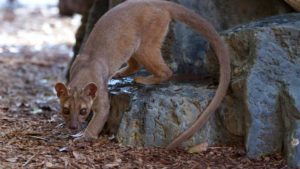
The fossa!

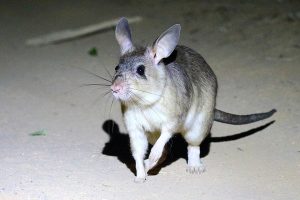
The votsotsa is a rodent, not a rabbit! [photo by Andrey Giljov – Own work, CC BY-SA 4.0, https://commons.wikimedia.org/w/index.php?curid=113271739]:

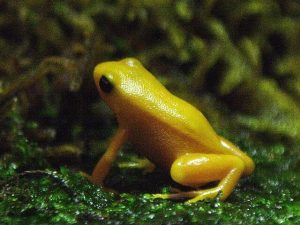
The golden mantella frog is sometimes golden, but sometimes red:

The nano-chameleon may be the smallest reptile in the world:

Show transcript:

Welcome to Strange Animals Podcast. I’m your host, Kate Shaw.

This week we have a very old Pranav suggestion, animals of Madagascar!

The island country of Madagascar is off the southeastern coast of Africa. About 88 million years ago, it broke off from every other landmass in the world, specifically the supercontinent Gondwana. The continent we now call Africa separated from Gondwana even earlier, around 165 million years ago. Madagascar is the fourth largest island in the world and even though it’s relatively close to Africa these days, many of its animals and plants are much different from those in Africa and other parts of the world because they’ve been evolving separately for 88 million years.

But at various times in the past, some animals from Africa were able to reach Madagascar. We’re still not completely sure how this happened. Madagascar is 250 miles away from Africa, or 400 kilometers, and these days the prevailing ocean currents push floating debris away from the island. In the past, though, the currents might have been different and some animals could have arrived on floating debris washed out to sea during storms. During times when the ocean levels were overall lower, islands that are underwater now might have been above the surface and allowed animals to travel from island to island until they reached Madagascar.

We’re not sure when the first humans visited Madagascar, but it was at least 2,500 years ago and possibly as much as 9,500 years ago or even earlier. It’s likely that hunting parties would travel to Madagascar and stay there for a while, then return home with lots of food, but eventually people decided it would be a nice place to live. By 1,500 years ago people were definitely living on the island.

Let’s start with the fossa, an animal we’ve only talked about on the podcast once before, and then only in passing. It resembles a type of cat about the size of a cougar, although its legs are short in comparison to a similarly-sized cat. Its tail is almost as long as its body, and if you include its tail, it can grow around five feet long, or 1.5 meters. It’s reddish-brown with a paler belly. Its head is small with a short muzzle, rounded ears, and big eyes.

But the fossa isn’t a felid. It resembles a really big mustelid in many ways, especially a mongoose, and some studies suggest it’s most closely related to the mongoose. Really, though, it’s not closely related to anything living today. It spends a lot of time in trees, where it uses its long tail to help it balance. It even has semi-retractable claws. It eats lemurs and other mammals, birds, insects, crabs, lizards, and even fruit.

There used to be an even bigger fossa called the giant fossa, although we don’t know much about it. We only know about it from some subfossil remains found in caves. We’re not sure how big it was compared to the fossa living today, but it was definitely bigger and stronger and might have grown 7 feet long including its tail, or a little over 2 meters. There used to be much bigger lemurs living on Madagascar that have also gone extinct, so the giant fossa probably evolved to prey on them.

Most scientists estimate that the giant fossa went extinct at least 700 years ago, but some think it might have survived in remote areas of Madagascar until much more recently. There are even modern sightings of unusually large fossas, sometimes reported as twice the size of a regular fossa.

One interesting thing about the fossa is that its anus is hidden most of the time by a little fold of skin called an anal pouch, sort of like built-in underwear.

One animal most people outside of Madagascar have never heard of is the votsotsa, also called the Malagascar giant rat or the giant jumping rat since it’s a rodent that is especially known for its ability to jump. It actually looks a lot like a rabbit in size and shape, including its long ears, but it has a long tail. It’s gray or brown in color and grows about a foot long, or 30 cm, with a tail that can be up to 10 inches long, or 25 cm.

The votsotsa mates for life and both parents raise the single baby the mother gives birth to once or twice a year. It’s a nocturnal animal that spends the day in its burrow, which can be as much as 16 feet long, or 5 meters, with multiple exits. It eats nuts and seeds, fruit, leaves, and other plant material, along with insects and other small animals.

Lots of bats live on Madagascar, including the Madagascar flying fox. It’s a fruit-eating bat that’s brown or golden-brown in color with gray or black wings, and it’s the biggest bat native to the island. It has a wingspan of more than four feet across, or 125 cm. Like other species of flying fox, it lives in colonies of up to a thousand individuals that roost together in trees during the day. It mostly forages in the evenings, searching for fruit like figs. It eats flowers and sometimes leaves as well as fruit, and it may even be a pollinator for the kapok tree’s flowers.

Naturally, Madagascar also has a lot of reptiles, amphibians, and other non-mammalian animals. For instance, the golden mantella frog. It’s a little frog that’s only found in a few small areas, and measures around 20 millimeters long snout to vent. Some individuals are golden yellow while others are bright orange or red. As you may remember from our many previous episodes about frogs, such bright colors act as a warning to potential predators, to let them know that the frog is toxic. It absorbs toxins from some of the insects it eats. It’s active during the day in summertime, and in winter it spends most of the time hiding and doing nothing, which is the best way to spend the winter.

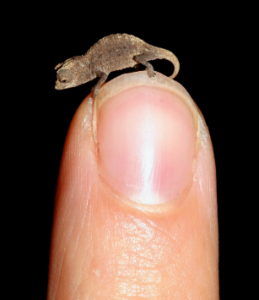
There are also lots of chameleons on Madagascar, including one called the nano-chameleon. It gets its name from its size, which is extremely small. It’s the smallest chameleon in the world, only 29 mm long at the very most, which is barely more than an inch long. Males are smaller than females, usually around 22 mm. It was described in 2021 and is brownish-grey with pale yellow or yellow-brown markings. Chameleons are famous for changing color, but the nano-chameleon doesn’t. It also mostly lives on the ground, where it hunts tiny insects and other invertebrates. Some scientists think it may be the smallest reptile in the world.

The female Darwin’s bark spider is about the same size as the female nano-chameleon, if you don’t count the spider’s legs. Males are much smaller. Darwin’s bark spider is a type of orb-weaver, which is the kind of spider that spins large webs that look like Halloween decorations. It was described in 2010 after first being discovered by scientists in 2009, which is surprising because it builds the largest orb webs known. Some webs can be over 30 square feet in size, or 2.8 square meters.

The silk is the strongest biological material ever studied, twice as strong as any other spider silk studied. The spider builds its web over water, because it eats a lot of mayflies and other insects that are attracted to water. It also eats a lot of dragonflies, and dragonflies are quite large and strong insects that don’t usually get caught in spiderwebs.

The people of Madagascar are considered very poor compared to other countries, after almost a century of French colonization and the resulting instability after it regained independence in 1960. A lot of animals that were once considered to be forbidden to bother, for religious and cultural reasons, now end up killed so people can eat them instead of starving. Mining and slash-and-burn agriculture has also contributed to pollution, habitat loss, and other factors that aren’t good for the animals of Madagascar or its people. Luckily, eco-tourism, where people visit the island to experience its beauty and see animals and plants found nowhere else on earth, is becoming more common. Hopefully that will help improve conditions for the people who live there and for the animals too.

You can find Strange Animals Podcast at strangeanimalspodcast.blubrry.net. That’s blueberry without any E’s. If you have questions, comments, or suggestions for future episodes, email us at strangeanimalspodcast@gmail.com. We also have a Patreon at patreon.com/strangeanimalspodcast if you’d like to support us for as little as one dollar a month and get monthly bonus episodes.

Thanks for listening!

Episode 421: Australian Animals

Thanks to Nora, Holly, Stephen, and Aila for their suggestions this week!

Further reading:

How ‘bin chickens’ learnt to wash poisonous cane toads

Monkeys in Australia? Revisiting a Forgotten Furry Mystery Down Under

The Australian white ibis:

The greater glider looks like a toy:

The thorny devil is very pointy:

Show transcript:

Welcome to Strange Animals Podcast. I’m your host, Kate Shaw.

This week we’re going to talk about some animals native to Australia, which is Nora’s suggestion. We’ll learn about animals suggested by Holly, Stephen, and Aila, along with a mystery animal reported in the 1930s in northern Australia.

Australia isn’t currently connected to any other landmass and hasn’t been for about 50 million years. That means that most animals on the continent have been evolving separately for a very long time. While in other parts of the world placental mammals took over many ecological niches, marsupials are still the dominant mammal type in Australia. Most marsupial females give birth to tiny, helpless babies that then continue their development outside of her body, usually in a pouch.

But let’s start the episode not with a marsupial but with a bird. Stephen suggested the Australian white ibis, a beautiful bird that doesn’t deserve its nickname of bin chicken.

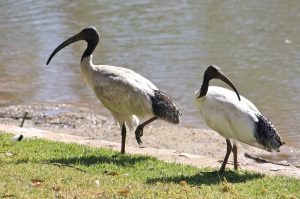
The white ibis is related to ibises from other parts of the world, but it’s native to Australia, and is especially common in eastern, northern, and southwestern Australia. It’s a large, social bird that likes to gather in flocks. Its body is mostly white with a short tail, long black legs, and a black head. Like other ibises, the adult bird’s head is bare of feathers. It also has a long, down-curved black bill that it uses to dig in the mud for crayfish and other small animals. When the bird spreads its magnificent black-tipped wings, it displays a stripe of featherless skin that’s bright red.

The Australian white ibis prefers marshy areas where it can eat as many frogs, crayfish, mussels, and other animals as it can catch. But at some point around 50 years ago, the birds started moving into more urban areas. They discovered that humans throw out a lot of perfectly good food, and before long they started to become a nuisance to people who had never encountered raccoons and didn’t know they should clamp those trash barrels closed really securely.

But no matter how annoying the Australian white ibis can be to people, it’s been really helpful in another way. In the 1930s, sugarcane plantation owners wanted to control beetles and other pests that eat sugarcane plants, so they released a bunch of cane toads in some of their fields in Queensland. But the cane toads didn’t do any good eating the beetles. Instead, they ate native animals and spread like wildfire. Since the toads are toxic, nothing could stop them, and there are now an estimated two billion cane toads living in Australia. But the Australian white ibis eventually figured out how to deal with cane toads.

The ibis will grab a cane toad, then whip it around and throw it into the air so that the toad secretes its toxins in hopes that the bird will leave it alone. Then the ibis will wash the toad in water or wipe it in wet grass, which washes away the toxins. Then the ibis eats the toad. Goodbye, toad!

Our next Australian animal is one suggested by Holly, the greater glider. When I saw the picture Holly sent, I was convinced it wasn’t a real animal but a toy plushie, but that’s just what the greater glider looks like. It’s incredibly cute!

The greater glider lives in eastern Australia, and as you might guess from its name, it is the largest of the three glider species found in Australia, and it can glide from tree to tree on flaps of skin between its front and back legs. Until 2020 scientists thought there was only one species of glider with local variations in size and coat color, but it turns out those differences are significant enough that it’s been split into three separate but closely related species.

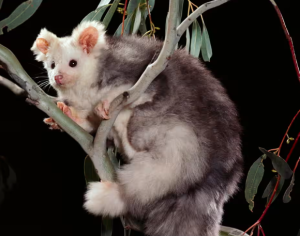
The greater glider is nocturnal and only eats plant material, mostly from eucalyptus trees. It has a long fluffy tail, longer than the rest of its body is. Its tail can be as much as 21 inches long, or 53 cm, while its body and head together can measure as much as 17 inches long, or 43 cm. It has dense, plush fur, a small head with big round ears, black eyes, and a little pinkish nose, and it superficially looks like a big flying squirrel. But the greater glider isn’t a rodent. It’s a marsupial, closely related to the ringtail possum. Some individuals have dark gray or black fur and some have lighter gray or brown fur, but all greater gliders have cream-colored fur on their tummies.

The greater glider’s gliding membranes, also called patagia, are connected at what we can refer to as their elbows and ankles. It uses its long tail as a rudder and it’s very good at gliding from tree to tree. It almost never comes down to the ground if it can avoid it. When it glides, it folds its front legs so its little fists are under its chin and its elbows are stuck out, which stretches the membranes taut.

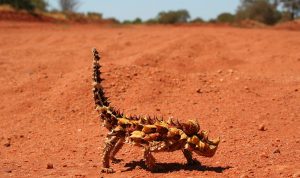
Aila suggested we learn more about the thorny devil, an Australian reptile we talked about way back in episode 97. It’s a spiky lizard that grows to around 8 inches long, or 20 cm. In warm weather its blotchy brown and yellow coloring is paler than in colder weather, when it turns darker. It can also turn orangey, reddish, or gray to blend in to the background soil. Its color changes slowly over the course of the day as the temperature changes. It also tends to turn darker if something threatens it.

It has a thick spiny tail that it usually holds curved upward, which makes it look kind of like a stick. It moves slowly and jerkily, rocking back and forth on its legs, then surging forward a couple of steps. Researchers think this may confuse predators. It certainly looks confusing.

As if that wasn’t enough, the thorny devil has a false head on the back of its neck. It’s basically a big bump with two spikes sticking out of its sides. When something threatens the lizard, it ducks its head between its forelegs, which makes the bump on its neck look like a little head. But all its spines make it a painful mouthful for a predator. If something does try to swallow it, the thorny devil can puff itself up to make it even harder to swallow, like many toads do. It does this by inflating its chest with air.

The thorny devil eats ants, specifically various species of tiny black ants found only in Australia. It has a sticky tongue to lick them up. This is very similar to the horned lizard of North America, also called the horny toad even though it’s not a toad, which we talked about most recently in episode 376. But despite their similarities in looks, behavior, and diet, the horned lizard and the thorny devil aren’t closely related. It’s just yet another example of convergent evolution.

Now, let’s finish with a strange report from the 1930s about a colony of hundreds, if not thousands, of monkeys in Australia. Australia doesn’t have very many native placental mammals, and no monkeys. But several Australian newspapers reported in 1932 that a party of gold prospectors encountered the monkeys in northern Australia, specifically Cape York Peninsula. The monkeys were reportedly gathered in one area to eat a huge crop of red nuts, and they appeared to be large monkeys that weighed up to 30 lbs, or 13 kg. Another gold prospector said in follow-up articles that he too had seen the monkeys and even shot a few of them, although he hadn’t saved any part of the bodies.

Newspaper hoaxes were pretty common back in the day, but by the 1930s things had mostly settled down and papers were more interested in imparting actual news instead of making it up. Cape York Peninsula was quite remote at the time, with rivers, rainforests, and savannas where a lot of animals unknown to science probably still live. But not monkeys!

One thing to remember is that at the end of the 19th century, it was a fad to release animals from one area into another. That’s how the European starling was introduced to North America, where it has become incredibly invasive. In the early 1890s, a group of people released a hundred starlings into New York City’s Central Park, because they wanted all the birds mentioned in Shakespeare’s writings to be present in the United States. This fad included Australia, where colonizers tried to release all sorts of animals. Most of the animals didn’t survive long, and we don’t have any records of monkeys being released, but it’s possible that someone just did it for fun and didn’t tell anyone.

Another suggestion is that the prospectors saw tree kangaroos and thought they were monkeys, even though tree kangaroos don’t actually look like monkeys. They look like little kangaroos that live in trees, not to mention they’re mostly nocturnal. Besides, the local Aboriginal people reportedly told the prospectors about the monkeys, and they would have identified tree kangaroos easily if that’s what they were. No other native Australian animal known to live in the area resembles a monkey either.

Zoologist Karl Shuker suggests the monkeys might have been macaques native to New Guinea. New Guinea isn’t all that far away from Australia, and macaques were often kept as pets too. It would have been pretty easy for someone to buy a bunch of macaques, import them on a ship, and release them into the wilderness. Or the macaques might have gotten there on their own, rafting to Australia on fallen trees washed out to sea during storms.

If there really were monkeys in Australia 90 years ago, of course, the big question is: are they still there?

You can find Strange Animals Podcast at strangeanimalspodcast.blubrry.net. That’s blueberry without any E’s. If you have questions, comments, or suggestions for future episodes, email us at strangeanimalspodcast@gmail.com. We also have a Patreon at patreon.com/strangeanimalspodcast if you’d like to support us for as little as one dollar a month and get monthly bonus episodes.

Thanks for listening!

Episode 414: Two Marvelous Frogs

Thanks to Eilee and Alexis for their suggestions this week, two amazing frogs!

Further reading:

Paradoxical frog: The giant tadpole that turns into a little frog

Fungus is wiping out frogs. These tiny saunas could save them.

How to build a frog sauna

The paradoxical frog [photo by Mauricio Rivera Correa – http://calphotos.berkeley.edu, CC BY-SA 2.5, https://commons.wikimedia.org/w/index.php?curid=6703905]:

The Vietnamese mossy frog [photo by H. Zell – Own work, CC BY-SA 3.0, https://commons.wikimedia.org/w/index.php?curid=81804225]:

Show transcript:

Welcome to Strange Animals Podcast. I’m your host, Kate Shaw.

Let’s start 2025 off right with an episode about frogs! Thanks to Alexis and Eilee for their suggestions.

Let’s start with Eilee’s suggestion, the paradoxical frog. The paradoxical frog is a type of tree frog that lives in South America. Like other frogs, it likes ponds and shallow lakes. Some individuals are green and some are brown, and a frog may have darker stripes or splotches, or might just be plain. The tadpoles eat algae and other tiny food, while the adults eat insects.

As with most frogs, the paradoxical frog hatches into a larval stage called a tadpole or pollywog, which is fully aquatic. It later metamorphoses into its adult form as a frog. Most tadpoles start out very small and grow larger, then metamorphose into a juvenile frog which then grows to fully adult size. But while the paradoxical frog’s tadpole starts out small, it can grow to as much as 11 inches long, or 28 centimeters! It’s the largest tadpole in the world as far as we know.

So how big is the adult frog if the tadpole is so enormous? About 3 inches long, or 7.5 cm, from snout to vent. That’s why it’s called the paradoxical frog, because a paradox is something that seems contradictory to expectations. Instead of the ordinary way of things, where a small tadpole grows into a bigger frog, in this case a big tadpole grows into a smaller frog. It’s sometimes called the shrinking frog.

One interesting detail is that not all of the tadpoles are that big. If a female lays her eggs in a small body of water that’s likely to dry up, or that doesn’t have a lot of food available, or if there are a lot of predators in the water, the tadpole metamorphoses quickly and doesn’t grow very big. But if the tadpole is in a better location it matures much more slowly, which allows it to reach much larger size before metamorphosing.

I should also mention that the 11-inch-long tadpole that is the largest ever measured was actually raised in captivity. In the wild, the largest paradoxical frog tadpole ever measured was 6 ½ inches long, or almost 17 cm. That’s still really big, but not that ridiculously big. But the confusing thing is that the tadpole is big and bulky, up to four times the size of the adult frog. Where does all that mass go after it transforms?

Early scientists who learned about the paradoxical frog wondered the same thing. They were so confused that they suggested that the frog actually came first and later metamorphosed into the tadpole, which then metamorphosed into a fish. But the main reason the tadpole is so long is its tail. When it metamorphoses into a frog, it absorbs the tail and therefore appears to shrink. The bulkiness of the tadpole’s body matches the bulkiness of the frog’s body. And unlike most frogs, which metamorphose into juvenile frogs that still have some growing to do, the paradoxical frog metamorphoses into a completely adult frog. It’s as big as it will ever get and fully mature, ready to mate and lay eggs.

Next, Alexis wanted to learn about the Vietnamese mossy frog. It lives in parts of Vietnam, Laos, and other nearby areas. It prefers mountainous rainforests and the female often chooses to lay her eggs in a tree hollow or even a rock cavity where water has collected. Instead of laying her eggs in the actual water, though, she lays them on rocks or branches above the water. The eggs don’t dry out because of the high humidity in rainforests, and when they hatch, the tadpoles fall into the water.

The tadpoles take a long time to mature, anywhere from four to eight months depending on how warm it is while they’re developing. They grow quite large, although not anywhere near the size of the paradoxical frog tadpole.

A big female Vietnamese mossy frog can grow up to 3 ½ inches long, snout to vent, or 9 cm, and is chubby and round. It’s nocturnal and spends the day hiding on mossy rocks or among plants in the water, then comes out at night to hunt insects like crickets as well as other small animals like worms.

The reason it’s called the mossy frog is because it looks for all the world as though this frog is covered in moss, or maybe is just made out of moss. It’s green and brown in color and its skin is covered in little bumpy structures called tubercules. This helps it blend in incredibly well in the rainforest, where moss is pretty much everywhere. If it feels threatened and it can’t jump into the water to hide, it will play dead.

This is what a Vietnamese mossy frog sounds like:

[frog beeping]

As we’ve talked about in other frog episodes, frogs throughout the world are declining in numbers because of a fungus that infects their skin. The effects of this fungus are worse in cold weather, so a team of scientists speculated that helping the frogs stay warm might help them stay healthier in winter and even help them recover from the infection. They tested their hypothesis by offering infected frogs a variety of temperatures in their enclosure. The frogs could pick where they wanted to spend their time. The frogs liked the warm areas but didn’t spend all their time in them, but they all recovered from the infection. Frogs who were given an overall warm environment also recovered, but not as fast. Frogs who had an ordinary enclosure without warmer areas remained infected with the fungus. Even better, frogs who had recovered from infection with the warm environment also showed resistance to later infections.

The team worked to develop plans that allow people to easily build what they call frog saunas. They don’t require electricity or fuel, just sunshine. When the saunas are placed near ponds or other areas with frogs, the frogs find them quickly and use them. There’s a link in the show notes if you want to learn how to make a frog sauna for your own back yard.

You can find Strange Animals Podcast at strangeanimalspodcast.blubrry.net. That’s blueberry without any E’s. If you have questions, comments, or suggestions for future episodes, email us at strangeanimalspodcast@gmail.com. We also have a Patreon at patreon.com/strangeanimalspodcast if you’d like to support us for as little as one dollar a month and get monthly bonus episodes.

Thanks for listening!

Episode 386: The Greater Siren and the Anhinga

Thanks to Kai and Emily for their suggestions this week!

The greater siren [photo by Kevin Stohlgren, taken from this site]:

The anhinga [photo by Tim from Ithaca – Anhinga, CC BY 2.0, https://commons.wikimedia.org/w/index.php?curid=15526948]:

An anhinga swimming [photo by Wknight94, CC BY-SA 3.0 <https://creativecommons.org/licenses/by-sa/3.0>, via Wikimedia Commons]:

Show transcript:

Welcome to Strange Animals Podcast. I’m your host, Kate Shaw.

This week we’re going to learn about two animals, one suggested by Kai and the other suggested by Kai’s mom Emily. It’s so awesome to hear when families like to listen to the podcast together. This episode even includes a mystery animal I bet you’ve never heard of.

Let’s start with Kai’s suggestion, the greater siren. The greater siren is an amphibian, specifically a salamander, but it’s probably not the kind of salamander you’re thinking of. For one thing, it can grow over three feet long, or about a meter, which is pretty darn big for a salamander. It’s dark green or gray in color with tiny yellow or green speckles, and while it has short front legs, those are the only legs it has or needs. It also has external gills which it keeps throughout its life, unlike most salamanders who lose their external gills when they metamorphose into adults.

The greater siren lives primarily in Florida, but it’s also found in coastal wetlands throughout much of the southeastern United States. It’s mostly nocturnal and during the day it hides among water plants or under rocks, and will even burrow into the mud. At night it comes out to find food, which includes crayfish and other crustaceans, insects and spiders, little fish, other amphibians, snails, and even algae. It swallows its food whole, even snails and other mollusks. It poops out the shells and other undigestible pieces.

The grater siren’s body is long but thin, sort of like an eel, with a rounded tail that’s slightly flattened to help it swim. While it does spend its whole life in the water, it has small lungs that allow it to breathe air if it needs to. It can wriggle above ground for short distances if it needs to find a new pond or river, and sometimes it will sun itself on shore. In drought conditions when its water dries up, the greater siren will burrow into the mud and secrete mucus that mixes with dead skin cells to form a sort of cocoon. The cocoon covers everything but the siren’s mouth, so it can still breathe. Then it enters a state of torpor called aestivation, and it can stay in its mud cocoon for a long time, possibly as much as five years, and still be fine once the water returns. It does lose a lot of its body fat and its gills wither away, but it regenerates them quickly once it has water, and will gain weight quickly too once it has food.

In early spring, the female siren lays her eggs in shallow water. The male fertilizes them and takes care of them for the next two months, when they hatch into little bitty sirens that go off on their own right away.

The greater siren has tiny eyes and probably doesn’t see very well. It has a good sense of smell instead, and it can also sense movement and vibrations around it with its lateral line system. This is an organ found in many fish and a lot of larval amphibians, although the greater siren retains it throughout its life. It allows the animal to sense the movement of water in extremely fine detail. The greater siren can probably also sense electrical impulses, which is something that all animals generate when they use their muscles.

If there’s a greater siren, you may be thinking, there must be a lesser siren too. There is, and it’s very similar to the greater siren, just not as big. It only grows about two feet long at most, or 61 cm.

Kai mentioned that the greater siren looks a lot like the axolotl, a critically endangered salamander found only in Mexico. I checked to see if the two salamanders were closely related and was actually surprised to find that they’re not. They’re both salamanders and therefore share the same order, but that’s all. The greater siren and its close relations do share one important trait with the axolotl, though, which is neotony. Neotony is when an adult organism retains juvenile traits, which in the case of the salamander means it retains gills and lives underwater as an adult.

Next, Emily wanted to learn more about a bird called the anhinga. It’s sometimes called the snakebird because it has a long, serpentine neck. But before we learn about the anhinga, let’s learn about a mystery animal from Kentucky. I promise this will make sense in a minute.

In 1993 a man named Barton Nunnelly and his wife were sitting in their back yard in Stanley County, Kentucky. It was a nice day and their house was close to the Ohio River, so as they often did they just relaxed and watched the river. On this particular day, they both noticed a strange animal in the water. It was snake-like with a bill similar to a duck’s, but it obviously wasn’t a duck. It swam with its head and neck above the water, but its body was never visible. It frequently sank into the water, then surfaced elsewhere. The couple watched the animal for half an hour before it disappeared downstream.

For most people, that sighting would just be an interesting story to tell at parties, but Barton Nunnelly was a cryptozoologist. That’s someone who likes to investigate mystery animals, and while it’s a great word, it’s not an official branch of science. Zoologists, biologists, and other scientists study mystery animals all the time as part of their jobs. Nunnelly investigated—and in fact still does investigate, since he’s alive and well—mystery animals that are a lot more mystery than animal, like Bigfoot. He wrote about his sighting of what he thought might be a young freshwater sea serpent in his book Mysterious Kentucky.

Now, with Nunnelly’s sighting in mind, let’s return to the anhinga and learn a little more about this unusual bird. It can grow almost three feet in length, or about 90 cm, with a nearly four-foot wingspan, or 115 cm. A lot of its body length is due to the long neck. The male is black all over with a white tail-tip, while the female looks similar but has a brown head and neck. It looks similar to the double-crested cormorant, a close relation, but it has a longer, sharper bill. It lives throughout much of South and Central America, and is also common around the Gulf of Mexico and parts of the southeastern United States. In North America it usually stays near the coast or around wetlands, but sometimes it’s found farther inland, especially along rivers.

The most interesting feature of the anhinga is the way it hunts. It has big webbed feet and swims extremely well, and it hunts fish, frogs, and other small animals underwater. Unlike other water birds, which have water-repellent oils coating their feathers, as soon as the anhinga gets in the water, its feathers get all wet. This causes it to lose buoyancy and sink, but that’s just fine with the anhinga. It also has dense bones compared to most birds, which helps it stay underwater. The bird swims underwater until it gets close to a fish or other prey animal. Then it stabs the animal with its sharp bill, before bringing it above water to swallow. Often it will swim with its body completely submerged but its head and neck sticking up out of the water.

One interesting fact about the anhinga is that it has no nostrils. It can only breathe through its mouth. It can hold its breath underwater for about four minutes and during that time can travel quite a distance, up to about 100 yards, or 90 meters, completely underwater. In addition to fish and frogs, it will eat crayfish, crabs, insects, water snakes, and lots of other small animals. After it’s done hunting, or if it wants a rest, it will stand in the sun with its wings spread in order to dry its feathers. Cormorants do this too for the same reason.

Now, think back to Barton Nunnelly’s sighting of a duck-billed water serpent. It sounds to me an awful lot like Nunnelly saw an anhinga hunting in the river. It’s a rare visitor that far inland, but not unheard of. Naturally, not everyone knows every single bird in the world, but I feel like if you’re going to write a book about mystery animals, you should do a little research first. But maybe that’s just me.

You can find Strange Animals Podcast at strangeanimalspodcast.blubrry.net. That’s blueberry without any E’s. If you have questions, comments, or suggestions for future episodes, email us at strangeanimalspodcast@gmail.com. We also have a Patreon at patreon.com/strangeanimalspodcast if you’d like to support us for as little as one dollar a month and get monthly bonus episodes.

Thanks for listening!