Podcast: Play in new window | Download (Duration: 9:43 — 10.7MB)
DRAMA! Bird drama! Here are some further-reading links if you want to verify that I’m not vilifying anyone:
Buff-breasted Buttonquail: An image claimed to be of this species revealed
Buff-breasted Buttonquail: Smoke & Mirrors
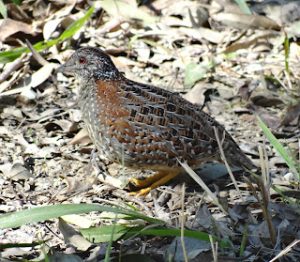
A painted button quail:
Show transcript:
Welcome to Strange Animals Podcast. I’m your host, Kate Shaw.
Back in episode 136 we talked about the button quail, because that episode was about tiny animals and the button quail is really tiny. But let’s revisit the button quail this month, because we have a mystery associated with a particular species of button quail.
Button quails generally live in grasslands and are actually more closely related to shore and ocean birds like sandpipers and gulls than to actual quails, but it’s not very closely related to any other living birds. It can fly but it mostly doesn’t. Instead it depends on its coloring to hide it in the grass where it lives. It’s mostly brown with darker and lighter speckled markings, relatively large feet, and a short little tail. It eats seeds and insects along with other small invertebrates.
The button quail is especially interesting because the female is more brightly colored than the male, although not by much. In some species the female may have bright white markings, while in others her speckled markings are crisper than the males. The female is the one who calls to attract a male and who defends her territory from other females. The female even has a special bulb in her throat that she can inflate to make a loud booming call.
The male incubates the eggs and takes care of the chicks when they hatch. Baby button quails are fuzzy and active like domestic chicken babies but they’re only about the size of a bumblebee. In many species, as soon as the female has laid her eggs, she leaves them and the male and goes on to attract another male for her next clutch of eggs.
The various species of button quail live in different areas, including Africa, Asia, and Australia. The species we’re talking about today is the buff-breasted button quail, which is native to one small area of Queensland, Australia. It grows about 9 inches long, or 23 cm, which is big for a button quail, most of which are closer to the size of sparrows, and it’s reddish-brown with darker and lighter speckles. It’s critically endangered due to habitat loss and introduced animals like cats and cattle. There are only an estimated 50 individuals alive today.
But that’s only an estimate, because no one has actually for sure seen a buff-breasted button quail since 1922. Also, I’m going to call it the BBBQ from now on because that name is hard to say.
The 1922 specimen was shot by a naturalist who was collecting specimens for a museum, which was regrettably common at the time and led to a lot of endangered species being driven to extinction. The bird was already rare in 1922 and that was the last anyone saw of it until 1985, when someone reported seeing one. People flocked to the area in hopes of spotting it, but while there were lots of sightings, no one got a good picture of a BBBQ. All the pictures, and all the recordings of its calls, turned out to be of another species of button quail, a very similar bird called the painted button quail.
It’s been 100 years since the bird was last seen, so while we have lots of museum specimens, we don’t have any modern sightings. That means two things. Either the buff-breasted button quail is probably extinct…or it never actually existed in the first place.
There are two other species of button quail that live in the same areas where the BBBQ is found, the painted button quail and the brown quail. They’re smaller but otherwise look very similar, especially the painted button quail. Maybe people were mistaking larger individuals of painted button quails as a different species.
In 2018, a team of scientists from the University of Queensland conducted a search for the BBBQ. All they found were painted button quails. But they discovered something surprising that had never been documented before. During the breeding season, the female painted button quail’s feathers are much more reddish-brown, while the rest of the year the feathers on her back are more gray-brown.
The team also studied as many BBBQ skins as they could track down from museums, where they learned something else surprising. It turns out that it’s not any larger than the painted button quail, which grows up to 8 inches long, or 20 cm. So the birds are the same size and during part of the year, they have almost identical plumage. Hmm.
That doesn’t mean the buff-breasted button quail never existed. One very distinctive difference between the painted and the buff-breasted species is eye color, with the former having red eyes and the latter having yellow. As far as I know a genetic study hasn’t been carried out on the museum specimens, but it’s likely that at least some of the specimens—maybe all of them—really are BBBQs. Scientists and bird enthusiasts are still looking for the bird, and that has led to a strange controversy.
In early 2022, a naturalist named John Young published a photo on Facebook of what he said was a male buff-breasted button quail on a nest, a photo taken by a camera trap in a secret location. The location had to be secret so that no one would try to find the birds and scare them away or damage a nest. Young said he had 16 other photos of BBBQs but wasn’t going to share them until he was ready to publish his findings. He was also raising money to continue his studies at the site.
Another naturalist thought there was something fishy about the photo. He discovered that the picture is actually a cropped and flipped photo of a painted button quail bird and nest reportedly taken at a different site—published in 2018 by John Young himself and labeled by him as a painted button quail. Young had reused one of his own photos and assumed no one would notice.
But it gets worse. Back in 2013, Young got photographs of another extremely rare Australian bird, the night parrot. One day we’ll have an episode about it. It was such a big deal that he was offered a job by the Australian Wildlife Conservancy, or AWC, to study the night parrot and the buff-breasted button quail. He documented sightings and produced photos of both birds, but he didn’t stay in that job too long. That’s because some people started getting suspicious of his parrot photos. After an inquiry into the night parrot photos, the AWC concluded that the eggs in a photo of a night parrot nest were probably fake.
And Young’s dubious photos go back even farther. In 2006 he claimed to have discovered a new species of parrot in Queensland, but while initially the Queensland government supported learning about the new species, it withdrew its support when the photo turned out to be…suspicious. It looked like Young had altered the coloration of a bird to make it look like a new species. When an expert requested the original photographs, Young said he’d deleted them.
More recently, the 2018 painted button quail photo and the supposed 2022 BBBQ photo were examined by a forensic photography expert. Young had removed the metadata from both so no one could tell where they were taken, but there’s a little white stone in both pictures that’s identical, along with many other identical details.
The problem with fake sightings and photographs is that it’s actually making things worse for the buff-breasted button quail. The AWC and other conservation groups are trying to get the bird listed as endangered, which means funding for research and conservation. Now all that is in jeopardy because it’s not clear if there have actually been any sightings of the bird at all.
Hopefully the buff-breasted button quail is still around and someone will get genuine photos of it soon so it can be protected and studied. That’s assuming it’s a real bird in the first place.
Thanks for your support, and thanks for listening!