Podcast: Play in new window | Download (Duration: 6:31 — 7.2MB)
Further reading:
Identifying the beasts in Caesar’s forest
Reindeer:
Show transcript:
Welcome to Strange Animals Podcast. I’m your host, Kate Shaw.
After the glaciers retreated from Europe at the end of the last ice age, around 11,000 years ago, forests grew wherever there was enough soil to support a tree. As these new forests spread, they joined forests that had survived the glaciations. By the time ancient Romans were writing about the things they encountered while exploring western Europe, around 2,000 years ago, the forest stretched across much of the continent and was considered a wild, dangerous place. They called it the Hercynian [her-SIN-ian] forest and it was supposed to be full of peculiar animals.
An account of the forest appears in the book Commentarii del Bello Gallico, the first edition of which was published just over 2,000 years ago in 49 BCE. It was written by Julius Caesar, or at least he was involved in it even if he didn’t actually write it personally, since it was about his military campaigns. In one section of the book he discusses the Hercynian forest and three remarkable animals that lived in it.
The first was called the uri, which were supposed to look like bulls but were almost the size of elephants, and were incredibly aggressive. This is probably the same animal often called the aurochs, which we talked about in episode 58. The aurochs was probably the wild ancestor of the domesticated cow and could stand almost six feet tall at the shoulder, or 1.8 meters. It had already gone extinct in most places 500 years before Caesar wrote his book, but it still lived in parts of Europe.
The second animal is a lot harder to identify. The alces looked like a big goat that either didn’t have horns or had very short ones, but its legs didn’t have joints. If an alces fell over, it couldn’t get up again. Caesar explained that hunters used this to their advantage. Because the alces couldn’t lie down at night, it would sleep by propping itself against a tree. The hunters would note which tree an alces preferred, and during the day they’d cut a notch in the trunk. When the alces leaned against it at night to sleep, the tree would topple over, taking the animal with it. The waiting hunters would then be able to just stroll up and kill the alces.
Naturally, this story doesn’t make any sense. All tetrapods have jointed legs. But the story of an animal without joints in its legs crops up in various stories from around this time, including the part where hunters cut a notch in a tree trunk to knock the animal over. It’s a story once told about the elephant and the Eurasian elk, among others, and the alces was probably based on the Eurasian elk. That’s the Eurasian population of the animal called the moose in North America. Because the story specifies that the alces either didn’t have horns or had very small ones, it’s possible that Caesar based his story on the female elk, which doesn’t have antlers.
Incidentally, we’re so certain that the alces was the same animal as the Eurasian elk that its scientific name is actually Alces alces.
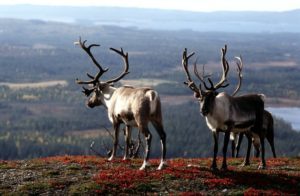
Finally, the Hercynian deer was likewise large and had a single horn. A translation of the passage states: “There is an ox with the shape of a deer; projecting out of its forehead, in the middle, between the ears, is a single horn, which is both longer and more upright than those horns we are used to seeing.” Other sources that talk about this animal also say that the horn branched at the end, and Caesar notes that both males and females had these horns.
This gives us a big clue as to what animal might have inspired the account. Unlike most deer, both male and female reindeer have antlers. Unlike caribou, the North American reindeer species, the European reindeer often has relatively long and straight main shafts on its antlers that then enlarge at the end in what’s called a palmate structure. That basically means it’s shaped like a hand.
But reindeer have two antlers, not one. It’s possible that the story of the Hercynian deer was inspired by the unicorn legend, which was based on the rhinoceros. It might also have been inspired by Caesar sighting a reindeer that had dropped one antler but hadn’t yet lost the other one, since like other deer, reindeer shed their antlers and regrow them every year.
The reason Caesar wrote about the animals of the Hercynian forest in the first place was to underline how strange and uncivilized the people living in the area were. The people in question are what today we would call Germans. Caesar stresses that all these animals are ones never seen anywhere else, and he might easily have added exotic details from other fabulous animals to make these animals seem extra weird.
These days most of the Hercynian forest is long gone, chopped down for people to turn into farmland and towns. While the Eurasian elk and the reindeer are still around, they no longer live as far south as Germany. The last aurochs went extinct in 1627 in Poland. But the German people are doing just fine, and they’re a lot more civilized than Caesar gave them credit for 2,000 years ago.
Thanks for your support, and thanks for listening!