Podcast: Play in new window | Download (Duration: 11:03 — 12.0MB)
Further reading:
Scientists solve a shark murder mystery
Stone Age Animal Urine Could Solve a Mystery about Technological Development
South African rock art possibly inspired by long-extinct species
The porbeagle shark [photo by Andy Murch, taken from this site]:

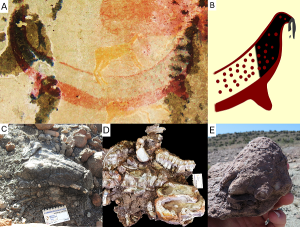
Dicynodont fossils and their possible art interpretation by the San people:
Show transcript:
Welcome to Strange Animals Podcast. I’m your host, Kate Shaw.
It’s finally monster month, and I’m looking forward to sharing lots of fun mystery animals and animal mysteries over the next four weeks.
Our first mystery is from an article titled “Scientists solve a shark murder mystery.” The word solve is doing a lot of heavy lifting in this case, but let’s find out what happened to the shark.
The shark in question was a porbeagle shark, a type of mackerel shark that can grow as much as 12 feet long, or over 3.5 meters, and is gray and white in color. It lives in cold water in the North Atlantic and around Antarctica, and it eats fish and cephalopods like squid. It hardly ever bothers people although people like to eat it, and in some regions it’s been so overfished that the species is listed as endangered.
The porbeagle is especially unusual because it’s able to thermoregulate to some degree, like the basking shark and some other sharks that we talked about in episode 353, about warm-blooded fish. The porbeagle is actually really good at keeping its brain, eyes, and internal organs warm, which is why it’s so successful in cold water. It can live to be at least 65 years old.
There’s still a lot we don’t know about the porbeagle, including where exactly it lives and how far it migrates throughout the year. A team of scientists has been tagging porbeagle sharks with little transmitters, like shark Air Tags, to find out where the sharks travel and other information, like how deeply they dive and what the water temperature is. The transmitter is attached to a shark’s fin and is designed to stay in place for a year, then detach and transmit all the information it’s gathered as soon as it floats to the water’s surface.
In October 2020, the scientists captured an 8-foot, or 2.5 meter, female porbeagle and fitted her with a transmitter before releasing her again. They were especially happy to see that she was pregnant, partly because the porbeagle is endangered and reproduces slowly, partly because they were interested to find out where a pregnant shark traveled.
About six months later, in April 2021, the tag began to transmit its information. It was too early for it to have detached on its own, but sometimes something happens to a tag and it ends up removed from the shark before it’s scheduled to.
The team’s lead scientist, Brooke Anderson, examined the transmitter’s information and knew something weird had happened to the shark. Everything seemed normal until about a week before the tag began to transmit, when the tag indicated a slight but steady increase in the temperature of its surroundings, even though it was still deep underwater. Anderson suspected that the shark had been killed and eaten at that point, and the tag ended up inside the body of another animal that was able to thermoregulate. When the transmitter was expelled from the predator’s body, it floated to the surface and did what it was designed to do, transmit its saved information.
But while the porbeagle isn’t a huge shark, it’s still big and dangerous. It’s also a fast swimmer. Something really big had to have attacked the shark.
The first thing Anderson suspected was an orca, but she and her team immediately rejected that theory. Orcas are mammals, which means an orca’s internal temperature is much higher than the tag had recorded. That narrowed the suspects down to another shark that’s able to thermoregulate, but it also had to be a really big shark. They decided in the end that the porbeagle was probably eaten by a great white.
Next, we need to learn a little about the rock hyrax, because a deposit of ancient rock hyrax urine is helping scientists learn more about our own prehistoric ancestors.
The rock hyrax looks like a weird rodent but it’s actually more closely related to dugongs, manatees, and elephants. I’m literally not even kidding. Hyraxes are native to Africa although the rock hyrax also lives in parts of the Middle East. It’s also called the dassie. It’s a chonky animal with a short tail and thick fur, small rounded ears, and nails instead of claws. Even a big male rock hyrax grows less than two feet long, or 50 cm, about the size of a small marmot or groundhog, which it resembles superficially. It eats plants.
The rock hyrax lives in family groups of one male and several females, along with their young offspring. It doesn’t dig a burrow but lives in holes and shelters it finds already dug, including caves, and that brings us to the sort-of mystery.
Like many animals, the rock hyrax tends to pee in the same place every time it needs to go, and a group of hyraxes living in the same shelter tend to all pee in the same place. A good shelter, like a cave, will get used by generation after generation of hyraxes. The rock hyrax is well adapted to dry areas and its kidneys are efficient. It doesn’t need a lot of water. As a result, its urine tends to be fairly thick and it also hardens quickly when exposed to the air.
In other words: rock hyraxes have been peeing in one part of Boomplaas Cave in South Africa for at least 50,000 years, and that urine is preserved in thin layers that contain pollen and other clues about the climate over the last 50 millennia. The urine can be carbon dated, too. That means scientists can cut samples from that huge deposit of ancient urine, determine how old each layer is, and examine the pollen trapped inside to learn what kind of plants were growing in the area at the time. That helps them determine what the climate was like, which in turn helps them learn more about the ancient humans who lived in the area too.
Until the samples were tested in 2022, the changes in South Africa’s climate over the last 50,000 years wasn’t well known. Now we have an unbroken record of the climate. The main problem is that the urine smells really, really bad. Like, really really bad. But it’s worth it, for science.
Let’s finish with another mystery from South Africa. Around 200 years ago, between 1821 and 1835, some artists among the San people painted an interesting animal on a rock wall. It’s not the only part of the painting, which contains art of other animals and various cultural elements, but it’s the only animal that can’t be identified as something real.
Of course, you can’t study art the same way you’d study a fossil. If you draw a dragon from your imagination, that’s art. If a scientist comes along 200 years later and tries to claim that dragon was based on a real animal that had four legs and two wings and could breathe fire, they’re misunderstanding what art is. But if that same scientist looked at your drawing along with the journal you kept at the same time telling about how you visited the zoo, they might suggest that your drawing was inspired by the crocodiles and monitor lizards you saw.
That’s what Julien Benoit thinks about the painting of an animal referred to as the horned serpent. The San have lived in that particular part of South Africa for longer than hyraxes have been peeing in Boomplaas Cave, and their culture is rich and in many ways unchanged from that of their ancient ancestors. They know everything about their land, including all the animals that live there now and a lot that used to live there.
The horned serpent painting is a long-bodied animal that doesn’t actually look like a serpent or an animal with horns. It very clearly has legs even though they’re short, and its body is thick but with a long thin tail and a small head with downward pointing tusks. If the animal was painted near somewhere that you’d expect to find walruses, everyone would assume it’s a walrus. But it’s not a walrus, or probably not, and the painting doesn’t resemble anything that actually lives in South Africa.
However, Benoit suggests that it does resemble an animal that used to live in what is now South Africa, the dicynodont. It had downward-pointing tusks, a thick body, and fairly short, strong legs. It ate plants and was very common in the area when it was alive—but it went extinct over 200 million years ago.
Clearly, as ancient as the San culture is, they weren’t around in the Triassic, so how could they possibly have known about dicynodonts? The answer is pretty simple. Dicynodonts were so common that their fossils are regularly found in the Karoo Basin of South Africa, including well-preserved skulls eroding out of the ground.
The San would have undoubtedly come across these fossils. They even have myths about huge animals that once roamed the area but that died out long ago, and archaeologists have found collections of fossils made by the San centuries ago. Benoit thinks the so-called horned serpent is an artistic depiction of a dicynodont, with elements taken from the fossils and from myth.
In other words, basically, the San people understood paleontology and extinction long before Europeans figured it out.
Thanks for your support, and thanks for listening!