Podcast: Play in new window | Download (Duration: 10:06 — 10.3MB)
Show transcript:
Welcome to Strange Animals Podcast. I’m your host, Kate Shaw.
Monster month is upon us, and to kick us off I’ve got a fun episode about a supposed Bigfoot discovery called the Minnesota Iceman.
It happened in 1968, although the iceman had been around for a while as part of a traveling exhibition. But in 1968 a zoologist named Terry Cullen saw it at a livestock fair in Chicago. Curious and excited, Cullen talked to the owner of the exhibition, named Frank Hansen. Hansen said he wasn’t actually the iceman’s owner but that he was taking care of it for the owner.
Cullen contacted two cryptozoologists and urged them to look at the iceman, author Ivan Sanderson and zoologist Bernard Heuvelmans. Both wrote several influential books and basically founded modern cryptozoology, which of course is the study of animals that might or might not actually exist. Ivan Sanderson comes up in the podcast occasionally because he was everywhere back in the day, managing to have all sorts of sightings of mystery animals with absolutely no proof except for his own say-so.
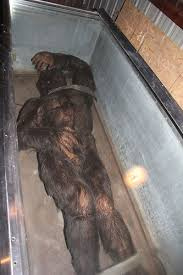
But the iceman was clearly a real thing, because there it was. This is a good time to describe it, huh? It wasn’t a living animal but a dead one preserved in a block of ice. It was apelike but much larger than most apes with human-like proportions, and would have stood about six feet tall when alive, or 1.8 meters. The iceman’s face was somewhat flat in shape with pronounced brow ridges and a short snub nose. It had dark fur and enormous hands and feet, and while the ice obscured a lot of the details, both Heuvelmans and Sanderson got a good close look at it in Hansen’s home that December. The exhibition was on its winter break and Hansen kept it at his house in a refrigerated case. The body itself showed signs of injury, including a possibly broken arm and an eyeball dislodged from its socket.
Both Sanderson and Heuvelmans took photos and made careful drawings of the iceman. Heuvelmans, who was a zoologist, published a description of it in a Belgian scientific journal in 1969. He first suggested it was a new species of human that he named Homo pongoides, but later he changed his mind and decided it was probably more closely related to Neandertals.
Sanderson, meanwhile, was active in drumming up media interest. He also was sure it was a new species, but instead of Homo pongoides, he chose to call it Bozo. Yeah, Bozo. Sanderson published an article about the iceman in a 1969 issue of Argosy science fiction magazine, where he was an editor. In that article he suggests the iceman was the missing link between humans and apes. Remember what I’ve said about people claiming they’ve found the missing link? They either don’t know what they’re talking about or it’s a hoax. Sometimes both.
Sanderson also contacted John Napier, a primatologist who worked for the Smithsonian Institution and had a longstanding interest in the Yeti and other Bigfoot-type creatures, and suggested he investigate. Napier and the Smithsonian’s director, S. Dillon Ripley, also a Yeti enthusiast, were both interested. But when they asked to see the iceman, suddenly Hansen said nope, the iceman’s actual owner didn’t want anyone else looking at their…sideshow exhibit.
Later Hansen said Napier and Ripley could see it after all. But when they did, it was clear to them that it wasn’t a real animal. Napier said it looked like a latex model. Hansen promptly said that he’d hidden the original, worried that he would get in trouble if it turned out to be a type of human, and that Napier had actually viewed the model he’d replaced the actual iceman with. Sanderson and Heuvelmans did say that the photos Napier took looked different from their own photos and what they remembered. But Hansen wouldn’t let anyone see the original iceman, so the scientists’ interest waned and that was pretty much it.
So where did the iceman come from and where is it now? Surely by now some museum or university has bought the actual specimen and thawed it out to examine, right? Where’s the genetic profile? Why isn’t this thing in textbooks?
Soooo, well. Let’s start with where it came from. Hansen said the body had been discovered in Siberia by seal hunters, floating in a block of sea ice just off the coast. But he also said it had been found not by Russian seal hunters but by Japanese whalers. Okay, well, maybe he couldn’t remember exactly who found it. But wait. He also said it had been shot by a hunter in Minnesota. And he also said it was killed in Vietnam and smuggled into the United States during the war in a body bag. And he also said someone discovered it in Hong Kong in a deep freeze after it was confiscated by authorities from the seal hunters or possibly whalers.
In other words, Hansen was clearly just making all this up. But maybe he didn’t know where it came from. After all, he always said he wasn’t the iceman’s owner, although he wouldn’t say who the owner was, just that they were an “eccentric California millionaire.” He also claimed the specimen’s hairs and blood had been tested and came back with lots of anomalies, but he refused to let anyone have current samples and he conveniently didn’t have copies of the test reports.
In 2013 someone listed the iceman in an eBay auction. It was bought by the Museum of the Weird in Austin, Texas, where apparently it’s still on display. It looks like the photos and illustrations made by Heuvelmans and Sanderson, but it’s not a real animal. It’s a latex model, just like Napier suspected.
Back in the early 1970s, Napier had done some digging and discovered that in 1967, Hansen had commissioned a latex model of an ape-man from a company that made movie props.
It’s quite possible that there was more than one model of the iceman made, since obviously that would increase its earning power in sideshow exhibits. That would explain why the iceman Heuvelmans and Sanderson saw looked different from the iceman Napier and Ripley saw. Or the differences could have come about when the model was thawed for easier storage, then frozen again in ice when it was time to go back on tour.
Of course, some people refuse to believe that the iceman was a hoax. They believe Hansen really did switch out the actual real iceman with a model. They base this on the report by Heuvelmans and Sanderson that when they examined the iceman, there was a place where the ice had melted, exposing the skin, and they said they smelled putrefaction.
There are several possible explanations for this, however. Just as people see what they expect to see, people smell what they expect to smell. I’m sure that model didn’t smell great, either, especially after being exhibited all over the country all summer. My freezer smells kind of funny even though there’s literally nothing in it but ice. Any questionable whiffiness might have been interpreted as that of putrefaction. Or, of course Hansen might have thrown a piece of rotten meat in its case to make it smell more realistic.
Whatever the reason for the smell they reported, that’s a really slim reason to ignore all the evidence that points to the Minnesota iceman being a latex model. I mean, we actually have the model to look at, and we know Hansen commissioned a model right before the Minnesota iceman conveniently went on exhibition, and that was well before Napier even knew about it.
Everything points to a hoax, but really, you can’t exactly blame Hansen. He didn’t approach Sanderson and Heuvelmans, they approached him. Hansen was a showman, so he probably hoped that if he convinced the pair the iceman was real, it would lead to a lot more publicity and therefore more money for him. That was his job, after all, and it sounds like he was good at his job.
Thanks for your support, and thanks for listening!