Podcast: Play in new window | Download (Duration: 11:57 — 13.3MB)
You can buy and download an ebook of Small Mysteries here!
Thanks to Murray and Nathan Andrew for their suggestions this week! Happy Halloween!
xeno-canto.org is an excellent resource for bird, insect, and other animal recordings by field scientists, naturalists, and citizen scientists!
Further reading:
Reconstruction of an extinct soundscape reveals ultrasonic communication in the Jurassic
John Young Rediscovered the Australian Night Parrot, but Did He Lie About His Later Findings?
A Naturalist With a Checkered Past Rediscovered a Long-lost Parrot . . . Then Things Got Interesting
Night Parrot man in jail after bush bolthole bid
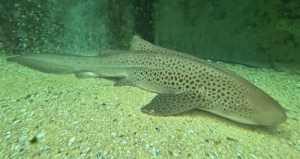
The Indo-Pacific leopard shark [photo by Felix Frost-Savage – Own work, CC BY-SA 4.0, https://commons.wikimedia.org/w/index.php?curid=150136016]:
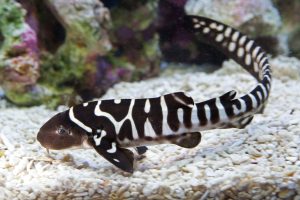
A young Indo-Pacific leopard shark, so you can see why it’s also called the zebra shark:
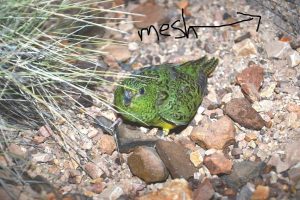
One of John Young’s controversial night parrot photos, showing wire mesh in the upper right-hand corner that might be part of a cage or enclosure:
Show transcript:
Welcome to Strange Animals Podcast. I’m your host, Kate Shaw.
This week is our Halloween episode, and a brand new one since I wasn’t going to skip Halloween! I thought about covering a really spooky topic, but decided to go with interesting instead. Thanks to Murray and Nathan Andrew for their suggestions this week.
First, though, a quick note that if you check the show notes, or go to the website at strangeanimalspodcast.blubrry.net, you’ll find a link to buy the Small Mysteries ebook! Unless I forgot to add it! It’s $3 and is available in epub, PDF, or whatever format file it is that Kindle uses. The ebook of Beyond Bigfoot & Nessie is there too for $5, which is cheaper than anywhere else.
We’ll start with Murray’s suggestion, the Indo-Pacific leopard shark! You might find this animal spooky if you’re afraid of sharks, but Murray isn’t, and in fact he was snorkeling off the coast of Australia where he lives when he saw a leopard shark not too long ago!
The Indo-Pacific leopard shark is also called the zebra shark, and it’s a different animal from the leopard shark that lives off the Pacific coast of North America. It’s bigger, for one thing. It can grow over 8 feet long, or 2.5 meters, and possibly larger. It’s covered with small dark brown spots on a lighter brown or yellowish background.
The reason it’s also called the zebra shark is because baby leopard sharks have stripes. The young shark is dark brown with a yellowish belly, and it has white or pale yellow stripes and spots. It looks so different from the adult leopard shark that scientists in the 18th century thought they were separate species.
The leopard shark lives in shallow water, often around coral reefs. It’s most active at night, and spends the day resting on the bottom of the ocean, doing nothing much. Murray pointed out that the leopard shark is the only shark that doesn’t have to keep swimming in order to push water through its gills, and I had to look this up to see if it was true. It turns out that a few sharks, including the leopard shark, have special organs called spiracles that pull water into the respiratory system without the shark needing to move. The spiracles are small openings just behind the eyes. It allows some bottom-dwelling sharks to rest on the sea floor. All other sharks really do have to keep swimming or they’ll suffocate. The leopard shark usually rests with its head pointing into a current, which helps bring oxygenated water to it so its spiracles are more effective.
The leopard shark mostly eats mollusks, along with small fish, crustaceans, and other small animals. It’s a slender, slow-moving shark that lives throughout the tropical Indo-Pacific. Its eyes are very small and so is its mouth, and it almost never bothers people. In other words, it’s not very spooky but it is very pretty.
Next, Nathan Andrew told me about an invertebrate that lived back in the Jurassic period, alongside dinosaurs. It’s an ancient katydid, an insect related to modern katydids, that lived about 165 million years ago.
We don’t know very much about what the world sounded like in those days. The sound-producing organs in most animals are made of soft tissue and don’t fossilize well. But katydids, crickets, and some related insects make their calls by stridulation, where the male has a serrated section of his wing or leg, depending on the species, and he rubs it over the opposite wing or leg to make a loud call. And the great thing is, the exoskeletons of these insects are made of chitin, which fossilizes well, as do their wings. The only problem is finding them, since they’re so small.
The research team worked with 20 well-preserved specimens of katydid ancestors called ensiferans, all of them found in the same part of China but including individuals from nine different species. Before they modeled the ensiferan wings, though, they used a microscanning laser, high-speed video, and motion detectors to measure the wings of living species of katydid and find out exactly how the wings moved. They used that information to build a digital model of the wings. Then they scanned the fossilized wings and applied them to their digital model, and examined how the ancient wings differed and didn’t differ from the modern wings.
The main reason they did all this was to get an idea of pitch and vibration in the ancient insects’ wings as they stridulated, and that gives us an idea of what they might have sounded like.
The different species of ensiferan communicated with different frequencies, including some that communicated in ultrasound, which is something that many modern katydids and their relatives still do.
But let’s listen to one of the recordings! First, though, here’s a modern katydid:
[katydid chirping]
Now, here’s a simulated call of an ancient katydid ancestor:
[ancient katydid chirping]
Finally, let’s talk about a spooky-sounding bird, the night parrot. It’s a small Australian parrot that’s yellowish-green with dark speckles and other markings. It’s closely related to the ground parrot, also found in Australia, which looks similar but is a brighter green.
Like the ground parrot, the night parrot can fly, but while the ground parrot prefers not to, the night parrot flies up to 25 miles a night, or 40 kilometers, to find food and water. It’s nocturnal and very shy, and spends almost all of its time in big clumps of spinifex and other grasses and shrubs, or in woodlands. Spinifex grows in dense banks, and the night parrot hides inside them during the day in tunnels it makes through the plants. It eats seeds and other plant material.
The night parrot used to be common throughout much of inland Australia, but is now critically endangered. For a long time scientists thought it was extinct, since there was not a single verified sighting of a night parrot between 1912 and 1979. Even now sightings are incredibly rare, leading to speculation that there may only be a few hundred or even just a few dozen of the birds left in the world.
In 1990 and 2006, two dead night parrots were found in different parts of western Queensland, so scientists knew the birds were still hanging on. Then in 2013, naturalist John Young discovered a small population of the birds.
You may remember that back in episode 474, which ran on March 2, 2026, we talked about the buff-breasted button quail. A naturalist named John Young featured in that episode, and I made sure to cite my sources very carefully, because accusing someone of scientific fraud is a serious matter. And yes, this is the same John Young.
In 2006, Young had learned of the dead night parrot discovered in western Queensland, and he camped out for weeks in the same area where it was found. He heard night parrot calls but couldn’t see them in the darkness. He searched for years until in 2013, he got photographs of a night parrot. But the presence of wire mesh in the photograph indicated Young might have trapped a night parrot to take its photo, which is illegal. The photos were also timestamped at 5pm, when a nocturnal bird wouldn’t have been active, and Young touched up the photos as well—he says to remove a spinifex twig from the bird’s feathers, but some people question whether he was erasing damage done to the feathers when he captured the bird.
The 2013 photos really do show a night parrot, but later photos that Young presented might not be real. He claimed to have found nests with eggs in them, but in the photos, some of the eggs look like they’re made of clay, while others are clearly eggs from a different parrot species. Even the nests are suspicious. Night parrots lay their eggs directly on the ground inside spinifex bushes, but Young’s photos show acacia leaves and other vegetation, not spinifex. There’s more, but you get the idea.
John Young was arrested in 2024 after evading the police for a year, by the way. His arrest didn’t have anything to do with birds so I won’t talk about it here, since this isn’t a true crime podcast. In 2025 he pleaded guilty and is still in prison as this episode goes live, which is where he belongs considering the crime in question.
In much better news, also in 2024 a team of Indigenous rangers and scientists discovered a population of 50 night parrots in Western Australia’s Great Sandy Desert. One of the reason night parrots have become so rare is that feral cats eat them, but in this particular area, there are plenty of dingoes. Dingoes don’t eat night parrots, but they do eat cats. So the presence of dingoes has inadvertently helped save the night parrot. The area where the night parrots were found is being kept secret, except that it’s in the Ngururrpa Indigenous Protected Area in northern Western Australia. It’s a very remote area where livestock and most vehicles are not allowed, which has also helped the night parrots survive.
This is what the night parrot sounds like, first a short call recorded in 2015, and then clips of a male calling during a thunderstorm, recorded in 2017.
[night parrot calls]
Maybe the night parrot isn’t actually a spooky bird despite its name, but it’s pretty awesome anyway! Have a fun, safe, and happy Halloween!
You can find Strange Animals Podcast at strangeanimalspodcast.blubrry.net. That’s blueberry without any E’s.
Thanks for listening!