Podcast: Play in new window | Download (Duration: 6:48 — 7.5MB)
This week let’s look at the work of a really astonishing number of spiders!
Further reading:
Some of the webs:
Show transcript:
Welcome to Strange Animals Podcast. I’m your host, Kate Shaw.
Baltimore, Maryland is a city in the northeastern United States, in North America, with a population of 2.8 million people. In 1993 a new wastewater treatment plant was built called the Back River Wastewater Treatment Plant, which filters water through big sand beds to trap any particles remaining in it after it’s been filtered and treated in other facilities. The plant consists of 48 big sand beds with a corridor down the middle, and in order to keep the sand beds as clean as possible, the whole area has a big metal roof over it held up with steel columns. It doesn’t have walls, though, just a roof. The whole thing covers four acres, or 1.6 hectares, which I think is a metric term. It’s just over 16,000 square meters. It’s big, in other words, and the roof is pretty tall, up to 24 feet high over the walkway, or 7.5 meters.
Obviously, I’m telling you about this place in detail because of an animal that got into the water treatment plant and caused a lot of alarm. It wasn’t a big animal like a bear, though. It wasn’t even a dangerous animal. It was, in fact, a really small animal that’s mostly harmless to humans, various species of orbweaver spider. The problem wasn’t the spider itself but just how many spiders were in the water treatment plant.
The plant had always had problems with lots of orbweavers, but in 2009 there were so many spiders that the workers were worried for their safety. In late October 2009, the managers called for help about “an extreme spider situation.” The problem was way beyond anything that an ordinary pest control business could deal with, so the city put together a team of arachnologists, entomologists, and experts in urban pest control to figure out the best course of action.
The team didn’t just charge in, say, “Wow, that’s a lot of spiders, let’s hose the whole place down.” They were scientists and studied the situation methodically. They consulted the architectural plans of the plant to determine just how much volume was available under the roof, they took samples of the webs and stored them for study, they took over 300 photos, and basically they got as much data as they could.
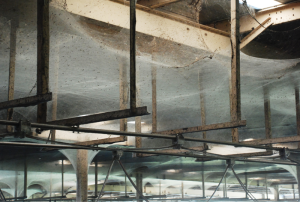
There were so many spiders that their webs blended together into thick mats that filled almost every space the spiders could reach. These cobweb mats were attached to the rafters, the walkways, everywhere, with the older mats starting to detach and fray. Light fixtures hung down from the tallest point of the roof that were 8 feet long, or 2.44 meters, and there were so many webs attached to them that they were pulled out of alignment. And all the webs were filled with spiders.
The spiders in the web samples were removed and preserved, then examined to see what species they belonged to. The team identified specimens from nine genera in six families, but most of the spiders caught were the species Tetragnatha guatemalensis. This is a type of long-jawed orbweaver native to North and Central America. Females are much larger than males, with a legspan up to 2 inches across, or about 5 cm. Long-jawed orbweavers have long, thin bodies, and one of the ways it hides is by stretching out on a blade of grass or a twig with its legs out straight. It especially likes marshy areas, such as in the rafters above 48 giant sand beds full of water.
A conservative estimate of the number of spiders in the Back River Wastewater Treatment Plant in the first week of November, 2009 was 107 million. 107 million spiders! Since a big percentage of the spiders were newly hatched, there were probably a lot more in the facility than the scientists estimated from the samples they took, so there might easily have been several hundred million spiders total. The sheets of webbing in the ceiling covered an estimated 2 acres total, or about 8,000 square meters, while the cloud-like masses of webbing in other areas was about half that size and would have filled 23 railroad boxcars.
The really interesting thing is that orbweaver spiders are usually solitary. Spiders may build webs near each other, but not usually like this. But these orbweavers lived in a place protected from wind and weather, and close to water, which attracted lots of midges and other small insects, and the presence of humans probably kept a lot of potential spider predators away, like birds. Life was good for these spiders and the scientists observed that they weren’t acting aggressively to each other, even when they were of different species.
After studying the water treatment plant and its spiders, the team came to several conclusions. Since the spiders are harmless to humans, and are doing a really good job controlling the midge population, the scientists decided that pest control was not necessary and would even be a bad idea since the pesticides would inevitably get into the water. Instead, they recommended that web removal be implemented as a normal course of action when the webs started building up too much. They even suggested that the workers should be proud of their record-breaking webs, and that the plant was an ideal site for scientists to study the spiders in detail.
Thanks for your support, and thanks for listening!