Podcast: Play in new window | Download (Duration: 6:58 — 7.8MB)
Further reading:
A possible home for a bizarre Carboniferous animal: is Typhloesus a pelagic gastropod?
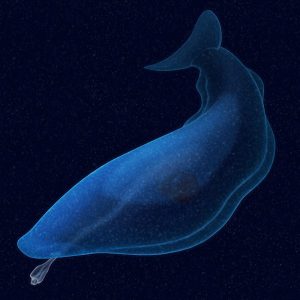
An artist’s rendition of what Typhloesus might have looked like [pic taken from the Nix Illustration link above]:
Show transcript:
Welcome to Strange Animals Podcast. I’m your host, Kate Shaw.
I recently discovered the excellent Nix Illustration blog, which is about scientific illustration and palaeontology. I’m finding so many fun topics that I keep going back to it, so I hope you don’t mind another invertebrate mystery I learned about from the site. There are links in the show notes if you want to read the original blog posts.
This month’s mystery is Typhloesus wellsi, sometimes referred to as the “alien goldfish” because of its shape and its peculiar anatomy. It definitely wasn’t a fish. It lived around 324 million years ago and was first discovered in the early 1970s in Montana, in the middle of North America. It grew up to four inches long, or 10 cm, and was shaped not like a real goldfish but kind of like a goldfish cracker. Its body was roughly cylinder-shaped, and it had a vertical tail fin and a pair of fin-like lobes on its sides that are referred to as keels. But it didn’t have eyes or, as far as scientists can determine, an anus. It did have a mouth and gut cavity–but it also had something truly unexpected and mysterious in its body, a pair of disc-shaped organs that contained a lot of iron but whose function is completely unknown and unlike anything scientists have ever seen.
Those initial specimens also contained lots of conodont teeth, which led scientists to hope they’d finally discovered the conodont animal. We’ve talked about conodont teeth before, but it’s been quite a while ago. Conodont animals were incredibly common for around 300 million years, and their teeth are found throughout the world. Technically they’re not teeth but tooth-like structures called conodont elements, some of them microscopic, some of them almost an inch long, or 2 cm. Each animal had three types of conodont elements, and they interacted in a way that we don’t fully understand since they were completely different from modern animal mouthparts.
Until the 1980s, no one knew what the conodont animal looked like. The only fossils we had were the tiny teeth. Then some body impressions of the conodont animal were discovered. Now we know it was shaped like an eel and grew up to 20 inches long, or 50 cm. We also know it had large eyes, a notochord (or primitive spine), and fins on the tail end. It was probably related to hagfish and lampreys and may have looked similar, although not everyone agrees with this classification.
Whatever the conodont animal was related to, Typhloesus definitely wasn’t one. It turns out that the conodont teeth associated with Typhloesus fossils were actually in its gut, after the alien goldfish ate a conodont animal.
So scientists were back to square one. What was Typhloesus?
In 2022, a study of several specimens revealed a clue. Typhloesus had a radula. That’s a mouthpart that resembles a tooth-studded tongue. Snails, for instance, use tiny radulas to scrape algae and other food off of rocks. True radulas are a trait of mollusks, which means Typhloesus was most likely an early mollusk, maybe even a gastropod like snails and slugs.
That’s a start to classifying Typhloesus, but it doesn’t explain the pair of weird disc-shaped organs. It’s called a ferrodiscus and we still don’t know what it was for. Because of its placement just under the midgut and its high concentration of iron, which would have made it quite hard in comparison to most of the rest of its body, the ferrodiscus might have had something to do with digestion. Then again, it might have had something to do with chemoreception, which is probably how Typhloesus found its food. Some modern mollusks have a chemoreceptor organ under the radula, but it’s mainly a bundle of nerve cells and not any kind of weird iron discs. We just don’t know what the ferrodiscus was.
Typhloesus probably swam around until it encountered a small animal like a conodont, and then it would stick its radula out like a spiky tongue and use it to grab the animal. Typhloesus had no anus, so after it digested its meal it just spat out the indigestible parts. It might also have been a scavenger that used its radula to pull pieces off of a dead animal to eat.
Not every scientist agrees that Typhloesus was a mollusk. Only mollusks have true radulas, although not all mollusks have them, but other animals have evolved similar structures. Typhloesus is so different from known mollusks, living and extinct, that scientists can’t definitively determine what it was related to. It had no gills and no notochord, so we know it had to be an invertebrate. Some cnidarians, which include jellyfish and sea anemones, have no anus, but Typhloesus has even less in common with that phylum of animals than it has with mollusks. Some flatworms have no anus, but again, Typhloesus doesn’t seem to have a lot of other traits in common with flatworms.
Until we learn more about it from studying well-preserved fossils, we can only speculate about where Typhloesus fits in the tree of life and what the ferrodiscus actually was. Mysteries like this are part of the challenge of science, and part of the fun too.
Thanks for your support, and thanks for listening!