Episode 503: The Mystery of Typhloesus

Further reading:

A possible home for a bizarre Carboniferous animal: is Typhloesus a pelagic gastropod?

Typhloesus

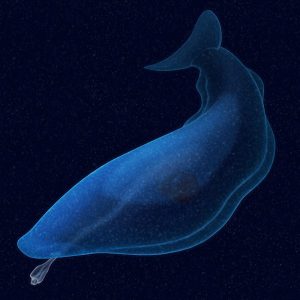
An artist’s rendition of what Typhloesus might have looked like [pic taken from the Nix Illustration link above]:
Show transcript:

Welcome to Strange Animals Podcast. I’m your host, Kate Shaw.

I recently discovered the excellent Nix Illustration blog, which is about scientific illustration and palaeontology. I’m finding so many fun topics that I keep going back to it, so I hope you don’t mind another invertebrate mystery I learned about from the site. There are links in the show notes if you want to read the original blog posts.

This month’s mystery is Typhloesus wellsi, sometimes referred to as the “alien goldfish” because of its shape and its peculiar anatomy. It definitely wasn’t a fish. It lived around 324 million years ago and was first discovered in the early 1970s in Montana, in the middle of North America. It grew up to four inches long, or 10 cm, and was shaped not like a real goldfish but kind of like a goldfish cracker. Its body was roughly cylinder-shaped, and it had a vertical tail fin and a pair of fin-like lobes on its sides that are referred to as keels. But it didn’t have eyes or, as far as scientists can determine, an anus. It did have a mouth and gut cavity–but it also had something truly unexpected and mysterious in its body, a pair of disc-shaped organs that contained a lot of iron but whose function is completely unknown and unlike anything scientists have ever seen.

Those initial specimens also contained lots of conodont teeth, which led scientists to hope they’d finally discovered the conodont animal. We’ve talked about conodont teeth before, but it’s been quite a while ago. Conodont animals were incredibly common for around 300 million years, and their teeth are found throughout the world. Technically they’re not teeth but tooth-like structures called conodont elements, some of them microscopic, some of them almost an inch long, or 2 cm. Each animal had three types of conodont elements, and they interacted in a way that we don’t fully understand since they were completely different from modern animal mouthparts.

Until the 1980s, no one knew what the conodont animal looked like. The only fossils we had were the tiny teeth. Then some body impressions of the conodont animal were discovered. Now we know it was shaped like an eel and grew up to 20 inches long, or 50 cm. We also know it had large eyes, a notochord (or primitive spine), and fins on the tail end. It was probably related to hagfish and lampreys and may have looked similar, although not everyone agrees with this classification.

Whatever the conodont animal was related to, Typhloesus definitely wasn’t one. It turns out that the conodont teeth associated with Typhloesus fossils were actually in its gut, after the alien goldfish ate a conodont animal.

So scientists were back to square one. What was Typhloesus?

In 2022, a study of several specimens revealed a clue. Typhloesus had a radula. That’s a mouthpart that resembles a tooth-studded tongue. Snails, for instance, use tiny radulas to scrape algae and other food off of rocks. True radulas are a trait of mollusks, which means Typhloesus was most likely an early mollusk, maybe even a gastropod like snails and slugs.

That’s a start to classifying Typhloesus, but it doesn’t explain the pair of weird disc-shaped organs. It’s called a ferrodiscus and we still don’t know what it was for. Because of its placement just under the midgut and its high concentration of iron, which would have made it quite hard in comparison to most of the rest of its body, the ferrodiscus might have had something to do with digestion. Then again, it might have had something to do with chemoreception, which is probably how Typhloesus found its food. Some modern mollusks have a chemoreceptor organ under the radula, but it’s mainly a bundle of nerve cells and not any kind of weird iron discs. We just don’t know what the ferrodiscus was.

Typhloesus probably swam around until it encountered a small animal like a conodont, and then it would stick its radula out like a spiky tongue and use it to grab the animal. Typhloesus had no anus, so after it digested its meal it just spat out the indigestible parts. It might also have been a scavenger that used its radula to pull pieces off of a dead animal to eat.

Not every scientist agrees that Typhloesus was a mollusk. Only mollusks have true radulas, although not all mollusks have them, but other animals have evolved similar structures. Typhloesus is so different from known mollusks, living and extinct, that scientists can’t definitively determine what it was related to. It had no gills and no notochord, so we know it had to be an invertebrate. Some cnidarians, which include jellyfish and sea anemones, have no anus, but Typhloesus has even less in common with that phylum of animals than it has with mollusks. Some flatworms have no anus, but again, Typhloesus doesn’t seem to have a lot of other traits in common with flatworms.

Until we learn more about it from studying well-preserved fossils, we can only speculate about where Typhloesus fits in the tree of life and what the ferrodiscus actually was. Mysteries like this are part of the challenge of science, and part of the fun too.

Thanks for your support, and thanks for listening!
Episode 339: The Tully Monster!

Is it an invertebrate? Is it a vertebrate? It’s the Tully monster!

Further reading:

3D Tully monster probably not related to vertebrates

Has the “Tully monster” mystery finally been solved after 65 years?

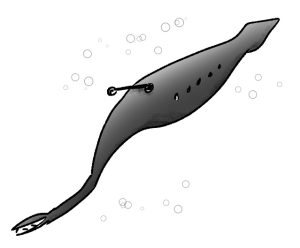
Possibly what the Tully monster looked like while alive:

Show transcript:

Welcome to Strange Animals Podcast. I’m your host, Kate Shaw.

This week we’re going to learn about an ancient creature surrounded by mystery. When I was working on last week’s updates episode, I found some new information about it and intended to include it as an update. Then I realized I was referencing a Patreon episode, which I also reworked into a chapter of the Beyond Bigfoot & Nessie book. So instead, I included the new information in this episode all about the Tully monster.

In 1955, an amateur fossil collector named Francis Tully discovered a really weird fossil. This was in one particular area of Illinois in the United States, roughly in the middle of North America. The fossil was about six inches long, or 15 cm, and Tully thought it resembled a tiny torpedo.

He took the fossil to the Field Museum of Natural History in Chicago in hopes that somebody could tell him what his fossil was. The paleontologists he showed it to had no idea what it was or even what it might be related to. It was described in 1966 and given the name Tullimonstrum, which means Mr. Tully’s monster, which is pretty much what everyone was calling it already.

300 million years ago, in what is now the state of Illinois, a strange animal lived in the shallow sea that covered part of the area. The land that bordered this sea was swampy, with many rivers emptying into the ocean. These river waters carried dead plant materials and mud, which settled to the bottom of the ocean. When an animal died, assuming it wasn’t eaten by something else, its body sank into this soft muddy mess. The bacteria in the mud produced carbon dioxide that combined with iron that was also present in the mud, which formed a mineral called siderite that encased the dead animal. This slowed decay long enough that an impression of the body formed in the mud, and as the centuries passed and the mud became stone, the fossilized body impression was surrounded by a protective ironstone nodule. That’s why we know about the soft-bodied animals from this area, even though soft-bodied animals rarely leave fossil evidence.

So what did this weird animal look like?

The Tully monster was shaped sort of like a slug or a leech, and it had a segmented body. Its eyes were on stalks that jutted out sideways, although the stalks were more of a horizontal bar that grew across the top of the head. The tail end had two vertical fins, which argues that the Tully monster was probably a good swimmer. But at the front of its body it had a long, thin, jointed proboscis that ended in claws or pincers lined with eight tiny tooth-like structures.

It’s easy to assume that the pincers acted as jaws and therefore the proboscis was a mouth on a jointed stalk, but we really don’t know. The Tully monster may have used its proboscis to probe for food in the mud at the bottom of the sea, but because the proboscis had a joint, it probably couldn’t act as a sort of straw. The pincers may have grabbed tiny prey and conveyed it to a mouth that hasn’t been preserved on the specimens we have.

The Tully monster resembles nothing else known, and is so bizarre that researchers aren’t sure where to place it taxonomically. And it wasn’t rare. Paleontologists have since found lots of Tully monster fossils in the Illinois fossil beds, known as the Mazon Creek formation. The Mazon Creek formation is also the source of highly detailed fossils of hundreds of other plant and animal species, including some that have never been found anywhere else.

Scientists have suggested any number of animal groups that the Tully monster might belong to. It might be a type of arthropod, a mollusk, a segmented worm…or it might be a vertebrate. The tiny tooth-like structures in the pincers have been analyzed and some researchers think they were more similar to keratin than chitin. Keratin is a vertebrate protein while chitin is an invertebrate protein.

In 2016 a study argued that pigments in the eyes are arranged the same way as they are in vertebrates, which meant the Tully monster might have been a vertebrate. The problem is that some invertebrates also have these same pigment arrangements, notably cephalopods like octopuses. A 2019 study also looked at the chemical makeup of the fossil eyes, this time with even more advanced equipment—specifically, a synchrotron radiation lightsource, which is a type of particle accelerator. It sounds so science-y. This study suggested that the Tully monster’s eyes had a different chemical makeup than the vertebrates found in the same fossil beds, which means the Tully monster probably wasn’t a vertebrate after all. But it also didn’t match up with known invertebrates from the same fossil beds.

Of course, it might be a deuterostome. The animals in this superphylum develop a nerve cord at some stage of life, usually as an embryo, but may not retain it into adulthood. This includes echinoderms such as sea stars and sea urchins, tunicates like sea squirts, and possibly acorn worms although some scientists disagree. All vertebrates are also members of the superphylum too.

One suggestion is that the Tully monster is related to a type of animal called a conodont. Technically the term conodont refers to its teeth, with the animal itself known as conodontophora, but conodont is easier to say. We know very little about the conodont, since almost the only fossils we have of it are the tiny teeth. We also have eleven body impressions, so we know it was long and skinny like an eel and grew up to 20 inches long, or 50 cm. We also know it had large eyes, a notochord (or primitive spine), and fins on the tail end.

Conodont teeth first appear in the fossil record during the Cambrian, some 525 million years ago. They disappear entirely from the fossil record about 200 million years ago during the Triassic-Jurassic extinction event. But during those 300-some million years they were around, they left a whole lot of tiny fossil teeth, so many that they’re considered an index fossil, which helps scientists determine how old a particular strata of rock is.

When I say tiny teeth, I mean tiny—they’re microfossils usually measured in micrometers, although some of the larger ones were as much as 6 mm long. But they weren’t teeth like modern animal teeth, and the mouth wasn’t like anything we know today.

The conodont’s mouth is called a feeding apparatus by scientists, and it’s very different from what most of us think of as a mouth. This was long before jawed animals evolved some 400 million years ago, and the conodont’s teeth are technically known as conodont elements since they’re not really teeth. There were three types of the conodont elements, meaning they had different shapes and probably different functions.

Some species of conodont may have used the elements to crush prey, but they probably weren’t very strong swimmers so may have mostly eaten very small animals. Some researchers even suggest the conodont used the elements to filter plankton from the water, while others think the conodont might have been parasitic on larger animals, like the sea lamprey is. Conodonts were probably related to hagfish and lampreys and may have looked similar, although not everyone agrees with this classification. Some researchers even think conodonts might have been invertebrates.

Another possibility is that the Tully monster was related to Anomalocarids, which you may remember from the Cambrian explosion episode. Anomalocaris and its relations were arthropods that resemble nothing else alive. It had eyes on stalks, clawed appendages that grew from its front near the mouth, and the rear of its body was segmented with tail fins. Another Cambrian arthropod, Opabinia, had a single flexible feeding proboscis with claws at the end, five eyes on stalks, and a segmented body, so the Tully monster may have been related to it. But we don’t have anything definitive yet one way or another as to what it was related to.

The most recent study on whether the Tully monster was an invertebrate or a vertebrate was published in early 2023 in the journal Nature. The study used high-resolution 3D scanning to examine 153 Tully monster specimens. The scientists determined that the tooth-like structures at the end of the proboscis don’t appear to be keratin, and the Tully monster has segmentation in its head, which is not something found in vertebrates. These and other findings mean that as of now, it looks like the Tully monster was an invertebrate.

However, we still have no idea what kind of invertebrate it might have been. The 2023 study suggests it was either a non-vertebrate chordate or a protostome. Non-vertebrate chordates include hagfish and tunicates, while protostomes include a whole lot of invertebrates, including insects, worms, and mollusks.

The reason all this is important is because there’s a whole lot we don’t know yet about how jawed animals evolved from jawless fish. If the Tully monster really was a vertebrate, it would give us new information about jawless animals. But part of the reason it’s hard to determine where the Tully monster should be placed taxonomically is because of how incredibly weird it is, and that’s exciting too.

You can find Strange Animals Podcast at strangeanimalspodcast.blubrry.net. That’s blueberry without any E’s. If you have questions, comments, or suggestions for future episodes, email us at strangeanimalspodcast@gmail.com. If you like the podcast and want to help us out, leave us a rating and review on Apple Podcasts or Podchaser, or just tell a friend. We also have a Patreon at patreon.com/strangeanimalspodcast if you’d like to support us for as little as one dollar a month and get monthly bonus episodes.

Thanks for listening!