Podcast: Play in new window | Download (Duration: 9:12 — 10.4MB)
Further reading:
Pterosaur melanosomes support signalling functions for early feathers
Show transcript:
Welcome to Strange Animals Podcast. I’m your host, Kate Shaw.
This month we have a small mystery from Australia, which as far as I can find is still unsolved.
In 1950, a man named George Gray started hearing bellowing from the gum swamp near his house. His adult son, Ted, heard it too and reported it was loud enough to hear half a mile away, or about 800 meters.
The bellowing sounded like a crocodile. The problem is, the Grays lived just outside of the small town of Wee Waa in New South Wales, Australia. Very, very rarely a saltwater crocodile wanders down the coast as far as New South Wales, but Wee Waa is a five or six hour drive inland. It’s not crocodile country. It gets cold in winter and it’s surrounded by farmland.
Ted Gray found tracks in the swamp where a large animal had flattened tall grass, although the footprints didn’t have claw marks. He estimated that if the animal was a crocodile, it was only about 6 feet long, or 1.8 meters, although he did note that none of the trails seemed to lead to the water. The bellowing mostly occurred in early morning and around sundown and continued for several months.
Attempts to search the wetlands were unsuccessful, mostly because of heavy rain that spring and summer. The water was ordinarily no more than 3 feet deep, or about a meter [actually about 92 cm, got this wrong], but was much deeper that year. Hundreds of people came to listen to the bellowing, though, and one constable perched in a tree for most of a day hoping to shoot the animal. He never saw it.
Seven years earlier, during World War II, an armored division of troops stayed in the area. The troops had been based in northwest Australia for a time and were supposed to have brought some baby crocodiles with them as mascots. The soldiers were told to kill the crocodiles, but newspapers in 1950 suggested they’d been released instead and that one had found its way to George Gray’s swamp. That doesn’t explain how it survived seven winters or why no one had seen or heard it until then.
Then again, one man named Ross Tuckey claimed he’d seen a crocodile several years before about 20 miles away, or 32 kilometers. He’d first thought it was a goanna, which is a type of monitor lizard that lives in Australia. Some species of goanna can grow more than 8 feet long, or about 2.5 meters. When Tuckey’s dog rushed at the animal, it bowled the dog away with its tail and slid into a dammed stream. Tuckey watched it float in the water with only its nostrils visible.
The Wee Waa monster was never identified.
That’s all there is! I tried to find out more but if anyone ever found what animal was bellowing in George Gray’s swamp, the newspapers didn’t report about it. I actually only learned about this animal mystery when I was searching for something else, which is always a lot of fun.
***
115 million years ago a colony of strange flying animals lived in what is now northeastern Brazil in South America. It was a reptile that lived at the same time as dinosaurs, but it wasn’t a dinosaur. It wasn’t a bird either. Its wingspan might have been as much as 13 feet across, or 4 meters, which was big for a pterosaur, which of course is what it was. Specifically, it’s Tupandactylus imperator [too-pan-DAK-tillus imper-AH-ter], and it is a complete weirdo.
Tupandactylus was only described in 1997, but we have several really well preserved specimens, including nearly complete skulls. And it’s the skull that makes it so bizarre. Many pterosaurs had large crests that were probably brightly colored and probably used to attract mates, but Tupandactylus had what may be the largest crest ever found. It was just ridiculously large, nearly as big as its whole body, not counting its wings, of course.
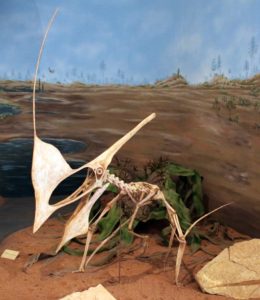
Tupandactylus’s skull is hard to describe. I’m going to do my best, but you might want to click through to the show notes and look at the picture.
First, imagine a pelican’s bill. It’s long and has a pouch underneath. But in your mental picture, push that pouch forward so that it’s at the base of the lower jaw like a chin, and made of bone instead of soft tissue. Tupandactylus had a sort of keel on the underside of the end of its lower jaw that was probably for display.
Next, the upper jaw is tall but narrow. Maybe it will help to picture a toucan’s bill, but unlike a toucan, Tupandactylus’s upper jaw had a projection at the top that formed the base of the crest. This projection is a big triangular piece of bone that tops the upper jaw, and at the upper point of the triangle there’s a long, thin spur of bone that points upward and bends back. It’s ridiculously long.
Finally, the rear of the skull has another projection that points straight back to form the back of the crest. The tall rod of bone on top of the upper jaw forms the front of the crest. The crest itself was mostly made of soft tissue and keratin stretched between the two bony rods.
To finish our description of the skull, Tupandactylus had no teeth and probably also had a keratin beak at the very tips of its jaws, especially its lower jaw. We don’t know what it ate, but some paleontologists hypothesize it might have mostly eaten fruit and other plant material. It probably spent a lot of time on the ground looking for food and hanging out in its flock, sort of like geese do today.
We have a pretty good idea of what the crest looked like because a few specimens have soft tissue impressions left by the crest when the animal died and fell into mud. The complete crest was like a big sail, although there’s no evidence that it helped the animal fly.
What we don’t know is what color the crest was, but researchers have long assumed it was brightly colored and probably patterned to attract a mate.
In an article published in Nature in April of 2022, a team of paleontologists from Brazil and Belgium announced that they’ve found some amazing details in a newly discovered Tupandactylus skull. Tupandactylus had feathers.
They discovered the feathers at the bottom of the crest, some of them fluffy and some of them longer and more like modern bird feathers. And that’s not all. The feathers are so well preserved that under electron microscopes, the team found preserved melanosomes, which are pigment granules. We still don’t know what colors the feathers were, but they were definitely different colors because the melanosomes are different shapes, and in bird feathers different melanosome shapes correspond to different colors. Simple feather fibers have also been found on the jaws, which suggests that Tupandactylus might have had feathers over much of its body. That means other pterosaurs probably did too.
There are actually two species of Tupandactylus known, T. imperator and T. navigans. T. navigans is smaller and has a smaller, less extravagant crest. Some researchers suggest the two species might actually be the same species, with sexually dimorphic males and females (meaning they look different). Maybe one day we’ll find out for sure.
Thanks for your support, and thanks for listening!