Podcast: Play in new window | Download (Duration: 9:54 — 10.9MB)
It’s our 500th episode! Wow!
Thanks to Rosie, Remy and Julien, and Dylan, Emily, and Michelle for their suggestions this week!
Further reading:
Crikey! Newly Discovered Snake Species Named After Steve Irwin
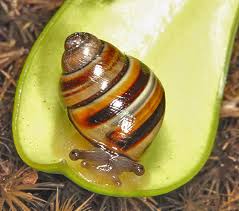
A young Steve Irwin’s tree snail [photo taken from link above]:
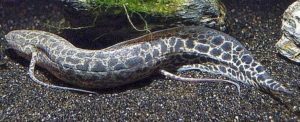
A marbled lungfish:
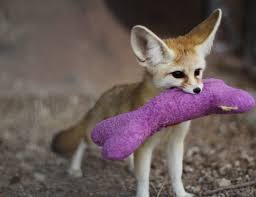
A fennec, smallest and cutest of all foxes:
Show transcript:
Welcome to Strange Animals Podcast. I’m your host, Kate Shaw.
This week we have a brand new episode, because it’s episode 500! Congratulations to me and to you too, listening to the 500th episode of a podcast! That doesn’t happen very often!
Despite the big 5-0-0, I’m going to treat this like a regular episode. Thanks to Dylan, Emily, and Michelle, Remy and Julien, and Rosie for their suggestions this week!
We’ll start with Dylan, Emily, and Michelle, who live in Australia. A while back now they got to visit the Australia Zoo, which is run by the Irwin family. Steve Irwin was a conservationist, science educator, and wildlife rehabilitator, also known as the Crocodile Hunter for his work relocating crocodiles who were endangering people, and vice versa. He died tragically young in 2006 but his wife and children continue his work.
Michelle pointed out that Irwin has been honored by scientists who have named newly discovered animals for him, so let’s learn about a few of them!
The most recent one is a type of wolf snake discovered on the Great Nicobar Island off the coast of India and described in 2025, Lycodon irwini. It’s mostly black in color with a slender body, and can grow as much as 47 inches long, or 119 cm. That’s almost four feet long! Luckily it’s non-venomous, plus it has only been found on that one island in evergreen forests, so you’re not likely to run across one by accident. It probably eats small animals like frogs, but we don’t know a whole lot about it yet.
Back in 1990, Steve Irwin caught a strange turtle while fishing with his father, Bob, who was also a conservationist. Between them, the two men knew a whole lot about Australian wildlife but they didn’t know what the turtle was. They sent pictures to a turtle expert, who determined that yes, it was a species new to science. It was described in 1997 and named Irwin’s turtle, Elseya irwini.
Irwin’s turtle has a black and yellow carapace and lives in the lower part of the Burdekin River in northern Queensland. The female also has a light-colored head and other pale spots on the body.
Like some other turtles, it can absorb oxygen from the water through its cloaca, which is often referred to as its butt. A chamber at the end of the cloaca contains structures that act like gills and absorb oxygen. This allows it to stay underwater longer, and in fact it can’t survive in water that doesn’t contain enough oxygen.
As a result, Irwin’s turtle is endangered due to habitat loss, especially from pollution and the damming of its river home. It used to be common but its numbers are in decline. The Australia Zoo started a captive breeding program to help conserve the species, and in 2023 they succeeded in hatching the very first Irwin’s turtle babies ever bred in captivity.
The last one is my favorite, a land snail named after Steve Irwin. It was described as a new species in 2009, only a few years after Irwin died, and was named Crikey steveirwini. It’s the only species in the genus Crikey. It only lives in high altitudes in the tropical rainforests of northeastern Queensland. It’s rare and not much is known about it, because it’s so hard to find and so small. It has a cone-shaped shell that’s striped with spiral bands of brown, yellow-brown, and white, and it only grows 15 mm long at most.
Next, brothers Remy and Julien wanted to learn about the African lungfish. Lungfish are fascinating fish, because as you can probably guess from the name, they have gills but they also have lungs, and the fish needs both to get enough oxygen.
Four species of lungfish live in Africa, all belonging to the family Protopteridae. They’re eel-like in shape although they’re not closely related to eels at all, with soft scales, and a dorsal fin that continues down the fish’s back and continues around the end of the tail, since the dorsal fin and tail fin are actually fused into one big fin. Its only other fins are the pectoral and pelvic, which are very thin and are more like flexible legs than actual fins. The lungfish can actually crawl along the bottom of the swamp or lake with its fins, although it can also swim like an eel.
While the African lungfish does have gills, they’re small and are mostly associated with eliminating carbon dioxide instead of absorbing oxygen. The lungs do most of the work. The fish surfaces periodically to gulp fresh air into its lungs. It’s one of the few fish that can drown if it can’t surface for air.
African lungfish eat insect larvae, especially of aquatic insects, crustaceans, mollusks, small fish, and frogs, but it can also sometimes eat seeds and other plant material. It usually lives in shallow water like swamps and small rivers, where there’s not a lot of oxygen in the water. In many cases, its waterways dry up periodically, but the fish can still survive. As its water gets lower and lower, the lungfish digs into the mud and curls up, then secretes a thick mucus that helps retain moisture and stops its body from drying out. Its metabolism slows way down so it doesn’t need to breathe very often, and it doesn’t need to eat. It can survive this way for up to four years, although it usually only has to stay in its cocoon for a few months, until the rains return and its waterways fill up again.
The smallest species of African lungfish is the East African lungfish, which only grows about 17 inches long, or 44 cm, while the largest is the marbled lungfish that can grow a whopping six and a half feet long, or two meters.
Lastly, Rosie suggested we learn about the fennec fox, which lives in northern Africa. It’s the smallest fox in the world, barely eight inches tall at the shoulder, or 20 cm, but it has incredibly large ears. Its ears can be as much as six inches long, or 15 cm.
Part of the reason its ears are so big is so it can hear insects and other small animals moving around underground, but they’re also big because they help dissipate heat from the fox’s body into the air. Since the fennec lives in deserts, that’s only one of many adaptations it has to the heat and lack of water.
For instance, the fennec gets most of its water through the food it eats. It’s also a nocturnal animal. The pads of its paws are protected by long, coarse hairs that grow between the pads, so hot sand won’t burn its toe beans. The hair also gives the fox better traction in loose sand.
The fennec’s fur is a pale sandy color with a black tip to the tail, and it has dark eyes. It eats rodents, birds and their eggs, insects, scorpions, and other small animals, as well as fruit and other plant material. It can jump really far, some four feet in one bound, or 120 cm. Not only can it run really fast, it can change directions really quickly too. This helps it escape predators and catch prey.
Fennecs can be social animals and like to play, even as adults. Pairs mate for life and both parents take care of the babies. A fennec’s burrow can be very large and may even link up to neighboring fennec family burrow, so neighbors can visit each other without going out into the heat of the day.
You can find Strange Animals Podcast at strangeanimalspodcast.blubrry.net. That’s blueberry without any E’s.
Thanks for listening!
Thanks to those of you who backed my recent crowdfunding campaign! Right now the Small Mysteries book isn’t available yet, but in the Halloween episode in October, I’ll make sure to put a link where you can buy the ebook.