Episode 460: Blue Blobs and Graveyard Snakes

Further reading:

Mysterious ‘blue goo’ at the bottom of the sea stumps scientists

Three new species of ground snakes discovered under graveyards and churches in Ecuador
Show transcript:

Welcome to Strange Animals Podcast. I’m your host, Kate Shaw.

I’ve come down a cold this week, and while I’m feeling better, it is settling into my chest as usual and I’m starting to cough. Since I’m still recovering and need to be in bed instead of sitting up researching animals, and since my voice is already sounding a little rough, here’s a Patreon episode this week instead of a regular episode. I had been planning to run old Patreon episodes for a few weeks in December so I could have some time off for the holidays, and those were already scheduled, so I just moved one of those episodes up to use this week instead.

This is a Patreon episode from October of 2022, where we talked about two very slightly spooky animal discoveries.

We’ll start with a suggestion from my brother Richard, about a strange newly discovered creature at the bottom of the ocean.

On August 30, 2022, the NOAA Ocean Exploration research team was off the coast of Puerto Rico. That’s in the Caribbean, part of the Atlantic Ocean. The expedition was mostly collecting data about the sea floor, including acoustic information and signs of climate change and habitat destruction. Since the Caribbean is an area of the ocean with high biodiversity but also high rates of fishing and trawling, the more we can learn about the animals and plants that live on the sea floor, the more we can do to help protect them.

When a remotely operated vehicle dives, it sends video to a team of scientists who can watch in real time and control where the rover goes. On this particular day, the rover descended to a little over 1,300 feet deep, or around 407 meters, when the sea floor came in view. Since this area is the site of an underwater ridge, the sea floor varies by a lot, and the rover swam along filming things and taking samples of the water and so forth, sometimes as deep as about 2,000 feet, or 611 meters.

The rover saw lots of interesting animals, including fish and corals of various types, even a fossilized coral reef. Then it filmed something the scientists had never seen before.

It was a little blue blob sitting on the sea floor. It wasn’t moving and it wasn’t very big. It was shaped roughly like a ball but with little points or pimples all over it and a wider base like a skirt where it met the ground. And it was definitely pale blue in color.

Then the rover saw more of the little blue blobs, quite a few of them in various places. The scientists think it may be a species of soft coral or possibly a type of sponge, possibly even a tunicate, which is also called a sea squirt. All these animals are invertebrates that don’t move, which matches what little we know about the blue blob.

The rover wasn’t able to take a sample from one of the blue blobs, so for now we don’t have anything to study except the video. But we know where the little blue blobs are, so researchers hope to visit them again soon and learn more about them.

Next, let’s return to dry land and learn about some newly discovered snakes. In fact, we’re not just on dry land, we’re way up high in the Andes Mountains in South America, specifically in some remote villages in Ecuador.

A teacher named Diego Piñán moved to the town of El Chaco in 2013, and he started noticing dead snakes on the road that he didn’t recognize. He also realized that people were killing the snakes on purpose. A lot of people are afraid of snakes, so Piñán made sure to teach his students about them so they would learn that most snakes aren’t dangerous. He also kept the dead snakes he found and preserved them in alcohol so he could figure out later what species they were. But he never could figure it out.

Then a scientist named Alejandro Arteaga assembled a team to study the animals found in remote areas of the Andes Mountains. When they came to Piñán’s town, they were excited to see the snakes he’d preserved, because even the snake experts on the team didn’t recognize the snakes either, although they were pretty certain they belonged to a genus of snakes called Atractus.

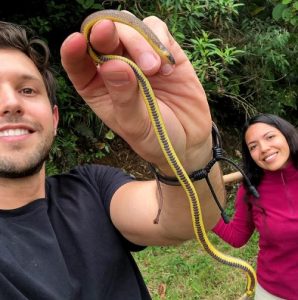
The snakes were quite pretty, gray-brown above with a bright yellow pattern underneath. They were small and slender, completely harmless to humans and pets, and they lived underground most of the time. The team searched and discovered more of the snakes living in the area. Most Atractus snakes are shy and stay away from people, but because the town of El Chaco had grown a lot recently, the snakes had moved from their home in the forest into the local cemetery. That’s right, they were burrowing around among the crypts. Of course, the snakes don’t know they’re in a graveyard. They just know they’re in a quiet place where people don’t visit very often to disturb them.

The team eventually found three new species of snake in different towns, all three described in September 2022. One species was living in the cemetery, another was in a schoolyard, and another was living near a church.

Still. Graveyard snakes.

Thanks for your support, and thanks for listening!
Episode 459: Strange Little Dolphins

Thanks to Alexandra, Jayson, and Eilee for their suggestions this week!

Further reading:

Scientists have discovered an ancient whale species. It may have looked like a mash-up of ‘a seal and a Pokémon’

The nomenclatural status of the Alula whale

Field Guide of Whales and Dolphins [1971]

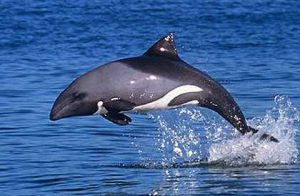
The little Benguela dolphin [photo taken from this site]:

The spinner dolphin almost looks like it has racing stripes [photo by Alexander Vasenin – Own work, CC BY-SA 3.0, https://commons.wikimedia.org/w/index.php?curid=25108509]:

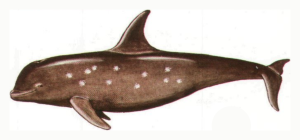
The Alula whale, which may or may not exist:

Show transcript:

Welcome to Strange Animals Podcast. I’m your host, Kate Shaw.

This week let’s learn about some whales and dolphins, including an ancient whale and a mystery whale, all of them really small. Thanks to Alexandra, Eilee, and Jayson for their suggestions!

Let’s start with an ancient whale, suggested by Jayson. The genus Janjucetus has been known since its first species was described in 2006, after a teenage surfer in Australia discovered the fossils in the late 1990s. It grew to about 11 feet long, or 3.5 meters, and lived about 25 million years ago. So far it’s only been found around Australia. But much more recently, just a few months ago as this episode goes live, a new species was described. That’s Janjucetus dullardi, also found in Australia along the same beach where the first Janjucetus species was found, and dating to around the same time period.

We don’t know a lot about the newly described whale, since it’s only known from some teeth and partial skull. Scientists think the individual was a juvenile and estimate it was only around 6 feet long when it died, or 2.8 meters. Small as it was, it would have been a formidable hunter when it was alive. Its broad snout was shaped sort of like a shark’s and it had strong, sharp teeth and large eyes.

Because it was an early whale, it wouldn’t have looked much like the whales alive today. It might even have had tiny vestigial back legs. Its eyes were huge in proportion to its head, about the size of tennis balls, and it probably relied on its eyesight to hunt prey because it couldn’t echolocate.

Its serrated teeth and strong jaws indicate that it might have hunted large animals, but some scientists suggest it could also filter feed the same way a crabeater seal does. Modern crabeater seals have similar teeth as Janjucetus, as do a few other seals. The projections on its teeth interlock when the seal closes its mouth, so to filter feed the seal takes a big mouthful of water, closes its teeth, and uses its tongue to force water out through its teeth. Amphipods and other tiny animals get caught against the teeth and the seal swallows them.

If Janjucetus did filter feed, it probably also hunted larger animals. Otherwise its jaws wouldn’t have been so strong or its teeth so deeply rooted. But Janjucetus wasn’t related to modern toothed whales. While it wasn’t a direct ancestor of modern baleen whales, it was part of the baleen whale’s family tree. Baleen whales, also called mysticetes, have baleen plates made of keratin instead of teeth. After the whale fills its mouth with water, it closes its jaws, pushes its enormous tongue up, and forces all that water out through the baleen. Any tiny animals like krill, copepods, small squid, small fish, and so on, get trapped in the baleen. It’s just like the crabeater seal, but really specialized and way bigger.

Whether or not Janjucetus could and did filter feed doesn’t really matter, because the fact that it’s an ancestral relation of modern baleen whales but it had teeth helps us understand more about modern whales.

Next, Eilee wanted to learn about the Benguela [BEN-gull-uh] dolphin, also called Heaviside’s dolphin. It lives only off the southwestern coast of Africa, and it’s really small, only a little over 5 and a half feet long at the most, or 1.7 meters. It’s dark gray with white markings, with a blunt head that’s almost cone-shaped and a triangular dorsal fin.

The Benguela dolphin is named for its ecosystem. The Benguela current flows northward along the coast, bringing cold, nutrient-rich water up from the depths, which attracts lots of animals. The dolphin lives in relatively shallow water and mainly eats fish and octopuses that it finds on or near the sea floor.

The Benguela dolphin lives in social groups and sometimes hangs out with other species of dolphin. It doesn’t travel very far throughout the year, barely more than 50 miles, or 80 km. When it hunts for food, it uses very high-pitched navigation clicks that orcas can’t hear, but when it’s in safe areas, socializing without any predators around, it communicates and navigates with lower-pitched sounds. Sharks also sometimes attack it and sometimes humans will catch and eat one, but for the most part, it lives a pretty stress-free life just hanging out with its friends and eating little fish. And that’s basically all we know about this little dolphin.

Alexandra wanted to hear about the spinner dolphin, which is common in warmer waters throughout the world. It’s called the spinner dolphin because it likes to leap into the air, spinning around as it does like an American football, which is pretty spectacular. No one except the spinner dolphin is completely sure why it spins, but scientists speculate it serves more than one purpose. The activity takes a lot of energy, so it might be a way to signal to other dolphins that it’s really strong and fit. The big splash when it lands on its side may be a way to communicate with other dolphins. The action might also help dislodge parasites like remora fish that really do attach themselves to bigger, faster animals to hitch rides and incidentally steal food.

Whatever the reason, the spinner dolphin is one of the most acrobatic dolphins in the world. It not only spins, but it jumps around, flips, slaps its tail on the water, and basically acts like a kid on the first swimming pool visit of the summer. Like most dolphins and whales, it’s a social animal, hanging out with friends, family, and sometimes other dolphin species. It eats small animals like fish, squid, and crustaceans, and at least some populations are nocturnal so they can hunt animals that migrate to shallower water at night.

The spinner dolphin is actually pretty small, growing to not quite 7 feet long at most, or 2.4 meters. It’s mainly dark gray on top, lighter gray on the sides, and pale gray or white on its belly.

Let’s finish with our mystery whale or dolphin, called the Alula whale because it was sighted near the town of Alula, Somalia at some time prior to the early 1970s. In 1971 a Dutch sea captain reported that he had seen these whales on multiple occasions, in the Gulf of Aden and the Indian Ocean. But although it’s a distinctive-sounding whale or dolphin, its existence hasn’t been verified.

Captain Willem Mörzer Bruyns, whose name I have mispronounced, described the Alula whale as being similar in size and shape to the orca or pilot whale, with a tall dorsal fin and rounded forehead. It was sepia brown all over, though, except for white scars all over its body that were shaped sort of like stars. He reported seeing small groups of these whales, anywhere from 4 to 8 of them, traveling together on at least four occasions. He estimated the whales were up to 24 feet long, or 7.2 meters.

There’s quite a bit of confusion about this mystery whale spread across the internet. Some sites I looked at mentioned a book written by Mörzer Bruyns called Field Guide of Whales and Dolphins, published in 1971, but quoted a different book, A World Guide to Whales, Dolphins, and Porpoises published in 1981 by Donald S. Heintzelman.

Let me quote the relevant paragraphs from the 1971 book, the original:

“At first encounter a school of 4 approached the ship head on and seeing the dorsal fins the author thought they were [orcas]. When they passed the ship at a distance of less than 50 yards just under the surface in the flat calm, clear sea, it was obvious that this was a different species. … These dolphins were seen in the area during crossings in April, May, June and September, usually swimming just under the surface with the dorsal fin above the water. One duty officer reported he observed them chasing a school of smaller dolphins, who tried to escape. There is, however, a possibility that both species were chasing the same prey.”

If you go to Wikipedia to read about the Alula whale, as of mid-November 2025, it states that the dorsal fin was about 6 and a half feet tall, or 2 meters. But Mörzer Bruyns reported that the dorsal fin was 2 feet tall, or about 60 cm. That’s an important difference. Orcas, AKA killer whales even though they’re actually big dolphins, are distinctively patterned with black and white, and a male orca can have a dorsal fin up to 6 feet tall, or 1.8 meters, while a female’s is typically less than half that height. The pilot whale is also a dolphin, despite its name, but it has a relatively small dorsal fin and is black, dark gray, or sometimes brown. Some researchers suggest that Mörzer Bruyns misidentified pilot whales as something mysterious, but the details he provided don’t really match up.

There are a lot of little-known whales alive today, some only discovered in the last few decades. It’s possible that the Alula whale really is a very rare small whale or dolphin. It’s not clear from his report, but it sounds like Mörzer Bruyns saw the whales on several occasions in the same year. If so, maybe the Alula whale doesn’t actually live in that part of the ocean most of the time, and Mörzer Bruyns saw the same small group several times that just happened to have traveled to the Indian Ocean that year. Maybe no one else has seen them because they’re all living in some remote part of the ocean where humans seldom travel. Hopefully someone will spot one soon.

You can find Strange Animals Podcast at strangeanimalspodcast.blubrry.net. That’s blueberry without any E’s. If you have questions, comments, or suggestions for future episodes, email us at strangeanimalspodcast@gmail.com. We also have a Patreon at patreon.com/strangeanimalspodcast if you’d like to support us for as little as one dollar a month and get monthly bonus episodes.

Thanks for listening!

Episode 458: The Tasmanian Tiger and Friends

Thanks to Viki, Erin, Weller, and Stella for their suggestions this week!

Further reading:

Tasmanian tiger pups found to be extraordinary similar to wolf pups

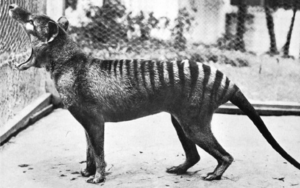
The thylacine could open its jaws really wide:

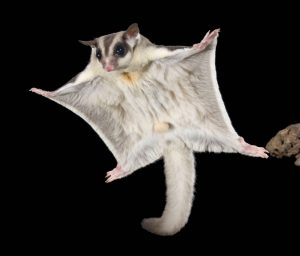
A sugar glider, gliding [photo from this page]:

A happy quokka and a happy person:

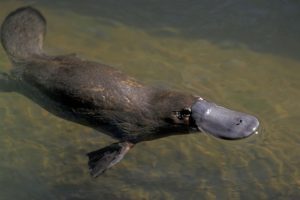
A swimming platypus:

Show transcript:

Welcome to Strange Animals Podcast. I’m your host, Kate Shaw.

This week we’re going to learn about some marsupial mammals suggested by Erin, Weller, and Stella, and a bonus non-marsupial from Australia suggested by Viki.

Marsupials are mammals that give birth to babies that aren’t fully formed yet, and the babies then finish developing in the mother’s pouch. Not all female marsupials actually have a pouch, although most do. Marsupials are extremely common in Australia, but they’re also found in other places around the world.

Let’s start with Weller’s suggestion, the Tasmanian tiger. We’ve talked about it before, but not recently. We talked about it in our very first episode, in fact! Despite its name, it isn’t related to the tiger at all. Tigers are placental mammals, and the Tasmanian tiger is a marsupial. It’s also called the thylacine to make things less confusing.

The thylacine was declared extinct after the last known individual died in captivity in 1936, but sightings have continued ever since. It’s not likely that a population is still around these days, but the thylacine is such a great animal that people hold out hope that it has survived and will one day be rediscovered.

It got the name Tasmanian tiger because when European colonizers arrived in Tasmania, they saw a striped animal the size of a big dog, about two feet high at the shoulder, or 61 cm, and over six feet long if you included the long tail, or 1.8 meters. It was yellowish-brown with black stripes on the back half of its body and down its tail, with a doglike head and rounded ears.

The thylacine was a nocturnal marsupial native to mainland Australia and the Australian island of Tasmania, but around 4,000 years ago, climate change caused more and longer droughts in eastern Australia and the thylacine population there went extinct. By 3,000 years ago, all the mainland thylacines had gone extinct, leaving just the Tasmanian population. The Tasmanian thylacines underwent a population crash around the same time that the mainland Australia populations went extinct—but the Tasmanian population had recovered and was actually increasing when Europeans showed up and started shooting them.

The thylacine mostly ate small animals like ducks, water rats, and bandicoots. Its skull was very similar in shape to the wolf, which it wasn’t related to at all, but its muzzle was longer and its jaws were comparatively much weaker. Its jaws could open incredibly wide, which usually indicates an animal that attacks prey much larger than it is, but studies of the thylacine’s jaws and teeth show that they weren’t strong enough for the stresses of attacking large animals.

Next, Stella wanted to learn about the sugar glider, and I was surprised that we haven’t talked about it before. It’s a nocturnal marsupial native to the forests of New Guinea and parts of Australia, with various subspecies kept as exotic pets in some parts of the world. It’s called a glider because of the animal’s ability to glide. It has a flap of skin between its front and back legs, called a patagium, and when it stretches its legs out, the patagia tighten and act as a parachute. This is similar to other gliding animals, like the flying squirrel.

The sugar glider resembles a rodent, but it isn’t. It’s actually a type of possum. It lives in trees and has a partially prehensile tail that helps it climb around more easily, and of course it can glide from tree to tree. It’s an omnivore that eats insects, spiders, and other small animals, along with plant material, mainly sap. It will gnaw little holes in a tree to get at the sap or gum that oozes out. It will also eat fruit, nectar, pollen, and seeds, but most of the time it prefers to hang around flowers and wait for insects to approach. Then it grabs and eats the insect without having to chase it.

The sugar glider is gray with black and white markings, big eyes that allow it to see well in darkness, rounded ears, and a really long, thick, furry tail. It’s a social animal that lives in family groups in small territories. Both males and females help take care of the joeys when they’re out of the mother’s pouch, mainly by helping them stay warm when it’s cold.

Our last marsupial of this episode is Erin’s suggestion, the quokka. It’s about the size of a domestic cat, related to wallabies and kangaroos. It’s shaped roughly like a chonky little wallaby but with a smaller tail and with rounded ears, and it’s grey-brown in color.

The quokka is considered incredibly cute because of the way its muzzle and mouth are shaped, which makes it look like it’s smiling. If you take a picture of a quokka’s face, it looks like it has a happy smile and that, of course, makes the people who look at it happy too.

This has caused some problems, unfortunately. People who want to take selfies with a quokka sometimes forget that they’re wild animals. While quokkas aren’t very aggressive and are curious animals who aren’t usually afraid of people, they can and will bite when frightened. Touching a quokka or giving it food or drink is strictly prohibited, since it’s a protected animal.

The quokka is most active at night. It sleeps during most of the day, usually hidden in a type of prickly plant that helps keep predators from bothering it. It gets most of its water needs from the plants it eats, and while it mostly hops around like a teensy kangaroo, it can also climb trees.

Let’s finish with our non-marsupial animal. Viki wanted to learn about the platypus, which we haven’t really talked about since way back in episode 45. It’s native to Australia and is very weird-looking, so it’s easy to think it’s another marsupial, but the platypus is even weirder than that. It’s not a marsupial and it’s not a placental mammal. Instead, it’s an extremely rare third type of mammal called a monotreme.

There are only two kinds of monotremes alive today, the echidna and the platypus. Monotremes retain a lot of traits that are considered primitive in mammals. Instead of giving birth to live babies, a monotreme mother lays eggs. The eggs have soft, leathery shells, but when they hatch, the babies look like marsupial newborns.

The platypus is sometimes called the duck-billed platypus, because its snout does kind of look like a duck’s bill, but instead of being hard, the snout is soft and rubbery, and it’s packed with electroreceptors that allow the platypus to sense the tiny electrical fields generated by muscle contractions in its prey. I bet that was not what you expected from what looks like a small beaver with a duck bill!

The platypus grows not quite two feet long, or 50 cm, and has short, dense, brown fur. It spends a lot of its time in the water, and has a flattened tail that acts as a rudder when it swims, along with its hind feet. It propels itself through the water with its front feet, which are large and have webbed toes. It lives in eastern Australia along rivers and streams, and digs a short burrow in the riverbank to sleep in. The female digs a deeper burrow before she lays her eggs, and she makes them a nest out of leaves.

Baby platypuses are called puggles, and while the mother doesn’t have a pouch, she keeps her babies warm by tucking them against her tummy with her tail. Monotremes don’t have teats, but they do produce milk from what are called milk patches. The puggles lick the milk up. Until scientists figured out that monotremes have these milk patches, in 1824, they thought monotremes weren’t mammals at all but something more closely related to reptiles.

Monotremes were much more common throughout the world until about 60 to 70 million years ago, when marsupials started outcompeting them. Marsupials don’t spend much time in water, though, because if they did their joeys would drown. The platypus and echidna both survived to the present day because they’re adapted for the water. The platypus mainly navigates in the water using its electrolocation abilities, and eats worms, fish, insects, crustaceans, and anything else it can catch.

It’s easy to think, “Oh, that mammal is so primitive, it must not have evolved much since the common ancestor of mammals, birds, and reptiles was alive 315 million years ago,” but of course that’s not the case. It’s just that the monotremes that survived did just fine with the basic structures they evolved a long time ago, and they’re still going strong today.

You can find Strange Animals Podcast at strangeanimalspodcast.blubrry.net. That’s blueberry without any E’s. If you have questions, comments, or suggestions for future episodes, email us at strangeanimalspodcast@gmail.com. We also have a Patreon at patreon.com/strangeanimalspodcast if you’d like to support us for as little as one dollar a month and get monthly bonus episodes.

Thanks for listening!

Episode 457: Parrots!

Thanks to Fleur, Yuzu, and Richard from NC for their suggestions this week!

Further reading:

World’s rarest parrot, extinct in wild, hatches at zoo

Kakapo recovery

This Parrot Stood 3 Feet Tall and Ruled the Roost in New Zealand Forests 19 Million Years Ago

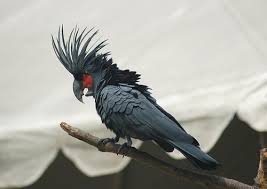
The magnificent palm cockatoo:

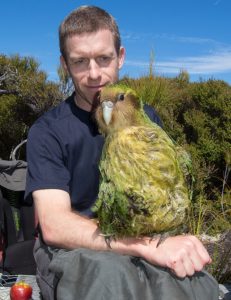
The gigantic kakapo:

Show transcript:

Welcome to Strange Animals Podcast. I’m your host, Kate Shaw.

This week we have a bird episode, specifically some interesting parrots. Thanks to Fleur, Yuzu, and Richard from NC for their suggestions!

Parrots are intelligent, social birds that are mostly found in tropical and subtropical parts of the world, but not always. Most parrots eat plant material exclusively, especially seeds, nuts, and fruit, but some species will eat insects and other small animals when they get the chance. Most parrots are brightly colored, but again, not always. And, unfortunately, most parrot species are endangered to some degree due to habitat loss, hunting for their feathers and for the pet trade, and introduced predators like cats and rats.

All parrots have a curved beak that the bird uses to open nuts and seeds, but which also acts as a tool or even a third foot when it’s climbing around in trees. All parrots have strong clawed feet that they also use to climb around and perch in trees, and to handle food and tools.

Let’s start with Yuzu’s suggestions, the cockatoo and the parakeet. A parakeet is a small parrot, but it’s a term that refers to a lot of various types of small parrots. This includes an extinct bird called the Carolina parakeet.

It was small parrot that was common throughout a big part of the United States. It had a yellow and orange head and a green body with some yellow markings, and was about the size of a mourning dove or a passenger pigeon. Its story of extinction mirrors that of the passenger pigeon in many ways. The Carolina parakeet lived in forests and swamps in big, noisy flocks and ate fruit and seeds, but when European settlers moved in, turning forests into farmland and shooting birds that were considered pests, its numbers started to decline. In addition, the bird was frequently captured for sale in the pet trade and hunted for its feathers, which were used to decorate hats.

By 1860 the Carolina parakeet was rare anywhere except the swamps of central Florida, and by 1904 it was extinct in the wild. The last captive bird died in the Cincinnati Zoo in 1918, which was not only the same zoo where the last passenger pigeon died in 1914, it was the same cage. It was declared extinct in 1939.

The parakeet Yuzu is probably referencing is the budgie, or budgerigar. It’s the one that’s extremely common as a pet, and it’s native to Australia. In the wild it’s green and yellow with black markings, but the domestic version, which has been bred in captivity since the 1850s, can be all sorts of colors and patterns, including various shades of blue, yellow all over, white, and piebald, meaning the bird has patches of white on its body.

The budgie can learn to repeat words and various sounds, especially if it’s a young bird. I had two parakeets as a kid, named Dandelion and Sky so you can guess their colors, and neither learned to talk although I really tried to teach them. Some birds just aren’t interested in mimicry, while others won’t stop, especially if they get attention when they speak.

In the wild, budgies live in flocks that will travel long distances to find food and water. The birds mostly eat grass seeds, especially spinifex, but will sometimes eat wheat, especially in areas where farmland has destroyed much of their wild food. They’re social birds that are sometimes called lovebirds, although that’s the name of a different type of bird too, because they will preen and feed their mates.

Like many birds, the parakeet can see ultraviolet light, and their feathers glow in UV light. This makes them even more attractive to potential mates, as if the parakeet wasn’t beautiful enough to start with.

Yuzu also asked about the cockatoo. There are 21 species of cockatoo, also native to Australia and other nearby places, including Indonesia and New Guinea. It’s much larger than the budgie and most species have a crest of some kind. It lives in flocks and eats various types of plant material, including flowers and roots, but it will also eat insects. The cockatoo isn’t as brightly colored as many parrots, and is usually black, white, or gray, often with patches of color on the crest, cheeks, or tail.

The pink cockatoo is white with pale salmon pink markings on the body, and brighter pink and yellow on its crest. The sulphur-crested cockatoo is white with pale yellow on the undersides of the wings and tail, and a bright yellow crest. We talked about the palm cockatoo in episode 23 because not only does it look like it should be a drummer of the Muppet Animal variety, since it’s black with red cheeks and a big messy crest, it does actually use sticks and nuts to drum against tree branches, to attract a mate.

Richard from NC suggested we learn about Spix’s macaw, also called the blue macaw, because it’s considered one of the world’s rarest parrots. In fact, it was declared extinct in the wild in 2019. It only survives at all because of intensive conservation efforts, including a captive breeding program spread over multiple zoos.

The blue macaw is native to one small part of Brazil in South America, although it used to be much more common several hundred years ago. It’s blue with a gray-blue head. It’s such a beautiful parrot that it was driven to extinction by people trapping the birds to sell as pets, even though that had been outlawed by Brazil, although its numbers had been falling for centuries due to habitat loss. It relied on a particular species of tree called the tree of gold, because its flowers are bright yellow. The blue macaw nested in these trees, and its seedpods were one of its main foods. As groves made up of the tree of gold were chopped down to make way for farmland and towns, the bird became more and more rare.

Luckily, even though the blue macaw doesn’t breed very quickly in captivity, by 2022 there were enough healthy young birds to release twenty into the wild. Just a few weeks ago as this episode goes live, another egg has hatched in captivity in a bird conservation center in Belgium, after the previous hundred eggs were infertile and never hatched.

Next, Fleur wanted to learn more about the kakapo, a flightless, nocturnal parrot that lives only in New Zealand. We talked about it in episode 313, but it’s definitely time to revisit it.

The kakapo is the largest living parrot. It has green feathers with speckled markings, blue-gray feet, and discs of feathers around its eyes that make its face look a little like an owl’s face. That’s why it’s sometimes called the owl parrot. Males are almost twice the size of females on average. It can grow over two feet long, or 64 cm, and can weigh as much as 9 lbs, or about 4 kg. That’s way too heavy for it to fly, but its legs are short but strong and it will jog for long distances to find food. It can also climb really well, right up into the very tops of trees. It uses its strong legs and its large curved bill to climb. Then, to get down from the treetop more efficiently, the kakapo will spread its wings and parachute down, although its wings aren’t big enough or strong enough for it to actually fly. A big heavy male sort of falls in a controlled plummet while a small female will land more gracefully.

The kakapo evolved on New Zealand where it had almost no predators. A few types of eagle hunted it during the day, which is why it evolved to be mostly nocturnal. Its only real predator at night was one type of owl. As a result, the kakapo was one of the most common birds throughout New Zealand when humans arrived.

But by the end of the 19th century, the kakapo was becoming increasingly rare everywhere. By 1970, scientists worried that the kakapo was already extinct. Fortunately, a few of the birds survived in remote areas. Several islands were chosen as refuges, and all the kakapos scientists could find were relocated to the islands, 65 birds in total. While the kakapo is doing a lot better now than it has in decades, it’s still critically endangered. The current population is 237 individuals according to New Zealand’s Department of Conservation.

The kakapo may be the largest living parrot, but it’s not the largest parrot that ever lived. That would be the giant parrot. It’s known only from a few fossils dated to between 16 and 19 million years ago, but from those fossils scientists estimate that the giant parrot grew around 3 feet tall, or almost a meter, and possibly weighed almost twice what the kakapo weighs. It’s the largest parrot that ever lived as far as we know, and it was probably related to the kakapo.

We don’t know a lot about the giant parrot because only two fossils have been found, both of them leg bones and probably from the same individual. They bones are so big that scientists initially thought they belonged to an eagle. Hopefully soon more fossils will come to light so we can learn more about the giant parrot. For all we know, those leg bones belonged to a young parrot that wasn’t fully grown yet. Maybe the adults were even bigger than we think!

You can find Strange Animals Podcast at strangeanimalspodcast.blubrry.net. That’s blueberry without any E’s. If you have questions, comments, or suggestions for future episodes, email us at strangeanimalspodcast@gmail.com. We also have a Patreon at patreon.com/strangeanimalspodcast if you’d like to support us for as little as one dollar a month and get monthly bonus episodes.

Thanks for listening!