Podcast: Play in new window | Download (Duration: 10:07 — 11.4MB)
Thanks to Audie, Katie, Eilee, Emily, Maryjane, and Dylan for their suggestions this week! Sorry this episode is late–the site was down. 🙁
Further reading:
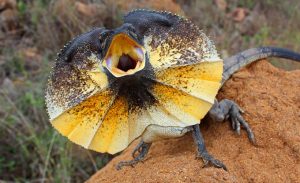
A frill-neck lizard showing off:
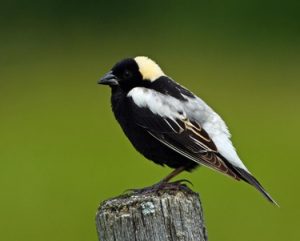
A bobolink:
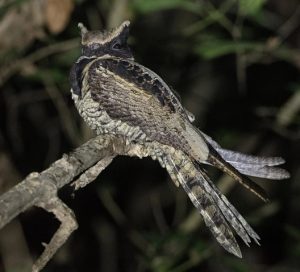
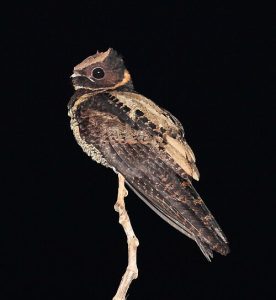
The great-eared nightjar [picture by Venkata Shreeram Mallimadugula, taken from this site]:
Another great-eared nightjar [Picture by Nigel Voaden from UK – Great Eared-Nightjar, Tangkoko, Sulawesi, CC BY-SA 2.0, https://commons.wikimedia.org/w/index.php?curid=39857392]:
Show transcript:
Welcome to Strange Animals Podcast. I’m your host, Kate Shaw.
This week we have an episode about some birds and reptiles. Thanks to Audie, Katie, Eilee, Emily, Maryjane, and Dylan for their suggestions! If this episode showed up later than usual in the podcast feed, it’s because I’ve been having trouble with the website and couldn’t get it uploaded until it was fixed.
We’ll kick off the episode with an animal that can’t kick, because snakes don’t have any legs. Audie suggested we learn about the scaleless rat snake, which means that first we have to learn about the rat snake, the ordinary one with scales.
Rat snakes are constrictors and are common throughout many parts of Asia, Europe, North America, and the Middle East, and they’re called rat snakes because they eat rats and other small animals like lizards, frogs, and baby birds.
Rat snakes are popular pets because they’re so pretty and they aren’t dangerous to humans. Different species are different colors and patterns, and the rhinoceros rat snake, also called the Vietnamese longnose snake, even has a little hornlike projection on the tip of its nose that points forward. I’m pretty sure we’ve talked about that particular rat snake before on the podcast, but I can’t look up which episode because the website is down.
Most rat snakes don’t grow much bigger than 5 feet long, or 1.5 meters, but a few species can get longer than that. The black rat snake, which lives in North America, can grow over 8 feet long, or more than 2.5 meters. It’s black with small white markings on the head, but snakes bred for sale as pets are sometimes white all over or partially white, or even albino, meaning an individual has a mutation where its body doesn’t produce pigment. Pet black rat snakes are also bred that don’t have scales.
That brings us to the scaleless rat snake. It’s an ordinary rat snake but it has a mutation that causes it to have very few scales. This is a mutation that happens occasionally in the wild since it’s a recessive trait, and while it can make the snake a little more vulnerable to injury, scaleless snakes can survive just fine in the wild. They do have belly scales like a normal snake, which are the ones that allow them to move around, and they may have a scattering of scales on other parts of the body too. A scaleless snake still sheds its skin once a year like an ordinary snake, since it’s actually the outer layer of skin that sheds along with the scales.
Scaleless rat snakes are popular as pets because they’re so soft and because their coloration is usually very bright. A snake’s coloration comes from pigments in its skin. A snake’s scales are actually transparent, so without a layer of scales, a scaleless snake looks even more colorful than a regular snake. Many species of snake have been found in the wild that are scaleless, but it seems to be a little more common in rat snakes.
Next, Dylan and Emily wanted to learn about the frill-neck lizard, which is found in northern Australia and the very southern part of New Guinea. It’s a big lizard that can grow almost three feet long, or 90 cm, including its incredibly long tail. Males are larger than females on average, with a bigger frill.
The frill is a flap of skin around the head and neck, and most of the time it’s folded back over the neck and shoulders so it’s not that noticeable. The lizard is pretty ordinary-looking that way, just a big gray or brown animal with a big head. But when the lizard feels threatened, or if it comes across another frill-neck lizard, it can extend the frill by moving the small bones and cartilage that act as struts, which also requires the lizard to open its mouth.
When extended, the frill is as much as a foot across, or 30 cm, and it’s marked with bright colors. Different individuals have different colored frills, red, orange, yellow, or white, or a mixture of colors and patterns. The size and color of the frill opening up so quickly will often startle a potential predator, allowing the lizard to escape. The frill-neck lizard can even run on two legs if it needs to, although it has to run with its head pointing straight up in the air.
The frill-neck lizard mostly eats insects, especially termites. It spends most of its time in trees and some people believe it can use its frill as a parachute, but that doesn’t actually seem to be the case.
Let’s move on to a few birds next. Maryjane suggested we learn about the bobolink, a type of blackbird native to the Americas. In summer the male bobolink is black with a pale yellow nape and white markings, and in winter he molts into a drab outfit of brown to help him hide. The female is brown with black streaks and stripes.
In the summer the bobolink flies to the northern United States and Canada to nest and raise babies, and it migrates to southern South America in winter. This is a huge distance for such a little songbird to travel, but it’s a strong flyer and can travel over a thousand miles, or 1,800 km, in a single day. It navigates using the stars at night and can sense the earth’s magnetic field too, which helps it find its way.
The bobolink prefers prairies and grassy areas. It eats seeds and insects, and especially likes rice and a type of caterpillar called the armyworm. It’s sometimes considered a pest because it eats so much rice, but then again armyworms are also considered pests and the bobolink eats so many of them that it has probably saved a lot of crops that way. While the bobolink is still numerous, its numbers have been in decline for years due to habitat loss.
The bobolink is most famous for its song. Both males and females sing, and males not only sing while perched, they sing while flying. The bobolink’s songs are varied and lovely. This is what the bobolink sounds like, first a song recorded while the bird was flying:
[bobolink song]
And here’s another song recorded while a different bird in a different place was perched and singing:
[bobolink song]
Finally, both Katie and Eilee wanted to learn about the great-eared nightjar, also called the dragon bird or the baby dragon.
Nightjars are nocturnal birds, and the great-eared nightjar is found in parts of southern and Southeast Asia. It can grow up to 16 inches long, or 41 cm, and is a chonky bird with big dark eyes and a broad bill that can open very wide. The “ears” in its name are tufts of feathers on the top of its head that look like ears or little horns. It can raise the ears if it wants to, but most of the time they just stick out backwards. Like other nightjars, the great-eared nightjar’s head looks flattened most of the time, and the bird itself spends a lot of time crouched down looking like a very flat bird, but then it sits up and pricks up its ear tufts, and it looks more like a thin owl with a long tail. The bird is brown with black markings, which makes it almost invisible at night.
During the day, the great-eared nightjar sits in a tree or just on the forest floor, so well camouflaged by its feathers that it blends in with the leaf litter or kind of looks like a piece of stump or broken-off branch. At night it flies around catching insects on the wing like a bat.
Instead of building a nest and laying eggs in it like other birds, the great-eared nightjar just lays a single egg among dead leaves on the ground. The egg, and the baby when it hatches, are so well camouflaged that it’s as safe on the ground as it would be in a nest way up in a tree.
The great-eared nightjar has an eerie call. This is what it sounds like:
[great-eared nightjar call]
You can find Strange Animals Podcast at strangeanimalspodcast.blubrry.net. That’s blueberry without any E’s. If you have questions, comments, corrections, or suggestions, email us at strangeanimalspodcast@gmail.com.
Thanks for listening!