Episode 141: Zombie Animals

We’re inching closer to Halloween and it’s getting spookier out there! This week let’s learn about some animals that get zombified for various reasons. This is an icky episode, so you might not want to snack while you’re listening. Thanks to Sylvan for the suggestion about the loxo and mud crabs!

Further reading:

Zombie Crabs!

Ladybird made into ‘zombie’ bodyguard by parasitic wasp

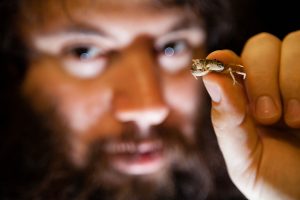
A mud crab held by a dangerous wizard:
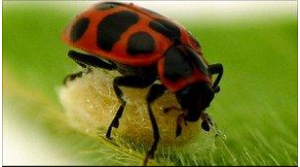
A paralyzed ladybug sitting on a parasitic wasp cocoon:
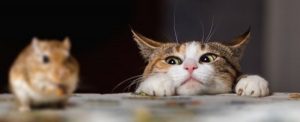
A cat and a rodent:
Show transcript:

Welcome to Strange Animals Podcast. I’m your host, Kate Shaw.

It’s another week closer to Halloween, so watch out for ghosts and goblins and zombie animals! Zombie animals?! Yes, that’s this week’s topic! Thanks to Sylvan for suggesting the loxo parasite, which we’ll talk about first. Brace yourself, everyone, because it’s about to get icky!

Before we learn about loxo, let’s learn about the mud crab, for reasons that will shortly become clear. Mud crab is the term for a whole lot of small crabs that live in shallow water, mostly in the Atlantic or eastern Pacific Oceans but sometimes in lakes and other fresh water near the ocean, depending on the species. Most are less than an inch long, or under about 30 mm. The largest is called the black-fingered mud crab, which grows to as much as an inch and a half long, or 4 cm. Most mud crabs are scavengers, eating anything they come across, but the black-fingered mud crab will hunt hermit crabs, grabbing their little legs and yanking them right out of their shells. It also uses its strong claws to crack the shells of oysters.

Loxothylacus panopaei is actually a type of barnacle. You know, the little arthropods that fasten themselves to ships and whales and things. But loxo, as it’s called, doesn’t look a bit like those barnacles except in its larval stages. After it hatches, it passes through two larval stages; during the first stage, it molts four times in only two days as it grows rapidly.

Then, during the cyprid larval stage, the microscopic loxo searches for a place to live. The male remains free-swimming but the female cyprid larva is looking for a mud crab. She enters the crab’s body through its gills and waits for it to molt its exoskeleton, during which time she metamorphoses into what’s called a kentrogon, basically a larva with a pointy end. As soon as the crab molts its exoskeleton, the female loxo uses her pointy end, called a stylet, to stab a hole in the crab’s unprotected body. Then she injects parasitic material that actually seems to be the important part of herself, which enters the crab’s blood—called hemolymph in arthropods like crabs. Like most invertebrates, crabs don’t have blood vessels. The hemolymph circulates throughout the inside of the body, coming into direct contact with tissues and organs. This means that once the loxo has infiltrated the hemolymph, she has access to all parts of the crab’s body.

At this stage, the loxo matures into something that isn’t anything like a barnacle, but is an awful lot like something from a horror movie. She grows throughout the crab, forming rootlets that merge with the crab’s body and changes them. Basically, the female loxo becomes part of her crab host. Eventually she controls its nervous system and molds it to her own needs. She even molds the body to her own needs, since if she’s parasitized a male crab she has to widen its body cavity so it can hold her eggs.

The crab stops being able to reproduce and doesn’t want to. It only wants to care for the eggs that the female loxo produces. She extrudes an egg sac so that it hangs beneath the crab’s abdomen, where a male loxo can fertilize it when he swims by. The crab then treats the egg sac as if it contains its own eggs, protecting them and making sure they get plenty of oxygenated water. This is true even for male crabs, which ordinarily don’t take part in protecting their own eggs. The loxo eggs hatch in about a week, and as soon as they do, the female loxo inhabiting the crab starts the process over again. While a mud crab in the wild can live for a few years, once it’s taken over by the loxo parasite it only lives around 45 days.

Most mud crab populations are reasonably resistant to the parasite, but where the loxo has been introduced to areas where it didn’t live before, it can decimate the local mud crab population. This happened in Chesapeake Bay in the 1960s in North America. The local oysters had been so over-fished that they were nearly completely gone, also nearly destroying the local oyster industry. They imported oysters from the Gulf of Mexico to replenish local stocks, but no one realized they were bringing the loxo with those oysters. These days, up to 90% of the Chesapeake Bay mud crabs are infected with the loxo parasite, while only up to 5% of the Gulf of Mexico mud crabs are infected. Researchers at the Chesapeake Bay Parasite Project are working to figure out more about how the loxo infiltrates its host and changes it genetically, and are monitoring infection rates in the wild.

If you think that’s gross, it’s not going to get any better the rest of this episode.

Next let’s learn about another zombie animal, this one a spider. A number of spiders are parasitized by a tiny wasp called Zatypota percontatoria. It lives throughout much of the northern hemisphere and prefers forested areas with plenty of web-building spiders in the family Theridiidae, also known as cobweb spiders.

Cobweb spiders are really common with around 3,000 species that live throughout the world, including the black widow, which by the way is not nearly as dangerous as people think. Some cobweb spiders are kleptoparasites, which means they steal food and other resources from another animal, in this case larger spiders. A kleptoparasite cobweb spider actually lives in the web of a larger spider, and when a small bug gets caught in the web, it steals it. Sometimes the cobweb spider will kill and eat the spider that built the web in the first place too.

But most cobweb spiders are ordinary spiders, and most are quite small, usually only a few millimeters long. Many are marked with pretty patterns in brown, white, black, and other colors. Different species build different kinds of webs, but they all eat small insects.

As for the wasp, it’s about the same size as the spider it’s trying to parasitize, and sometimes smaller. It has long wings, long antennae, and a long abdomen that in the female ends in a sharp ovipositor. The female finds a spider, usually a young spider that’s less able to defend itself, and stabs it in the abdomen with her ovipositor. Then she lays a single egg inside the spider and flies away.

The egg doesn’t bother the spider, although once the egg hatches into a larva it starts to feed on the spider’s hemolymph. Remember, that’s the equivalent of blood in the invertebrate world. At the same time, it’s releasing hormones into the spider that change its habits. Basically the wasp larva controls the spider so that it acts to the benefit of the larva, not itself.

All this takes about a month. When the larva is ready to pupate and metamorphose into an adult wasp, it secretes a final hormone that influences the spider’s behavior. This one causes the spider to spin a strong, cocoon-like web. When the web is finished, the larva bursts out of the spider’s body, killing it, and eats the spider. Then it enters the cocoon and develops into an adult wasp.

Because spiders are good at defending themselves, only about 1% of spiders end up parasitized. I’m sure the spiders think that’s 1% too many. There are other parasitic wasp species in other places, but they all act about the same as Zatypota.

Another wasp, Dinocampus coccinellae, parasitizes ladybugs. Like Zatypota, the female wasp lays one egg in the ladybug’s body. When it hatches, the larva eats the ladybug’s insides while the ladybug continues to go about its ordinary activities. But after several weeks, the larva is ready to pupate. It paralyzes the ladybug, bursts out of its body, and spins a cocoon that the ladybug sits on.

But the ladybug isn’t dead. It protects the cocoon from other insects by twitching and making grasping motions with its legs.

After about a week, the adult wasp emerges from its cocoon and flies away. The ladybug usually dies, but not always. About a quarter of infected ladybugs recover and are fine. Researchers aren’t sure how the wasp larva causes the paralysis. It may release a virus that infects the ladybug or it may have something to do with venom released by the larva.

This wouldn’t be a proper zombie episode if I didn’t talk about that disgusting parasitic fungus that affects certain carpenter ants in the rainforests in Brazil and Thailand. It completely squicks me out so I’m going to explain it very, very quickly.

Fungal spores float through the air and land on an ant, where they stick. They release enzymes that eventually break down the ant’s exoskeleton, allowing the fungus to spread inside the ant’s body. Finally it’s able to control the ant and makes it crawl up the stem of a plant and bite into a leaf vein. The ant is unable to move at this point and eventually dies. The fungus sprouts from inside the ant and grows into stalks, especially from the ant’s head. About a week later it releases spores that go on to infect other ants. Ugh. So glad I’m not an ant.

Ants can sense when one of the colony has contracted the fungus, and will carry the infected ant far away from the colony so it’s less likely to infect others. The ants also groom each other to remove any spores that may have attached. The fungus can completely destroy ant colonies, but it has a parasite of its own, another fungus that stops the first fungus from releasing spores. A related parasitic fungus also infects certain caterpillars.

Look, I’m totally over talking about fungus, so let’s move on.

So is there any chance that a parasite will turn you into a zombie? There’s not, but a behavior-changing parasite does sometimes infect humans. It’s called Toxoplasma gondii, and while its effects on human behavior has been studied extensively, the effects are so minor as to be nearly nonexistent in most cases.

Toxoplasmosis is a disease caused by a single-celled parasite, and it’s one that not only infects humans, it’s really common. I probably have it but I’m not going to think too hard about that. For most people, it never bothers them and never causes any symptoms, or only mild short-term symptoms like a lowgrade cold that takes a few weeks to clear up. But it can be more serious in people with a suppressed or weak immune system, and can cause problems for the baby if its mother gets infected while she’s pregnant.

There are estimates that up to half the people in the world are infected with toxoplasmosis but never know. The reason it’s so common is that the parasite targets cats, and can be spread in cat feces. And, you know, if you scoop out the cat’s litter box you might be exposed. That’s why pregnant women shouldn’t clean up after a cat. Infection can also result from eating undercooked meat from an infected animal, eating unwashed fruit or vegetables, drinking unpasteurized milk, and drinking untreated water.

Any mammal or bird can contract the parasite, but it can only reproduce in a cat’s digestive system. It doesn’t hurt the cat, it just wants to get inside the cat so it can reproduce. And the best way to get inside a cat is to be part of a rodent that a cat eats.

When a rat or other rodent is infected with Toxoplasma gondii, its behavior changes. Suddenly, it starts to like cats. You can probably see where this is going. Not only does it stop avoiding cats, it actually seeks them out. The cat, naturally, can’t believe its luck, kills and eats the rodent, and may become infected.

If you have a pet cat, the best way to reduce the risk of contracting toxoplasmosis is to scoop the litter box daily, then wash your hands. It takes about a day for the parasite to become active after being shed in cat poop, so if you scoop the litter box right away the risk is lower. Researchers are working on vaccines, and they’ve actually already developed a vaccine that’s now used in sheep. If you keep your cat inside, where it’s safer anyway, it’s much less likely to be exposed to the parasite in the first place.

So, take ordinary precautions but don’t worry too much about toxoplasmosis. Unless, of course, you are a rodent.

You can find Strange Animals Podcast online at strangeanimalspodcast.blubrry.net. That’s blueberry without any E’s. If you have questions, comments, or suggestions for future episodes, email us at strangeanimalspodcast@gmail.com. We also have a Patreon if you’d like to support us that way.

Thanks for listening!
Episode 093: Insects Large and Small, mostly large

Many thanks this week to listeners Bob, Nicholas, and Damian, who all suggested insects of one kind or another! So this week is an insect extravaganza, or at least we learn about some gigantic insects, the rarest insect in the world, and a tiny ant.

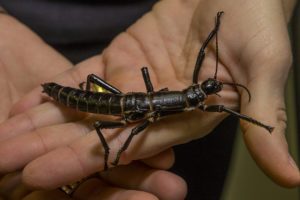
The Lord Howe Island phasmid:

The longest insect in the world:

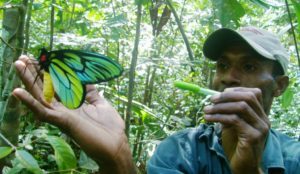
The Queen Alexandra’s birdwing butterfly:

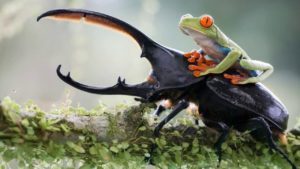
The Hercules beetle with random frog. Onward, my steed!

Further reading:

An article about phasmid eggs

Show transcript:

Welcome to Strange Animals Podcast. I’m your host, Kate Shaw.

I’ve received a bunch of excellent topic suggestions this year and I’m getting behind on addressing them, so the next few weeks will mostly be listener suggestions. This week we’re going to look at a topic several listeners have suggested…insects.

Now, you know insects are not my favorite, but they are definitely interesting. So thanks to listeners Bob, Nicholas, and Damian, we’re going to learn about various horrifying, I mean fascinating, insects!

We’ll start with some very small insects. I could probably do a whole episode just about ants, and maybe one day I will, but right now let’s look at a type of ant suggested by Bob. Bob lives in California and mentioned that the type of ant common in that part of the United States is the Argentine ant. It’s native to South America, specifically lowlands around the Paraná River, but it’s spread to many other parts of the world.

The Argentine ant is only about 2 to 3 mm long and are brownish in color. The queen ants are about twice the size of the worker ants, and each colony has many queens, unlike other ant species that may only have one queen per colony. Queen ants are the only ones that lay eggs. Worker ants find food and bring it back to the colony, tend the queen and her eggs, and dig the shallow nest where the colony lives.

Argentine ants are omnivorous, eating pretty much anything, and are definitely pests. They get into people’s kitchens to find food and will even make nests inside houses. Because a colony has more than one queen, the colonies are hard to eradicate. They also displace native ant species, which can impact the entire ecosystem since other animals that depend on native ants as their primary food won’t be able to find enough to eat. Argentine ants also cause problems for farmers, partly because they eat the larvae of pollinating insects, partly because they tend aphids for the honeydew that aphids secrete. Aphids are a pest to many crops, and the last thing farmers want is more aphids around—but Argentine ants want all the aphids they can get.

Researchers have found out something really unusual about Argentine ants. The ants that still live in their native habitat are genetically diverse and territorial, with different colonies fighting each other for nesting sites and hunting grounds. This keeps the population under control naturally. But outside of its native habitat, all the Argentine ants in the world are so genetically similar that in many cases, ants from different colonies act as though they were from the same colony. They don’t fight for territory, and instead act like a supercolony that can stretch for hundreds of miles, killing off or displacing native ants and other insect species.

But in some parts of North America, the Argentine ant is facing an ant species that may end up beating it at its own game. The Asian needle ant has started taking territory from the Argentine ant, helped by its resistance to cold weather. Both species of ant become less active in winter, but the Asian needle ant starts reproducing and foraging much earlier in the spring than the Argentine ant. This gives it a head start every year. Plus, the Asian needle ant is aggressive and has a venomous sting. Unfortunately, the Asian needle ant is just as bad an invasive species as the Argentine ant, driving out native ant species—and, in fact, it’s worse because some people are allergic to its sting.

Now let’s go from tiny ants to an insect I was terrified of as a kid, the stick insect, also called walking sticks or phasmids. I like the word phasmid. I don’t know why the idea of a stick insect was so scary to kid me, except that I liked to climb trees and I think I thought one day I’d climb a tree and discover that some of those sticks were not actually part of the tree. Nicholas suggests the Lord Howe Island phasmid in particular, which isn’t just a stick insect, it’s the rarest insect in the world. AND it’s enormous! In fact, it’s sometimes called the land lobster or tree lobster.

The Lord Howe Island phasmid can grow eight inches long, or 20 cm, and can weigh a full ounce, or 25 grams. Males are smaller than females. It has a round head with short antennae, sort of like a cricket, but its body is long and heavy with big legs. It’s black in color with no wings. It’s thicker than most stick insects and doesn’t so much resemble a stick as a cricket on steroids. I’m looking at a picture right now of someone holding one on the palm of their hand, and the insect is literally longer than their palm and almost as long as their palm and fingers. Put it down. Don’t touch it.

These days the Lord Howe Island phasmid lives in one place. That place is not Lord Howe Island off the coast of Australia. That’s where it used to live, and it was so common and so large that fishermen used it as bait. But rats and mice invaded the island in 1918, and by 1920 they’d eaten all the phasmids, which were declared extinct in 1960. But in 1964, someone found a dead phasmid on Ball’s Pyramid, a volcanic islet 12 miles, or 20 km, away from Lord Howe Island.

Ball’s Pyramid is what’s known as a volcanic stack, the eroded remnant of a volcano which is part of the submerged continent of Zealandia. It’s basically a cliff rising straight up out of the ocean. It’s the tallest volcanic stack in the world, 1,844 feet high, or 562 meters, 3,600 feet long, or 1,100 meters, and 980 feet wide, or 300 meters. It’s surrounded by rough seas and barely submerged rocks, and there’s pretty much nothing on it, so not very many people have ever tried to land on the islet. A group of mountain climbers scaled it in 1965 and again in 1979, but in 1982 access to the islet was restricted. It’s now part of the Lord Howe Island Marine Park.

During the successful climbs of Ball’s Pyramid, and a few unsuccessful climbs, dead phasmids were photographed but no live ones found. In 2001, a couple of entomologists landed to make a survey of the islet, primarily to determine whether the Lord Howe Island phasmid was alive on the island or actually extinct. They were pretty sure it was extinct. They found some Melaleuca howeana shrubs growing in a few cracks in the rock, and incidentally that’s a subspecies of tea tree that only grows on Ball’s Pyramid and Lord Howe Island. It grows up to ten feet tall, or 4 meters, and almost as wide. And in one of the shrubs they found 24 live Lord Howe Island phasmids.

Since then, eggs have been collected from the wild and relocated to a captive breeding program, which has been successful so far. Hopefully Lord Howe Island phasmids will be rereleased onto Lord Howe Island, once the rats and mice are eradicated.

Researchers think the Lord Howe Island phasmid was able to survive in such low numbers because females are able to reproduce without being fertilized by males, called parthenogenesis. Researchers have compared DNA taken from the Ball’s Pyramid insects to museum specimens gathered from Lord Howe Island prior to 1920 and determined that they are the same species.

The term phasmid, of course, refers to an order of insects that are mostly camouflaged to look like twigs or leaves, and it contains the longest insects in the world. And that’s good, because listener Damian wants to know about the biggest insects alive today.

The longest insect is Phryganistria chinensis Zhao, a stick insect only discovered in 2014 by researcher Zhao Li of the Insect Museum of West China. Locals in the mountains had told him about a massively long phasmid and he finally tracked one down. He brought it back alive to the museum, where it laid six eggs. Can you possibly imagine how excited he must have been by those eggs? When they hatched, the smallest of the babies was 26 centimeters long, or over ten inches. The adult female measured 62.4 cm, or just over two feet long. HOLY CRAP. TWO FEET LONG. That’s more of a walking branch than a walking stick. Not only that, its legs are almost as long as its body.

Since then, the babies have grown up and one of them, another female, is now the longest living insect ever measured, at 64 cm, or 25 inches. So you know what this means. It means there are some of them in the wild that are probably even longer.

Before the discovery of Zhao’s phasmid, the longest insect known was called Chan’s megastick, which was 22.3 inches long, or 56.7 cm. It was discovered in 2008 in Borneo in Southeast Asia, and only six specimens have ever been found. That means it too probably has even longer individuals living in the wild.

Many stick insects lay eggs that look like seeds. For a long time researchers weren’t sure why. After all, birds eat seeds. Why would an insect lay eggs that might attract hungry birds? But it turns out that the eggs contain a deposit of fat that attracts seed-eating ants, and the ants carry the eggs back to their nest and bury them. The eggs are then safe from birds, parasitic wasps, and other predators. We have come full circle back to ants, notice? Not only that, but researchers in Japan tested whether the protective coating on some seed-mimicking phasmid eggs would protect the eggs if they were eaten by birds. Sure enough, when they fed the eggs to the brown-eared bulbul, a bird known to eat phasmids, a few of the eggs survived and hatched. So it’s likely that phasmid eggs resemble seeds to attract ants but it’s okay if they also attract birds—in fact, it might even be a good thing since the birds would spread the eggs to new areas. Special thanks to Nicholas, who sent me links to several articles about stick insects, including the article about phasmid eggs. I’ll put a link in the show notes if you want to read the article, because it’s really interesting.

So the longest insects are phasmids, but what is the heaviest insect alive? That would be the Little Barrier Island giant weta from New Zealand, also called the wetapunga, which has weighed in at 72 grams, or over 2 ½ ounces. That’s heavier than some songbirds and mice. The wetapunga is basically an enormous cricket and somewhat resembles a gigantic, rather elongated version of one of my least favorite bugs, the cave cricket. It’s that same sort of sickly orangey tan color. If you look at it from the right angle it looks kind of like a lobster, which I also don’t like. Not only can the wetapunga be really heavy, it’s also long—not stick insect long, but a respectable four inches or so long, or 10 cm, and even longer if you count the stretched-out legs.

It eats plants and is mostly nocturnal.

Like the Lord Howe Island phasmid, the wetapunga is vulnerable to introduced predators. It only survives in the wild on Little Barrier Island, and is now the subject of a successful captive breeding program. It’s been around for 190 million years so it would be a shame to let it go extinct now.

The insect with the biggest wingspan is a butterfly called Queen Alexandra’s birdwing, which can have a wingspan almost a foot across, or over 25 cm. Its body is just over 3 inches long, or 8 cm. The female is larger than the male and has brown wings with pretty white and yellow markings. The male looks much different, with iridescent blue-green wings and a bright yellow abdomen. The butterfly is a strong flyer that spends a lot of time flying much higher that typical butterflies do. Males court females with a spectacular aerial dance.

The Queen Alexandra’s birdwing lives in eastern Papua New Guinea in a coastal rainforest, a habitat that is only about 40 square miles total, or 100 square km. Not only is it threatened by habitat loss due to palm oil plantations, which are absolutely insidious and seriously, you should stop buying products that use palm oil, but a volcanic eruption in the 1950s destroyed part of its habitat too. It’s protected and no one is supposed to buy, sell, or trade individuals, live or dead. Hopefully conservationists can work out a way to breed the butterfly in captivity.

The biggest beetle alive today is probably the Hercules beetle, which lives in the rainforests of Central and South America. It’s only longer than the titan beetle that lives in the Amazon rainforest because of its long rhinoceros-like horns, which push its length to 7 inches, or 17 cm. A male uses his horns to fight by grabbing another male with his horns and throwing him. The male Hercules beetle is black with yellowish or yellow-green wing cases. Females are usually all black and don’t have horns. Hercules beetle larvae are humongous and weigh a whopping 100 grams, or 3.5 ounces. So technically the Hercules beetle larva is the heaviest insect, but I’ve disqualified it because it’s not fully grown and anyway, it eats rotting wood. I wouldn’t be surprised if half its weight is just all the rotten wood it’s eaten. The adult beetles eat fruit.

So what about extinct insects? Were there ever insects even bigger than the ones alive today? The answer, as you may already know, is a big loud YES. Back in the early Permian era, around 290 million years ago, two species of flying insect called a griffinfly, which resembled a dragonfly, had a wingspan of almost two feet across, or 71 cm, and a body length of 17 inches, or 43 cm. Researchers estimate they may have weighed as much as a pound, or 450 grams.

If you were brave enough to listen to the spiders episode a few weeks ago, you may remember that spiders, and insects, can’t grow too big or they literally can’t get enough oxygen to function. So how did a huge active flying insect of that size manage?

One theory is that the atmosphere in the Permian contained more oxygen than the current level, which made it easier for insects to get the oxygen they needed. Air today is made of about 21% oxygen, with the other 80% made up of other gases, mostly nitrogen, but in the early Permian oxygen content was around 30%, although that was down from a peak of 35% only ten million years before. By the late Permian oxygen content had plunged to 16% and even reached as low as 12% at the beginning of the Triassic, killing off many animals and fragmenting populations of the ones that survived. Because the oxygen content was so low, animals could only survive at or near sea level. Even the lowest mountains were deadly because the air at higher elevations naturally contains less oxygen. Researchers estimate that breathing air with only 12% oxygen at sea level would be like breathing air at 17,400 feet, or 5,300 meters. Humans can’t survive at elevations above about 19,500 feet, or 5,950 meters. The reduction of oxygen in the atmosphere led to a massive extinction event called the Great Dying, where 90% of all marine life and almost 75% of all life on land went extinct around 251 million years ago.

Researchers aren’t sure what caused the de-oxygenation of the atmosphere, but it’s possible the massive volcanic activity near the end of the Permian played a part by releasing carbon dioxide and other gases into the atmosphere. The rock record during the Permian shows the results in stark detail: limestone in the older rock strata that’s full of fossils and the fossilized burrows of little animals that lived in the soft mud at the bottom of shallow oceans. Then there’s a mineralized layer of rock full of pyrite, which forms in low atmospheric conditions. Above this are bands of clay full of minerals from volcanic eruptions but with no fossils present. Above that are mudstone layers where fossils finally start appearing again in small numbers as life rebounded after the extinction event.

I’ve sort of gotten away from huge insects here, so I’ll finish by pointing out that clearly the phasmids of today aren’t having any issues with growing really big. So, you know, watch out where you put your hands when you’re climbing trees.

You can find Strange Animals Podcast online at strangeanimalspodcast.com. We’re on Twitter at strangebeasties and have a facebook page at facebook.com/strangeanimalspodcast. If you have questions, comments, or suggestions for future episodes, email us at strangeanimalspodcast@gmail.com. If you like the podcast and want to help us out, leave us a rating and review on Apple Podcasts or whatever platform you listen on. We also have a Patreon if you’d like to support us that way.

Thanks for listening!