Episode 467: The Dragon Bird and Friends

Thanks to Audie, Katie, Eilee, Emily, Maryjane, and Dylan for their suggestions this week! Sorry this episode is late–the site was down. 🙁

Further reading:

Bobolinks

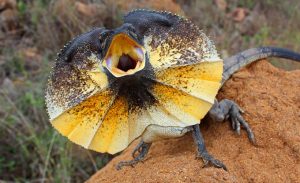
A frill-neck lizard showing off:

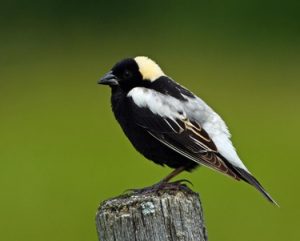
A bobolink:
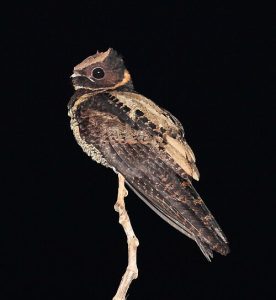
The great-eared nightjar [picture by Venkata Shreeram Mallimadugula, taken from this site]:
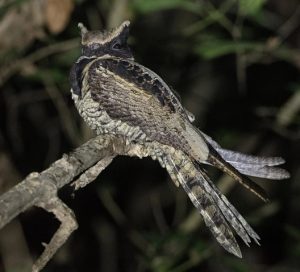
Another great-eared nightjar [Picture by Nigel Voaden from UK – Great Eared-Nightjar, Tangkoko, Sulawesi, CC BY-SA 2.0, https://commons.wikimedia.org/w/index.php?curid=39857392]:
Show transcript:

Welcome to Strange Animals Podcast. I’m your host, Kate Shaw.

This week we have an episode about some birds and reptiles. Thanks to Audie, Katie, Eilee, Emily, Maryjane, and Dylan for their suggestions! If this episode showed up later than usual in the podcast feed, it’s because I’ve been having trouble with the website and couldn’t get it uploaded until it was fixed.

We’ll kick off the episode with an animal that can’t kick, because snakes don’t have any legs. Audie suggested we learn about the scaleless rat snake, which means that first we have to learn about the rat snake, the ordinary one with scales.

Rat snakes are constrictors and are common throughout many parts of Asia, Europe, North America, and the Middle East, and they’re called rat snakes because they eat rats and other small animals like lizards, frogs, and baby birds.

Rat snakes are popular pets because they’re so pretty and they aren’t dangerous to humans. Different species are different colors and patterns, and the rhinoceros rat snake, also called the Vietnamese longnose snake, even has a little hornlike projection on the tip of its nose that points forward. I’m pretty sure we’ve talked about that particular rat snake before on the podcast, but I can’t look up which episode because the website is down.

Most rat snakes don’t grow much bigger than 5 feet long, or 1.5 meters, but a few species can get longer than that. The black rat snake, which lives in North America, can grow over 8 feet long, or more than 2.5 meters. It’s black with small white markings on the head, but snakes bred for sale as pets are sometimes white all over or partially white, or even albino, meaning an individual has a mutation where its body doesn’t produce pigment. Pet black rat snakes are also bred that don’t have scales.

That brings us to the scaleless rat snake. It’s an ordinary rat snake but it has a mutation that causes it to have very few scales. This is a mutation that happens occasionally in the wild since it’s a recessive trait, and while it can make the snake a little more vulnerable to injury, scaleless snakes can survive just fine in the wild. They do have belly scales like a normal snake, which are the ones that allow them to move around, and they may have a scattering of scales on other parts of the body too. A scaleless snake still sheds its skin once a year like an ordinary snake, since it’s actually the outer layer of skin that sheds along with the scales.

Scaleless rat snakes are popular as pets because they’re so soft and because their coloration is usually very bright. A snake’s coloration comes from pigments in its skin. A snake’s scales are actually transparent, so without a layer of scales, a scaleless snake looks even more colorful than a regular snake. Many species of snake have been found in the wild that are scaleless, but it seems to be a little more common in rat snakes.

Next, Dylan and Emily wanted to learn about the frill-neck lizard, which is found in northern Australia and the very southern part of New Guinea. It’s a big lizard that can grow almost three feet long, or 90 cm, including its incredibly long tail. Males are larger than females on average, with a bigger frill.

The frill is a flap of skin around the head and neck, and most of the time it’s folded back over the neck and shoulders so it’s not that noticeable. The lizard is pretty ordinary-looking that way, just a big gray or brown animal with a big head. But when the lizard feels threatened, or if it comes across another frill-neck lizard, it can extend the frill by moving the small bones and cartilage that act as struts, which also requires the lizard to open its mouth.

When extended, the frill is as much as a foot across, or 30 cm, and it’s marked with bright colors. Different individuals have different colored frills, red, orange, yellow, or white, or a mixture of colors and patterns. The size and color of the frill opening up so quickly will often startle a potential predator, allowing the lizard to escape. The frill-neck lizard can even run on two legs if it needs to, although it has to run with its head pointing straight up in the air.

The frill-neck lizard mostly eats insects, especially termites. It spends most of its time in trees and some people believe it can use its frill as a parachute, but that doesn’t actually seem to be the case.

Let’s move on to a few birds next. Maryjane suggested we learn about the bobolink, a type of blackbird native to the Americas. In summer the male bobolink is black with a pale yellow nape and white markings, and in winter he molts into a drab outfit of brown to help him hide. The female is brown with black streaks and stripes.

In the summer the bobolink flies to the northern United States and Canada to nest and raise babies, and it migrates to southern South America in winter. This is a huge distance for such a little songbird to travel, but it’s a strong flyer and can travel over a thousand miles, or 1,800 km, in a single day. It navigates using the stars at night and can sense the earth’s magnetic field too, which helps it find its way.

The bobolink prefers prairies and grassy areas. It eats seeds and insects, and especially likes rice and a type of caterpillar called the armyworm. It’s sometimes considered a pest because it eats so much rice, but then again armyworms are also considered pests and the bobolink eats so many of them that it has probably saved a lot of crops that way. While the bobolink is still numerous, its numbers have been in decline for years due to habitat loss.

The bobolink is most famous for its song. Both males and females sing, and males not only sing while perched, they sing while flying. The bobolink’s songs are varied and lovely. This is what the bobolink sounds like, first a song recorded while the bird was flying:

[bobolink song]

And here’s another song recorded while a different bird in a different place was perched and singing:

[bobolink song]

Finally, both Katie and Eilee wanted to learn about the great-eared nightjar, also called the dragon bird or the baby dragon.

Nightjars are nocturnal birds, and the great-eared nightjar is found in parts of southern and Southeast Asia. It can grow up to 16 inches long, or 41 cm, and is a chonky bird with big dark eyes and a broad bill that can open very wide. The “ears” in its name are tufts of feathers on the top of its head that look like ears or little horns. It can raise the ears if it wants to, but most of the time they just stick out backwards. Like other nightjars, the great-eared nightjar’s head looks flattened most of the time, and the bird itself spends a lot of time crouched down looking like a very flat bird, but then it sits up and pricks up its ear tufts, and it looks more like a thin owl with a long tail. The bird is brown with black markings, which makes it almost invisible at night.

During the day, the great-eared nightjar sits in a tree or just on the forest floor, so well camouflaged by its feathers that it blends in with the leaf litter or kind of looks like a piece of stump or broken-off branch. At night it flies around catching insects on the wing like a bat.

Instead of building a nest and laying eggs in it like other birds, the great-eared nightjar just lays a single egg among dead leaves on the ground. The egg, and the baby when it hatches, are so well camouflaged that it’s as safe on the ground as it would be in a nest way up in a tree.

The great-eared nightjar has an eerie call. This is what it sounds like:

[great-eared nightjar call]

You can find Strange Animals Podcast at strangeanimalspodcast.blubrry.net. That’s blueberry without any E’s. If you have questions, comments, corrections, or suggestions, email us at strangeanimalspodcast@gmail.com.

Thanks for listening!
Episode 097: Unusual Reptiles

Thanks to listeners Finn and Leo, who suggested this week’s topics of strange lizards, and the thorny devil and mata mata turtle, respectively! Join us this week to learn about those reptiles and a bunch more!

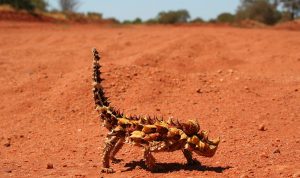
Thorny devil. Definitely do not eat.

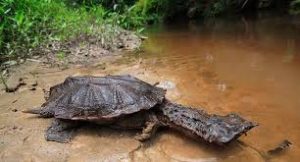
The mata mata turtle. Big leafhead boi

A frilled lizard BWAAAAAMP

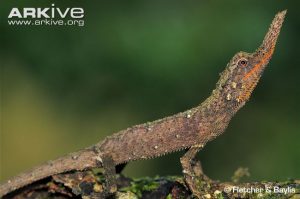
A Pinocchio lizard. Wonder where that name comes from.

Poke poke poke does this bother you? poke poke

om nom nom

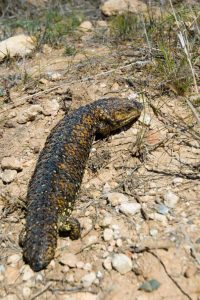
A shingleback, or as I like to call it, an ambulatory poop:

Show transcript:

Welcome to Strange Animals Podcast. I’m your host, Kate Shaw.

We have more listener suggestions this week! Ages ago, listener Finn suggested strange lizards, and more recently, listener Leo suggested a particular type of strange lizard and a strange turtle.

We’ll start with Leo’s suggestion, the thorny devil. He describes it as “a cool animal with spikes all around it,” which is definitely a good way to put it. The thorny devil is a lizard from Australia, and it does indeed have spikes all over its head, back, and tail, and smaller spikes on its legs. The spikes are modified scales and are sharp.

The thorny devil grows to around 8 inches long, or 20 cm, with females being larger than males on average. In warm weather its blotchy brown and yellow coloring is paler than in colder weather, when it turns darker. It can also turn orangey, reddish, or gray to blend in to the background soil. Its color changes slowly over the course of the day as the temperature changes. It also tends to turn darker if something threatens it.

It has a thick spiny tail that it usually holds curved upward, which makes it look kind of like a stick. It moves slowly and jerkily, rocking back and forth on its legs, then surging forward a couple of steps. Researchers think this may confuse predators. It certainly looks confusing.

As if that wasn’t enough, the thorny devil has a false head on the back of its neck. It’s basically a big bump with two spikes sticking out of the sides. When something threatens the lizard, it ducks its head between its forelegs, which makes the bump on its neck look like a little head. But all its spines make it a painful mouthful for a predator. If something does try to swallow it, the thorny devil can puff itself up to make itself even harder to swallow, like many toads do. It does this by inflating its chest with air.

The thorny devil eats ants and only ants, specifically various species of tiny black ants found only in Australia. It has a sticky tongue to lick them up. Because it has such a specific diet, it’s hard to keep in captivity. Only a few zoos in Australia have thorny devils on display. If you listened to episode 93, where we talked about invasive ant species having an effect on entire ecosystems, the thorny devil is an example of this. Fortunately the ants it eats are doing just fine, but if an invasive ant species were introduced to the areas where it lives, the thorny devil would probably be in trouble. So no moving ants around, everyone, I mean it.

The thorny devil lives in desert and scrubland regions, and in hot weather it digs a burrow to shelter in. Females lay their eggs in burrows. To get enough water in its desert environment, the thorny devil has microscopic grooves between its scales that suck up water by capillary action. At night dew condenses on the lizard’s body, and it also collects dew by brushing against dewy vegetation or just by standing or lying on damp sand. If it does happen across water in a puddle, it will put a leg in the water and the tiny grooves in its skin suck up water and funnel it to the mouth. It’s like a living straw.

While I was researching this, I found some information on how rattlesnakes drink. When it starts to rain, a rattlesnake will coil up tightly so that rainwater collects in its coils. Then it drinks the water. This sounds like something someone just made up, but it’s real.

Let’s skip right from a snake fact to a weird turtle, because Leo also suggested the mata mata turtle as a topic. This is where I got distracted while researching, and ended up with an entire episode about giant tortoises. If you were wondering, the main difference between a turtle and a tortoise is that turtles spend most or all of their time in water, while tortoises live only on land.

The mata mata turtle lives in shallow, slow-moving water in South America, especially swamps around the Amazon and Orinoco river basins. It isn’t closely related to the snapping turtle of North America, but it does resemble a snapping turtle in some ways. Its shell is brown or black, its skin is grayish, and its plastron, or the belly section of its shell, is yellow or brown. It grows to around two feet long, or 60 cm, with a long, broad neck and wide, triangular head. Its nose comes to a point like the stem of a leaf. In fact, if you look down on a mata mata in the water, the shape of its head looks exactly like a dead leaf. It has notches and ridges on its shell, and its knobbly skin has flaps that helps camouflage the turtle among dead leaves and sticks in the water. It also has claws and webbed toes.

Unlike the snapping turtle, the mata mata is harmless to humans and most animals. It doesn’t have a sharp bill and it won’t bite. It can’t even chew its food, just swallows it whole. It eats fish, water insects, and other small animals that it captures by opening its large mouth suddenly under the water. This creates suction, sucking a lot of water and the prey right into the turtle’s mouth.

The only time the mata mata leaves the water is to lay eggs. Unlike many other turtle eggs, the mata mata eggs have hard shells, more like bird eggs. It takes the eggs about 200 days to hatch.

The mata mata spends almost all of its time motionless in the water, waiting for prey to come near, and occasionally extending its ridiculously long neck so it can take a breath from the surface. Its pointy nose is a proboscis that it breathes through. It can swim, but it usually prefers to walk along the bottom of the pond or marsh. I bet its feet squish in the mud. Squish squish squish.

Speaking of pointy-nosed reptiles, the male Pinocchio lizard has a nose that points forward and slightly upward like a rhinoceros horn. But it’s not a horn, because it’s flexible, made of cartilage. It lives in the Mindo cloud forest in Ecuador, and was only discovered by scientists in 1953, when researchers collected six specimens. And that was the last time anyone saw the Pinocchio lizard—until 2005, when some birdwatchers saw a weird lizard, took pictures and posted them online, and herpetologists started freaking out.

The Pinocchio lizard blends in so well with its environment that it’s hard to spot. It turns white when it’s asleep, which helps it look like part of a tree branch. It always perches on the end of a branch to sleep, too. During the day, it climbs verrry slowly into the treetops. It’s not a big lizard, only about three inches long, or 7.5 cm, not counting its tail, which is as long as its body. We still don’t know much about it because it’s so hard to study.

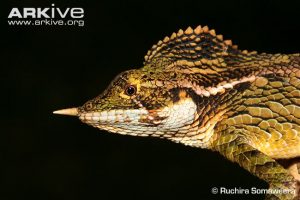
It’s not the only lizard with a horn on its nose. For instance, the rough-nosed horned lizard lives in Sri Lanka and is an ordinary-looking lizard for the most part, although it’s covered with short bristly scales that make it look like it would work well for scrubbing out dirty pots and pans. But it has a really long nose, also covered in bristly scales. Oh, and yellow or orange markings on its face that make it look like it has a big orange clown mouth. Males have longer horns than females. Male mountain horned agamas, which also live in Sri Lanka, have a single white or cream-colored horn that sticks directly forward from their nose like a tiny unicorn horn, except it’s not spiraled. In fact, it’s not a horn at all, it’s a single big pointy scale. But those lizards aren’t related to the Pinnocchio lizard.

The La Gomera giant lizard doesn’t have any horns and it’s not all that giant, less than two feet long, or around 49 cm long, including the tail. It’s black or brown on its back with a white belly. Males also have a white throat, and during mating season males inflate their throat and bob their head to attract females. It mostly eats plants, although it will eat insects too, and it lives in the Canary Islands. It’s not the most exciting lizard to look at, but it has an interesting history.

The Canary Islands are a group of islands off the coast of Morocco. It was once called the Fortunate Isles, so if you ever see that in an old book you know what islands it’s talking about. Pliny the Elder, a historian from ancient Rome, said the name Canaria came from the number of dogs on the islands. The word for dog in Latin is canis. The people of the islands were supposed to worship dogs, and some modern historians believe the old accounts of dog-headed people may be a garbled account of the Canary Islanders. Oh, and the little yellow songbirds that live on the Canary Islands took their name from the islands, not vice versa.

The islands were probably visited in ancient times by Phoenician and Greek sailors, but reportedly no one lived there when the Romans explored it in the 1st century. But when Europeans returned in the late middle ages, there were inhabitants that may have been settlers from North Africa. The islands were invaded by Europeans, who then spent centuries fighting with each other over who ruled them. It’s Spain, currently. Scientific expeditions started in the late 18th century. One of the animals the expeditions reported seeing was the La Gomera giant lizard, but it disappeared sometime after about 1900. Researchers assumed it had gone extinct.

Then a 1999 expedition from the University of La Laguna on Tenerife, one of the Canary Islands, heard stories from local residents on the island of La Gomera. They said there was a big lizard living in a few places on the island. The biologists in the expedition checked it out…and sure enough, there were giant lizards. Specifically, six of them. Just six lizards. Later they found another small group of the lizards in another area, but the total population was still no more than fifty.

Fortunately, a captive breeding program has been successful and today there are around 250 of the lizards in the wild, living only on two hard to reach cliffs. They’re vulnerable to introduced predators, especially cats, which eat the eggs and young lizards. Another 300 or so live in a recovery center where they’re protected from predators before being released into the wild. So basically, the La Gomera giant lizard isn’t so much strange as just very, very lucky.

Another lizard that is definitely strange is the frilled lizard from northern Australia and southern New Guinea. It’s bigger than the La Gomera giant lizard, almost three feet long, or 85 cm, and eats insects, spiders, and small animals. It lives in trees and is well camouflaged with blotches and spots on a gray or brown background to help camouflage it among branches and against bark.

The frilled lizard gets its name from the frill on eitherside of its head. Most of the time it keeps the frill folded back against itsneck. When it’s threatened, though, it spreads the frill out and opens itsmouth wide. The inside of its mouth is bright yellow or pink, and the frill hasbright red or yellow scales that don’t show when it’s folded. It’s the lizardequivalent of a jump scare in scary movies. Regular lizard, regular lizard…BWAMP BIG SCARY BRIGHT LIZARD

The frill is made up of spines of cartilage that grow from the lizard’s jaw bones, with skin connecting the spines. It’s not small, either. When expanded, it can be almost a foot across, or 25 cm.

The frilled lizard isn’t dangerous, though, and if its threat display doesn’t scare off a predator, it runs away until it finds a tree to climb. It runs so fast, in fact, that it lifts its body up and just runs on its hind legs, which helps it navigate uneven ground and gives it a better view of what’s around it. It also holds its long tail out as a counterweight to keep its body upright.

That’s supposed to be all the strange details about the frilled lizard…but there are sightings of it doing something unexpected on rare occasions. People occasionally report seeing a frilled lizard fall or jump from a tree, and glide down using its frill as a parachute. There’s no proof that this actually happens, but it sounds plausible.

Another Australian lizard called the shingleback, or bobtail, looks kind of like a pinecone with legs. Or a poop with legs, just going to set that down and walk away. It’s brown with darker and lighter speckles or yellow splotches, large overlapping scales, a stubby thick tail, and a broad head. In fact, its head and tail look a lot alike, which confuses predators. It also stores fat in its tail for winter. It grows about a foot long, or 30 cm, and eats snails, insects, flowers, and other small animals and plants. It lives in arid and desert areas, and their tough skin and overlapping scales help reduce water loss. Its eyes are tiny, like little black beads.

The shingleback looks nothing like the frilled lizard, but it has one thing in common with it. When threatened, the shingleback will open its mouth wide and stick out its large, dark blue tongue. It is an impressively blue, impressively big tongue, and the inside of the shingleback’s mouth is otherwise pale, so it’s startling, to say the least.

The shingleback mates for life. Most of the year the shingleback is solitary, but in spring mated pairs find each other again and go around together while they hunt for food. The female gives birth to two live babies instead of laying eggs.

I could go on and on and on about all the weird reptiles in the world. There are just so many! We’ll definitely come back to this topic in the future, but for now, let’s finish up with a snake called Iwasaki’s snail-eater.

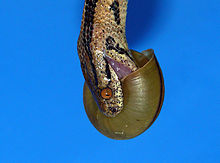
The snail-eater lives on a few small islands southwest of Japan’s main islands. It’s small, only about 7 inches long, or 22 cm, and is orangey in color with darker markings and bright orange eyes. And it only eats one thing: snails.

It’s so perfectly adapted to its diet of snails that its jaw is asymmetrical so it can more easily wedge it into the typical snail’s shell, which coils clockwise. If you remember from the little yard animals episode, some snails very rarely coil the opposite way, and the snail-eater snake is so specialized to eat ordinary snails that it has trouble with counter-clockwise coiled snail shells. It has more teeth on its right mandible. There are other snail-eater snakes closely related to Iwasaki’s snail-eater that have this same adaptation, and in some areas where the snakes are numerous, counter-clockwise snails are much more common than in areas without a lot of snail-eater snakes.

So that’s a reminder that whether you’re a little snail-eating snake or a regular human being, the things you do have an effect on the world around you, even if it’s in ways too small for you to notice without looking very closely.

You can find Strange Animals Podcast online at strangeanimalspodcast.com. We’re on Twitter at strangebeasties and have a facebook page at facebook.com/strangeanimalspodcast. If you have questions, comments, or suggestions for future episodes, email us at strangeanimalspodcast@gmail.com. We also have a Patreon if you’d like to support us that way.

Thanks for listening!