Episode 012: The Wyvern, the Basilisk, and the Cockatrice

This week we range across the world to solve (sort of) the mystery of the wyvern, the basilisk, the cockatrice, and crowing snakes! Thanks to listener Richard E. for suggesting this week’s topic!

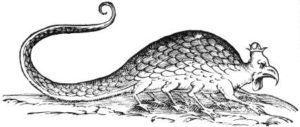
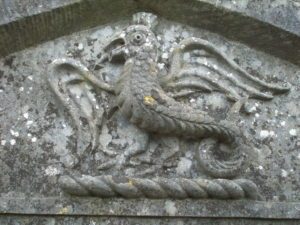
From left to right, or whatever since the three have been confused since at least the middle ages: the basilisk, the cockatrice, and the wyvern:

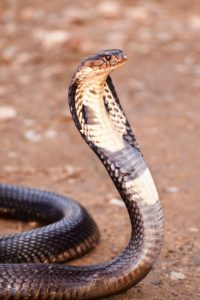
The king cobra, or maybe the basilisk:

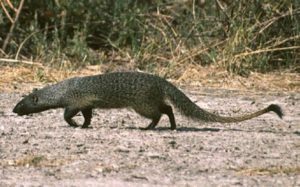
The Egyptian mongoose/ichneumon, or maybe the cockatrice:

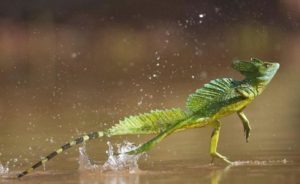
Basilisk!

Further reading:

Extraordinary Animals Revisited by Karl P.N. Shuker

Gode Cookery: The Cockentrice – A Ryal Mete

Show transcript:

Welcome to Strange Animals Podcast. I’m your host, Kate Shaw.

This week’s episode was inspired by listener Richard E., who suggested the wyvern as a topic. He even attached some photos of wyverns in architecture around Leicester, England. I forgot to ask him if he lives in Leicester or just visits the city, but I looked at the photos and was struck by how much the wyvern resembles the cockatrice. Next thing I knew, I was scouring the internet for audio files of howling snakes. It all makes sense by the end.

Before we jump in, I’d like to apologize to a guy named Mike W. who is from Leicester. Mike, if by some crazy coincidence you’re listening, I am so, so sorry for the way I treated you in London in 1996. I was a jerk in my 20s, to put it mildly. You were such a great guy and I have felt awful ever since.

Okay, my oversharing out of the way, let’s talk about wyverns.

The word wyvern is related to the word viper, and originally that’s what it meant, but by the 17th century the word had lost its original meaning and was attached to a heraldic animal instead. The wyvern has been popular in heraldry since the middle ages.

In video games, the wyvern is usually a two-legged dragon with wings. In heraldry, it’s less dragonlike and more snakey, but it almost always has one pair of legs and one pair of wings. Frequently it wears a crown or has some sort of crest, and quite often its head looks a lot like a rooster’s.

The heraldic wyvern doesn’t seem to have ever been considered a real animal, but the cockatrice was. The cockatrice is usually depicted as a snakelike animal with a one pair of legs, one pair of wings, and a rooster-like head. You see the connection. But here’s the really confusing thing. The words cockatrice and basilisk were used more or less interchangeably as early as the 14th century. In fact, in the King James Version of the Bible, Isaiah 14 Verse 29 mentions a cockatrice, while the same verse in the English Revised Version uses the word basilisk instead.

Those two words don’t even sound alike. And if like me you grew up playing Dungeons & Dragons and reading books like Walter Wangerin Jr.’s The Book of the Dun Cow, you think of the cockatrice and the basilisk as totally different animals.

I’m going to talk about the basilisk first. Then I’ll come back to the cockatrice.

The basilisk has an old, old pedigree. A lot of online sources claim that Pliny the Elder was the first to describe the basilisk in his natural history in about 79 CE, but it was already a well-known animal by then. We know because the Roman poet Lucan, who died in 65 CE, makes reference to the basilisk twice in his epic poem Pharsalia in a way that implies his audience was completely with the animal’s supposed abilities.

The basilisk was supposed to be deadly—so deadly, in fact, that if a man on horseback speared a basilisk, the venom would run up the spear and kill not only the rider, but the horse too. That’s one of the stories Lucan references in his poem. Pliny also includes it in his natural history.

All the basilisk had to do was look at you and you’d die or be turned to stone. Birds flying in sight of a basilisk, no matter how high above it they were, would die in midair. The ground around a basilisk’s home was blighted, every plant dead and even the rocks shattered.

So what did the basilisk look like? Pliny describes it this way. I’ve taken this quote from a site called “The Medieval Bestiary,” which has a much clearer translation than Wikipedia’s and other sites that seem to have copied Wikipedia.

“It is no more than twelve inches long [30 cm] and has white markings on its head that look like a diadem. Unlike other snakes, which flee its hiss, it moves forward with its middle raised high.”

In other words, the basilisk was a snake, and not even a big snake. And according to Pliny, the weasel was capable of killing the basilisk. “The serpent is thrown into a hole where a weasel lives and the stench of the weasel kills the basilisk at the same time as the basilisk kills the weasel.”

In other words, someone would pick up a basilisk—which was supposed to be deadly to touch—and toss it down into a weasel’s burrow, and the weasel and the basilisk would both end up dead. Pliny, did you even think about what you were writing?

But back up just a little and the story starts to make more sense. We all saw “Rikki Tikki Tavi” as kids, right? The mongoose does look like a weasel. It’s also resistant to the king cobra’s venom and will prey on it and other snakes. The king cobra has an expandable hood with light-colored false eye spots on it. Its venom is so potent that it can kill a human in half an hour, and one of the final symptoms is paralysis, which may account for reports of the basilisk turning people to stone. King cobras can’t spit their venom, but many other cobras can. And most importantly, the weird notion that the basilisk moves forward with its middle raised high maybe explained by the king cobra’s habit of rearing up when threatened. It can still move forward when its front is raised.

But the king cobra is a big snake. Its average length is about twelve feet [3.7 m] and it can grow as long as 18 feet [5.5 meters]. Pliny describes a snake only a foot long [30 cm]. It’s possible Pliny just wrote the length wrong, conflated the cobra with some smaller snake, or scribes made a mistake copying the original writing. But the idea that the basilisk is actually a cobra seems cemented not by Pliny but by Lucan. Let me quote from book nine of Pharsalia, verses 849 to 853:

“There upreared his regal head

And frighted from his track with sibilant terror

All the subjects swam

Baneful, ere darts his poison. Basilisk.

In sands deserted king.”

A hissing poisonous crowned animal that rears up? It sounds like a king cobra to me. And the fact that stories about the basilisk mention its terrible hissing makes it even more likely.

The king cobra’s hiss sounds more like a growl. It has low-frequency resonance chambers in its windpipe that enhance and deepen the sound of its hiss. Here’s a clip of one, and I would not want to hear this coming from a snake the length of a truck:

[scary hissing]

At some point, though, the basilisk became a more lizard-like animal in western culture and took on rooster-like characteristics. The Venerable Bede, an English monk who lived from about the year 672 to 735, was the first to write down the story of the basilisk as many of us know it today. He said the basilisk was born from an egg laid by an old rooster. Hens do occasionally change sex and take on male characteristics, such as growing a pronounced crest and wattles, long tail feathers, and crowing. Sometimes they stop laying eggs but sometimes they don’t.

Incidentally, the other chickens take all this in stride and do not make a big deal about where the new rooster can go to the bathroom.

Other details got added to the basilisk story over the centuries. Sometimes the egg is described as round and leathery, which is true of many reptile eggs, and sometimes a toad is supposed to brood the egg until it hatches. Sometimes the rooster has to lay the egg at a certain time of year or moon phase. Whatever the circumstances surrounding the egg being laid, the animal that hatches from it is supposed to be a deadly serpent or lizard.

These are all details not described by Pliny. My guess is that the story of a rooster’s egg hatching into a deadly reptile was already a folktale in England when Pliny wrote his Natural History. The stories got conflated, probably by scholars who thought they described the same animal. That might also explain why the word cockatrice got grafted onto the rooster-egg legend. Let’s go back to learn about the cockatrice to figure out how.

The word cockatrice comes from a medieval Latin word that was a translation of the Greek word ichneumon from our old friend Pliny’s Natural History. It’s the same name used for the mongoose, although it can also mean otter. According to Pliny, the ichneumon will fight a snake by first covering itself with several coats of mud and letting it dry to form armor. Pliny also describes the ichneumon as waiting for a crocodile to open its jaws for the little tooth-cleaning birds to enter. When the crocodile falls asleep during the bird’s ministrations, the ichneumon runs down its throat and eats the croc’s intestines, killing it.

So the word that inspired the cockatrice wasn’t a snake at all. It was something that killed snakes and crocodiles. The confusion seems to be etymological. Ichneumon means something like “tracker” from a Greek word I can’t spell, track or footstep. Translated into Latin, it becomes cockatrix [probably spelled wrong] for the word for “tread.” Cockatrice is the corruption of cockatrix. But a cockatrice to English-speaking ears no longer sounds like any kind of snake-killing mammal. It sounds like the word cock, a rooster, combined with a slithery-sounding ending. So it’s very possible the confusion came from the word change mixed with confused tellings of the basilisk story. And when you consider that Chaucer referred to the basilisk as a basilicock, it’s easy to see that English speakers, at least, have been confusing the words and monsters for many centuries.

So it seems we’ve solved this mystery once and for all. The basilisk was a king cobra, the cockatrice was a mongoose, the wyvern was a fanciful heraldic animal, and we’re done.

But wait. Not so fast.

There are widely spread stories of snakes with combs and wattles that can crow like roosters. But those stories aren’t from England. They’re from Africa, with related stories in the West Indies.

The story goes that there’s a snake in east and central Africa that can grow up to twenty feet long [6 meters]. It’s dark brown or gray but has a scarlet face with a red crest that projects forward. Males also have a pair of face wattles and can crow, while females cluck like hens. Supposedly they have deadly venom and will lunge down from trees to attack humans who pass beneath.

At this point I got a little frantic and started trying to find out more about snake sounds. I didn’t think snakes could do anything but hiss, but it turns out that snake vocalizations are a lot more interesting than that.

In addition to the cobra’s deep hiss, bull snakes grunt. That’s how they get their name; they sound a little like cows. And at least one snake makes a sound no one would expect. That’s the Bornean cave racer, Orthriophis taeniurus grabowskyi, native to Sumatra and Borneo. It’s a lovely slender blue snake, not poisonous, also called the beauty ratsnake, and can grow some six feet long [1.8 m]. Some subspecies are kept as pets, but not grabowskyi as far as I know.

The snake has been known to science for a long time, but in 1980, a scientific exploration of the Melinau cave system in Borneo heard an eerie hoarse yowling in the dark, something like a cat. After the scientists no doubt wet their pants, they spotted a beauty ratsnake coiled on the cave floor. It was clearly making the sound.

I tried so hard to find audio of this snake. I really, really wanted to share it. But I’ve had no luck so we’ll just have to imagine it.

Most snakes don’t have vocal cords. That’s the name given to folds of tissue above the larynx. Snakes do have a larynx, and the bull snake, also called the pine snake or gopher snake, and native to the southeastern United States as far north as New Jersey, has a single vocal cord and a well-developed glottis flap. They’re noisy little guys for snakes. They grunt, hiss, and rattle their tails against dead leaves to scare potential predators away. Here’s a sample:

[hissing snake]

There are also stories from all around the world, from every region where snakes live, about snakes mimicking prey to draw it near. The stories come from people from every walk of life who are in position to observe nature closely: farmers, hutners, fishers, explorers—but unfortunately not any scientists. Not yet, anyway. Here’s one of the many examples given in Karl Shuker’s excellent book Extraordinary Animals Revisited, an excerpt I’ve chosen for reasons that will shortly become clear. It’s from an African report from 1856.

“The story of the cockatrice, so common in many parts of the world, is also found among the Demares. But instead of crowing, or rather chuckling like a fowl when going to roost, they say it bleats like a lamb. On its head like the guinea fowl it has a horny protuberance of a reddish color.”

It’s entirely possible that many snakes make sounds that mimic other animals, although whether they do it to lure prey near or whether it’s just a coincidence is another thing. But what about the whole issue about snakes not being able to hear airborne sounds? When I was a kid, I remember reading many books that said snakes can’t hear, they can only detect vibrations from the ground through their jaw bones.

Well, that’s not actually true. Snakes can hear sounds quite well, although their range of hearing is limited compared to mammals. In fact, a survey published in 2003 by the Quarterly Review of Biology confirms that snakes are more sensitive to airborne sounds than they are to ground-borne sounds. So it’s not that ridiculous to imagine a snake that makes sounds people might interpret as crowing or clucking.

But what about the wattles? A lot of snakes have head decorations, including many species of horned vipers that have modified scales above the eyes that really do look like horns. The rhinoceros viper has two or three horns on its nose. I couldn’t find any snakes with wattle-like frills, but it’s not out of the range of possibility. Plus, sometimes snakes don’t fully shed their skins and end up with bits and pieces of old skin left behind, which can stick out from the body.

Whether the African crowing snake legends have anything to do with the European legends of basilisks hatched from rooster eggs, I have no idea. The stories are different enough that I’m inclined to think they’re not related. Then again, reports of crowing snakes might have influenced the basilisk legend.

Incidentally, there’s a real-life lizard given the name basilisk, also called the Jesus lizard because it runs on water to escape predators. It lives in tropic rain forests in Central and South America and can run as fast as seven miles per hour [11 km/hr] on its hind legs, and when it reaches water it just keeps going. It’s big webbed feet and its speed keep it from sinking immediately.

The name ichneumon has been given to a few modern animals too: a type of mongoose that ancient Egyptians believed ate crocodile eggs, and various types of flies and wasps that parasitize caterpillars.

I was hoping that the cockatrice and wyvern would have lent their names to modern real animals too, but I couldn’t find any. But I did find something almost as good. In the middle ages there was a fancy dish called a cockatrice. I found this at a site called “Gode Cookery dot com” where good is spelled g-o-d-e. The site has it listed under cockentrice, with an N. I’ll put a link in the show notes.

Here’s a sample recipe, which the site took a book published in 1888 titled “Two Fifteenth Century Cookery-Books.”

“Take a capon, scald it, drain it clean, then cut it in half at the waist. Take a pig, scald it, drain it as the capon, and also cut it in half at the waist. Take needle and thread and sew the front part of the capon to the back part of the pig, and the front part of the pig to the back part of the capon, and then stuff it as you would stuff a pig. Put it on a spit and roast it, and when it is done, gild it on the outside with egg yolks, ginger, saffron, and parsley juice, and then serve it forth for a royal meat.”

A capon, incidentally, can mean either a castrated rooster or an old rooster. Either way, roast cockatrice sounds better than turducken, and way better than being the guy who has to throw the basilisk into the weasel den.

You can find Strange Animals Podcast online at strangeanimalspodcast.blubrry.net. That’s blueberry without any E’s. If you have questions, comments, or suggestions for future episodes, email us at strangeanimalspodcast@gmail.com. We also have a Patreon if you’d like to support us that way.

Thanks for listening!

Episode 004: The Irish Elk

(re-recorded audio)

In which your host calls her own podcast by the wrong name! And doesn’t catch it until it’s too late to change (i.e. five minutes ago). This week’s episode of Strange Animals Podcast is about the Irish Elk specifically and the Pleistocene era in general, especially as regards to humans spreading out across the world from Africa. Did the Irish elk’s enormous antlers really have anything to do with its extinction? And is it really for-sure extinct? (Spoiler alerts: no and yes.)

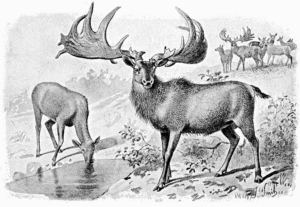
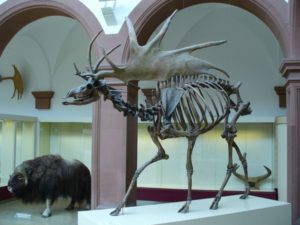
The Irish elk (more accurately called the giant deer) could stand as tall as seven feet high at the shoulder.

Show transcript:

Welcome to Strange Animals Podcast. I’m your host, Kate Shaw. This is a re-record of the original episode to improve audio quality and bring some of the information up to date.

This week’s episode is about the Irish elk, the first of many episodes about Ice Age megafauna. But before we learn about the Irish elk, let’s start with the span of time popularly known as the ice age, along with information about how humans spread across the world.

The last two million years or so of history is known as the Pleistocene, which ended about 12,000 years ago. The end of the Pleistocene coincides roughly with the extinction of a lot of the Pleistocene megafauna and the beginning of modern historical times.

During the Pleistocene, the earth’s axis tilt and plane of orbit resulted in reduced solar radiation reaching the earth. The process is due to what is called Milankovitch cycles, which I won’t go into since I don’t actually understand it. To grossly oversimplify, the earth got colder for a while because there wasn’t as much sunshine as usual, and all of these glaciers formed, and then it would warm up again and the glaciers would melt. This happened repeatedly throughout the Pleistocene, which was actually a series of ice ages with interglacial times in between.

Our current era is called the Holocene, and it’s considered an interglacial period. But if you’re hoping that the next ice age is a neat solution to global warming associated with climate change, the next glacial period isn’t expected for another 3,000 years.

The word megafauna means “giant animals.” You might hear dinosaurs referred to as megafauna, and that’s accurate. It’s a general term applied to populations of animals that grow larger than a human. Humans are also considered a type of Ice Age megafauna. high five, all my ice age peeps yes I kept that dumb line in this re-record

During the Pleistocene, humans migrated from Africa and spread across the world, rubbing shoulders with Neandertals, making awesome stone tools, and killing megafauna whenever they could. Humans are good at killing animals. In elementary school, I remember reading about ancient tribes of people stampeding mastodons over cliffs, eventually killing them all off. I didn’t believe it, but that’s actually true. We have lots of evidence that many types of animals were killed in this way, and it may have led to the extinction of some of the megafauna. It certainly didn’t help them. Wherever humans showed up, extinctions followed. The only exception is Africa, probably because the animals in Africa evolved alongside humans and knew how to deal with us. But when the first bands of humans showed up in Eurasia and the Americas, the native animals didn’t even know we were predators. They certainly didn’t know how to avoid being stampeded over cliffs. That’s a skill you don’t get many chances to practice.

Many people, especially Europeans, think that native peoples of whatever part of the world are natural conservationists. They live in harmony with nature, taking only what they need and using, for instance, every part of the buffalo. But human nature is human nature. Sure, when you live in a comfortably established village with a set territory, and your hunters and fishers start noticing that there’s not much game left, you learn conservation or you starve. But when you’ve got an entire world ahead of you—vast continents that have never seen a tool-using great ape with wicked intelligence and an insatiable appetite, you don’t need to live in harmony with nature. Our ancestors would find a nice area, settle there for a while, and when all the easily obtainable food was gone, they’d move on.

Humans still act this way. That’s why we leave trash all over the place. But the good news is that we are also good at recognizing when we’re causing a problem and deciding to fix it. So even though our first impulse might be to throw trash everywhere, we can also stop doing that and clean up trash already on the ground.

By the beginning of the Pleistocene, the continents were in their current spots. The world looked about the way it did now. But during the glacial periods, so much water froze that sea levels dropped around 300 feet. This exposed huge areas of continental shelf, making the continents bigger and joining some of them together. For instance, during glaciation, Alaska was connected to Asia. In some books you’ll see this talked about as a land bridge, which I always imagined as narrow and muddy. But it wasn’t just a bridge, it was a huge chunk of continent, and it stayed that way for thousands of years.

Then the temperature would warm up, sometimes dramatically. Within a few decades, the glaciers had mostly melted, the sea levels rose and flooded the low-lying land, and animals scrambled to find a comfortable habitat. It’s easier for an animal to move than to adapt to a changing habitat.

Even though a lot of land was flooded, other land opened up as glacial barriers disappeared. Animals that had traveled to Alaska on a land bridge from Asia could now move deeper into North America. Animals from deeper in North America could enter Alaska.

This colder-warmer-colder pattern happened a few dozen times during the Pleistocene, shaking the climate up repeatedly and leading to extinctions, with or without human help, and animals that look strange to us now because we don’t fully understand the environments they adapted to. But one thing is for sure. The megafauna were all awesome.

Fast forward to a few hundred years ago. European humans are in the middle of a territorial war with North American humans, and as they pushed their way farther into North America, they started to find interesting things: giant bones in the southerly areas, actual frozen carcasses in the permafrost of the northerly areas. Some of those carcasses looked so fresh, and the interior of North America was so little explored by Europeans that a lot of people assumed they’d find living mammoths if they looked in the right spot. When Thomas Jefferson sent Lewis and Clark on their turn of the 19th century expedition, one of their goals was to find mastodons and other megafauna.

They didn’t, of course. Instead they almost died repeatedly and had to be rescued by Sacajawea, who I like to imagine kept sighing with exasperation but who at least got to hang out with the expedition’s Newfoundland dog. Newfies are the best. (I miss you, Jasper.)

So, now we have a little bit of background about Ice Age megafauna. If you’re interested in learning more about how humans evolved and spread across the world, and our extinct close cousins, you can listen to episodes 25 and 26.

The Irish elk was the reason I started this podcast. I happened across the so-called fact I learned in elementary school, that the Irish elk died out because its antlers became so big that it couldn’t escape from predators.

I hadn’t thought of the Irish elk in literally decades. But that antler thing didn’t sound right. I caught myself thinking about it on and off, even getting angry. It didn’t make sense. It’s not like evolution is a power-up in a video game, and as soon as one elk got extra super gigantic antlers, suddenly all elk had them. If overlarge antlers were an issue, only stags with the biggest antlers would die. Does would mate with the remaining stags with smaller antlers and their offspring would be more likely to have small antlers. Besides, deer of all kinds shed their antlers every year and regrow them, which means the stags with biggest antlers wouldn’t have to deal with them for more than a few months of the year.

I did some research, which I found so much fun I decided to turn it into a podcast. Then I realized I couldn’t really make an ongoing podcast exclusively about Irish elk, which is pretty obvious now that I think about it.

So, it turns out that the Irish elk is neither exclusively Irish nor an elk. It did live in the area now called Ireland, but it also lived all across Eurasia and even in northern Africa. Like many deer it liked open woodland and was a browsing animal, meaning it didn’t eat grass but did eat lots of other plants, including green twigs and bark, and if it lived nowadays it would undoubtedly come to my yard and eat my garden.

Recent genetic analysis suggests it’s more closely related to the fallow deer than to elk. For these reasons, many publications these days refer to it as the Giant Deer. Officially it’s Megaloceros giganteus.

Megaloceros did have huge antlers, that’s for sure, sometimes as much as a twelve-foot span, or 3.7 meters. If you’re sitting in an ordinary house, the ceiling is probably eight feet high, maybe nine, or 2.4 to 2.7 meters. The biggest male giant deer could stand about seven feet at the shoulder, or 2.1 meters, and weigh as much as 1500 pounds, or 680 kg. That’s the size of a bull Alaskan moose, although moose antlers are maybe six feet across, or 1.8 m.

So, giant deer had giant antlers, the biggest of any known deer species. But were they really that big relative to the animal’s size? Stephen Jay Gould published a study in 1974 that concluded that compared to the deer’s body size, Megaloceros’s antlers weren’t actually out of proportion at all. They’re just big animals. Sexual selection did encourage antler size—the ladies liked stags with big racks, and stags with bigger antlers could intimidate rival males more easily. But since Megaloceros shed and regrew their antlers every year, in years where the foraging wasn’t as good, everybody’s antlers tended to be smaller.

So why did Megaloceros die out? When did it happen? And are there pockets of giant deer still living in Siberia?

Those questions are all interrelated and surprisingly hard to answer—although I’m not going to lie, if you’re packing your bags for Siberia to look for giant deer, you’re probably going to be disappointed. But there is evidence that Megaloceros survived much later than formerly thought.

Until recently, the last known remains of Megaloceros were dated to the end of the Pleistocene, about 11,000 years ago. Then a partial giant deer skeleton was found on the Isle of Man, and an antler was found in southwest Scotland. Both were dated to about 9,000 years ago, as published in a year 2000 paper in Nature. In 2004, another paper in Nature revealed that giant deer remains found in western Siberia had been dated to about 7,700 years ago.

So, giant deer were around several thousand years later than previously thought, at least in Siberia. Back in the mid-19th century, some naturalists thought Megaloceros might even have survived well into modern days and been hunted to extinction by modern humans. Well preserved skulls were sometimes found in Irish peat bogs, and it wasn’t uncommon for the antlers to be mounted and displayed. I would.

In 1846, a huge cache of bones was found on a small island in a lake near Limerick in Ireland. Among the bones were Megaloceros skeletons. What interested researchers at the time were the Megaloceros skulls. The stags’ skulls were normal. The smaller skulls, thought to be from females, had holes in the front. They looked for all the world like the skulls of cows that had been slaughtered by being poleaxed in the head—a common butchering practice in the area up until recent times. Researchers thought they might have found evidence of limited domestication of giant deer, where the less dangerous females were raised in captivity while stags were hunted in the wild.

Unfortunately, excavation methods in those days left a lot to be desired. There’s no way now to determine whether the Megaloceros bones were actually mixed in with more recent domestic animal bones or whether they were in older deposits. There’s also doubt that the doe skulls were actually Megaloceros. It’s more likely they were elk or moose skulls. Both animals lived in the area well into the Holocene before going extinct, and the skulls are very similar to those of Megaloceros. As far as I can find out, the bones are gone so they can’t even be DNA tested or radiocarbon dated to see how old they are.

As to why the giant deer went extinct, I’m not saying it was humans…but it was humans. Actually we don’t really know. In some places extinction may have been caused by environmental pressures, including a shortened growing season that would have made food scarce. In other places humans may have been at least a partial cause. But isolated pockets of Megaloceros remained for thousands of years afterwards. Why aren’t they still around?

Hopefully, as more remains are found we’ll learn more. It’s likely that the Siberian deer, which survived longest, migrated onto the plains as the foothills of the Urals became more heavily forested about 8,000 years ago. But that coincided with a dry period and with settlers moving into the area. A combination of reduced fodder, loss of habitat, and hunting may have finally driven the giant deer to extinction.

But don’t be sad! Even if we don’t have Megaloceros in zoos these days, we do have a lot of fascinating deer and relatives of deer—moose, reindeer, elk, and so forth. You can still appreciate them.

I do sometimes think that being extinct makes an animal seem more interesting, just because we know we can never see a living specimen. If moose were extinct, this episode would probably be about the moose, and how awesome it was, and how little we know about it, and how it’s a shame they’re all dead. But hey, moose are still around. Take a little time out of your day today to appreciate the moose. (Also, you can check out episode 30 for lots more information about moose and reindeer.)

You can find Strange Animals Podcast online at strangeanimalspodcast.com. We’re on Twitter at strangebeasties and have a facebook page at facebook.com/strangeanimalspodcast. If you have questions, comments, or suggestions for future episodes, email us at strangeanimalspodcast@gmail.com. We also have a Patreon if you’d like to support us that way.

Thanks for listening!