Podcast: Play in new window | Download (Duration: 8:01 — 8.7MB)
Further reading:
https://www.sci.news/paleontology/confuciusornis-shifan-11528.html
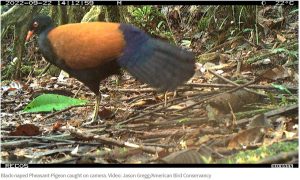
The black-naped pheasant-pigeon:
Confuciusornis:
Show transcript:
We’re going to learn about two birds that have been in the news lately.
The first is the black-naped pheasant-pigeon. The word nape refers to the back of the neck, and this bird does have a black neck. It’s a dark blue-black all over, in fact, with reddish-brown wings, a red bill, red eyes, and long yellow legs. It looks almost identical to the other three species of pheasant-pigeons known, although some scientists think they’re subspecies. Those three are the white-naped, the green-naped, and the grey-naped pheasant-pigeons, and if you’re wondering if the spot of color on the back of the neck is the easiest way to tell these birds apart, you are exactly right. All four species are native to parts of New Guinea or small islands nearby.
Pheasant-pigeons look a lot like pheasants and are about the size of a chicken, although they’re actually pigeons. They live in forests and eat seeds and fruit, and while they can fly they spend almost all of the time on the ground. We don’t know a whole lot about them because they’re so secretive and hard to spot in the wild, although the white-naped and green-naped birds are sometimes kept in zoos. In the case of the black-naped pheasant-pigeon, all scientists knew about it was from two specimens collected in 1882. It hadn’t been seen since…until September of 2022.
A team of scientists visited Fergusson Island off the east coast of Papua New Guinea in September, as part of a worldwide collaboration of scientists called The Search for Lost Birds. This is similar to the Search for Lost Frogs that has been active for over a decade, discovering lots of new amphibians and rediscovering even more. The 2022 search was actually a follow-up to a 2019 expedition that had failed to find the bird, although it did make other discoveries.
In 2022, the team brought more people and equipment, determined to make the best effort possible to find the black-naped pheasant-pigeon. They consulted with local hunters to find the best places to search, and talked to lots of residents to see if anyone had seen one, and spent day after day hiking through forested mountains. For weeks they had no luck. Then, in a remote mountain village, they finally met some people who were familiar with the bird. One man led them to the right part of the forest and they set up camera traps, but at that point they only had a few days left before they had to leave the island.
When they checked the pictures captured by the camera traps, though, they’d found it! Two of the cameras had taken pictures and video of what were definitely black-naped pheasant-pigeons, and since the cameras were several kilometers apart the pictures were probably of different individuals. The black-naped pheasant-pigeon wasn’t extinct, which means it can be protected. Habitat loss, especially from commercial logging, and feral domestic cats are the two main threats to birds in the area.
The other bird we’re going to talk about today hasn’t been seen in even longer: 119 million years, in fact. The article about this fossil was only released a few days ago as this episode goes live. You can check the show notes for links to this article and a good one about the pheasant-pigeon too.
Paleontologists discovered the bird’s fossil remains in northeastern China, in fossil beds that contain incredibly well-preserved animals and plants. The Jiufotang Formation in China dates to the early Cretaceous, between about 122 and 119 million years ago, and researchers think it’s from an area that was once a shallow lake surrounded by forests. Every so often, a nearby volcano would erupt and the resulting ash would fall into the lake, causing anoxic conditions that helped preserve animals that died and sank into the mud at the bottom of the lake. There are lots of fish, pterosaurs, birds, and dinosaurs among the fossils discovered, most of them small but a few quite large. This includes a type of tyrannosaur that probably grew around 33 feet long, or 10 meters. A few early mammals have been discovered too. In one case, the remains of 40 individual birds were found on one big slab of stone, and scientists think an entire flock of birds was killed by a volcanic ashfall or poisonous gases from the volcano.
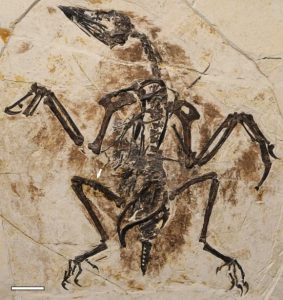
The newly described fossil we’re talking about today was almost complete and almost completely articulated, preserved with the impression of feathers around its body. The bird has been named Confuciusornis shifan and was a little smaller than a modern crow. It had a toothless beak and a short tail, although it probably had long tail feathers. Other Confuciusornis species have been discovered with the impressions of long tail plumes.
All of the Confuciusornis fossils discovered so far were birds that could fly well but probably nowhere near as well as any bird today. But C. shifan had an adaptation in its wings not seen in any other bird, living or extinct. It had a small extra bone in the wing that acted like a cushion and probably helped the wings withstand the stresses of flight.
The most interesting thing about the different Confuciusornis species is that if we could go back in time and see them when they were alive, they probably wouldn’t have looked unusual to most people, except to bird experts who would instantly freak out. For the most part, they just looked like birds. Some specimens show preserved melanosomes under electron microscopy that indicate the feathers were various colors including white, brown, red, and black. There’s even evidence of a pattern of spots and streaks on some feathers. Their feet were adapted for perching the way many modern songbird feet are. But Confuciusornis wasn’t a direct ancestor of modern birds as far as we know.
Even though we have lots of beautifully preserved Confuciusornis fossils, the fossils can only tell us so much. We have a pretty good idea of what the birds looked like, but we don’t know much about how they lived. One specimen was found with the remains of a tiny fish inside its body, so researchers think the birds may have eaten fish or might have just been omnivores that weren’t picky about what they ate. One specimen was found with an egg beside it that was the right size to have fit through its pelvic opening, but we can’t know for sure if the egg belonged to the bird or was from another bird and just happened to have settled near the dead bird when it fell in the water.
Still, even though we only have fossil remains, that’s much better than having no knowledge of these early birds at all.
Thanks for your support, and thanks for listening!