Episode 005: The Unicorn

Everyone knows the legend of the unicorn and most of us know unicorns don’t really exist. But how did the legend get started? And more importantly, can we talk about narwhals a whole lot? Narwhals are rad.

Narwhal. So rad.

I haven’t seen this show but apparently it’s pretty good. I love that elasmotherium.
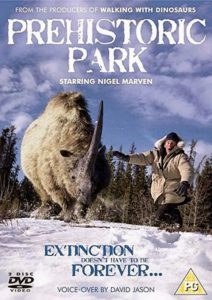
Unicorns are (sort of) real. Unicorning certainly is.

Thanks to Jen and Dave for suggesting this week’s topic!

Show transcript:

Welcome to Strange Animals Podcast. I’m your host, Kate Shaw.

This week’s episode is about the unicorn, or at least about almost-unicorns. This is a re-record of the original episode to improve sound quality and update some information.

When I was a kid, I was convinced unicorns were real. I’m not alone in this, apparently. A lot of people assume the unicorn is a real animal. Take away the magical trappings and it’s just a horse-like animal with one spiral horn. It seems a lot more plausible than squids, for instance.

I’m sorry to tell you that that kind of unicorn doesn’t exist, and never has, or at least we have no fossil or subfossil evidence that an animal resembling the classical unicorn actually existed. But the animals that probably inspired the unicorn legend are fascinating.

Everyone knows that the unicorn has one spiral horn growing from its forehead. The horn was supposed to have curative properties. If you ground up a little bit of the horn, known as alicorn, it acted as a medicine to cure you of poisoning or other ailments. If you actually made a little cup out of alicorn, you could drink from it safely knowing any poison was already neutralized. People in the olden days were really worried about being poisoned, probably because they didn’t understand how food safety and bacteria worked and they didn’t have refrigerators or meat thermometers and so forth. I suspect a lot of so-called poisoning cases were actually food poisoning. But this re-record is already off the rails, so back we get to the main topic.

All this about alicorn wasn’t legend, either. You could buy alicorn from apothecaries up until the late 18th century. Doctors prescribed it. It was expensive, though—literally worth its weight in gold. Pharmacies kept their alicorns on display but chained down so no one could steal them.

The alicorn, of course, was actually the tusk of the narwhal, and the narwhal is as mysterious as the unicorn in its own way. In fact, the narwhal seems a lot less plausibly real than a unicorn and a lot of people actually don’t realize it’s a real animal. I had that discussion with a coworker last year and had a lot of fun astonishing her with science facts, or maybe boring her. It’s a fairly small whale, some 13 to 18 feet in length not counting the tusk. That’s about four to five and a half meters long. It’s pale gray in color with darker gray or brown dapples, but like gray horses, many narwhals get paler as they age. Old individuals can appear pure white.

The narwhal and the beluga whale are similar in size and physical characteristics, such as their lack of a dorsal fin. They live in the same areas and are the only two living members of the family Monodontidae. They even interbreed very rarely.

But the narwhal is the one with the horn, or more accurately a tusk. It’s not a horn at all but a tooth. Most males and about 15% of females grow a tusk. Occasionally an individual grows two tusks, but almost always it’s the left canine tooth that pierces through the lip and continues to grow, sometimes up to ten feet long, or 3 meters.

It’s a weird, weird tooth too. It can bend as much as a foot without breaking, or 30 cm, not something teeth are generally known for. It also grows in a spiral. And we still don’t know what the narwhal uses its tusk for.

For a long time, researchers assumed that male narwhals used their tusks the same way male deer use their antlers, to show off for females and to battle other males. Males do exhibit behavior called tusking, where two individuals will rub their tusks together in what researchers once assumed was a ritual fight display. But that seems not to be the case.

A 2005 study discovered that the tusk is filled with nerves and is extremely sensitive. Through its tusk, the whale can identify changes in water temperature and pressure, water salinity, and the presence of fish and other whales. It even acts as an antenna, amplifying sound. The study was led by Martin Nweeia of the Harvard School of Dental Medicine. Nweeia is a dentist, basically, which delights me. Okay, he’s a clinical instructor in restorative dentistry and biomaterials scientist, but dentist is funnier.

I liked Nweeia even more when I found this quote: “Why would a tusk break the rules of normal development by expressing millions of sensory pathways that connect its nervous system to the frigid arctic environment?” As someone who has trouble biting ice cream without wincing, I agree.

In other words, the narwhal’s tusk has scientists baffled. You hear that a lot in a certain type of article, but in this case it’s true. Especially baffling in this case is why the tusk is found mostly in males. If having a tusk confers some advantage in the narwhal’s environment, why don’t all or most females grow one too? If having a tusk does not confer an advantage beyond display for females, why does the tusk act as a sensory organ?

The narwhal lives in the Arctic, especially the Canadian Arctic and around Greenland, and it’s increasingly endangered due to habitat loss, pollution, and noise pollution. Overall increased temperature of the earth due to climate change has caused a lot of the sea ice to melt in their traditional breeding grounds, and then humans decided those areas would make great oil drilling sites. The noise and pollution of oil drilling and exploration threatens the narwhal in particular, since when a company searches for new oil deposits it sets off undersea detonations that can deafen or even outright kill whales. But it’s hard to count how many narwhals are actually alive, and some recent studies have suggested that there may be more around than we thought. That’s a good thing. Now we just have to make sure to keep them safe, because narwhals are awesome.

The narwhal eats fish and squid and shrimp and sometimes accidentally rocks, because instead of biting its prey the narwhal just hoovers it up, frequently from the sea floor, and swallows it whole. It does that because it doesn’t actually have any teeth. Besides the one.

As a final narwhal mystery, on December 17, 1892, sailors aboard a ship in the Dundee Antarctic Expedition spotted a single-horned narwhal-like whale in the Bransfield Strait. But narwhals don’t live in the Antarctic…as far as we know.

One of the reasons why so many people believe the unicorn is a real animal is because it’s mentioned in some English-language versions of the Bible. When the Old Testament was first translated from Hebrew into Greek in the third century BCE, the translators weren’t sure what animal the re’em was. It appeared in the texts a number of times but wasn’t described. The translators settled on monokeros for their translation, which in English is unicorn. The King James Version of the Bible mentions the unicorn seven times, giving it a respectability that other animals (like squids) can’t claim.

These days, Biblical scholars translate re’em as a wild ox, or aurochs. You can learn more about the aurochs in episode 58, Weird Cattle. The aurochs was the ancestor to domestic cattle and was already extinct in most parts of the world by the third century BCE, but lived on in the remote forests north of the Alps until its final extinction in 1627.

So while the Greek translators didn’t know what the re’em was, why did they decide it was a unicorn? It’s possible they were drawing on the writings of Greek physician Ctesias, from the fourth century BCE. Ctesias described an animal from India he called a type of wild ass, which had “a horn on the forehead which is about a foot and a half in length.” But it seems clear from his writing that he was describing a rhinoceros.

In fact, any description of a rhino given by someone who hasn’t actually seen one, just heard about it, comes across as a unicorn-like animal. So it’s quite likely that the translators made a wild guess that the fierce re’em was a rhinoceros, which they would have known as a horse-like animal with one horn.

But while the unicorn is mentioned in the Bible, it isn’t a specifically Christian legend. The karkadann is a huge monster in Muslim folk tradition, with a horn so big it could spear two or three elephants on it at the same time. In Siberia, some tribes told stories of a huge black ox with one horn, so big that when the animal was killed, the horn alone required its own sledge for transport. In some Chinese tales, the kilin was supposed to be a huge animal with one horn. For more information about the kilin, or kirin, you can listen to episode 61.

It’s probable that all these stories stem from the rhinoceros, which is a distinctive and unusual animal that we only take for granted today because we can go visit it in zoos. But some researchers have suggested a more exotic animal.

Elasmotherium was an ice age animal sometimes called the steppe rhino, giant rhino, or Siberian unicorn. The largest of the three species of elasmotherium was the size of a mammoth, some seven feet tall at the shoulder, or 2.1 meters. It was a grazer like horses and cattle today, and like them it had long legs, much longer than living rhinos. It could probably gallop at a pretty good clip. It lived at the same time as the smaller woolly rhino, but while the woolly rhino resembled modern rhinos in a lot of respects, notably its large horn on the nose with a smaller horn farther up, elasmotherium only had one horn…one enormous horn. On its forehead.

We don’t actually have any elasmotherium horns to look at. Rhino horns aren’t true horns at all but a keratin structure. Keratin is an interesting fiber. It can be immensely tough, as it is when it forms rhinoceros horns, but it’s also what our nails and hair are made of. It doesn’t fossilize any more than hair fossilizes. The main reason we know elasmotherium had a horn is because of its skull. While rhino horns are made of keratin fibers instead of bone, the skull shows a protuberance with furrows where blood vessels were that fed the tissues that generated the horn. In elasmotherium, the protuberance is five inches deep, or 13 cm, and three feet in circumference, or just over a meter. Researchers think the horn may have been five or six feet long, or 1.5 to 1.8 meters.

Researchers have also found an elasmotherium fossil with a partially healed puncture wound. It’s possible the males sparred with their enormous horns and sometimes inflicted injuries. At least it happened once.

For a long time researchers thought elasmotherium died out 350,000 years ago, much too long ago for humans to have encountered it. But a skull found a few years ago in Kazakhstan was radiocarbon dated to about 29,000 years old. If elasmotherium and humans did cross paths, it wouldn’t be at all surprising that the animal figured in stories that have persisted for millennia. More likely, though, our early ancestors found carcasses partially thawed from the permafrost the way mammoth carcasses are sometimes found today. This might easily have happened at the end of the Pleistocene, a relatively recent 11,000 years ago or thereabouts. A frozen carcass would still have a horn, and while the carcasses are long gone now, it’s not unthinkable that stories of a massive animal with a monstrous single horn were passed down to the present.

Of course, this is all conjecture. It’s much more likely that the stories are not that old and are about the modern rhinoceros. But it’s definitely fun to think about our ancestors crossing a vast hilly grassland for the first time in search of new hunting grounds, and coming across a herd of towering monsters with five-foot horns on their foreheads. That would definitely make an impression on anyone.

One final note about the unicorn. When I was a kid, I read a book called A Grass Rope by William Maine, published in 1957 so already an oldie when I found it in my local library. It concerns a group of Yorkshire kids who hunt for a treasure of local legend, which involves a unicorn. I was an American kid from a generation after the book was written, so although it’s set in the real world it felt like a fantasy novel that I could barely understand. When one of the characters discovers a unicorn skull, it didn’t seem any more extraordinary to me than anything else. But on rereading the book in my late teens, I was struck by a character at the end who tells the children “it’s not very hard to grow unicorns.”

By that time, I pretty much had Willy Ley’s animal books memorized, including the chapter about unicorns. In it, he talks about unicorning animals that have two horns.

The practice of unicorning has been known for centuries in many cultures, but the first modern experiment was conducted in 1933 by Dr. Franklin Dove in Maine. He removed the horn buds from a day-old bull calf and transplanted them to the middle of the calf’s forehead. The calf grew up, the horn buds took root and grew into a single horn that was almost completely straight and which sprouted from the bull’s forehead.

Dr. Dove reported that the bull was unusually docile, although I suspect his docility may have come from being handled more than the usual bull calf, so he became tamer than most bulls. Either way, the experiment proved that unicorning wasn’t difficult. Any animal that grows true horns, such as sheep, goats, and cattle, can be unicorned.

More recently, in the 1980s, neopagan writer Oberon Zell Ravenheart and his wife Morning Glory unicorned mohair goats that looked astonishingly like the unicorns of legend. So technically, kid me was right. Unicorns are sort of real.

You can find Strange Animals Podcast online at strangeanimalspodcast.blubrry.net. That’s blueberry without any E’s. If you have questions, comments, or suggestions for future episodes, email us at strangeanimalspodcast@gmail.com. We also have a Patreon at patreon.com/strangeanimalspodcast if you’d like to support us and get twice-monthly bonus episodes for as little as one dollar a month.

Thanks for listening!
Episode 004: The Irish Elk

(re-recorded audio)

In which your host calls her own podcast by the wrong name! And doesn’t catch it until it’s too late to change (i.e. five minutes ago). This week’s episode of Strange Animals Podcast is about the Irish Elk specifically and the Pleistocene era in general, especially as regards to humans spreading out across the world from Africa. Did the Irish elk’s enormous antlers really have anything to do with its extinction? And is it really for-sure extinct? (Spoiler alerts: no and yes.)

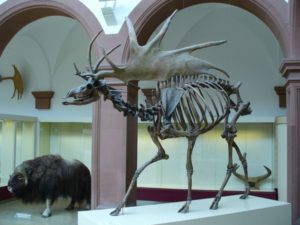
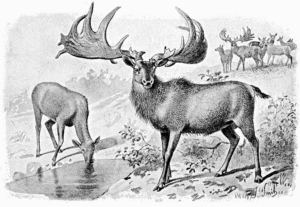
The Irish elk (more accurately called the giant deer) could stand as tall as seven feet high at the shoulder.

Show transcript:

Welcome to Strange Animals Podcast. I’m your host, Kate Shaw. This is a re-record of the original episode to improve audio quality and bring some of the information up to date.

This week’s episode is about the Irish elk, the first of many episodes about Ice Age megafauna. But before we learn about the Irish elk, let’s start with the span of time popularly known as the ice age, along with information about how humans spread across the world.

The last two million years or so of history is known as the Pleistocene, which ended about 12,000 years ago. The end of the Pleistocene coincides roughly with the extinction of a lot of the Pleistocene megafauna and the beginning of modern historical times.

During the Pleistocene, the earth’s axis tilt and plane of orbit resulted in reduced solar radiation reaching the earth. The process is due to what is called Milankovitch cycles, which I won’t go into since I don’t actually understand it. To grossly oversimplify, the earth got colder for a while because there wasn’t as much sunshine as usual, and all of these glaciers formed, and then it would warm up again and the glaciers would melt. This happened repeatedly throughout the Pleistocene, which was actually a series of ice ages with interglacial times in between.

Our current era is called the Holocene, and it’s considered an interglacial period. But if you’re hoping that the next ice age is a neat solution to global warming associated with climate change, the next glacial period isn’t expected for another 3,000 years.

The word megafauna means “giant animals.” You might hear dinosaurs referred to as megafauna, and that’s accurate. It’s a general term applied to populations of animals that grow larger than a human. Humans are also considered a type of Ice Age megafauna. high five, all my ice age peeps yes I kept that dumb line in this re-record

During the Pleistocene, humans migrated from Africa and spread across the world, rubbing shoulders with Neandertals, making awesome stone tools, and killing megafauna whenever they could. Humans are good at killing animals. In elementary school, I remember reading about ancient tribes of people stampeding mastodons over cliffs, eventually killing them all off. I didn’t believe it, but that’s actually true. We have lots of evidence that many types of animals were killed in this way, and it may have led to the extinction of some of the megafauna. It certainly didn’t help them. Wherever humans showed up, extinctions followed. The only exception is Africa, probably because the animals in Africa evolved alongside humans and knew how to deal with us. But when the first bands of humans showed up in Eurasia and the Americas, the native animals didn’t even know we were predators. They certainly didn’t know how to avoid being stampeded over cliffs. That’s a skill you don’t get many chances to practice.

Many people, especially Europeans, think that native peoples of whatever part of the world are natural conservationists. They live in harmony with nature, taking only what they need and using, for instance, every part of the buffalo. But human nature is human nature. Sure, when you live in a comfortably established village with a set territory, and your hunters and fishers start noticing that there’s not much game left, you learn conservation or you starve. But when you’ve got an entire world ahead of you—vast continents that have never seen a tool-using great ape with wicked intelligence and an insatiable appetite, you don’t need to live in harmony with nature. Our ancestors would find a nice area, settle there for a while, and when all the easily obtainable food was gone, they’d move on.

Humans still act this way. That’s why we leave trash all over the place. But the good news is that we are also good at recognizing when we’re causing a problem and deciding to fix it. So even though our first impulse might be to throw trash everywhere, we can also stop doing that and clean up trash already on the ground.

By the beginning of the Pleistocene, the continents were in their current spots. The world looked about the way it did now. But during the glacial periods, so much water froze that sea levels dropped around 300 feet. This exposed huge areas of continental shelf, making the continents bigger and joining some of them together. For instance, during glaciation, Alaska was connected to Asia. In some books you’ll see this talked about as a land bridge, which I always imagined as narrow and muddy. But it wasn’t just a bridge, it was a huge chunk of continent, and it stayed that way for thousands of years.

Then the temperature would warm up, sometimes dramatically. Within a few decades, the glaciers had mostly melted, the sea levels rose and flooded the low-lying land, and animals scrambled to find a comfortable habitat. It’s easier for an animal to move than to adapt to a changing habitat.

Even though a lot of land was flooded, other land opened up as glacial barriers disappeared. Animals that had traveled to Alaska on a land bridge from Asia could now move deeper into North America. Animals from deeper in North America could enter Alaska.

This colder-warmer-colder pattern happened a few dozen times during the Pleistocene, shaking the climate up repeatedly and leading to extinctions, with or without human help, and animals that look strange to us now because we don’t fully understand the environments they adapted to. But one thing is for sure. The megafauna were all awesome.

Fast forward to a few hundred years ago. European humans are in the middle of a territorial war with North American humans, and as they pushed their way farther into North America, they started to find interesting things: giant bones in the southerly areas, actual frozen carcasses in the permafrost of the northerly areas. Some of those carcasses looked so fresh, and the interior of North America was so little explored by Europeans that a lot of people assumed they’d find living mammoths if they looked in the right spot. When Thomas Jefferson sent Lewis and Clark on their turn of the 19th century expedition, one of their goals was to find mastodons and other megafauna.

They didn’t, of course. Instead they almost died repeatedly and had to be rescued by Sacajawea, who I like to imagine kept sighing with exasperation but who at least got to hang out with the expedition’s Newfoundland dog. Newfies are the best. (I miss you, Jasper.)

So, now we have a little bit of background about Ice Age megafauna. If you’re interested in learning more about how humans evolved and spread across the world, and our extinct close cousins, you can listen to episodes 25 and 26.

The Irish elk was the reason I started this podcast. I happened across the so-called fact I learned in elementary school, that the Irish elk died out because its antlers became so big that it couldn’t escape from predators.

I hadn’t thought of the Irish elk in literally decades. But that antler thing didn’t sound right. I caught myself thinking about it on and off, even getting angry. It didn’t make sense. It’s not like evolution is a power-up in a video game, and as soon as one elk got extra super gigantic antlers, suddenly all elk had them. If overlarge antlers were an issue, only stags with the biggest antlers would die. Does would mate with the remaining stags with smaller antlers and their offspring would be more likely to have small antlers. Besides, deer of all kinds shed their antlers every year and regrow them, which means the stags with biggest antlers wouldn’t have to deal with them for more than a few months of the year.

I did some research, which I found so much fun I decided to turn it into a podcast. Then I realized I couldn’t really make an ongoing podcast exclusively about Irish elk, which is pretty obvious now that I think about it.

So, it turns out that the Irish elk is neither exclusively Irish nor an elk. It did live in the area now called Ireland, but it also lived all across Eurasia and even in northern Africa. Like many deer it liked open woodland and was a browsing animal, meaning it didn’t eat grass but did eat lots of other plants, including green twigs and bark, and if it lived nowadays it would undoubtedly come to my yard and eat my garden.

Recent genetic analysis suggests it’s more closely related to the fallow deer than to elk. For these reasons, many publications these days refer to it as the Giant Deer. Officially it’s Megaloceros giganteus.

Megaloceros did have huge antlers, that’s for sure, sometimes as much as a twelve-foot span, or 3.7 meters. If you’re sitting in an ordinary house, the ceiling is probably eight feet high, maybe nine, or 2.4 to 2.7 meters. The biggest male giant deer could stand about seven feet at the shoulder, or 2.1 meters, and weigh as much as 1500 pounds, or 680 kg. That’s the size of a bull Alaskan moose, although moose antlers are maybe six feet across, or 1.8 m.

So, giant deer had giant antlers, the biggest of any known deer species. But were they really that big relative to the animal’s size? Stephen Jay Gould published a study in 1974 that concluded that compared to the deer’s body size, Megaloceros’s antlers weren’t actually out of proportion at all. They’re just big animals. Sexual selection did encourage antler size—the ladies liked stags with big racks, and stags with bigger antlers could intimidate rival males more easily. But since Megaloceros shed and regrew their antlers every year, in years where the foraging wasn’t as good, everybody’s antlers tended to be smaller.

So why did Megaloceros die out? When did it happen? And are there pockets of giant deer still living in Siberia?

Those questions are all interrelated and surprisingly hard to answer—although I’m not going to lie, if you’re packing your bags for Siberia to look for giant deer, you’re probably going to be disappointed. But there is evidence that Megaloceros survived much later than formerly thought.

Until recently, the last known remains of Megaloceros were dated to the end of the Pleistocene, about 11,000 years ago. Then a partial giant deer skeleton was found on the Isle of Man, and an antler was found in southwest Scotland. Both were dated to about 9,000 years ago, as published in a year 2000 paper in Nature. In 2004, another paper in Nature revealed that giant deer remains found in western Siberia had been dated to about 7,700 years ago.

So, giant deer were around several thousand years later than previously thought, at least in Siberia. Back in the mid-19th century, some naturalists thought Megaloceros might even have survived well into modern days and been hunted to extinction by modern humans. Well preserved skulls were sometimes found in Irish peat bogs, and it wasn’t uncommon for the antlers to be mounted and displayed. I would.

In 1846, a huge cache of bones was found on a small island in a lake near Limerick in Ireland. Among the bones were Megaloceros skeletons. What interested researchers at the time were the Megaloceros skulls. The stags’ skulls were normal. The smaller skulls, thought to be from females, had holes in the front. They looked for all the world like the skulls of cows that had been slaughtered by being poleaxed in the head—a common butchering practice in the area up until recent times. Researchers thought they might have found evidence of limited domestication of giant deer, where the less dangerous females were raised in captivity while stags were hunted in the wild.

Unfortunately, excavation methods in those days left a lot to be desired. There’s no way now to determine whether the Megaloceros bones were actually mixed in with more recent domestic animal bones or whether they were in older deposits. There’s also doubt that the doe skulls were actually Megaloceros. It’s more likely they were elk or moose skulls. Both animals lived in the area well into the Holocene before going extinct, and the skulls are very similar to those of Megaloceros. As far as I can find out, the bones are gone so they can’t even be DNA tested or radiocarbon dated to see how old they are.

As to why the giant deer went extinct, I’m not saying it was humans…but it was humans. Actually we don’t really know. In some places extinction may have been caused by environmental pressures, including a shortened growing season that would have made food scarce. In other places humans may have been at least a partial cause. But isolated pockets of Megaloceros remained for thousands of years afterwards. Why aren’t they still around?

Hopefully, as more remains are found we’ll learn more. It’s likely that the Siberian deer, which survived longest, migrated onto the plains as the foothills of the Urals became more heavily forested about 8,000 years ago. But that coincided with a dry period and with settlers moving into the area. A combination of reduced fodder, loss of habitat, and hunting may have finally driven the giant deer to extinction.

But don’t be sad! Even if we don’t have Megaloceros in zoos these days, we do have a lot of fascinating deer and relatives of deer—moose, reindeer, elk, and so forth. You can still appreciate them.

I do sometimes think that being extinct makes an animal seem more interesting, just because we know we can never see a living specimen. If moose were extinct, this episode would probably be about the moose, and how awesome it was, and how little we know about it, and how it’s a shame they’re all dead. But hey, moose are still around. Take a little time out of your day today to appreciate the moose. (Also, you can check out episode 30 for lots more information about moose and reindeer.)

You can find Strange Animals Podcast online at strangeanimalspodcast.com. We’re on Twitter at strangebeasties and have a facebook page at facebook.com/strangeanimalspodcast. If you have questions, comments, or suggestions for future episodes, email us at strangeanimalspodcast@gmail.com. We also have a Patreon if you’d like to support us that way.

Thanks for listening!

Episode 003: The Tuatara and the Sea Lamprey

In this week’s episode, we look at a couple of so-called living fossils: the tuatara and the lamprey. One of them hasn’t changed appreciably in almost 400 million years. Tune in to find out which one and learn about how gross it is and how cute the other one is! (I may be biased.) (re-recorded audio)

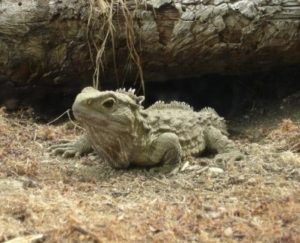
The adorable tuatara! It eats anything, including baby tuataras. Not cool, lizardy guy:

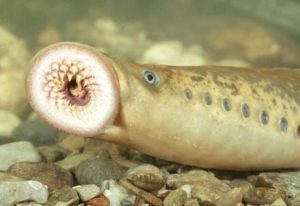
A face not even a mother could love. The sea lamprey:

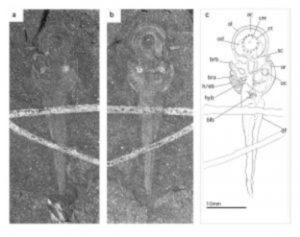
A recently discovered fossil lamprey, complete with impression of its body:

Show transcript:

Welcome to Strange Animals Podcast. I’m your host, Kate Shaw.

This week’s episode is about my favorite reptile and a revolting sea creature, and just to be clear, those are two different animals.

If you look at a tuatara, it appears pretty ordinary. It’s a brownish-grayish-green lizard with lighter-colored spines along its back, and it can grow to about two feet long, or 61 cm. It’s a hefty lizard, sure, but you’d probably think it was nothing special. But dang, is it special.

First of all, it’s not strictly a lizard. It’s the only surviving member of its own order, Rhynchocephalia. It also has many physical traits not shared by lizards—or any other living reptile. Or mammal. Or bird. Or anything else.

Its teeth, for instance. The tuatara has two rows of teeth in the upper jaw, one in the lower, with the lower jaw’s teeth fitting neatly between the two upper rows. Some snakes have two upper rows of teeth and one lower row, but not arranged like the tuatara’s. Not to mention that the tuatara’s teeth aren’t even teeth at all. They’re just pointy projections of the jaw bone.

The tuatara also chews in a literally unique way. When the lower teeth mesh between the upper rows of teeth, the animal moves its jaw forward and back. This slices its food against the sharp tooth edges.

The tuatara also has a third eye. I’m not making this up. It legit has a photoreceptor on top of its head called the parietal (pahRAYetal) eye with a lens, cornea, retina, and so forth. Hatchling tuataras have a translucent patch of skin above the eye, but as the hatchling grows and molts its skin, the patch darkens until the third eye is no longer visible. Researchers think it may help with thermoregulation and hormone production. The tuatara isn’t the only creature with a third eye, but it has the most well developed one.

Like the turtle, the tuatara has a primitive auditory system. It has no external ears and no eardrum, although it can hear. Its skeleton has some features apparently retained from its fish ancestry, such as its spine and some aspects of its ribs. Males don’t have a penis—but a lot of birds don’t either and we still have lots of birds, so obviously they make it work.

Because it has such a slow metabolism—the lowest body temperature of any other reptile—the tuatara grows slowly. It won’t reach breeding age until it’s ten to twenty years old, and females only lay eggs about once every four years. The average lifespan of a tuatara is 60 years. Researchers believe it could live to 200 years in captivity.

Baby tuataras are active in the daytime, probably so their parents won’t eat them. Tuataras eat pretty much anything they can catch. Adult tuataras are active at night, and sleep during the day in dens. Sometimes a tuatara digs its own den, sometimes it shares a den with burrowing seabirds. The birds leave in the morning and the tuatara comes home to sleep until night, when the birds return.

The Tuatara is native to New Zealand, and in an all-too-common situation, when people showed up, the tuatara promptly went extinct on the mainland. It was restricted to 35 islands where it was mostly safe from introduced rats, until its reintroduction in the fenced Karori Sanctuary in 2005. Tuataras have begun to breed in the sanctuary.

One thing I didn’t know about New Zealand—one of many many things, since pretty much all of my New Zealand knowledge comes from watching the Lord of the Rings movies, is that it was underwater for millions of years. Some 82 million years ago, New Zealand separated from Gondwana, the chunk of land that eventually separated into the southern continents we know today. The entire continent containing New Zealand was partially drowned some 25 million years ago, and for a long time scientists thought New Zealand was completely underwater. In the late 2000s, though, a fossil tuatara was found in New Zealand that was dated to about 18 million years ago. If New Zealand was underwater for a few million years, how did the tuatara recolonize it after the sea receded? Tuataras are not good swimmers, and it’s a long distance to float on driftwood without water.

Researchers now think that the highest elevations of New Zealand remained above sea level, allowing tuataras and some other species of plants and animals to survive the inundation.

You’ll see the tuatara referred to as a living fossil in a lot of articles. The media loves to call things living fossils. The tuatara has been around for 225 million years, but so have crocodiles and alligators. In fact, crocs and gators are found in the fossil record even earlier, 250 million years ago. The tuatara in particular has a lot of modern adaptations, including a number of cold-weather adaptations. A 2008 study discovered that the tuatara has the highest molecular evolution rate of any animal ever measured.

Basically, you can’t keep the tuatara down. Drown its entire continent? No problem. Run a couple of ice ages through there? It’ll adapt. And now we realize that this isn’t even its final form.

I take you now from a chunky little lizardy thing eating crickets in New Zealand to a two-foot-long monstrosity that drills into living creatures to drink the blood and bodily fluids it rasps from their tissues, the sea lamprey.

What does the tuatara have to do with the sea lamprey? I mean beyond the fact that the tuatara would happily slurp up any lampreys it could get into its mouth? Well, if the tuatara is the most rapidly evolving creature ever studied, the lamprey has remained basically unchanged for at least 360 million years.

Lampreys are eel-like parasites that lack jaws. Instead, they have a circular mouth rimmed with rows and rows of rasping teeth, for lack of a better word. I saw this described in one paper as a feeding apparatus, and it’s as good a description as any although it doesn’t convey the utter, utter horror that is the lamprey’s mouth. I may be showing my prejudices here.

Those aren’t teeth, by the way, they’re made of cartilage. The lamprey doesn’t have any bones at all, but it does have a cartilage tooth-studded tongue used to drill into its prey once it’s clamped on with its sucker-like mouth. Dear God.

Not all lampreys are parasitic. Some are filter feeders as larva and don’t eat at all once they grow up, just live on their bodily reserves until they breed and die, but I’m just talking about parasitic lampreys today because they’re gross. The most common parasitic lamprey is the sea lamprey, which lives in the Atlantic Ocean, parts of the Mediterranean and Black Seas, and in the Great Lakes as an introduced pest. The sea lamprey can grow up to four feet long, or 120 cm.

Because of their lack of bone, lampreys don’t fossilize well, but one fossil found in South Africa has revealed a lot about the lamprey. In a 2006 paper in Nature, researchers describe a beautifully preserved lamprey dated to 360 million years ago. Not only are the gills and mouth perfectly visible, so is an impression of its body. It was the oldest lamprey fossil found at the time, and it shows that the lamprey basically hasn’t changed ever since. If anything deserves to be called a living fossil, it’s the lamprey.

Back when the lamprey first evolved, it wasn’t preying on true fish. There weren’t any yet. The lamprey has held fast through at least four major extinction events. It’s a vertebrate, but has never evolved those things other vertebrates—except the hagfish, which is just weird—have developed: jaws, scales, paired fins. On the other hand, some lampreys do have a third eye.

Because lampreys are so primitive from an evolutionary standpoint, scientists can study them to learn how other vertebrates evolved. For instance, the lamprey has seven pairs of gill arches. In other vertebrates, the interior pair of gill arches evolved into upper and lower jaws and middle ear bones. That includes us.

Lampreys today prefer fresh water that’s not too warm, although the sea lamprey spends most of its adult life in the ocean, although it will also be fine in fresh water. The sea lamprey migrates upriver to spawn. After the female lays her eggs, she and the male both die. When the eggs hatch, the larvae migrate downstream to quiet water where they feed on plankton until they metamorphose into adult lampreys. Then they continue their migration downstream to the ocean or lake. They live about a year before returning upstream to spawn and die.

Lamprey larvae live as filter feeders, and until about 2014 scientists didn’t know if this was a recent development or not. Then some fossilized lamprey larvae were discovered in inner Mongolia rocks dating back 125 million years, and they look identical to modern larvae.

Old and “primitive” as it is, the lamprey is able to tolerate all sorts of environments. Most water animals can either live in saltwater or freshwater, not both, but the sea lamprey does just fine in either. In the Great Lakes, sea lampreys are so damaging to the native fish that researchers have been trying for decades to get rid of them. The sea lamprey can also feed on fish that are toxic to pretty much any other predator.

In many cultures, lamprey is considered a delicacy, and it’s supposed to taste quite good, but make sure you clean those things well. Their mucus is a toxin. You will not catch me eating lamprey if I can possibly avoid it.

You can find Strange Animals Podcast online at strangeanimalspodcast.com. We’re on Twitter at strangebeasties and have a facebook page at facebook.com/strangeanimalspodcast. If you have questions, comments, or suggestions for future episodes, email us at strangeanimalspodcast@gmail.com. We also have a Patreon if you’d like to support us that way.

Thanks for listening!