Episode 051: The Carolina Parakeet and the Elephant Bird

This week’s episode is about the Carolina parakeet, a cheerful, pretty bird that was once common in the central and eastern United States but which has been extinct for a century. Thanks to Maureen for the suggestion! I’ve paired it with the elephant bird, a gigantic extinct bird that we don’t know much about except for its enormous eggs.

The Carolina parakeet, deceased:

An ex-parrot next to an ex-passenger pigeon:

A still from the 1937? Nelson video:

The 2014 mystery parakeet photo:

An elephant bird, an elephant bird egg, and Sir David Attenborough (right):

Further Reading/Watching:

Here’s a close evaluation of the Nelson video taken in the late 1930s, supposedly in the Okefenokee Swamp.

I can’t get the Nelson video to embed properly, so here’s a link to it. You’ll need to scroll down to the bottom of the page for a decent-sized version that will play.

Show transcript:

Welcome to Strange Animals Podcast. I’m your host, Kate Shaw.

This week’s episode is about two birds, one small and one really big, and both extinct. Probably.

First, let’s learn about the Carolina parakeet, a suggestion by listener Maureen. It was a type of small parrot that was common throughout a big part of the United States, as far west as Nebraska and parts of Colorado and as far north as New York, and as far south as Florida and around the Gulf of Mexico. It had a yellow and orange head and a green body with some yellow markings, and was about the size of a mourning dove or a passenger pigeon.

This story of extinction mirrors that of the passenger pigeon in many ways. The Carolina parakeet lived in forests and swamps in big, noisy flocks and ate fruit and seeds. But when European settlers moved in, turning forests into farmland and shooting birds that were considered pests, its numbers started to decline. In addition, the bird was frequently captured for sale in the pet trade and hunted for its feathers, which were used to decorate hats. Part of the reason it was so easy to kill was that if a wounded bird’s cries were heard by other Carolina parakeets—and they probably would hear it, since these birds were loud, with calls carrying up to two miles—the whole flock would come flying out to help the wounded bird.

By 1860 the Carolina parakeet was rare anywhere except the swamps of central Florida, and by 1904 it was extinct in the wild. The last captive bird died in the Cincinnati Zoo in 1918, which was not only the same zoo where the last passenger pigeon died in 1914, it was the same cage. It was declared extinct in 1939.

We don’t know a lot about the Carolina parakeet even though it survived into the 20th century because no one made any particular study of the bird. John Audubon painted it and made some notes, and we have a lot of skins, skeletons, and some stuffed specimens, but that’s about it. There were two subspecies, one that lived to the east of the Appalachian mountain range, and one that lived to the west, that went extinct sooner than the eastern subspecies and was more bluish-green than green.

One interesting thing that Audubon noted is that cats that killed and ate Carolina parakeets died. The bird ate a lot of cockleburs, and the cocklebur’s seed is poisonous—so much so that livestock die from eating them. If you listened to episode 31, venomous animals, you may remember the Africa spur-winged goose that eats toxic blister beetles, collects the toxin in its tissues, and is therefore poisonous to eat. It’s probable that the Carolina parakeet did the same with cocklebur toxins.

Sightings of the bird in the wild occurred through the 1920s and 30s. A whole flock of some 30 birds was spotted in Florida in 1920, and in 1926 three nesting pairs were seen in Okeechobee County, Florida by the Curator of Birds at Florida University, Charles Doe. Doe was so excited to find these supposedly extinct birds that he ROBBED ALL THREE PAIRS OF THEIR EGGS. Because that man was an idiot and he will go down in history as an idiot. Charles E. Doe, Idiot, it probably says on his tombstone. His egg-shaped tombstone, probably.

In the mid-1930s ornithologist Alexander Sprunt Jr collected a number of sightings of Carolina parakeets in the Santee Swamp in South Carolina. Numerous trained bird wardens and ornithologists saw the birds, but it didn’t matter. In 1938 the Santee River was dammed and a power plant built, which radically changed the area ecosystem, and much of the surrounding forest was cut down and the swampland drained during the construction process. No one has reported any parakeet sightings since then.

Of course, the southeast still has lots of swampland, some of it all but impenetrable. The Okefenokee Swamp in Georgia and Florida is close to half a million acres, or more than 1700 square kilometers, and most of that area has been a national wildlife refuge since 1974. In 1937 or a little after, someone shot about 50 seconds of color film footage of three green birds in the Okefenokee. The footage is usually attributed to a man named Oren, or Orsen, Stemville.

In the early 1950s an Audubon lecturer named Dee Jay Nelson bought an old film camera from a boat operator in the Okefenokee Swamp. The box it came in contained eight rolls of processed 16mm film, but Nelson didn’t actually view those rolls for about 15 years. One roll contained footage of alligators and toads native to the Okefenokee, and in between those was some strange footage of three green birds.

Roger Tory Peterson, a member of the American Ornithologists’ Union, got a copy of the film and presented it to the society for analysis in 1969. There was no consensus as to whether the birds were feral pet parakeets of some kind or Carolina parakeets. Peterson misplaced his copy of the film and when Nelson was contacted by the society in 1979, he said he had lost the original. But in 2005 the copy turned up in Peterson’s effects after he died. At that point the Ornithologists’ Union analyzed the film again and concluded that not only are the birds not Carolina parakeets, they appear to have been artificially colored to look like Carolina parakeets. In other words, it was a hoax—and not even a very good one. It’s possible that only one of the birds was even real; the others were probably taxidermied birds or models. Nelson’s story about how he found the footage is fishy anyway. In the 1960s Nelson was a screen-tour lecturer from Montana, so he may have shot the footage himself to illustrate some project that never got off the ground.

The 2005 analysis of the footage was thorough. The society even brought in botanists to find out what kind of tree is shown in the film, but they were unable to identify it and said that the Spanish moss draped on the branches appears to have been placed there instead of growing there naturally. I’ll put a link in the show notes to the society’s close notation of the footage, practically frame by frame. The film is archived with the Cornell University’s Laboratory of Ornithology, and I’ll include a link to the video too.

The problem with sightings is that the green parakeet, a species native to Central America as far north as the southern tip of Texas, and the red-masked parakeet from Ecuador and Peru, look similar to the Carolina parakeet and have been pets in the United States for a long time, as have many other parrot species. In Florida in particular, escaped parrots sometimes survive and band together in breeding colonies, and by the 1920s had already begun to do so. So if the Nelson footage isn’t a hoax, it might be mistaken identity.

While I’m pretty nearly certain that the Carolina parakeet really is extinct, if it still manages to hang on in the depths of the Okefenokee swamp or elsewhere, anyone who’s observed it might assume they’ve only seen a red-masked parakeet or something.

On April 1, 2009 someone posted an article that looked like a press release from Cornell University about the discovery of a population of Carolina Parakeet in northern Honduras. It was an April fool’s joke, but it was so convincing that people still claim it’s real. I really hate April fool’s, by the way.

In January 2014, someone posted an interesting picture to a bird forum, saying her son took the picture at their home in southern Georgia in 2010 and asking what kind of parrot it was. The bird’s a dead ringer for a Carolina parakeet sitting in an apple tree. The poster deleted the thread later, upset at being accused of posting a hoaxed picture. This being the internet, no one can agree on whether the picture is real or shopped. It looks real to me, but while it might be a young yellow-headed Amazon parrot, the red cheeks aren’t a yellow-headed trait. So it’s a mystery.

From this small, brightly colored bird we go to a gigantic one. The elephant bird stood about ten feet tall head to toe, or 3 m, and while it looks superficially like an ostrich, it was more closely related to the tiny kiwi of New Zealand. But the elephant bird only lived in Madagascar.

It’s possible that stories about the roc, an eagle so big it could pick up elephants, were actually garbled stories about the elephant bird. That’s where the name elephant bird comes from, incidentally. The real life elephant bird probably became the fabled roc not from sightings of the bird but from its eggs. The eggs were enormous, the largest bird egg known and possibly the largest egg ever known, some over a foot long or about 34 cm, and big enough to hold over two gallons of liquid, or seven and a half liters. We’re getting close to watermelon sized here.

In 1930, in the southernmost point of Western Australia, two boys were playing along the beach and discovered a gigantic egg buried in a sand dune. They took it home, where no one had any idea what bird might have laid it. It was twice the size of an ostrich egg. Eventually it was given to the Western Australia Museum, and in 1962 a naturalist examined it and identified it as the egg of an elephant bird. Another elephant bird egg was found in western Australia by three children in 1992. But what were they doing in Australia? Elephant birds can’t fly, were never native to Australia or anywhere else except Madagascar, and anyway by 1930 they were certainly extinct.

Well, eggs can float, especially in saltwater and especially if the embryo inside has died, as would happen if the egg was washed out of its nest and into cold water. The elephant bird liked to lay its eggs in sand along the beach or rivers. Sometimes they would be washed out to sea. People who found elephant bird eggs without knowing what kind of enormous bird they would hatch into would naturally tell stories about them, like the roc. And even now, when there are no elephant birds around to lay new eggs, intact eggs are still occasionally found. The shells of elephant bird eggs were as much as 4 mm thick, which doesn’t sound like much but is way thicker than any other egg shell. That’s over an eighth of an inch thick.

So these were big, tough eggs that weren’t easily destroyed. Moreover, the egg found in Australia in 1992 was dated to 2,000 years old and was found in deposits of sand that had been laid down a few thousand years ago too. Both eggs had been in place for millennia until those meddling kids dug them up.

In 1974 a King Penguin egg was found floating near the beach very near where the 1930 elephant bird egg was found, having drifted some 1200 miles, or 2,000 km, in only a matter of weeks. In 1991 another King Penguin egg was found in the same region. This one was covered in barnacles and algae, but both were easily removed without damaging the egg. And in the early 1990s, a man working on a dredge in the Timor Sea, which is part of the Indian Ocean, spotted an ostrich egg in the water and retrieved it. It was so heavily weighted down with algae that it wasn’t bobbing along at the surface, but it was still floating under the surface and was intact. Any barnacles that had grown on the elephant bird eggs would have been sandblasted off by wind once the eggs were beached. The 1930 egg had one surface polished smooth from exposure to wind.

The elephant bird ate plants, probably nuts and fruit. Some researchers think the fruit of some rare species of palm trees on Madagascar were eaten and dispersed by the elephant bird. It had muscular legs like an ostrich but was so heavy, it probably couldn’t run very fast.

We’re not sure when the elephant bird went extinct. Some egg shells have been dated to about 1,000 years ago and that seems to be the latest signs of elephant birds. But as late as the 17th century native people from Madagascar were adamant that it still lived in hard-to-travel swamps.

We do have a pretty good idea of why the elephant bird went extinct, though. The eggshells were used as buckets and bowls, and archaeological studies have found plenty of charred shells in cooking fires. One elephant bird egg could feed an entire family. The adult birds were also hunted and eaten. Not only that, when European settlers decided they’d like to live in Madagascar now, thanks very much, you native people can just shift over and give us all the good land, deforestation and overhunting combined to finish off the elephant bird forever.

Like other recently extinct animals, the elephant bird is a good candidate for de-extinction once cloning technology is perfected. But if we do get the elephant bird back, we have to promise not to eat all its eggs.

You can find Strange Animals Podcast online at strangeanimalspodcast.com. We’re on Twitter at strangebeasties and have a facebook page at facebook.com/strangeanimalspodcast. If you have questions, comments, or suggestions for future episodes, email us at strangeanimalspodcast@gmail.com. If you like the podcast and want to help us out, leave us a rating and review on Apple Podcasts or whatever platform you listen on. We also have a Patreon if you’d like to support us that way.

Thanks for listening!

Episode 050: Tallest Animals

We’re discovering which animals are the tallest this week! This episode includes our first dinosaur!

Sauroposeidon proteles:

Giraffes:

Bop bop bop have at thee!

Paraceratherium (I couldn’t find one that I liked so I drew one, along with a giraffe and ostrich to scale):

Ostrich running:

I SAID DON’T @ ME

A fine day at the ostrich races. I could not make this stuff up if I tried:

Show transcript:

Welcome to Strange Animals Podcast. I’m your host, Kate Shaw.

This week we’re looking at tall animals. Is the giraffe the tallest mammal that’s ever lived? Is the ostrich the tallest bird? And what about tall dinosaurs?

I don’t talk about dinosaurs much in this podcast because there are so many good podcasts devoted specifically to dinosaurs. I recommend I Know Dino. It’s family friendly and goes over the latest dinosaur news without talking down to listeners or dumbing down the information.

Four-footed animals are usually measured at the shoulder, since some animals hold their heads low, like bison, while others hold their heads high, like horses. But we’re talking about tall animals today, and that includes animals with long necks. So the measurements here are all from head to toe, with the head and neck held in its natural standing position.

Let’s start with the real biggie, the tallest dinosaur ever found.

In 1994 a guy named Bobby Cross noticed some fossils weathering out of the ground at the Oklahoma correctional facility where he worked as a dog trainer. As he always did when he found fossils, he called the Oklahoma Museum of Natural History. They sent a team to take a look. The team found four vertebrae, but they were just so big—around four feet long each, or 120 cm—that at first they thought they must be fossilized tree trunks.

Sauroposeidon proteles was probably closely related to Brachiosaurus, but was even bigger and taller. Sauroposeidon stood 60 feet tall, or 18 meters, and its neck alone was 39 feet long, or 12 meters. Its body and legs were relatively short and stocky. We don’t have a complete skeleton, just the four vertebrae found in southeastern Oklahoma, and a few vertebrae from two other individuals found in Montana and Texas. A trail of giant footprints in Texas may be a Sauroposeidon track too. But for sauropods, neck vertebrae are the most valuable fossils because they tell so much about the animal.

Sauroposeidon’s neck bones were massive, but they were lighter than they look due to tiny air sacs in the bones, like those in bird bones. The air sacs in bird bones actually contain air that flows through the lungs, called pneumatic bones, which provides the bird with more oxygen. A CT scan of the Sauroposeidon fossils—at least the portions of the fossils that would actually fit in the CT scanner—revealed that sauroposeidon’s vertebrae were constructed in the same way that bird bones are. We know that pterosaurs and theropods had pneumatic bones, so it’s not too surprising that at least some sauropods did too.

Sauroposeidon lived around 110 million years ago, during the Mesozoic era, specifically during the early to mid Cretaceous. The sea level was much higher then than it is now, so Sauroposeidon lived near the coast. It ate plants, and like many birds, it also swallowed stones to help it digest those plants, called gastroliths. Paleontologists have found lots of sauropod gastroliths associated with fossil animals. Unlike mammals, which chew their food before swallowing, sauropods swallowed it whole and the plant material was broken up in a stomach or gizzard-like structure. That’s why its head is so small relative to its body, and how it could eat enough plants to keep such an enormous body going. It probably ate literally a ton of food every single day.

We know a lot about sauropods, and since sauroposeidon appears to be structurally typical of other sauropods, just really big, it’s a safe bet to assume it was like other sauropods in many ways. It probably nested in groups and laid about two dozen eggs at a time in big nests on the ground. We don’t have any sauroposeidon eggs, but they probably wouldn’t have been all that big, maybe about the size of a football. Babies would have grown rapidly and were full grown in ten to twenty years. Sauroposeidon migrated in herds throughout the year, traveling from nesting grounds to new grazing grounds. While it lived near the ocean, it would have had to be careful about walking on soft ground. An animal that tall and heavy can get mired in mud easily. Paleontologists have actually found fossils of sauropods that died standing up, unable to climb out of a muddy hole after sinking in soft ground.

Giraffes are the tallest living animals today, with the tallest recorded giraffe, a male, measuring 19.3 feet, or 5.88 meters. That’s pretty darn tall, about 1/3 the height of sauroposeidon. Giraffes are related to deer and cattle, and live in the savannahs and forests of Africa, where they eat tree leaves that are much too high off the ground for other animals to reach. Female giraffes and their young make up loose groups, while males form groups of their own. While giraffes can kick hard enough to kill lions, when males fight over females, they use their necks. A male will swing its head at another male, and the two will tussle back and forth bopping necks together. As a result, male giraffes have thicker, stronger necks than females. Males are also usually taller than females.

The giraffe not only has a long neck and long legs, it has a long tongue that it uses to grab leaves that are juuuust too far away. The tongue is about 18 inches long, or 45 cm. A giraffe at Knoxville Zoo licked my hair once. The giraffe’s upper lip is also prehensile, and is hairy as a protection from thorns. Because of all the thorns it encounters, giraffe skin is surprisingly tough. The giraffe has large eyes that give it good vision, and it also has keen hearing and smell. It can close its nostrils to protect them from dust, sand, insects, and—you guessed it—thorns. So many thorns. And giraffe fur contains natural parasite repellents, which also makes giraffes smell funny.

All this is pretty awesome, but we’re not done with giraffe awesomeness. Giraffes have skin-covered horns called ossicones. Females and males both have ossicones, although males also have a median lump at the front of the skull that’s not exactly an ossicone but is sort of like one. Some females also have this median lump. Ossicones are made of cartilage that has ossified, or turned boney, and they’re covered in skin and hair, although since males use their ossicones in necking fights, they tend to rub all the hair off and have bald ossicones.

The only other animal alive today that has ossicones is the okapi, a close relative of the giraffe, but giraffe ancestors once had all kinds of weird ossicones. Xenokeryx amidalae, for instance, which lived about 16 million years ago in what is now Spain, had two ossicones over its eyes, and a third sticking up from the back of its head that was T-shaped. The name amidalae comes from the character Padme Amidala in Star Wars: The Phantom Menace, if you remember that weirdly shaped headdress she wore.

Because giraffes are so tall, they have some physical adaptations that are unique among mammals living today. A giraffe has the same number of neck bones as all other mammals except sloths and manatees, which are weird, but the vertebrae are much longer than in other mammals, almost a foot long, or 28 cm. The giraffe can also tilt its head right back until it’s just about in line with the back of the neck. I’m picturing everyone listening tilting their heads back right now, and hopefully you notice how the back of your neck curves when you look up. Also, please don’t wreck your car because you’re looking up while driving. The giraffe’s circulatory system is really unusual. Its heart is enormous and beats around 150 times per minute. The jugular veins, which are the big veins that carry blood up the neck to the brain, have valves that keep blood from running backwards when a giraffe lowers its head to drink.

Giraffes can walk, and giraffes can run, but they don’t have any other gaits. They can’t trot or canter, for instance. Even humans have more than two gaits, because we can skip. Despite its height, a giraffe can really move. It can run over 30 miles per hour, or about 50 km per hour, and keep it up for several miles. It has cloven hooves. Because a giraffe’s body is so heavy and its legs so long and thin, it has specialized ligament structures in its legs that keep them from collapsing. Horses also have this structure, which also helps the animal sleep while standing.

Oh, and the giraffe doesn’t eat leaves all the time. It spends a lot of the day just standing around chewing its cud.

There used to be a mammal that stood almost as tall as the giraffe at the shoulder. Paraceratherium orgosensis went extinct around 23 million years ago, and it’s not even related to the giraffe. It’s a member of the rhinoceros family. Like sauroposeidon, we don’t have a complete skeleton of paraceratherium, so its size is an estimate based on the proportions of closely related animals whose sizes we do know. It probably stood 18 feet high at the shoulder, or 5.5 meters, and while its neck was probably around 7 feet long, or a little over 2 meters, it probably held it forward like a rhino instead of up like a giraffe, so it didn’t add much to the animal’s overall height.

In episode 32 we learned about the giant moa, a flightless bird that once lived in New Zealand. It was probably the tallest bird that ever lived, with big females 12 feet tall, or 3.6 meters. But the tallest living bird is the ostrich. It also lives in Africa and is famous for being flightless and for being able to run really fast. In fact, it’s not only the tallest bird alive, it’s the fastest. It can run over 40 miles per hour, or about 70 km per hour, and it uses its large wings as rudders and even to help it brake. With its head raised, a big ostrich can be nine feet tall, or 2.8 meters.

There are a lot of differences between ostriches and most other birds. Most birds have four toes, for instance. The ostrich has two, one large toe with a hoof-like nail, and a smaller outer toe with no nail at all. All other living birds secrete urine and feces together, but the ostrich secretes them separately the way mammals do. And while most male birds don’t have a penis, the male ostrich does. And the ostrich has a double kneecap. Not only is that unique to birds, it’s unique to everything. No other animal known, living or extinct, has a double kneecap. Researchers have no idea what it’s for, although one hypothesis is that it allows a running ostrich to extend its legs farther, and another hypothesis is that it might protect tendons in the bird’s leg.

The ostrich eats plants, seeds, and sometimes insects. Like Sauroposeidon and many other dinosaurs and birds, the ostrich swallows small rocks and pebbles to help digest its food in its gizzard. The gizzard contracts, smashing the gastroliths and plants together to help break up the plant material the way mammals would chew it.

Ostrich eggs are the biggest laid by any living bird, about six inches long, or 15 cm. Females lay their eggs in a communal nest.

Ostriches are farmed like big chickens, for their feathers, meat, and skin for leather. Ostriches are also sometimes ridden and raced with special saddles and bridles. But ostriches aren’t easy birds to manage. They can be aggressive, and they can kill a human with one kick.

To wrap things back around to dinosaurs, some researchers think many fast-running dinosaurs used their feathered forelimbs the way ostriches use their wings, to help maneuver and possibly to help keep unfeathered portions of the body warm at night. During the day, when it’s hot, ostriches keep their wings raised so that their unfeathered upper legs can release heat into the atmosphere, but at night they cover their upper legs to retain heat. It’s just another link between birds and their long-distant ancestors, the dinosaurs.

You can find Strange Animals Podcast online at strangeanimalspodcast.com. We’re on Twitter at strangebeasties and have a facebook page at facebook.com/strangeanimalspodcast. If you have questions, comments, or suggestions for future episodes, email us at strangeanimalspodcast@gmail.com. If you like the podcast and want to help us out, leave us a rating and review on Apple Podcasts or whatever platform you listen on. We also have a Patreon if you’d like to support us that way.

Thanks for listening!
Episode 049: The Brantevik Eel and Friends

This week’s episode is about some interesting eels, including the Brantevik eel.

A European eel:

A leptocephalus, aka an eel larva:

A moray eel. It has those jaws you can see and another set of jaws in its throat:

Episode transcript:

Welcome to Strange Animals Podcast. I’m your host, Kate Shaw.

This week, we’re going to learn about the Brantevik eel and some other eels, including an eel mystery.

The Brantevik eel is an individual European eel, not a separate species. Its friends knew it as Åle, which I’ve probably misprounounced, so I’m nicknaming it Ollie. So what’s so interesting about Ollie the eel?

First, let’s learn a little bit about the European eel in general to give some background. It’s endangered these days due to overfishing, pollution, and other factors, but it used to be incredibly common. It lives throughout Europe, from the Mediterranean to Iceland, and has been a popular food for centuries.

The European eel hatches in the ocean into a larval stage that looks sort of like a transparent flat tadpole, shaped roughly like a leaf. Over the next six months to three years, the larvae swim through the ocean currents, closer and closer to Europe, feeding on microscopic jellyfish and plankton. Toward the end of this journey, they grow into their next phase, where they resemble eels instead of tadpoles, but are mostly transparent. They’re called glass eels at this point. The glass eels make their way into rivers and other estuaries and slowly migrate upstream. Once a glass eel is in a good environment it metamorphoses again into an elver, which is basically a small eel. As it grows it gains more pigment until it’s called a yellow eel. Over the next decade or two it grows and matures, until it reaches its adult length—anywhere from two to five feet, or 60 cm to 1.5 meters. When it’s fully mature, its belly turns white and its sides silver, which is why it’s called a silver eel at this stage. Silver eels migrate more than 4,000 miles, or 6500 km, back to the Sargasso Sea to spawn, lay eggs, and die.

One interesting thing about the European eel is that during a lot of its life, it has no gender. Its gender is determined only when it grows into a yellow eel, and then it’s mostly determined by environmental factors, not genetics.

Until the late 19th century, everyone thought these different stages—larva, glass eel, elver, yellow eel, and silver eel—were all separate animals. No one knew how or even if eels reproduced. The ancient Greeks thought eels were a type of worm that appeared spontaneously from rotting vegetation. Some people thought eels mated with snakes or some types of fish. By the 1950s the eel’s life cycle was more or less understood, but many researchers thought the European eels never made it to the Sargasso Sea to spawn. It was just too far, so they thought the eels that arrived in Europe were all larvae of the American eel, which is almost identical in appearance to the European eel. The Sargasso Sea is off the coast of the Bahamas, so the American eel doesn’t have nearly as far to travel. These days we know from DNA studies that the American and European eels are different species. The European eel is just a world-class swimmer.

European eels are nocturnal and may live in fresh water, brackish water, or sometimes they remain in the ocean and live in salt water, generally in harbors and shallows. They eat anything they can catch, from fish to crustaceans, from insect larvae to dead things, and on wet nights they’ll sometimes emerge from the water and slide around on land eating worms and slugs. Many populations don’t eat at all during the winter.

Now, back to the Brantevik eel. Brantevik is a tiny fishing village in Sweden. In 1859, an eight-year-old boy named Samuel Nilsson caught an eel and released it into his family’s well to eat insect larvae and other pests. This was a common practice at the time when water wasn’t treated, so the fewer creepy-crawlies in the water, the better.

And there the eel stayed. Ollie got famous over the years, at least in Sweden. Its 100th well anniversary was celebrated in 1959, and children’s books and even movies featured it. But in summer of 2014, Ollie died. Its well is now on the property of Tomas Kjellman, whose family bought the cottage and its well in 1962. Everyone knew about the resident eel, which the family treated as something of a pet. In fact, they discovered it was dead when they opened the well’s cover to show the eel to some visiting friends.

Ollie’s remains were removed from the well and shoved in the family’s freezer, and later sent to be analyzed at the Swedish University of Agricultural Science’s Institute of Freshwater Research. That analysis confirmed that Ollie was over 150 years old.

In the wild, European eels don’t usually live longer than twenty years, and ten years is more likely. But in captivity, where eels don’t spawn, they can live a long time. A female European eel named Putte lived over 85 years in an aquarium at Halsinborgs Museum in Sweden.

What most people don’t know is that Ollie wasn’t alone. Another eel still lives in the well and is doing just fine, but it’s younger, only about 110 years old.

The larvae of European eels are small, only about three inches at the most, or 7.5 cm. Even conger eel larvae are small, only 4 inches long, or 10 cm, and conger eels can grow 10 feet long, or 3 meters. But on January 31, 1930, a Danish research ship caught an eel larva 900 feet deep off the coast of South Africa—and that larva was six feet 1.5 inches long, or 1.85 meters.

Scientists boggled at the thought that this six-foot eel larva might grow into an eel more than 50 feet long, or 15 meters, raising the very real possibility that this unknown eel might be the basis of many sea serpent sightings.

The larva was preserved and has been studied extensively. In 1958, a similar eel larva was caught off New Zealand. It and the 1930 specimen were determined to belong to the same species, which was named Leptocephalus giganteus. Leptocephalus, incidentally, is a catchall genus for all eel larvae, which can be extremely hard to tell apart.

In 1966 two more of the larvae were discovered in the stomach of a western Atlantic lancet fish. They were much smaller than the others, though—only four inches and eleven inches long, or 10 cm and 28 cm. Dr. David G. Smith, an ichthyologist at Miami University, determined that the eel larvae were actually not true eels at all, but larvae of a spiny eel. Deep-sea spiny eels are fish that look like eels but they’re not closely related. And while spiny eels do have a larval form that resembles that of a true eel, they’re much different in one important way. Spiny eel larvae grow larger than the adults, then shrink when they develop into their mature form.

So the six-foot eel larvae, if it had lived, would have eventually developed into a spiny eel no more than six feet long itself at the most, and probably shorter.

More recent research has called Dr. Smith’s findings into question, and many scientists today consider L. giganteus to be the larvae of a short-tailed eel, which is a true eel—but not a type that grows much larger than its larvae. So either way, the adult form would probably not be much longer than a conger eel.

But…we still don’t have an adult. So there’s still a possibility that a very big deep-living marine eel is swimming around in the world’s oceans right now.

The longest known eel is the slender giant moray, which can reach 13 feet in length, or 4 meters. Morays are interesting eels for sure. They live in the ocean, especially around coral reefs, and have two sets of jaws, their regular jaws with lots of hooked teeth, and a second set in the throat that are called pharyngeal jaws, which also have teeth. The moray uses the second set of jaws to help grab and swallow prey that might otherwise wriggle out of its mouth. The moray has a strong bite and doesn’t see very well, although its sense of smell is excellent. This occasionally causes problems for divers who think it would be fun to feed an eel and end up with a finger bitten off. Don’t feed the eels, okay? Not only that, but a moray can’t release its bite even if it’s dead, so if one bites a diver, someone has to pry the eel’s jaws open before the bite can be treated. And as if all that wasn’t warning enough to not feed wild animals, and frankly just stay out of the water entirely, research suggests that some morays are venomous. Oh, and the giant moray sometimes hunts with a fish called the roving coralgrouper, which grows to some four feet long, or 120 cm, which is a rare example of interspecies cooperative hunting.

Some people believe that at least some sightings of the Loch Ness monster can be attributed to eels—European eels, in this case. An eel can’t stick its head out of the water like Nessie is supposed to do, but it does sometimes swim on its side close to the water’s surface, which could result in sightings of a string of many humps undulating through the water. But while eels do live in and around Loch Ness, it’s unlikely that any European eel would grow much larger than around five feet, or 1.5 meters. Still, you never know. Loch Ness is the right habitat for an eel to grow to its maximum size, and while we have learned a lot about eels in general, and the European eel in particular, since Ollie was released into a well in Brantevik, we certainly don’t know everything about them.

One last note about eel larvae. Occasionally on facebook and other social media, well-meaning people will share warnings about a nearly invisible wormlike parasite that can be found in drinking water, with pictures of, you guessed it, eel larvae. Eel larvae are not parasites, are not found in fresh water at all, and even if you did accidentally swallow one, you’d just digest it and get a little protein out of the bargain. So you don’t need to worry about those clickbait warnings, the eels do.

You can find Strange Animals Podcast online at strangeanimalspodcast.com. We’re on Twitter at strangebeasties and have a facebook page at facebook.com/strangeanimalspodcast. If you have questions, comments, or suggestions for future episodes, email us at strangeanimalspodcast@gmail.com. If you like the podcast and want to help us out, leave us a rating and review on Apple Podcasts or whatever platform you listen on. We also have a Patreon if you’d like to support us that way.

Thanks for listening!
Episode 041: Comb Jellies and Sea Sponges THE CONTROVERSY

We’re learning about comb jellies this week, along with the sea sponge, and the MASSIVE CONTROVERSY ABOUT THE TWO THAT IS PITTING SCIENTIST AGAINST SCIENTIST I might be overstating it just a bit

The lovely Arctic comb jelly:

The lovely Venus’s girdle comb jelly:

A fossil comb jelly. Probably lovely when it was alive:

A sea sponge (most are not this Muppet-like):

Show transcript:

Welcome to Strange Animals Podcast. I’m your host, Kate Shaw.

For this week’s episode, we’re revisiting jellyfish, more properly known as jellies. The first jelly episode is far and away our most popular and I can’t figure out why. I mean, I’m glad people like it. This time, we’re going to learn all about comb jellies, which are not really as exciting as true jellies. There is no ship-sinkingly enormous comb jelly lurking in the oceans of the world. But they are really interesting.

When you think of a jelly, you probably picture a roughly bell-shaped thing with long stinging tentacles. But most comb jellies are more like egg-shaped blobs, and either don’t have tentacles at all or only have relatively small tentacles that don’t sting. Although they look alike superficially, comb jellies and true jellies are so different that scientists don’t think they’re very closely related at all. Comb jellies are officially called ctenophores (TEN-oh-fours), spelled with a c-t at the beginning if you were wondering. I looked up the pronunciation. Yeah, I know, I pronounced Pliny wrong all through episode 12, but come on, it looks like it should be pronounced Pliny and not Plinny. It’s not like anyone ever came up to me and said, “Hey, what about that Plinny, what a guy.” I just read the name.

But I digress, inexplicably.

Instead of pulsing its bell to maneuver in the water, a comb jelly has rows of tiny compact filaments called cilia, fused together in combs that help it swim. The combs are also called swimming plates.

There are two main types of comb jellies, those with tentacles and those without tentacles. The ones without are called Nuda, or Beroids, and while they don’t have tentacles, they do have combs of extra-large cilia, called macrocilia, that sever prey into pieces small enough to swallow. Mostly they eat other comb jellies. Beroids also have big mouths, but a beroid can actually seal its mouth shut while it’s moving so it’s more streamlined.

Comb jellies with tentacles are divided into eight orders roughly based on body shape. The most common order, the cydippida, are egg-shaped with a pair of thin tentacles that they use sort of like fishing lines. The tentacles are long and sticky, trapping tiny organisms or particles of food. Some species have branched tentacles but none have more than two. The tentacles can retract—when you see a picture of a comb jelly with a weird spring-like thing sticking out from its bottom, that’s a retracted tentacle, not anything gross like a poop. The tentacles contain cells called colloblasts. When an organism touches a tentacle, the colloblast cells rupture and basically release glue that keeps the prey from escaping.

A cydippid comb jelly also has eight combs that run from the top of the body to the bottom, which makes it look sort of like a fancy decorated egg. Comb jelly cilia are iridescent, by the way, so they reflect light in rainbow patterns. Basically what I’m saying is, these little guys are actually really pretty.

All comb jellies are predators, but most eat plankton and other tiny food, because most comb jellies are really small—only a few inches long at most. Bigger species may eat krill and small crustaceans. The biggest comb jelly, Cestum veneris, more often called Venus’s girdle, can grow some five feet long, or 1.5 meters, but only some two inches, or 5 cm, wide. It looks like a nearly transparent or purplish ribbon and lives in tropical and subtropical seas. I wouldn’t want to touch it, but it’s not exactly dangerous. In fact, it’s so delicate that a diver attempting to touch one may accidentally destroy it instead. A lot of comb jellies are that delicate, making them hard to study, so we still don’t know a whole lot about them.

Comb jellies only have one body opening, called a mouth for convenience sake although the jelly uses it for anything that requires a body opening. Until recently, researchers thought that included pooping. Yeah, now you see why it’s not exactly a mouth. But it turns out that a comb jelly has pores on the opposite end of its body from its mouth opening that it uses to release at least some particles of indigestible food. This is interesting since it helps scientists understand how the anus evolved.

There aren’t that many species of comb jellies, maybe 100 or so. But new ones are discovered occasionally, especially deep-sea comb jellies. While comb jellies that live near the surface of the ocean are usually transparent, many deep-sea species are red, since it’s a color most deep-sea animals can’t see. Most are also bioluminescent, and when threatened some species will secrete a luminescent goo. The predator may get confused and attack the goo while the comb jelly swims away as fast as its frantically waving cilia can take it.

If you’ve listened to episode 15, about the hammerhead shark and megalodon, you’ll remember that we don’t have a lot of shark fossils because shark skeletons are made of cartilage, not bone. We just have a lot of shark teeth, mostly. Now think about how big and solid sharks are, then think about how smooshy jellies are. Then try to imagine what a jelly fossil might look like. Yeah.

We do have some comb jelly fossils, though. But we don’t have many. Like, five. We have five. The oldest are from the mid-Cambrian, some 500 million years ago, but they were very different from the comb jellies living today. They had lots more combs, for one thing—between 24 and 80 instead of 8. Researchers have found other fossils that may be of comb jellies. There’s a good possibility that they were widespread throughout the oceans back then—but from genetic testing and other molecular analysis, it appears that the comb jellies alive today are all descended from a common ancestor that survived the Cretaceous-Paleogene extinction around 65 million years ago. So it’s possible that in addition to so many dinosaurs dying off, almost all comb jellies went extinct then too.

Just think, if that one species hadn’t survived and evolved into the comb jellies we have today, researchers might not have a clue what animal those comb jelly fossils represented. If you know about the Burgess shale fossils that have baffled and fascinated paleontologists for decades now, because so many of the fossils don’t resemble anything living today, then it’ll make sense to learn that a few of those five comb jelly fossils were actually found in the Burgess shale.

There are some other comb jelly fossils discovered in China and dated to 520 million years ago. But they don’t resemble the comb jellies living today at all because they had skeletons and spines. Pretty much every fossil found from the Cambrian had supportive or armored structures, even ones like comb jellies that don’t have those things today. I’ll probably do a whole episode eventually about the Cambrian period and the Burgess shale discoveries.

Anyway, there’s some controversy going on right now regarding whether comb jellies or sponges were the species that gave rise ultimately to all other animals, so let’s take a quick side trip and learn about sponges.

The sponge is a very simple animal, still around today. They don’t have any specialized structures like nerves or a digestive system or a circulatory system or organs. They’re just a sponge, basically. And if you were wondering, the sponge you use to clean your kitchen is named after the sea sponge, not vice versa, and you can still get actual dried sea sponges to use for cleaning. They’ve been used that way for millennia. It wasn’t until 1866 that scientists even realized sponges were animals and not plants.

Living sponges just hang out in the ocean or freshwater, stuck to a rock or something. Water flows through them and washes food and oxygen in and waste out. That’s it. That’s all a sponge does is let water flow through it. I feel like there’s a life lesson to be learned there, but I’m too busy doing ten things at once to figure it out.

Mostly sponges eat bacteria and other tiny food particles, although some eat small crustaceans and a few have developed a symbiotic relationship with plantlike microorganisms, which live safely in the sponge and produce enough food for both it and the sponge. Every so often a sponge will release eggs or sperm into the water. If the conditions around a sponge deteriorate, some species will create bundles of unspecialized cells called gemmules. When conditions improve, the gemmules will either grow into new sponges or, if the sponge that created them has died, it will recolonize the original sponge’s skeleton.

A sponge’s skeleton is a sponge, by the way. If you’ve got a natural sea sponge in your house, that’s what you’re cleaning your kitchen counters with, the skeleton of a sea sponge. Different sponges use different minerals to create their skeletons and most are pretty hard, but the ones sold as natural sponges are softer and throughout history have been used for everything from padding armor, applying paint, and filtering water. Loofah sponges aren’t actually made from sea sponges, though. They’re actually from the dried insides of the sponge gourd. I did not actually know that until just now.

Oh, and guess what else I just learned? There’s a small population of bottlenose dolphins in Western Australia that use sponges. The dolphins frequently hunt close to the bottom of the bay. To keep from scraping its rostrum, or bill, in the sand, a dolphin will sometimes stick a sponge under its chin. Researchers think that one especially smart dolphin figured this out and has been teaching her children how to do it ever since.

So that’s the sea sponge. Useful for many things, not much of a party animal. Compared to sea sponges, comb jellies are intellectual masterminds. Even though comb jellies don’t have brains.

Instead, comb jellies have a nerve net. The nerves are concentrated around its mouth and on its tentacles. It does also contain an organ that helps the jelly sense its orientation, basically so it knows which way is up. It usually swims with its mouth pointing upward, incidentally. But while the comb jelly’s nervous system is pretty sophisticated for such a simple animal, it’s also very different from other animals’ nervous systems. Like, super different. Its nerves are constructed from different molecules and use different neurotransmitters.

Its nerve cells are so different from other animals’ that some researchers think it actually evolved separately. Specifically, neuroscientist Leonid Moroz thinks so. He thinks that the first ancestor of comb jellies split off from the sea sponges some three quarters of a billion years ago and evolved separately from all other animals.

Since comb jellies use a different set of chemicals as other animals to accomplish the same tasks, a couple of articles I read make a big deal about how evolution must therefore follow a prescribed path—that animals must have certain traits to survive. But assuming comb jellies did split off from sponges that early and did evolve separately from other animals, they were still competing against those other animals. It’s not like they had an ocean to themselves, although that would be awesome if they did, because who knows what they might have evolved into?

The controversy about whether sea sponges or comb jellies were basically the trunk of the tree of animal life started in 2008, when a study in the journal Nature compared DNA sequences across a number of animal species and suggested that the comb jellies were evolutionarily first. A 2013 paper published in Science by another team of researchers made the same conclusion based on the genome of a species of comb jelly called the sea walnut. That is such a cute name. Don’t you just want to cuddle the little sea walnut and make little hats for it?

All this ignited what some articles call a firestorm of controversy. I like to imagine researchers reading the articles and FREAKING OUT. Moroz’s studies of the comb jelly’s nervous system, and the complete genome of a different comb jelly, the sea gooseberry, appeared in Nature in 2014. Moroz now thinks that nervous systems have developed independently at least nine times in various different groups.

The controversy at this point appears to have several factions. Moroz’s group thinks comb jellies split off from sponges, and that everything else split off from comb jellies but developed separately in the neurological sense. Another group thinks comb jellies split off from sponges and everything evolved from comb jellies, and that comb jellies aren’t all that weird neurologically. Another group thinks comb jellies and sponges split off from a common ancestor of both that had a simple nervous system, which comb jellies retained but sponges lost, and that everything else evolved from comb jellies. But then there’s the other side, the ones who think sure, comb jellies split off from sponges, but so did everything else ultimately, and comb jellies are no more the base of all animal life than the man in the moon.

One thing everyone agrees on, though, is that we still don’t know enough about comb jellies. And they are really pretty.

You can find Strange Animals Podcast online at strangeanimalspodcast.com. We’re on Twitter at strangebeasties and have a facebook page at facebook.com/strangeanimalspodcast. If you have questions, comments, or suggestions for future episodes, email us at strangeanimalspodcast@gmail.com. If you like the podcast and want to help us out, leave us a rating and review on iTunes or whatever platform you listen on. We also have a Patreon if you’d like to support us that way. Rewards include stickers and twice-monthly bonus episodes.

Thanks for listening!
Episode 037: The Dobhar-Chu

This week we’re in Ireland learning about the dobhar-chú, a vicious creature that might be an otter but might be a KING otter! Either way, it’s a killer.

The weird creature carved on Grace Connolly’s gravestone:

How can such an adorable floof be so MURDEROUS? Eurasian otter:

The giant otter (from South America) imitating a sea serpent (hmm):

Giant otter has teeth:

Further reading:

The Search for the Last Undiscovered Animals by Karl PN Shuker

Show transcript:

Welcome to Strange Animals Podcast. I’m your host, Kate Shaw.

We’re one week closer to Halloween, and it’s time to learn about a mysterious, deadly animal from Ireland called the Dobhar-chú (pronounced do-war-coo). Appropriately enough, our story starts in a graveyard.

Conwall Cemetery is in the town of Drummans, near the valley of Glenade. In the cemetery is a sandstone grave marker lying flat on the ground. It’s about 4 ½ feet wide and nearly two feet high, or 1.37 by .6 meters, and is dated September 24, 1722. The name on the stone is Grace Con, wife of Ter MacLoghlin. But the main part of the stone is made up of a carving of an animal.

I’ll put a picture of the carving in the show notes. It’s not very clear, but basically, it looks like a heavy-bodied dog with limbs folded beneath it as though it’s crouching. It has a long tail although that has mostly worn off. Its head is small, with tiny ears, and its neck is folded back so that its head lies along its back. A hand holds the hilt of a sword that is plunged into the animal’s neck, with the tip of the sword just visible below the belly.

There are various stories and poems about what happened to Grace Con, or Grace Connolly, but they’re all basically the same. Incidentally, it was Gaelic custom for women to retain their maiden names, which is why Grace’s last name doesn’t match her husband’s.

One morning Grace went down to the lake either to wash or to do laundry, reports differ. When she didn’t return home, her husband Terence McGloughlan went to find her. But when he reached the lake, he found his wife’s body–with a monstrous animal, the dobhar-chú, feeding on it. Terence killed the beast, but as it died it gave a piercing whistle or squeal. The squeal was answered by another animal from the lake, which surfaced and charged Terence.

He fled home just ahead of the monster, leaped on his horse, and galloped away with the monster pursuing. Eventually his horse tired, so Terence dismounted and turned the horse sideways across the road to act as a sort of shield. When the dobhar-chú ducked to run beneath the horse’s belly, Terence stabbed it through the heart.

Dobhar-chú is an Irish term meaning water-hound. It’s used as a name for the Eurasian otter, but can also refer to something called a master otter or king otter. But before we go any farther, let’s get some background on the otters that live in Ireland and Scotland, since the legend of the dobhar-chú is known in both places.

The Eurasian otter lives throughout Europe and Asia. It’s shy, solitary, and territorial. It’s a pretty big animal, and some big adult males can grow as long as four and a half feet, or 1.4 meters, including the tail. Females are smaller. The otter’s toes are webbed, which makes it a good swimmer. It’s dark brown above, grayish-brown below, with white or cream-colored markings around the throat and cheeks. It has a long, slender body and flattened head with tiny ears and sensitive whiskers. Oh, and it’s incredibly cute. Oh my gosh is it cute.

The otter eats fish, frogs, and invertebrates like crayfish. It lives in rivers and lakes and likes plenty of cover around the water’s edge. While it prefers fresh water, it will enter the ocean, but it needs fresh water both to drink and to clean salt from its coat. It’s usually nocturnal and is especially active at dusk and dawn, although if an otter’s territory is along the coast it will be more active during the day since it forages in rock pools at low tide for fish and invertebrates. Sometimes people call otters who live along the coast sea otters, but in Great Britain and most of Europe they’re the same type of otter that lives in freshwater.

Instead of having one den, an otter’s territory has a number of places where it sleeps or just hangs out. Above-ground areas are called couches and are well hidden in dense vegetation and frequently on small islands. Underground areas are called holts. A holt might be dug into a river bank, among a big tree’s roots, or just be a crevice among fallen rocks. A mother otter will have her babies in a holt that’s fairly remote from her usual activities. She usually has two or three babies at a time, called cubs.

An otter marks its territory with droppings that actually smell nice, like new-mown hay. I have not smelled them myself so I can’t vouch for this. The droppings are called spraints. While otters were once common throughout Europe, they’re much rarer these days, mostly because they can’t live in polluted streams, and these days they are totally protected. You’re not even allowed to damage an otter’s couch or holt, much less the otter itself.

Now we know about the otter, but what’s a master otter? According to Irish and Scottish folklore, it’s basically a super-otter. It’s much larger than a regular otter and sometimes appears with scores of regular otters as though leading them, and it may have some magic powers. Carrying its pelt, or part of its pelt, is said to protect someone from injury or shipwreck. One description says it’s white except for black ear tips and a black cross on its back, another says it’s half wolf, half fish. One account from 1684 calls it an Irish crocodile and describes it as “of the pitch of an ordinary greyhound, of a black slimy skin, without hair,” and says it’s also called a water-dog or Anchu. Whatever it is, it’s rare and dangerous.

So what might it be? As it happens, there is a species of otter that sounds a lot like the dobhar-chú. It’s called the giant otter, and while these days a big male is not much more than about 5 and a half feet long, or 1.7 meters, in the past before they were nearly driven extinct for their fur, big males sometimes grew eight feet long, or 2.4 meters. Those lengths don’t even include the tail. The giant otter is brown or reddish in color, but when it’s wet it looks black. It has a white pattern on its throat that individuals use to identify each other, because unlike other otters, the giant otter is social, communicates with its clan members with whistles and other noises, is mostly active during the day, and can be aggressive. All this sure sounds like the dobhar-chú. The only problem is, the giant otter lives in South America, an entire ocean away from Europe.

Could a similar species of giant otter have once lived in Ireland and Scotland? We don’t have very many otter fossils, unfortunately–but we do have a recently discovered fossil of a new otter species from China. It’s been named Siamogale melilutra and it’s twice the size of the giant otter. From its teeth, it probably ate a lot of freshwater shellfish. The fossil dates to 6.24 million years ago, so it’s not likely that it was running around in Ireland in the early 18th century. But it’s interesting to know that really big otters did once exist in Asia, so it’s always possible that a species of rare giant otter also lived in parts of Europe until fairly recently.

Of course, it might be that the dobhar-chú really is just a folktale and not based on a real animal at all. Some accounts of a king otter say it’s the seventh cub of an ordinary otter, and the king otter’s magical attributes also push it farther into the realm of folklore than objective reality. It’s also possible that the dobhar-chú and the king otter are completely different animals, one real, one a folktale, with some confusion between the two since that’s just how people think.

I’m inclined to think that might be the case. So if we assume that the dobhar-chú is just an unusually large otter, does it fit the reported story? Do otters ever attack people?

Otter attacks are extremely rare, and usually only occur if a mother otter feels someone is threatening her cubs. In North America, where the river otter is very similar to the Eurasian otter, only 44 documented cases of an otter attacking a human have been recorded since 1875. Then again, when an otter does attack it can actually kill a human. Heck, the North American river otter occasionally kills alligators. An otter’s bite is similar in strength to that of a big dog, and it will chase people for at least a short distance if provoked. It can run 18 mph, or 30 km per hour. Usain Bolt can sprint 28 mph, or 45 km per hour, but most of us are a lot slower no matter how motivated we are.

In August of 2016, a Quebec woman swimming in a lake was attacked by an otter that repeatedly bit her legs until she managed to reach a dock with a ladder. Fortunately the otter didn’t chase her once she left the water. Needless to say, this is extremely unusual behavior for an otter, but it does happen. In 2014 an eight-year-old boy and his grandmother were swimming in a river in Washington state when an otter attacked the boy. When his grandmother came to his rescue, the otter turned on her. In 2013 a woman swimming in Yellowstone National Park was bitten and clawed by an otter. Her face, arms, and hands were bitten and some bones in her right hand broken. Fortunately, all these people recovered fully, but all of them had to spend time in the hospital.

So if Grace Connolly was in the lake back in 1733, bathing or washing clothes, and an otter took exception to her presence, it might well have killed her. The rest of the story might be embellishment or the otter might have also chased or attacked Grace’s husband before he managed to kill it. Either way, I don’t think we need to hypothesize about a rare giant otter in this case. A regular otter in a bad mood is scary enough.

Those little guys are cute as all get out, but don’t get too close. They bite.

Next week we’ll take a look at another water monster, this one from the sea–a weird and hideous two-legged fish thing–as we get closer and closer to Halloween.

You can find Strange Animals Podcast online at strangeanimalspodcast.com. We’re on Twitter at strangebeasties and have a facebook page at facebook.com/strangeanimalspodcast. If you have questions, comments, or suggestions for future episodes, email us at strangeanimalspodcast@gmail.com. If you like the podcast and want to help us out, leave us a rating and review on iTunes or whatever platform you listen on. We also have a Patreon if you’d like to support us that way. Rewards include stickers and twice-monthly bonus episodes.

Thanks for listening!
Episode 034: Saber-Toothed Animals

This week we’ve got a heaping helping of animals with big pointy teeth! Whether you spell it saber or sabre, you don’t want teeth of that description biting you.

Smilodon is the best saber-toothed cat:

Thylacosmilus’s weird chin bone:

Thylacosmilus might have looked something like this when alive:

Kolponomos might have looked something like this when alive:

And the sabertooth fish is still alive!

Show transcript:

Welcome to Strange Animals Podcast. I’m your host, Kate Shaw.

For this week’s episode, we’re looking at saber-toothed animals. The animal people generally think of as THE saber-tooth cat, or saber-tooth tiger, is Smilodon fatalis. Smilodon and its relatives were members of the feline family, although not very closely related to the big and little cats living today. We have a whole bunch of Smilodon fossils, many from the La Brea tar pits in California.

Smilodon was probably descended from a saber-tooth cat called Megantereon, which lived in North America, Eurasia, and Africa. It might have still been around only half a million years ago, was definitely around as recently as 2.5 million years ago, definitely around as long as 4.5 million years ago, and recent finds have been tentatively dated to 7 million years ago. So Megantereon was a very successful animal. It was stocky with strong forelimbs and neck, with long upper canines—not as big as Smilodon’s, but certainly saber-toothed. It wasn’t a giant cat, probably close to a jaguar in size, with males probably being around 5 or 6 feet long (or around 1.5 meters) not including the tail and a little over 2 feet high at the shoulder, or 72 cm. It probably killed its prey by leaping on it and biting its throat.

Megantereon probably acted a lot like a leopard, including climbing trees, but its descendant, Smilodon, was too heavy for tree-climbing. Smilodon was a big, tough kitty about the size of a modern lion. It lived in North America, and migrated into South America at some point too. It probably looked more like a bear than a cat since it was stocky, heavily muscled, and had a broad head and jaws that could open much wider than modern cats’.

Smilodon cubs didn’t have saber teeth. A cub only started growing its big teeth when it was around a year and a half old, and by around three years old the fangs were fully grown, about 7” long or 18 cm. Very few remains of young Smilodons have been found in the La Brea tar pits, so researchers think cubs were mostly fed and cared for by their mother until they had fully grown fangs and had learned to use them.

For a long time researchers thought Smilodon lived in forested areas, but recent studies show that it probably preferred open areas. One 2016 study compared carbon and nitrogen isotopes found in collagen samples from bones of Smilodon and other predators with those of prey animals in South America to find out what they were eating. It turns out that Smilodon ate a lot of Megatherium and other giant ground sloths, as well as a camel-like ungulate called Macrauchenia. There’s even some evidence that Smilodon may have hunted in family groups. Overall, the finding suggests that Smilodon lived a lot more like modern lions do than like other big cats.

The first Smilodon fossils found date to around 2.5 million years ago, but remains found in Florida dated to 5 million years ago have recently been described as a related saber-toothed cat. Smilodon lived until only 10,000 years ago at the end of the Pleistocene. It preyed on ice age megafauna and researchers think it may have died out when its main prey animals went extinct. Humans probably had something to do with their extinction too.

Smilodon wasn’t the only big predator in North America during the ice age, though. It wasn’t even the only big feline predator. It shared its territory with the American lion and the American cheetah. Neither of those had saber teeth but they’re awesome so I’m going to tell you a little bit about them anyway.

The American lion died out at the same time as much of the other ice age megafauna, around 11,000 years ago. Unlike Smilodon, it’s closely related to modern big cats—in fact, most researchers consider it a subspecies of the modern African lion. We don’t know for sure if the males had manes, but we do know that the American lion was much bigger than modern lions although not as heavy as Smilodon. It probably stood almost four feet tall at the shoulder, or 1.2 meters. Remains of American lions have been found in the La Brea tar pits so we know they shared territory with Smilodon.

The American cheetah lived on the prairies of North America. Its body plan resembled the modern cheetah’s and it was built for speed, but researchers aren’t sure if it was actually closely related to the modern cheetah. It may be more closely related to the cougar. It was a little larger and heavier than a modern cheetah. Either way, it’s probably the reason why pronghorn antelopes are so fast. They can run over 55 miles per hour or 88 km per hour, much faster than gray wolves and cougars, their current predators. The American cheetah died out around 12,000 years ago.

There are a lot of saber-toothed cats known to science, all related to Smilodon. But there are other animals with similar teeth that are unrelated to the saber-toothed cats. Thylacosmilus atrox looked superficially like a saber-toothed cat. It lived in South America, with most fossils found in Argentina, and went extinct close to three million years ago, long before Smilodon appeared in South America. But Thylacosmilus wasn’t a feline at all. It wasn’t even slightly related to felines. In fact, it was a marsupial, sometimes called a pouched saber-tooth because marsupials keep their babies in pouches, like kangaroos and possums.

Thylacosmilus was about the same size as Megantereon or a modern jaguar. Its saber-like canines were bigger than Smilodon’s and had roots so deep they were practically pressed up against the braincase. But it had something no saber-toothed cat had. Its lower jaw had a pair of bony downward projections called flanges. Think of it as a chin that went horribly wrong. The chin bones pointed downward at the same angle that the fangs pointed downward, and apparently protected them. Researchers aren’t sure if the fangs were actually inside the mouth or just pressed up against the outside of the chin.

Like Smilodon and its relatives, Thylacosmilus had immensely powerful forelegs that it used to grapple prey. But its jaws were weak. Smilodon’s jaws were much weaker than a big cat’s, but Thylacosmilus literally couldn’t outbite a domestic cat. Researchers think it grappled and subdued its prey with its forelegs, then delivered a precision bite with its fangs that severed the animal’s windpipe or major neck arteries. To do this, it didn’t need a strong bite, it needed strong neck muscles, and that’s exactly what it had.

Kolponomos was another saber-toothed animal, totally unlike Smilodon except for its teeth and powerful neck muscles. It’s related to bears, but that branch of the bear family also gave rise to pinnipeds like seals. Kolponomos lived around 20 million years ago along the Pacific coast and used its fangs not to bite the necks of its prey, but to pry shellfish off of rocks. Its snout was narrow and sloped downward, but we don’t have a complete skeleton so we don’t know how big it was or what it really looked like, but it probably resembled a buff sea otter with big fangs more than a seal or bear.

Clearly, saber teeth have evolved multiple times in different types of animals to serve different purposes. They’re not a recent development, either. 250 million years ago, just before dinosaurs evolved and took over the world. An animal called a gorgonopsid, or gorgon for short, lived in what is now Africa and Eurasia. Not a whole lot was known about it until 1998 when a very nearly complete skeleton was discovered in South Africa.

Complete skeletons are almost never found in the fossil record. Dinosaur and other animal skeletons displayed in museums are usually assembled from different individual animals. Sometimes a particular bone has never been found at all so scientists have to make an educated guess. But this gorgon looked like it had died and just flopped over. Nothing ate parts of it, nothing scattered its bones after it decayed. There it was, just waiting for the paleo team to find it.

Gorgon wasn’t a mammal. It wasn’t exactly a reptile either. It was a precursor to mammals, a reptilian creature with mammalian characteristics. It resembled a lion crossed with a monitor lizard, although researchers aren’t sure if it had actual fur or both bristles and scales. It was big—some ten feet or 3 meters long with saber-tooth fangs nearly 5” or 12 centimeters long. Reptiles living today have legs that stick out from the sides of their bodies, so when they walk their bellies are very close to the ground, but gorgon’s stance was different. Its walk probably resembled what’s called the “high walk” of crocodilians, where the gator lifts its body and tail off the ground entirely to walk more easily and quickly on land. Researchers think gorgon hunted by ambushing its prey and delivering a massive bite, then retreating to wait for the injured animal to weaken. This is similar to how komodo dragons hunt.

Gorgon died off in the Permo-Triassic extinction event 250 million years ago. Everyone knows about the Cretaceous-Paleogene extinction that ended the rule of the dinosaurs, but the Permo-Triassic extinction was even worse. More than 95% of all marine animals died out, and some 70% of land animals. Even a lot of insects went extinct, and some evidence suggests that a lot of plants went extinct too. Scientists don’t know what caused the extinctions, but it might have been a meteor strike like the one generally accepted to have caused the Cretaceous-Paleogene event. Whatever happened, it hit marine life hard because the oceans became extremely acidic due to increased CO2 levels in the air and the increased temperature at the ocean’s surface in many areas—104o F or 40o C. It took millions of years for the oceans to recover.

So far all the animals in this episode are extinct. While a lot of living animals have fangs of one kind or another, there don’t seem to be any that use their fangs the way saber-toothed cats did. But I don’t want to leave you after saying, “Yeah, something happened and everything DIED,” so I’ll finish up by talking about the sabertooth fish, of the family Evermannellidae. It’s alive and it’s wonderfully creepy.

The sabertooth fish lives in the depths of tropical and subtropical waters. It has tubular eyes that point upwards so it can see its prey, mostly squid, silhouetted against the far-off surface. It’s grayish-brown in color with a greenish iridescence. Its fins are brown. It has smooth skin without scales and a big mouth that can open extremely wide, which is good because the sabertooth fish can swallow prey that’s actually bigger than it is. Its stomach distends to hold whatever can fit down its gullet. This sounds terrifying, especially when you look at its teeth, but keep in mind that it’s only about seven inches long, or 18 cm. It has two pairs of curved fangs, one in the upper jaw, one in the lower, with smaller teeth in the back of its mouth. If you’ve ever tried to catch a living squid with just your mouth—and I really hope you have not—you’ll probably have noticed that it’s hard to keep the squid from slithering away. Wouldn’t some saber teeth help with that? The sabertooth fish thinks so.

You can find Strange Animals Podcast online at strangeanimalspodcast.com. We’re on Twitter at strangebeasties and have a facebook page at facebook.com/strangeanimalspodcast. If you have questions, comments, or suggestions for future episodes, email us at strangeanimalspodcast@gmail.com. If you like the podcast and want to help us out, leave us a rating and review on iTunes or whatever platform you listen on. We also have a Patreon if you’d like to support us that way. Rewards include stickers and twice-monthly bonus episodes.

Thanks for listening!
 

Episode 033: Dunkleosteus, Helicoprion, and their weird-toothed friends

This week we’ll learn about some terrifying extinct fish, the armored dunkleosteus and the spiral-toothed helicoprion, plus a few friends of theirs who could TEAR YOU UP.

Dunkleosteus did not even need teeth:

Helicoprion had teeth like crazy in a buzzsaw-like tooth whorl:

Helicoprion’s living relatives, chimaeras (or ghost sharks) are a lot less impressive than they sound:

Helicoprion probably looked something like this:

But helicoprion has been described in all sorts of wacky ways over the years:

So what are the odds this rendition of edestus is correct? hmm

Show transcript:

Welcome to Strange Animals Podcast. I’m your host, Kate Shaw.

This week we’ve got a listener suggestion! Will B. suggested placoderms, which were armored fish that lived hundreds of millions of years ago. He especially recommended Dunkleosteus. I looked it up and went, “Oh holy crap,” so you bet we’re going to learn about it today. I’m also pairing that terrifying fish with a really weird shark relation called Helicoprion. And we might even take a look at a few other fishes while we’re at it. Creepy extinct fish for everyone! Oh, and Will asked that I include more metric conversions. [heavy sigh] okay I guess

If you had happened to live around 350 million years ago when Dunkleosteus was alive, you would be a fish. Well, you would probably be a fish. I don’t know for sure. That was during the Late Devonian period, and the Devonian is remembered as the “age of fish” by undergraduate geology and palaeo students everywhere. While land plants were evolving like crazy, developing true roots and seeds, fish were even crazier. Ray-finned fish evolved during the Devonian and so did lobe-finned fish like coelacanths. The first amphibious critters developed in shallow lakes and started to spend time on land, and in the ocean there were early sharks, lots of trilobites, and a whole lot of armored fish. Including, eventually, dunkleosteus.

Dunkleosteus terrelli was the biggest species of placoderm. It probably grew over 30 feet long OR TEN METERS, WILL, which made it bigger than a great white shark. But dunkleosteus didn’t have teeth. And before you think, oh, it must have been a filter feeder or something, oh no. It didn’t need teeth. Instead it had bony plates like a gigantic beak. It could open and close its jaws incredibly fast—something like one 50th of a second—and could bite through armor and bone no problem. One article referred to its jaws as sheet-metal cutters. Scientists think its bite was as powerful as that of a T rex, although it didn’t quite match that of megalodon, but since T rex and megalodon both lived many millions of years later than Dunkleosteus, it’s useless to speculate who would win in a fight. But my money’s on Dunkleosteus.

Dunkleosteus wasn’t a fast swimmer. Its head was covered in heavy armor that probably served two main purposes. One, the armor plates gave its massive jaw muscles something substantial to attach to, and two, it kept its head safe from the bites of other placoderms. That’s right. Dunkleosteus was a cannibal.

We actually don’t know exactly how long Dunkleosteus was or what most of its body looked like. The only fossils we’ve found were of the head armor. We do have complete fossils and body impressions of other, much smaller placoderms, so since all placoderms seemed to have the same body plan we can make good guesses as to what Dunkleosteus looked like.

One surprising thing we do have associated with Dunkleosteus fossils are some remains of its meals. These are called fish boluses, and they’re basically just wads of partially-digested pieces of fish that either get horked up by whatever ate them or pass through the digestive tract without being fully digested. From the fish boluses, we know that Dunkleosteus probably preferred the soft parts of its prey and didn’t digest bones very well.

In 2013, a fossil fish over 400 million years old was described that combines features of a placoderm skeleton with the jaw structure that most bony fishes and four-footed animals share. Some other early bony fishes discovered recently also show some features of placoderm skeletons. What does that mean? Well, until these discoveries, researchers had thought bony fishes weren’t very closely related to placoderms. Now it looks like they were. And that means that placoderm jaws, those fearsome cutting machines, were actually the basis of our own jaws and those of most animals alive today. Only, in our case they’re no longer designed to shear through armor and bone. Maybe through Nutter Butters and ham sandwiches instead.

So what happened to dunkleosteus? Around 375 million years ago something happened in the oceans—not precisely an extinction event, but from our perspective it looks like one. Even without human help species do go extinct naturally every so often, and when that happens other species evolve to fill their ecological niches. But during the late Devonian, when species went extinct in the ocean… nothing took their place.

We don’t know what exactly was going on, but researchers have theories. One suggestion is that, since sea levels were rising, marine environments that were once separated by land got joined together. Species that had evolved in one area suddenly had access to a much bigger area. They acted like invasive species do today, driving native species to extinction and breeding prolifically. They kept new species from developing, and caused a breakdown in the biodiversity of their new territories. This only happened in the oceans, not on land, which adds credence to the theory.

It took a long, long time for the oceans to fully recover. For example, coral reefs disappeared from the fossil record for 100 million years as corals almost died out completely. But the animals that had already started evolving to take advantage of life on land survived and thrived—and that led to us, eventually. Us and our little unarmored jaws.

From Dunkleosteus and its sheet-metal cutter beak let’s go to another fish that looked like a shark but had teeth that are so bizarre I can’t even understand it. Helicoprion and its tooth whorl have baffled scientists for over a century.

The various species of Helicoprion lived around 290 million years ago. Like sharks, only its teeth are bony. The rest of its skeleton is made of cartilage, which doesn’t preserve very well.

So what’s a tooth whorl? It resembles a spiral shell, like a snail’s, only made of teeth. I’m not even making this up. Originally people actually thought they were some kind of weird spiky ammonite shell, in fact. Then someone pointed out that they were made of teeth, but no one could figure out what earthly use a circular saw would be if you were a fish and just wanted to eat other fish. Where would you even keep a circular saw of teeth?

Various suggestions included putting the tooth whorl at the very end of the lower jaw, just sort of stuck out there doing nothing; putting the tooth whorl way in the back of the throat where I guess it would cut up fish as they went down; on the snout, on the back, or even on the tail, which are not places where teeth typically do much good. Originally researchers thought the tooth whorl was probably a defensive trait, but now it’s accepted that it was used the way the rest of us use our teeth, which is to eat things with.

The smallest teeth in a tooth whorl are on the inside curls and the biggest are on the outside. Eventually researchers realized the small teeth were from when the individual was a baby fish and had little teeth. Like sharks, helicoprion kept growing teeth throughout its life. Unlike sharks, it didn’t lose its old teeth when the new ones grew in. The older, smaller teeth were just pushed forward along the curve of the whorl and eventually were buried within the animal’s jaw, with only the biggest, newest teeth actually being used.

In 1950 a crushed tooth whorl was found with some cranial cartilage, so scientists knew that the whorl was associated with the head and wasn’t, for instance, on the dorsal fin. That fossil was found in Idaho and consisted of 117 teeth. The whorl was 23 cm in diameter, or about 9 inches across, although slightly larger ones have been found. In 2011 the fossil was examined with a state-of-the-art CT scanner and a 3D computer model generated of the animal’s skull.

Researchers think they have a pretty good idea of what a living helicoprion’s head and jaws looked like. The tooth whorl was fused with and extended the full length of the lower jaw. It grew inside the mouth roughly where the tongue would be if it had a tongue, which it did not. Helicoprion didn’t have teeth in its upper jaw, so the tooth whorl acted less like chompers than like a meat slicing machine. When it closed its mouth, the tooth whorl was pushed back a little and would therefore slice through any soft-bodied prey in the mouth and also force its prey deeper into its mouth. Helicoprion probably ate small fish, cephalopods, and other soft-bodied organisms.

Since we don’t have any fossils or impressions of helicoprion’s body, we don’t know for sure what it looked like, but researchers estimate it probably grew to around 13 feet or 4 meters, but may have possibly exceeded 24 feet or 7.5 meters.

For a long time researchers thought helicoprion was a shark, but it’s now classified as a type of chimaera, which are small weird-looking shark-like fish known also as ghost sharks, spookfish, ratfish, and rabbit fish. I’m going to call them ghost sharks because that’s awesome. They’re not that closely related to sharks although they do have cartilaginous skeletons, and most species like the ocean depths. Ghost sharks have been spotted at depths of 8,500 feet, or 2,600 meters. The longest any species grows is around 5 feet, or 150 cm. Unlike helicoprion, they don’t have exciting teeth. They don’t really have teeth at all, just three pairs of tooth plates that grind together. Some species have a venomous spine in front of the dorsal fin.

While we’re talking about shark-like fish with weird teeth, let’s discuss Edestus, a genus of shark-like fish with weird teeth that lived around 300 million years ago, around the same time as dunkleosteus. It was related to helicoprion but it didn’t have a tooth whorl. Instead it had one curved bracket of teeth on the lower jaw and one on the upper jaw that meshed together like pinking shears. You know what pinking shears are even if you don’t recognize the name. Pinking shears are scissors that have a zigzag pattern instead of a straight edge, so you can cut a zigzag into cloth but not paper because do not dare use my pinking shears for anything but cloth. It dulls them.

Anyway, like helicoprion Edestus didn’t shed its teeth but it did grow new ones throughout its life, so like helicoprion it had a bunch of teeth it no longer needed. In Edestus’s case we don’t have any bits of skull or jaw cartilage to give us a clue as to how its teeth sat in its jaw. A lot of scientific art of Edestus shows a shark with a pointy mouth, where the upper point curves upward and the lower point curves downward with teeth sticking out from the middle. Sort of like an open zipper, if the zipper part was teeth and the non-zipper side was a shark’s mouth. To me that looks sort of ridiculous, and I suspect in reality Edestus looked a lot more like helicoprion. The downward and upward curved parts of the tooth arc was probably buried within its jaw, not sticking out. But that’s just a guess based on about 30 minutes of research.

Researchers estimate that the largest species of Edestus probably grew to about 20 feet long, or 6 meters. No one’s sure how or what it ate, but one suggestion is that if its teeth did project out of its mouth, it might have slashed at prey with its teeth sort of like a swordfish slashes prey with its elongated beak. Hopefully scientists will find a well preserved specimen one day that will give us some clues as to what Edestus looked like, at which point I bet the drawings we have now will look as silly as helicoprion with a tooth whorl perched on its nose.

You can find Strange Animals Podcast online at strangeanimalspodcast.com. We’re on Twitter at strangebeasties and have a facebook page at facebook.com/strangeanimalspodcast. If you have questions, comments, or suggestions for future episodes, email us at strangeanimalspodcast@gmail.com. If you like the podcast and want to help us out, leave us a rating and review on iTunes or whatever platform you listen on. We also have a Patreon if you’d like to support us that way. Rewards include stickers and twice-monthly bonus episodes.

Thanks for listening!
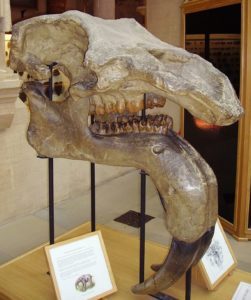
Episode 032: Some New Zealand birds

This week’s episode is about several New Zealand birds, from the still-living kiwi to the mmmmmaybe extinct moa! Note: I’m going to start putting a full transcript of each episode in the show notes for those who would like to know what words I’m mispronouncing and for those who may have hearing issues. Transcripts will be below the pictures.

A kiwi:

Superman has fought everything.

The controversial blurry “moa” picture taken by Freaney. Probably not a moa.

Show transcript:

Welcome to Strange Animals Podcast. I’m your host, Kate Shaw.

Before we get started, apologies for my voice. About the time I finally got over the cough I picked up at WorldCon in Finland, I went to DragonCon in Atlanta and got a big juicy cold. Hopefully I don’t sound too gross. My traveling for the year is over so I’m looking forward to having time to really dig into some fun topics for the podcast. In particular, I’m going to be covering some of the creepier strange animals in October, because Halloween is the best. And yes, Bigfoot is going to make an appearance.

This week’s episode is about some amazing birds from New Zealand. We learned about the takahe way back in episode seven, a big silly-looking flightless bird that was once thought extinct until its rediscovery in the middle of the last century. This week we’ll look at some other birds, some of them happily alive, some that are definitely extinct. At least, we’re pretty sure they are.

New Zealand wasn’t settled by humans until the late 13th century, only about 750 years ago. That’s mind-blowing until you take a look at a globe. New Zealand isn’t just a hop skip and jump away from Australia, it’s 900 miles away over open ocean. It’s 600 miles away from the Pacific Islands. That’s a long, long trip to make in a small boat, especially when you’re not sure if there’s any land out that way. But sometime between the years 1250 to 1300, people from eastern Polynesia discovered this new land. They liked it and stayed, and their descendants are now known as the Maori.

I know we’ve been talking about tectonic plates in a number of episodes recently. I haven’t done it on purpose—it’s just part of learning how and why different animals developed in different places. It’s definitely relevant when it comes to New Zealand.

New Zealand is just a little part of an otherwise submerged continent called Zealandia, or sometimes Tasmantis, which I actually prefer. Tasmantis. If Zealandia weren’t mostly under the ocean, it would be about half the size of Australia. Around 90 million years ago Zealandia, Australia, and Antarctica were all part of the supercontinent Gondwana. As Gondwana broke up, Zealandia separated from Antarctica and Australia around 80 million years ago, then slowly sank into the ocean.

After Zealandia separated from Gondwana, a cataclysmic event, probably a humongous meteor strike, led to the extinction of some 85% of the animals on earth. In most of the world, mammals began to evolve like crazy to fill the vacant ecological niches after the dinosaurs died off. But Zealandia didn’t have very many mammals to start with, and by 25 million years ago it was mostly underwater anyway except for the peaks of New Zealand, which were being pushed up slowly by tectonic forces—a process that’s still ongoing.

When travelers from Polynesia first landed on New Zealand, the only mammals on the islands were three species of bat. But there were birds in abundance, from enormous moas and eagles to tiny kiwi. Almost every ecological niche was filled by a bird.

Europeans first visited New Zealand in 1642. It didn’t go well and no one came back until 1769, and after that things got messy and lots of people died from war and introduced diseases. Around the mid-19th century Europeans started moving to New Zealand. Between them, the Maori, and introduced mammals like rats and dogs, a whole lot of birds went extinct.

I just want you to know that it took me hours and hours and hours to research all that stuff about Zealandia. Hopefully I got it right. I’m ready to talk about birds now.

Let’s start with a bird that is so unique to New Zealand that you’ll sometimes hear people call New Zealanders kiwis. There are five species of kiwi, all of them rare and protected. They’re round brown poofs of birds with long legs and long bills, and they eat worms, insects, seeds, fruit, frogs, and other things like that. They prefer to live in forests and usually mate for life, and can live for 50 years.

The kiwi has a lot of unusual characteristics. It’s flightless but has wings less than an inch long hidden under its feathers. Each wing has a tiny claw at its tip that doesn’t seem to have a use. The kiwi has no tail. Unlike every other bird out there, its nostrils are at the tip of its bill. The kiwi has a good sense of smell and may detect worms and other underground prey by smell, which should make you pause and wonder what earthworms smell like. The kiwi also has sensory pits at the tip of its bill that helps it detect vibrations, though, so it’s possible its good sense of smell is less important than researchers previously thought. When a kiwi detects its prey, it stabs its bill into the ground to catch it, which frequently leads to the kiwi later having to snort dirt out of its nostrils. Evolution does what it can, folks, but it’s not perfect.

Since it can’t fly and doesn’t need flight feathers, the kiwi’s feathers are hair-like and downy. But most curious of all is its egg. The kiwi is about the size of a chicken, but its egg is six times the size of a chicken egg and can weigh an entire pound. It’s so big that the female can’t even eat the last few days before she lays the egg. There’s no room in her body for food.

After the female lays her egg, the male incubates it. That huge egg has a huge yolk to feed the baby inside, so when the baby kiwi hatches, it’s ready to go. After a few days it leaves the nest and starts foraging, usually with its dad alongside for the first few weeks. It takes several years for it to grow to adult size.

The kiwi is territorial and will fight other kiwis that stray into its territory. Only its mate and its own offspring are allowed in its territory. It has powerful legs with claws that can inflict quite a bit of damage, and it can run faster than a human.

Scientists used to think the kiwi was closely related to moas, which we’ll talk about in a minute, but DNA studies have determined that its closest relative is the extinct elephant bird of Madagascar—and the elephant bird is the topic for a future episode.

The Maori describe a huge black swan called a Pouwa that lived in the Chatham Islands, but it had already gone extinct by the time Europeans arrived in the area in the late 1700s. Until recently researchers thought it was just the Australian black swan, either a population that lived in New Zealand or the occasional individual that flies across the Tasman Sea. Australian black swans were introduced to New Zealand in the 1860s.

But a recent study of DNA from fossilized swan remains from New Zealand show that it wasn’t the same bird as the Australian black swan but a related species. Around one or two million years ago Australian black swans lived in New Zealand and evolved into a separate species, heavier than the Australian birds with longer legs and shorter wings. It might have been a poor or reluctant flier and might have been on its way to evolving into flightlessness before it was eaten into extinction by the Maori.

The big name in extinct birds of New Zealand is the moa. Nine species of moa are recognized today, although in the past researchers thought there were a lot more. It turns out that female moas of some species were much larger than the males, so much so that scientists once thought they were looking at two different species. Moas were big flightless birds that in shape resembled big flightless birds from other parts of the world, known as ratites, which includes ostriches. Until DNA testing most researchers thought moas were closely related to the ratites of Australia, emus and cassowaries. But no, they are most closely related to a group of birds from Mexico, Central America, and South America collectively called tinamous. Tinamous are a type of ratite, but they can fly. They’re all fairly small and somewhat resemble quail and other game birds that spend a lot of time foraging on the ground.

Moas, however, are big. They are really big. Originally scientists mounted their skeletons so that the neck stuck more or less straight up, but now we know that they held their necks more like ostriches, with a gentle S-shaped curve. Even so, females of the biggest species, the South Island Giant Moa, stood around six and a half feet high at the back. That doesn’t even count the neck. With the neck outstretched, a big female moa could probably reach leaves twelve feet off the ground.

All moas were plant-eaters. Some ate leaves and fruit, others were adapted to digest tougher plant material like twigs, moss, and bark. Unlike other flightless birds, they didn’t have wings at all, not even for display, not even vestigial wings. They just flat-out didn’t have forelimbs. They did have strong legs although they probably couldn’t run very fast, unlike other flightless birds like ostriches. After all, moas didn’t need to run to escape predators. They only had one predator, and that was one they couldn’t outrun: Haast’s eagle.

Haast’s was the biggest eagle that ever lived, although its wings were comparatively short—only around 10 feet wide for big females, closer to 8 ½ feet wide for big males and more average-sized females. Since much of its hunting range was forested, its shorter wings probably helped it maneuver. It had a long tail too. But it had enormous talons with claws over four inches long, and its bill was similarly big. In fact, its talons were so big that its scientific name, Harpagornis moorei, means Moore’s grappling hook bird.

The Haast’s eagle’s prey was the moa, and when moas went extinct after overhunting, the Haast’s eagle went extinct soon after since it just didn’t have anything to eat. It did apparently try to adapt its hunting habits, though. Maori legends tell of the Pouakai, an enormous bird that would sometimes kill humans.

It’s pretty certain that Haast’s eagle is extinct. If it was still around, ranchers would spot it picking off sheep and calves. But the moa is something else. Moa sightings pop up pretty frequently in remote areas of New Zealand.

One of the smallest species of moa, Megalapteryx, also called the upland moa, may have survived on the south island until the mid-19th century. The upland moa was three or four feet tall including the head and neck, and was completely covered with feathers except for its bill and feet, since it lived in the mountainous areas of New Zealand’s south island where the climate was cool. It laid one or two blue-green eggs a year and the male took care of the babies.

Its accepted date of extinction is around the year 1500, but there have been numerous sightings since then. In 1880, Alice McKenzie, who was then seven years old, saw a three-foot-tall bird with blue feathers, dark green scaled legs, and three claws on each foot. She ran to get her father, but when they returned the bird had gone, although it had left big tracks in the sandy soil. She saw the same bird again in 1889.

The problem with this sighting is that the upland moa had feathered legs, and as far as we know no moas had blue plumage. We have plenty of upland moa feathers, which are grey, black and white. We even have mummified upland moa remains. Not only did Alice describe her bird as blue, she specifically noted it was the blue of a pukeko, which has vibrant plumage that varies from navy blue to violet. This wasn’t a grayish-blue bird. Alice herself thought, later in life, that she might have seen a takahe, which is also blue, but after the takahe was rediscovered she went to view some and was disappointed. They have red legs and she knew her bird’s legs were green.

But that’s not the only sighting. In addition to the sporadic accounts of big birds seen in the distance, in 1993 three men hiking in the Craigieburn Range saw what they described as a red-brown and gray moa some six feet high, including its neck. It ran off when it saw them, but one of the men, Paddy Freaney, ran after it and managed to get a photograph. He also got a few pictures of its footprints where it had stepped in a stream and then on a rock.

The picture is frustrating, to say the least. It’s so out of focus that it could be anything. However, I agree with one of the experts who have examined the photo, palaeoecologist Richard Holdaway, who says the figure’s neck is too thick for a moa. He thinks the picture is probably of a red deer. As far as I can find, Freaney’s photos of the footprints haven’t been released.

In 2007, a pair of cryptozoologists searching for moas in the hill country of the North Island spotted 35 footprints and what appeared to be a nest that they claimed were made by a group of moas, possibly a lesser moa. But considering that the pair of cryptozoologists are Rex and Heather Gilroy, who are notorious for being secretive, vague in their claims of evidence, and somewhat paranoid about their findings, I don’t expect them to show up with a live moa anytime soon. No other moa sightings or even rumors of moas living in the area have ever been uncovered.

It’s easy to dismiss this account, and the others, as wishful thinking, misidentification, and in some cases maybe outright hoaxes. Australian emus are raised in some areas of New Zealand and sometimes escape from captivity, too, which confuses the issue, since emus are big flightless birds that could easily be mistaken for moas at a distance. But there is something that makes me hopeful that the moa might still be around, especially one of the smaller species.

New Zealand’s south island is much less populated than its north island. Alice McKenzie’s sighting in 1880 was on her family’s farm near Milford Sound, which is now part of Fiordland National Park. This is a big nature reserve in the southwest corner of the south island, with rugged terrain and very few tracks passable to even offroad vehicles. The park includes the Murchison Mountains, which is where the takahe was rediscovered in 1948 after being thought extinct. So it’s entirely possible that a small species of moa might be hiding in the area. Maybe one day someone will get a really good picture—or better yet, a hiker or park ranger might come across a newly dead moa carcass and can bring it back for study.

We do have some subfossil moa remains that aren’t just skeletons and feathers. Dessicated body parts turn up occasionally, which has helped with DNA testing and our knowledge of what the living birds looked like. The moa is a good candidate for de-extinction by genetic cloning, and it would be really neat to have moas for sure running around in New Zealand again, so scientists can get right on that as far as I’m concerned.

You can find Strange Animals Podcast online at strangeanimalspodcast.com. We’re on Twitter at strangebeasties and have a facebook page at facebook.com/strangeanimalspodcast. If you have questions, comments, or suggestions for future episodes, email us at strangeanimalspodcast@gmail.com. If you like the podcast and want to help us out, leave us a rating and review on iTunes or whatever platform you listen on. We also have a Pattreon if you’d like to support us that way. Rewards include stickers and twice-monthly bonus episodes.

Thanks for listening!
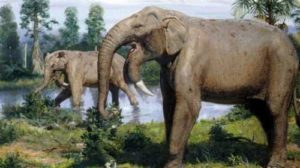
Episode 026: Humans Part Two

Part two of our humans episode is about a couple of our more distant cousins, the Flores little people (Homo floresiensis) and Homo naledi, with side trips to think about Rumpelstiltskin, trolls, and the Ebu gogo.

Homo floresiensis skull compared to a human skull. We are bigheaded monsters in comparison. Also, we got chins.

Homo naledi’s skull. I stole that picture from Wits University homepage because I really liked the quote and it turns out it’s too small really to read. Oh well.

Some of our cousins. Homo erectus in the middle is our direct ancestor. So is Lucy, an Australopithecus, although she lived much longer ago.

Show transcript

Welcome to Strange Animals Podcast. I’m your host, Kate Shaw.

This week is part two of our humans episode. Last week we learned how modern humans evolved and about two of our close cousins, Neandertals and Denisovans. This week, we’re going to walk on the weirder side of the hominin world.

Before we get started, this episode should go live on July 31, 2017, one week before I fly to Helsinki, Finland for WorldCon 75! Don’t worry, I’ve got episodes scheduled to run normally until I get home. If you’re going to be in Finland between August 8 and August 17, let me know so we can meet up. On Thursday, August 10 and 4pm I’ll be on a panel in room 207 about how to start a podcast, so check it out if you’re attending the convention. I’ll also be in Oslo during the day on August 7 and have two birding trips planned with lunch in between, and I’d love you to join me if you’re in Oslo that day too. Then, two weeks after I return from Finland, I’ll be attending DragonCon over Labor Day weekend. blah blah blah this is old news

Now, let’s learn about some of our stranger distant cousins!

In 2003, a team of archaeologists, some from Australia and some from Indonesia, were in Indonesia to look for evidence of prehistoric human settlement. They were hoping to learn more about when humans first migrated from Asia to Australia. One of the places they searched was Liang Bua cave on the island of Flores. They found hominin remains all right, but they were odd.

The first skeleton they discovered was remarkably small, only a bit more than three and a half feet tall [106 cm] although it wasn’t a child’s skeleton. That skeleton was mostly complete, including the skull, and appears to be that of a woman around 30 years old. She’s been nicknamed the Little Lady of Flores, or just Flo to her friends. Officially, she’s LB1, the type specimen for a new species of hominin, Homo floresiensis.

But until very recently, that statement was super controversial. In fact, there’s hardly anything about the Flores remains that aren’t controversial.

At first researchers thought the remains were not very old, maybe only twelve or thirteen thousand years old, or 18,000 at the most. Stone tools were found in the same sediment layer where Flo was discovered, as were animal bones. The tools were small, clearly intended for hands about the size of Flo’s, which argued right off the bat that she was part of a small-statured species and wasn’t an aberrant individual.

The following year, 2004, the team returned to the cave and found more skeletal remains, none very complete, but they were all about Flo’s size. Researchers theorized that the people had evolved from a population of Homo erectus that had arrived on the island more than three quarters of a million years before, and that they had become smaller as a type of island dwarfism. A volcanic eruption 12,000 before had likely killed them all off, along with the pygmy elephants they hunted.

But as more research was conducted, the date of the skeletons kept getting pushed back: from 18,000 years old to 95,000 years old to 150,000 years old to 190,000 years old. Dating remains in the cave is difficult, because it’s been subject to flooding and partial flooding over the centuries. Currently, the skeletal remains are thought to date to 60,000 years ago and the stone tools to around 50,000 years ago.

When news of the finds was released, the press response was enthusiastic, to say the least. The skeletons were dubbed Hobbits for their small size, which made the Tolkien estate’s head explode, and practically every few weeks it seems there was another article about whether there were small people still living quietly on the island of Flores, yet to be discovered.

And, of course, there were lots of indignant scientists who were apparently personally angry that the skeletons were considered a new species of hominin instead of regular old Homo sapiens. Part of the issue was that only one skull has ever been found. It’s definitely small, and the other skeletal remains are all correspondingly small, and the stone tools are all correspondingly small, and the skull shows a number of important differences from that of a normal human. But that doesn’t necessarily mean it’s not a subspecies of Homo sapiens, and of course that needs to be investigated. But some of the arguments got surprisingly ugly. There were even accusations that the entire find was faked. One person even suggested that the skull’s teeth showed evidence of modern dental work.

Amid all this, two unfortunate things happened. First, in December 2004 an Indonesian paleoanthropologist named Teuku Jacob removed almost all the bones from Jakarta’s National Research Centre of Archaeology for his own personal study for three months. When he returned them, two leg bones were missing, two jaw bones were badly damaged, and a pelvis was smashed. Then, not long after, Indonesia closed access to Liang Bua cave without explanation, although the archeological community suspected it was due to Jacob’s influence, and didn’t reopen it until 2007 after Jacob died.

It’s important to note that Jacob was a proponent of the theory that the remains found in Liang Bua cave were microcephalic individuals of the prehistoric local population, not a new hominin species at all. He also had a history of keeping Indonesian fossils from being studied unless he specifically approved of the research.

At any rate, since then, repeated studies of the LB1 skull have suggested that Homo floresiensis is a separate species of hominin and not a Homo sapiens with evidence of pathology, whether microcephaly or another disease, or a population with a genetic abnormality. There’s still plenty of research needed, of course, and hopefully some more skulls will be found. But it seems clear that Homo floresiensis isn’t just a weird subspecies of Homo sapiens.

One of the more common theories in the last few years was that Homo floresiensis was descended from Homo erectus, although Homo erectus was a lot bigger and more human-like than the Flores little people. But results of a study released just a few months ago show that Homo floresiensis shared a common ancestor with Homo habilis around 1.75 million years ago. Homo floresiensis may have evolved before migrating out of Africa, or their ancestor migrated and evolved into Homo floresiensis. Either way, they spread as far as Indonesia before dying out around 50,000 years ago.

Other hominin remains have since been found on the island. Part of a jaw and teeth were found at Mata Menge on the island of Flores, some 50 miles away from the cave. It’s around 700,000 years old and is a bit smaller than the same bones in the later skeletons. Researchers think it’s an older form of Homo floresiensis.

Possibly not coincidentally, modern humans arrived on the island about 50,000 years ago, maybe earlier, bringing with them the arts of fire, painting, making jewelry from animal bones, and killing all of our genetic cousins.

We don’t know if humans deliberately killed the Homo floresiensis people or if they just outcompeted them. It does seem pretty certain that the two hominin species coexisted on the island for at least a while. It’s even possible that knowledge of the strange small people of the island has persisted in folk tales told by the Nage people of Flores. Stories about the ebu gogo have been documented for centuries. They were supposed to be little hairy people around three feet tall [one meter], with broad faces and big mouths. They were fast runners with their own language and would eat anything, frequently swallowing it whole. In some stories they sometimes kidnapped human children to make the children teach them how to cook, although the children always outwitted the ebu gogo.

Supposedly, at some point, tired of their children being kidnapped and their food being stolen, villagers gave the ebu gogo palm fibers so they could make clothes. The ebu gogo took the fibers to their cave, and the villagers threw a torch in after them. The fiber went up in flames and killed all of the ebu gogo.

Until the discovery of Homo floresiensis, anthropologists assumed the stories were about macaque monkeys. But there’s a genuine possibility that the ebu gogo tales are memories of Homo floresiensis. It’s not just cryptozoologists and bigfoot enthusiasts making the connection between the ebu gogo and Homo floresiensis. Articles and editorials have appeared in journals such as Nature, Scientific American, and Anthropology Today. At least, they did back when archeologists thought Flo was only about 12,000 years old.

But we still don’t know for certain when Homo floresiensis went extinct. There may be remains that are much more recent than 50,000 years ago. Locals mostly say there are no ebu gogo left but that they were still around about a century ago. I don’t know how long historical elements can persist in an oral tradition without becoming distorted. As we discussed in episode 17, about Thunderbird, oral history is easily lost if the culture is disrupted by invasion, disease, war, or other major episodes. But some stories are tougher than others, and those that are less history and more entertainment—although they may contain warnings too—can be very, very old.

Researchers have traced some traditional folktales, like Rumpelstiltskin, back some 4,000 or even 6,000 years, although not without controversy. But while Rumpelstiltskin is usually described as a small person, no one’s suggesting that story is about real events. It’s the juxtaposition of the Flores discoveries of small skeletons and the oral tradition or small people living on the island that got researchers excited. And as it happens, there is an oral tradition many miles and many cultures away from Flores that might be something similar.

Old Norse stories about trolls date back thousands of years. The trolls vary in appearance and sometimes have a lot of overlap with other monsters, but generally are described as big and strong, not very smart, often placid unless provoked, and usually evil, or at least godless. Sometimes they capture humans who outwit them to escape. In one story, a man named Esbern Snare wanted to marry a woman, but her father would only agree to the marriage if Esbern would build a church. Esbern struck a deal with a troll, who said he would build the church—on one condition. If Esbern couldn’t guess the troll’s name by the time the church was built, the troll would demand as his payment Esbern’s heart and eyes.

Esbern agreed, but he failed to trick the troll into telling him his name. On the final day, in despair Esbern threw himself down on the bank of a river, where he overheard the troll’s wife singing to her baby:

“Hush, hush, baby mine,

Tomorrow comes Finn, father thine,

To bring you Esbern’s heart and eyes

To play with, so now hush your cries.”

Esbern rushed back to the church and greeted Finn the troll by name. In some version of the story, Finn is so furious that he leaves the church incomplete in some way, usually a missing pillar. For those of you who aren’t familiar with the Rumpelstiltskin story, that’s a variant. Oh, and Esbern Snare was a real person who lived in the twelfth century, although I’m pretty sure he didn’t actually strike any deals with trolls.

But I do wonder if some elements of troll folklore might be derived from memories of Neandertal people. I’m not the first to suggest this, although it is a pretty fringey theory. And in the end, we just don’t have any way to know. But it is interesting to think about.

As you may remember from part one of the humans episode, Homo sapiens evolved roughly 200,000 years ago. But around the same time, or a little earlier, another cousin in our family tree was living in southern Africa. Remains of Homo naledi were only discovered in 2013 by some cavers. Partial skeletons from at least 15 individuals were recovered in one field season, but due to narrow cave passages, the field work had to be done by people of small stature who weren’t claustrophobic, mostly women.

Homo naledi is a mixture of primitive and advanced features. Primitive in this case means more like our ape ancestors, and advanced means more like modern humans. Homo naledi had long legs and feet that looked just like ours, but also had a small brain and fingers that are much more curved than ours—not characteristics that would look out of place a few million years ago, but surprising to discover in our family tree at about the same time that modern humans were evolving.

On the other hand (with curved fingers), evolution doesn’t have an end goal. Homo sapiens is not the pinnacle of creation to which all other living beings aspire. We’re just another animal, just another great ape. If Homo naledi was successful in their environment with a small brain, that’s all that matters from an evolutionary standpoint.

There are lots of remains left in the cave, so many in fact that some researchers are convinced they didn’t get there by accident. It’s possible that the cave was used as a burial pit, maybe even over the course of centuries. Bodies may have been dropped in a deep shaft and were then moved by periodic flooding to the remote chamber where they were found, or they may have been carried to the cave depths and left there.

Homo naledi wasn’t a direct ancestor of Homo sapiens, but they were definitely a kind of human—no matter how small their brains may have been.

You can find Strange Animals Podcast online at strangeanimalspodcast.blubrry.net. That’s blueberry without any E’s. If you have questions, comments, or suggestions for future episodes, email us at strangeanimalspodcast@gmail.com. We also have a Patreon at patreon.com/strangeanimalspodcast if you’d like to support us and get twice-monthly bonus episodes for as little as one dollar a month.

Thanks for listening!
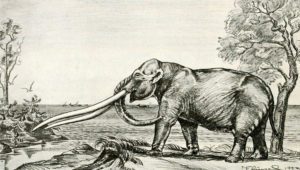
Episode 025: Humans Part I (Neanderthals and Denisovans)

This week is our first two-parter ever! I don’t intend to do that often but there was just too much to go over for one episode. This week we’ll talk about humans: where we come from, how we evolved, and who our closest cousins are–Neanderthals and Denisovans.
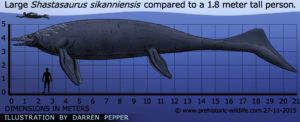
Some young humans. Humans can do many surprising things, including surfing, making stained glass, and repairing helicopters. Most humans like the color blue and enjoy listening to music.

The bracelet found with Denisovan bones in a Siberian cave. Humans didn’t make or wear this lovely thing, Denisovan people did.

Further reading:

How to Think Like a Neandertal by Thomas Wynn and Frederick L. Coolidge

Show transcript:

Welcome to Strange Animals Podcast. I’m your host, Kate Shaw.

This will be our first two-part episode. There’s so much to cover with this topic that I decided to split it into two. This week we’re going to investigate an unusual family of great apes: both the living representative and their extinct relatives—and I don’t know why I’m saying “their extinct relatives,” because the great apes in question are known as Homo sapiens.

Humans tend to view ourselves as separate from the natural world. Some of us see ourselves as special, above other animals and better than them. Some of us see ourselves as despoilers of nature who can’t be trusted at all. But in reality, we’re neither angels nor devils. We’re animals too, and we fit neatly in the world because we evolved to live here, just like every other animal did too.

Humans have two major things going for us. First of all, we’re really smart. We’re only now learning the ways other animals show high intelligence, but even so, hands down we are the brightest apes in the circus. Our intelligence allows us to invent amazing things to make our lives more comfortable, like beds and shoes and medicine and umbrellas and podcasts. Unfortunately, our intelligence also lets us invent things that aren’t so nice, like bombs, because like our close cousins the chimpanzees, we can be real jerks.

But besides our intelligence, which is an obvious plus, we’ve got something very few other animals have: stamina, and the ability to shed heat efficiently, which makes us tireless hunters. In fact, that combined with our ability to make and use tools made early humans pretty much unstoppable.

Persistence hunting is only practiced by a few species of animal, like grey wolves, spotted hyenas, and humans. Humans aren’t especially fast runners compared to horses and deer and other prey animals, but we can just run on and on, sweating to cool ourselves, while our prey has to rest to cool down. One downside to this is that we can drive ourselves to heat exhaustion without realizing it, when conditions are just too hot to be constantly active.

I just looked this up, because I just realized I didn’t know if other female animals menstruate like human women. It turns out that female chimps do, along with a few other primates—and bats, for some reason. Solidarity with our bat girlfriends.

Actually, all placental mammals prepare a womb lining periodically, but when it turns out they don’t need it because they’re not going to have babies, they just reabsorb the material. Only a few species shed it, and even in humans we reabsorb most of it. Some researchers think we menstruate because it’s actually easier on the body to just dump the last of that unused stuff rather than spend extra energy absorbing it.

Now that we all know a few things about humans that we might not have known before, here’s a somewhat simplified overview of how humans evolved.

Humans and our ancestors are called hominins collectively. There were some apes 6 or 7 million years ago that were probably somewhat bipedal, and which are considered the earliest known hominins. We’re not sure which of the several species is our direct ancestor and which is our last shared ancestor with gorillas and chimpanzees.

Bipedalism is a defining trait of hominins. It took a long time to develop because there are a lot of skeletal and other changes needed to make it work effectively. By about 3 or 4 million years ago, the Australopithecines had evolved, and we know they walked upright at least part of the time because we have a fossilized track.

But why did bipedalism develop in the apes at all? Of all the apes, only humans developed bipedalism, and it actually still gives us a lot of problems: weak backs that are subject to injury, for instance, and even increased difficulty in childbirth, since the human pelvis had to change so much to adapt to walking upright. The cause was probably habitat change.

If you look at a map of Africa, you’ll see what looks like a string of lakes on the eastern side of the continent. Those lakes, and the volcanoes scattered around the area, including Mount Kilimanjaro, are caused by the East African Rift. Researchers are still working out what exactly is causing the rift, but we do know what’s happening in general. The tectonic plate Africa sits on, which is naturally known as the African Plate, is splitting in two.

This sounds alarming, especially if you happen to live there, but it’s a ridiculously slow process from our point of view. The rift widens barely seven millimeters a year. But that adds up when you’re talking millions of years, and the rift started at least ten million years ago and will continue for another ten million years until the plates separate completely and those lakes become part of the ocean.

Around the time the rift started forming, the East African plateau rose up, accompanied by a lot of volcanic activity. This caused a major change in the local habitats. What had once been thick forest and lush jungle became open woodland and savanna. Grasses grew tall, there wasn’t as much cover, and the animals that evolved and moved into the area were fast runners. It wasn’t a great area to be a knuckle-walker like other apes, but it was ideal for apes who could stand and walk upright.

The rift is where we’ve found so many important hominin fossils, including that of Lucy. Lucy was an Australopithecus who lived 3.2 million years ago. In Ethiopia, where the partial skeleton was found, she’s known as Dinknesh, which means “you are marvelous” in the local language.

That kind of makes me want to cry a little. Lucy wasn’t just some ape who could walk upright part of the time while carrying things. She was our great-great-great-a million times-great grandma.

[oops copyright infringement hahahahahahahahahahaha]

By around two and a half million years ago, Homo habilis had evolved. Homo habilis probably still looked a lot like an ape, but was also getting recognizably human. They walked upright all the time and made stone tools. Then, a little less than two million years ago, Homo erectus appears in the fossil record.

Homo erectus was definitely human-looking, with a human-like nose, ordinary human-sized height, and very little hair except on the head. And Homo erectus had dark skin, which is linked to the loss of body hair.

By a little less than one million years ago, Homo erectus was wearing clothes, cooking their food, and were adept in making and using stone tools. If you went back in time and met a Homo erectus, you’d think you were just meeting a really weird-looking person—and you would be right. Also, where did you get the time machine and can I get a ride in it?

By 200,000 years ago, modern humans, Homo sapiens, had fully evolved. If you could go back in time and meet those early humans, they would look, act, and think like the people you see around you today.

Of course, evolution isn’t as cut and dried as it sounds here. When one species evolves over long, slow generations into another, that doesn’t mean the population it evolved from vanishes. You may have heard the so-called argument against evolution: if humans evolved from monkeys, why are there still monkeys?

Well, first of all, apes and monkeys are different animals entirely. Both monkeys and apes, and all the other primates, evolved from a distant ancestor that wasn’t a monkey or an ape, but which had the characteristics that made it distinctly primate instead of feline or canine or hippopotamine…that’s not a word.

Second of all, species evolve because of environmental pressures, and those same pressures may not be present in all parts of the species’s range. Homo erectus survived well into the era of modern humans, and in fact we probably killed them off, either directly (because remember, we can be jerks) or indirectly by outcompeting them in the same habitats.

At some point, humans started moving out of Africa into other parts of the world, maybe about 55,000 years ago although we’re not really sure yet. Researchers are still working it all out, but some research suggests there might be more than one wave of migration, or that the migration started much earlier than 55,000 years ago.

The hominins I’ve mentioned so far weren’t the only ones around. Those were only our direct ancestors. There were others who split off from our ancestors and evolved separately, and if they hadn’t all died out (again, thanks to us, Homo sapiens jerkuses), we’d have populations of living cousins who are much more closely related to us than the other great apes. So let’s learn about some of them!

I’ve actually been putting off doing this episode because right now, we’re in the middle of a golden age of hominin discoveries. I kept thinking that if I just waited a few more weeks or months, new findings might very well be announced. In fact, right after I started research, sure enough, new information was published about a recently discovered Denisovan baby tooth.

There are two known groups of hominins who aren’t direct human ancestors to Homo sapiens, Neanderthals and Denisovans. They were around at the same time as modern humans for at least a while, but not usually in the same places.

Neanderthals spread throughout parts of northern Europe and Asia, and the Denisovans spread into Asia and down through the Malay Archipelago and into Australia. Again, I need to stress that these were not direct human ancestors. While they could and did interbreed with Homo sapiens, and many modern populations carry traces of Neanderthal and Denisovan DNA, there is no practical genetic difference in a human from one continent or background and a human from a different continent or background. We’re all human.

Around 1.8 million years ago, a population of Homo erectus migrated into Eurasia, where they gave rise to Neanderthals and Denisovans. When humans later migrated into the same areas, they encountered their close cousins and lived alongside them for possibly as long as 10,000 years before the human population increased to the point that…those other guys? They had to go.

The first Neanderthal fossils were discovered in 1829 in Belgium, but it’s the 1856 discovery of fossils in a cave in Neader Valley in Germany that gave us their name. “Thal” [pronounced like the word tall] means dale or valley in German, spelled with a TH, which is why so often the name is pronounced Neander-thal. It doesn’t really matter how you pronounce it.

Anyway, there’s still a lot of controversy regarding whether Neanderthals are a subspecies of Homo sapiens or a separate species in their own right. One incredibly “clever” and just precious suggestion in 1866 was that the group be named Homo stupidus. In fact, Neanderthals were probably as smart as humans and were definitely bigger and stronger than us (so don’t make jokes about them). They were well adapted to the cold with a barrel chest, relatively shorter limbs than humans, and an overall more robust build. They probably had better eyesight than we do too. Genetic evidence suggests that some populations may have had light skin and red or blond hair.

But it’s possible they weren’t as socially adept as humans. The average Neanderthal social group consisted of a close family unit—mother, father, and kids, or brothers and their mates, who were not related to one another, plus their kids—rather than extended relatives and related families, as is typical among humans. It’s likely that several family groups sometimes came together to share particular bonanzas in food. Neanderthals frequently killed mammoths, and a full-grown mammoth could feed a whole lot more than one family before the meat spoiled.

Grandparents probably weren’t usually part of most family groups not because no one liked their Grandma back then, but because Neanderthals had short, brutal lives. They speared mammoths at close range to kill them. That is metal as heck, but it’s also really hard on the body. It was rare for a Neanderthal to survive past 30, and by then he or she would look like an old, old person due to all the injuries sustained while hunting.

The authors of the marvelous book How to Think Like a Neandertal, which I’m drawing from quite a lot here, point out that Neanderthals and rodeo cowboys show similar patterns of injury over their lifetimes. And Neanderthals didn’t have hospitals and doctors they could visit.

While Neanderthals did make stone tools and use fire, analysis of their campsites shows sometimes interesting compared to human campsites. There’s no central fire pit. Almost every individual had their own fire where they did their own thing. In prehistoric human campsites, way back 25,000 years ago and even more, there’s generally one central fire that everyone gathers around. We still do this the world over. Can you even imagine going to summer camp and every kid spends the evening alone, tending their own little campfire and not singing camp songs, not spelling spooky stories, not eating s’mores together?

In addition, while there have been some controversial theories over some findings, as far as we can determine, Neanderthals didn’t make art. Some perforated seashells have been found at two Neanderthal sites in Spain that researchers think may have been worn as pendants, and we have evidence that Neanderthals, like other hominins for at least 300,000 years, used mineral pigments as body decoration. But they didn’t appear to use ceremonial items, didn’t create clothing beyond rough hide blankets or wraps, and they only had the barest minimum of funerary rites. Neanderthals may have been strong and smart, but they don’t appear to have been especially creative by our standards.

One old man Neanderthal, who was probably not more than 35 when he died, was so injured that he could probably not walk or do much of anything else by the final years of his life. He had lost most of his teeth and wouldn’t have been able to eat. But he lived for years, because someone helped him. Someone brought him food. Someone probably chewed it for him. And when he died, someone tucked him in a shallow hole and scattered dirt over his body. So however different Neanderthals were from us, they were also people.

By about 40,000 years ago, Neanderthals were extinct. That was probably too long ago to have left any traces in human collective memory, but that’s something I’ll bring up in part two of this episode next week.

We still don’t know much about the Denisovans because we only discovered the first specimen, a fragment of a finger bone, about ten years ago. The bone is from a young woman who lived about 41,000 years ago and was found in the Denisova Cave in Siberia, in the mountains not far from China and Mongolia. Since then, scientists have also found some teeth from two different adult males, and a baby tooth from a little girl who lived much earlier than the others.

According to DNA testing done on the finger bone, Woman X, as the finger’s owner is called, was neither a modern human nor a Neanderthal, although she was related to both and could interbreed with both. Denisovan DNA has been found in some populations of humans. Not only that, Woman X contained some Neanderthal DNA and DNA from an ancient human lineage that we don’t yet recognize. So there’s at least one other hominin we haven’t yet discovered. A toe bone has also been found that may be from a hybrid Denisovan-Neanderthal, but we don’t know for sure yet, since studies are still ongoing.

We don’t know what the Denisovans looked like, but just going from Woman X’s finger bone, which is much thicker than even a big human’s finger bones, we can guess they were pretty robust people. They may have looked a lot like Neanderthals. Some fossils thought to belong to Neanderthals may actually be Denisovan, so I bet a lot of museum and university collections are being examined closely right about now.

The Denisova Cave was used as a home by humans, Neanderthals, and Denisovans at different times going back some 125,000 years, and as recently as the 18th century, when a Russian hermit named Denis lived there. A bracelet discovered in the same layer of soil where Woman X’s finger bone was found has been dated to about the same time as the bone and is not a human artifact as far as archaeologists can tell.

It’s a green chlorite bracelet, carefully carved and beautifully polished. It was probably worn on the right wrist. It’s delicate, fragile, and probably belonged to someone important who wore it on important occasions. In other words, Denisovans wore and probably made jewelry. Unlike Neanderthals, they probably had important occasions.

A marble ring was found at the same time as the bracelet, but no information on it has been released yet. Hopefully, it won’t be long before we learn more about these new cousins of ours. They seem like interesting people.

That’s it for part one of our episode on humans. Next week we’ll take a look at some less closely related and more mysterious human relations, especially ones known as Hobbits for their small stature. Maybe by then you’ll have gotten that Toto song out of your head.

You can find Strange Animals Podcast at strangeanimalspodcast.blubrry.net. That’s blueberry without any E’s. If you have questions, comments, or suggestions for future episodes, email us at strangeanimalspodcast@gmail.com. If you like the podcast and want to help us out, leave us a rating and review on Apple Podcasts or Podchaser, or just tell a friend. We also have a Patreon at patreon.com/strangeanimalspodcast if you’d like to support us for as little as one dollar a month and get monthly bonus episodes.

Thanks for listening!