Episode 457: Parrots!

Thanks to Fleur, Yuzu, and Richard from NC for their suggestions this week!

Further reading:

World’s rarest parrot, extinct in wild, hatches at zoo

Kakapo recovery

This Parrot Stood 3 Feet Tall and Ruled the Roost in New Zealand Forests 19 Million Years Ago

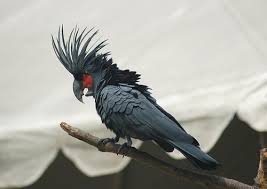
The magnificent palm cockatoo:
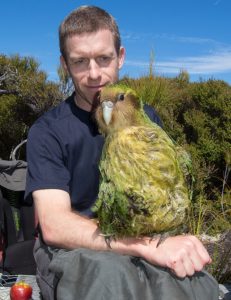
The gigantic kakapo:
Show transcript:

Welcome to Strange Animals Podcast. I’m your host, Kate Shaw.

This week we have a bird episode, specifically some interesting parrots. Thanks to Fleur, Yuzu, and Richard from NC for their suggestions!

Parrots are intelligent, social birds that are mostly found in tropical and subtropical parts of the world, but not always. Most parrots eat plant material exclusively, especially seeds, nuts, and fruit, but some species will eat insects and other small animals when they get the chance. Most parrots are brightly colored, but again, not always. And, unfortunately, most parrot species are endangered to some degree due to habitat loss, hunting for their feathers and for the pet trade, and introduced predators like cats and rats.

All parrots have a curved beak that the bird uses to open nuts and seeds, but which also acts as a tool or even a third foot when it’s climbing around in trees. All parrots have strong clawed feet that they also use to climb around and perch in trees, and to handle food and tools.

Let’s start with Yuzu’s suggestions, the cockatoo and the parakeet. A parakeet is a small parrot, but it’s a term that refers to a lot of various types of small parrots. This includes an extinct bird called the Carolina parakeet.

It was small parrot that was common throughout a big part of the United States. It had a yellow and orange head and a green body with some yellow markings, and was about the size of a mourning dove or a passenger pigeon. Its story of extinction mirrors that of the passenger pigeon in many ways. The Carolina parakeet lived in forests and swamps in big, noisy flocks and ate fruit and seeds, but when European settlers moved in, turning forests into farmland and shooting birds that were considered pests, its numbers started to decline. In addition, the bird was frequently captured for sale in the pet trade and hunted for its feathers, which were used to decorate hats.

By 1860 the Carolina parakeet was rare anywhere except the swamps of central Florida, and by 1904 it was extinct in the wild. The last captive bird died in the Cincinnati Zoo in 1918, which was not only the same zoo where the last passenger pigeon died in 1914, it was the same cage. It was declared extinct in 1939.

The parakeet Yuzu is probably referencing is the budgie, or budgerigar. It’s the one that’s extremely common as a pet, and it’s native to Australia. In the wild it’s green and yellow with black markings, but the domestic version, which has been bred in captivity since the 1850s, can be all sorts of colors and patterns, including various shades of blue, yellow all over, white, and piebald, meaning the bird has patches of white on its body.

The budgie can learn to repeat words and various sounds, especially if it’s a young bird. I had two parakeets as a kid, named Dandelion and Sky so you can guess their colors, and neither learned to talk although I really tried to teach them. Some birds just aren’t interested in mimicry, while others won’t stop, especially if they get attention when they speak.

In the wild, budgies live in flocks that will travel long distances to find food and water. The birds mostly eat grass seeds, especially spinifex, but will sometimes eat wheat, especially in areas where farmland has destroyed much of their wild food. They’re social birds that are sometimes called lovebirds, although that’s the name of a different type of bird too, because they will preen and feed their mates.

Like many birds, the parakeet can see ultraviolet light, and their feathers glow in UV light. This makes them even more attractive to potential mates, as if the parakeet wasn’t beautiful enough to start with.

Yuzu also asked about the cockatoo. There are 21 species of cockatoo, also native to Australia and other nearby places, including Indonesia and New Guinea. It’s much larger than the budgie and most species have a crest of some kind. It lives in flocks and eats various types of plant material, including flowers and roots, but it will also eat insects. The cockatoo isn’t as brightly colored as many parrots, and is usually black, white, or gray, often with patches of color on the crest, cheeks, or tail.

The pink cockatoo is white with pale salmon pink markings on the body, and brighter pink and yellow on its crest. The sulphur-crested cockatoo is white with pale yellow on the undersides of the wings and tail, and a bright yellow crest. We talked about the palm cockatoo in episode 23 because not only does it look like it should be a drummer of the Muppet Animal variety, since it’s black with red cheeks and a big messy crest, it does actually use sticks and nuts to drum against tree branches, to attract a mate.

Richard from NC suggested we learn about Spix’s macaw, also called the blue macaw, because it’s considered one of the world’s rarest parrots. In fact, it was declared extinct in the wild in 2019. It only survives at all because of intensive conservation efforts, including a captive breeding program spread over multiple zoos.

The blue macaw is native to one small part of Brazil in South America, although it used to be much more common several hundred years ago. It’s blue with a gray-blue head. It’s such a beautiful parrot that it was driven to extinction by people trapping the birds to sell as pets, even though that had been outlawed by Brazil, although its numbers had been falling for centuries due to habitat loss. It relied on a particular species of tree called the tree of gold, because its flowers are bright yellow. The blue macaw nested in these trees, and its seedpods were one of its main foods. As groves made up of the tree of gold were chopped down to make way for farmland and towns, the bird became more and more rare.

Luckily, even though the blue macaw doesn’t breed very quickly in captivity, by 2022 there were enough healthy young birds to release twenty into the wild. Just a few weeks ago as this episode goes live, another egg has hatched in captivity in a bird conservation center in Belgium, after the previous hundred eggs were infertile and never hatched.

Next, Fleur wanted to learn more about the kakapo, a flightless, nocturnal parrot that lives only in New Zealand. We talked about it in episode 313, but it’s definitely time to revisit it.

The kakapo is the largest living parrot. It has green feathers with speckled markings, blue-gray feet, and discs of feathers around its eyes that make its face look a little like an owl’s face. That’s why it’s sometimes called the owl parrot. Males are almost twice the size of females on average. It can grow over two feet long, or 64 cm, and can weigh as much as 9 lbs, or about 4 kg. That’s way too heavy for it to fly, but its legs are short but strong and it will jog for long distances to find food. It can also climb really well, right up into the very tops of trees. It uses its strong legs and its large curved bill to climb. Then, to get down from the treetop more efficiently, the kakapo will spread its wings and parachute down, although its wings aren’t big enough or strong enough for it to actually fly. A big heavy male sort of falls in a controlled plummet while a small female will land more gracefully.

The kakapo evolved on New Zealand where it had almost no predators. A few types of eagle hunted it during the day, which is why it evolved to be mostly nocturnal. Its only real predator at night was one type of owl. As a result, the kakapo was one of the most common birds throughout New Zealand when humans arrived.

But by the end of the 19th century, the kakapo was becoming increasingly rare everywhere. By 1970, scientists worried that the kakapo was already extinct. Fortunately, a few of the birds survived in remote areas. Several islands were chosen as refuges, and all the kakapos scientists could find were relocated to the islands, 65 birds in total. While the kakapo is doing a lot better now than it has in decades, it’s still critically endangered. The current population is 237 individuals according to New Zealand’s Department of Conservation.

The kakapo may be the largest living parrot, but it’s not the largest parrot that ever lived. That would be the giant parrot. It’s known only from a few fossils dated to between 16 and 19 million years ago, but from those fossils scientists estimate that the giant parrot grew around 3 feet tall, or almost a meter, and possibly weighed almost twice what the kakapo weighs. It’s the largest parrot that ever lived as far as we know, and it was probably related to the kakapo.

We don’t know a lot about the giant parrot because only two fossils have been found, both of them leg bones and probably from the same individual. They bones are so big that scientists initially thought they belonged to an eagle. Hopefully soon more fossils will come to light so we can learn more about the giant parrot. For all we know, those leg bones belonged to a young parrot that wasn’t fully grown yet. Maybe the adults were even bigger than we think!

You can find Strange Animals Podcast at strangeanimalspodcast.blubrry.net. That’s blueberry without any E’s. If you have questions, comments, or suggestions for future episodes, email us at strangeanimalspodcast@gmail.com. We also have a Patreon at patreon.com/strangeanimalspodcast if you’d like to support us for as little as one dollar a month and get monthly bonus episodes.

Thanks for listening!
Episode 023: Nonhuman Musicians

This week’s episode is about nonhuman musicians. It’s rarer than you’d think.

The palm cockatoo. Nature’s drummer. In possibly related news, I know what my next tattoo is going to be.

Snowball the Dancing Cockatoo.

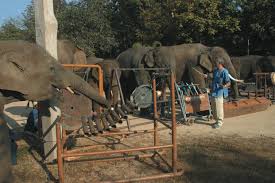
Members of the Thai Elephant Orchestra at the Thai Elephant Conservation Center:

Further reading:

Kinship with Animals by Dave Soldier

Show transcript:

Welcome to Strange Animals Podcast. I’m your host, Kate Shaw.

This week’s episode about nonhuman musicians was inspired by an article about palm cockatoos. The male cockatoos drum on tree trunks or hollow logs as part of their courtship display, which doesn’t sound all that unusual until you learn that they use special crafted sticks to drum. A male will select a stick, trim it down the way he wants it, and hold it in his claw to drum. Sometimes he’ll use a hard seedpod instead. The resulting beats are not only consistently in rhythm, each individual has a personal style. Some drum quickly, some slowly, some throw in little flourishes. Sometimes females will drum too, and if a female likes a male’s drumming, she may imitate him or join in.

Here’s a little clip of a male drumming. He’s also whistling.

[palm cockatoo drumming]

The palm cockatoo is an awesome-looking bird. It looks like a drummer. It’s up to two feet long, or 61 cm, smoky gray or gray-black with a heavy gray beak, red cheek patches that flush when the bird is upset or excited, and a messy crest of feathers. It’s native to Papua New Guinea, Indonesia, and the very northern tip of Australia, Cape York Peninsula. Only the Australian birds are known to drum. Unfortunately, the Australian birds are the ones most threatened in the wild due to habitat loss.

The palm cockatoo eats nuts and seeds, and like all parrots it can live a long time. And yes, you can get them as pets—and now I’m desperate for one even though the last thing I need is a pet cockatoo. I have a coworker with a pet parrot who she says is incredibly neurotic. He tends to get overexcited and starts screaming, and she has to put him in his cage and cover it so he’ll shut up. Her kids found the parrot when they were young. He plopped down in her yard when they were playing outside, and they put an empty laundry basket over him to trap him. No one claimed him, so my coworker has now been stuck with a neurotic parrot for over twenty years. She’s pretty sure he survived in the wild by hanging out with crows, because one of the things that will set off his excited screaming is hearing crows outside. And while cockatoos and parrots in general are typically affectionate and make good pets, palm cockatoos are not. They’re considered “difficult.” When parrot fanciers call a type of bird difficult, it’s difficult.

Anyway, the really unusual thing about the palm cockatoo’s drumming isn’t its tool use, which is well known among many types of birds, especially parrots and their relations. It’s the rhythm.

Most animals can’t keep a beat. Synchronization to an external rhythm is called rhythmic entrainment. Humans are really good at it and recognize a beat automatically, but responding in time to a rhythm is a learned skill. Small children have to learn to keep a beat by moving their bodies, speaking, or singing, and they learn it best in social settings. That’s why music, dance, and rhythmic play activities are so important to preschool children. And as a drummer myself, I promise you, humans of any age can learn to improve their rhythm.

But most animals don’t seem to have the ability to distinguish rhythmic beats, although it hasn’t been studied all that much until fairly recently. Some researchers think it may have something to do with the ability to mimic vocal sounds.

That would explain why many birds show rhythmic entrainment, varying from species to species. A sulfur-crested cockatoo named Snowball was internet-famous for a while in clips where the bird danced to music. As a result, Snowball became the subject of a rhythmic entrainment study that shows he can adapt his dancing to changing tempos.

But not all animals who show rhythmic entrainment can mimic vocally. California sea lions aren’t exactly the parrots of the sea animal world, but they can be trained to move to a beat. On the other hand, closely related seals are vocal learners. In fact, one famous harbor seal who was raised by a fisherman who found the orphaned pup could imitate the fisherman so well he was known as “Hoover the Talking Seal.”

Here’s the only clip I would find of Hoover. The first time I listened to it, I couldn’t figure out when the seal was talking. All I could hear was some gruff-sounding guy talking really fast. Well, that’s Hoover.

[Hoover the talking seal]

That is Hoover the talking seal talking. It’s creepy as heck.

It’s possible that sea lions still retain neural pathways that allow vocal mimicking even if they no longer use them. Then again, some researchers now believe that vocal mimicking ability may only be a skill related to rhythmic entrainment, not the source of the ability, and that the neural pathways for rhythmic entrainment may be very old. Some species can express entrainment, others appear to have lost it.

Studies on human brains show that when music plays, pretty much the entire brain lights up in response. That’s because we have special neural connections that help coordinate motor planning, speech, and other skills with the perceived beat. Brains of parrots and other birds are very similar. But monkeys are not. Monkeys can’t dance. Poor monkeys.

One study with rhesus monkeys who were trained to tap in rhythm with a metronome determined that they couldn’t anticipate the beat but could tap just after it, responding to it, even after years of training. Many rhythmic entrainment studies focus on great apes, since it’s reasonable to suppose that humans’ close cousins might share our rhythmic ability.

Patricia Grey, a bio-music researcher at the University of North Carolina at Greensboro, taught a group of captive bonobo apes to play a drum along with a beat. But it wasn’t as simple as showing a bonobo how a drum worked and seeing if it could keep a beat. She had to encourage the apes in a social setting, just like with human children. Also, she had to design a drum that could take a whole lot of abuse. I love that she went to Remo, a company that manufactures drums and drumheads, to have the drum made.

Her experiment started by accident. In 2010, Grey was at the Great Ape Research Center in Des Moines waiting for an experiment to be set up, and while she waited she idly tapped the glass on the bonobo enclosure. A bonobo named Kanzi came over and tapped her hand on the glass in response, matching Grey’s tempo. Intrigued, Grey continued tapping to see how long Kanzi would keep it up. Kanzi didn’t stop, even when her snack time came. She ate her snack lying on her back so she could continue to tap with her feet.

Wild chimpanzees and bonobos drum on logs and their own bodies to make rhythmic noise during play and dominance activities. Dominant male chimps do a particularly exaggerated slow display when thunderstorms approach, called a rain dance by researchers, that involves drumming. A variation of the rain dance has been seen when wildfires are approaching a troupe of chimps. Naturally it’s called a fire dance, and it includes a vocalization heard at no other time.

Chimps are pretty chill when it comes to fire, by the way. They understand how it spreads and how to avoid it without panicking.

Another animal that can keep the beat? Elephants! Asian elephants are vocal mimics and their ability to keep a beat is extremely precise. In 2000, the Thai Elephant Orchestra was created with elephants at a conservation center in Thailand, who learned to play oversized versions of traditional Thai percussion instruments.

The elephants learned the instruments easily, taking to it so quickly and so well that the orchestra’s founders were astonished. The great thing is, the elephants actually create much of the music themselves. The orchestra’s founders, neuroscientist Dave Soldier and elephant conservationist Richard Lair, wanted the elephants to have fun and enjoy making music. So for most songs, the animals are only signaled when to start and stop playing. Occasionally human musicians play along.

The orchestra released three albums between 2002 and 2011, which were all well received—not as novelty albums, but as actual improvisational compositions. Some of the songs are arranged, with the elephants trained to play traditional Thai music. The orchestra performs live for visitors at the conservation center.

The orchestra varies in size from five to fourteen elephants. One particularly talented drummer, Luk Kop, could play three drums at the same time and set up complex rhythms. Unfortunately he was also a dangerous elephant, and that’s not good for a band or an elephant orchestra, so he had to drop out.

The elephants prefer non-dissonant tones and learn to strike the properly resonant parts of their instruments without even being taught. The elephants at the center also enjoy playing harmonicas. The tip of an elephant’s trunk has a fingerlike projection, so an elephant can hold a harmonica and blow through it with its trunk. Soldier reports that one morning he arrived at the center early when the elephants were heading down to the river for their morning bath. Almost all the elephants had brought their harmonicas and were playing together as they walked.

Most of the elephants at the center are former logging animals, and many of their handlers, known as mahouts, once worked with them when they were logging. Mahouts traditionally sing to their elephants, which is supposed to keep them calm. So the elephants in the orchestra are familiar with traditional Thai music.

Locals who have heard the orchestra play say the music sounds like the music in Buddhist temples. Soldier, a musician and composer himself, transcribed an original elephant piece which was then played by a human orchestra in New York. The audience didn’t know it was composed by elephants. Some guesses as to who the composer might be included John Cage, Dvorak, and Charles Ives.

Whether or not you like improvisational Thai music played by elephants, or you think it’s just a stupid gimmick, it’s clear the elephants are having a lot of fun. Here’s a clip of some of their music recorded at the conservation center. That’s some mighty fine percussion for animals who don’t even have hands.

[elephant orchestra]

You can find Strange Animals Podcast online at strangeanimalspodcast.blubrry.net. That’s blueberry without any E’s. If you have questions, comments, or suggestions for future episodes, email us at strangeanimalspodcast@gmail.com. We also have a Patreon at patreon.com/strangeanimalspodcast if you’d like to support us and get twice-monthly bonus episodes for as little as one dollar a month.

Thanks for listening!