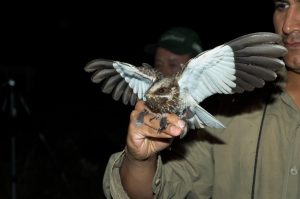
Episode 467: The Dragon Bird and Friends

Thanks to Audie, Katie, Eilee, Emily, Maryjane, and Dylan for their suggestions this week! Sorry this episode is late–the site was down. 🙁

Further reading:

Bobolinks

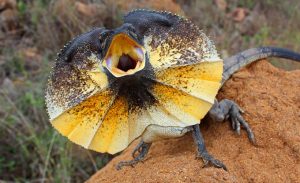
A frill-neck lizard showing off:

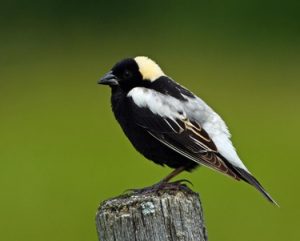
A bobolink:
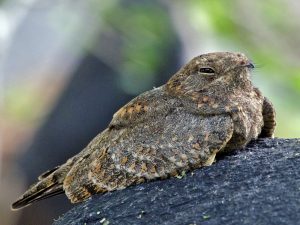
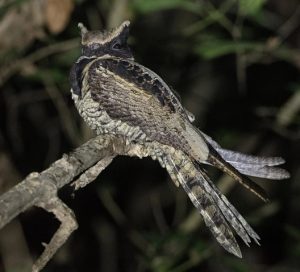
The great-eared nightjar [picture by Venkata Shreeram Mallimadugula, taken from this site]:
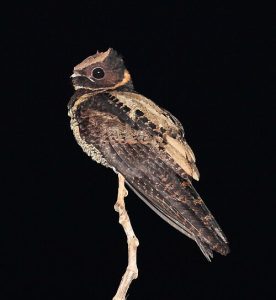
Another great-eared nightjar [Picture by Nigel Voaden from UK – Great Eared-Nightjar, Tangkoko, Sulawesi, CC BY-SA 2.0, https://commons.wikimedia.org/w/index.php?curid=39857392]:
Show transcript:

Welcome to Strange Animals Podcast. I’m your host, Kate Shaw.

This week we have an episode about some birds and reptiles. Thanks to Audie, Katie, Eilee, Emily, Maryjane, and Dylan for their suggestions! If this episode showed up later than usual in the podcast feed, it’s because I’ve been having trouble with the website and couldn’t get it uploaded until it was fixed.

We’ll kick off the episode with an animal that can’t kick, because snakes don’t have any legs. Audie suggested we learn about the scaleless rat snake, which means that first we have to learn about the rat snake, the ordinary one with scales.

Rat snakes are constrictors and are common throughout many parts of Asia, Europe, North America, and the Middle East, and they’re called rat snakes because they eat rats and other small animals like lizards, frogs, and baby birds.

Rat snakes are popular pets because they’re so pretty and they aren’t dangerous to humans. Different species are different colors and patterns, and the rhinoceros rat snake, also called the Vietnamese longnose snake, even has a little hornlike projection on the tip of its nose that points forward. I’m pretty sure we’ve talked about that particular rat snake before on the podcast, but I can’t look up which episode because the website is down.

Most rat snakes don’t grow much bigger than 5 feet long, or 1.5 meters, but a few species can get longer than that. The black rat snake, which lives in North America, can grow over 8 feet long, or more than 2.5 meters. It’s black with small white markings on the head, but snakes bred for sale as pets are sometimes white all over or partially white, or even albino, meaning an individual has a mutation where its body doesn’t produce pigment. Pet black rat snakes are also bred that don’t have scales.

That brings us to the scaleless rat snake. It’s an ordinary rat snake but it has a mutation that causes it to have very few scales. This is a mutation that happens occasionally in the wild since it’s a recessive trait, and while it can make the snake a little more vulnerable to injury, scaleless snakes can survive just fine in the wild. They do have belly scales like a normal snake, which are the ones that allow them to move around, and they may have a scattering of scales on other parts of the body too. A scaleless snake still sheds its skin once a year like an ordinary snake, since it’s actually the outer layer of skin that sheds along with the scales.

Scaleless rat snakes are popular as pets because they’re so soft and because their coloration is usually very bright. A snake’s coloration comes from pigments in its skin. A snake’s scales are actually transparent, so without a layer of scales, a scaleless snake looks even more colorful than a regular snake. Many species of snake have been found in the wild that are scaleless, but it seems to be a little more common in rat snakes.

Next, Dylan and Emily wanted to learn about the frill-neck lizard, which is found in northern Australia and the very southern part of New Guinea. It’s a big lizard that can grow almost three feet long, or 90 cm, including its incredibly long tail. Males are larger than females on average, with a bigger frill.

The frill is a flap of skin around the head and neck, and most of the time it’s folded back over the neck and shoulders so it’s not that noticeable. The lizard is pretty ordinary-looking that way, just a big gray or brown animal with a big head. But when the lizard feels threatened, or if it comes across another frill-neck lizard, it can extend the frill by moving the small bones and cartilage that act as struts, which also requires the lizard to open its mouth.

When extended, the frill is as much as a foot across, or 30 cm, and it’s marked with bright colors. Different individuals have different colored frills, red, orange, yellow, or white, or a mixture of colors and patterns. The size and color of the frill opening up so quickly will often startle a potential predator, allowing the lizard to escape. The frill-neck lizard can even run on two legs if it needs to, although it has to run with its head pointing straight up in the air.

The frill-neck lizard mostly eats insects, especially termites. It spends most of its time in trees and some people believe it can use its frill as a parachute, but that doesn’t actually seem to be the case.

Let’s move on to a few birds next. Maryjane suggested we learn about the bobolink, a type of blackbird native to the Americas. In summer the male bobolink is black with a pale yellow nape and white markings, and in winter he molts into a drab outfit of brown to help him hide. The female is brown with black streaks and stripes.

In the summer the bobolink flies to the northern United States and Canada to nest and raise babies, and it migrates to southern South America in winter. This is a huge distance for such a little songbird to travel, but it’s a strong flyer and can travel over a thousand miles, or 1,800 km, in a single day. It navigates using the stars at night and can sense the earth’s magnetic field too, which helps it find its way.

The bobolink prefers prairies and grassy areas. It eats seeds and insects, and especially likes rice and a type of caterpillar called the armyworm. It’s sometimes considered a pest because it eats so much rice, but then again armyworms are also considered pests and the bobolink eats so many of them that it has probably saved a lot of crops that way. While the bobolink is still numerous, its numbers have been in decline for years due to habitat loss.

The bobolink is most famous for its song. Both males and females sing, and males not only sing while perched, they sing while flying. The bobolink’s songs are varied and lovely. This is what the bobolink sounds like, first a song recorded while the bird was flying:

[bobolink song]

And here’s another song recorded while a different bird in a different place was perched and singing:

[bobolink song]

Finally, both Katie and Eilee wanted to learn about the great-eared nightjar, also called the dragon bird or the baby dragon.

Nightjars are nocturnal birds, and the great-eared nightjar is found in parts of southern and Southeast Asia. It can grow up to 16 inches long, or 41 cm, and is a chonky bird with big dark eyes and a broad bill that can open very wide. The “ears” in its name are tufts of feathers on the top of its head that look like ears or little horns. It can raise the ears if it wants to, but most of the time they just stick out backwards. Like other nightjars, the great-eared nightjar’s head looks flattened most of the time, and the bird itself spends a lot of time crouched down looking like a very flat bird, but then it sits up and pricks up its ear tufts, and it looks more like a thin owl with a long tail. The bird is brown with black markings, which makes it almost invisible at night.

During the day, the great-eared nightjar sits in a tree or just on the forest floor, so well camouflaged by its feathers that it blends in with the leaf litter or kind of looks like a piece of stump or broken-off branch. At night it flies around catching insects on the wing like a bat.

Instead of building a nest and laying eggs in it like other birds, the great-eared nightjar just lays a single egg among dead leaves on the ground. The egg, and the baby when it hatches, are so well camouflaged that it’s as safe on the ground as it would be in a nest way up in a tree.

The great-eared nightjar has an eerie call. This is what it sounds like:

[great-eared nightjar call]

You can find Strange Animals Podcast at strangeanimalspodcast.blubrry.net. That’s blueberry without any E’s. If you have questions, comments, corrections, or suggestions, email us at strangeanimalspodcast@gmail.com.

Thanks for listening!
Episode 146: Three strange animals

The next few weeks will be all listener suggestions! This week, Dylan and Genevieve of What Are You? Podcast request a strange fish, Kim suggests a strange invertebrate, and Callum suggests a strange bird. Thanks for the great suggestions!

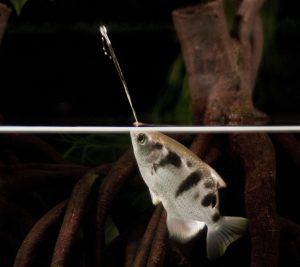
An archerfish, pew pew pew:

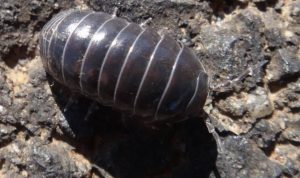
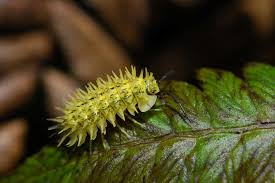
A regular roly poly and a spiky yellow woodlouse. Can you spot which is which??

A nightjar. Turn out light pls, is too bright:

A white-winged nightjar showing off his wings:

Show transcript:

Welcome to Strange Animals Podcast. I’m your host, Kate Shaw.

I’m really, really behind in getting to suggestions, as you will probably know if you have sent in a suggestion and you think I’ve forgotten all about it. So before the end of the year, which is coming up frighteningly fast, I’m going to try to get to a lot of the older suggestions. So this week we’re going to learn about a fish, an invertebrate, and a bird.

We’ll start with the archerfish, suggested by Dylan and Genevieve, who are part of the What Are You? Podcast. If you don’t already listen to What Are You?, I really recommend it. It’s a new animal podcast that’s especially for younger kids. If you like Cool Facts About Animals, you’ll like What Are You? Anyway, Dylan and Genevieve both really like the archerfish, so let’s find out why it’s such a weird and interesting fish.

The archerfish isn’t one fish, it’s a family of fish who all catch insects in an unusual way. Most archerfish species are small, maybe 7 inches at the most, or 18 cm, but the largescale archerfish can sometimes grow up to 16 inches long, or 40 cm. All archerfish live in Asia or Australia, especially southeast Asia. They like rivers and streams, sometimes ponds, and a few species live in mangrove swamps and the mouths of rivers where the water is brackish. That means it’s saltier than ordinary fresh water but not as salty as the ocean.

The reason the archerfish is so weird is the way it catches insects. Think about its name for a minute. Archer-fish. Hmm. An archer is someone who uses a bow and arrow, but obviously the archerfish doesn’t have arms and hands so it can’t shoot tiny arrows at insects. But it can shoot water at insects, and that’s exactly what it does.

The archerfish has really good eyesight, and it learns to compensate for the way light refracts when it passes from air to water. When it sees an insect or other small animal, maybe a spider sitting on a branch above its stream, it rises to the surface but only far enough so that its mouth is above water. Then it forms its tongue and mouth to make a sort of channel for the water to pass through. Then it contracts its gill covers, which shoots a stream of water out of its mouth. But because it shapes it mouth in a really specific way, the stream of water turns into a blob as it flies through the air, like a tiny water bullet. The water hits the spider, which falls from its branch and into the stream, where the archerfish slurps it up.

But the archerfish has to learn how to aim. Young archerfish aren’t very good at it, and they have to practice to shoot accurately and far. They can even learn by watching other archerfish shooting water, which is rare among all animals but practically unheard-of in fish.

Sometimes the archerfish will shoot underwater, sending out a jet of water instead of a bullet. It does this mostly to expose small animals hidden in the silt at the bottom of a pond or stream. And sometimes, of course, if the insect is close enough to the surface of the water, the archerfish will just jump up and grab it.

The archerfish shoots water with a force that’s actually six times stronger than its muscles would allow, and it does this by taking advantage of natural water dynamics. This means it uses a lot less energy to shoot water than if it was only using its muscles, and it gets a better result. It can shoot water up to ten feet away, or three meters, to bring down an insect or other small animal, although of course it prefers closer targets.

Archerfish do well in aquariums, so they’ve been studied by scientists to find out how smart they are. It turns out, they’re pretty darn clever. The archerfish takes into account the size of its target to adjust how strong a blob of water it needs to shoot. It also recognizes individual humans by their facial features. So it’s probably a good thing that they don’t have little arms and hands.

Next, Kim sent me some great suggestions way back in August, and I feel terrible that I’ve taken so long to get to any of them. We’ll look at one of those today, an invertebrate officially called a terrestrial isopod, although you may know it by one of a lot of different names. My preferred name for it is roly poly, but it’s also called a sowbug, a wood louse, a pillbug, a doodlebug, and many others.

You have probably seen roly polies, because they’re really common. The most well-known family are the various species that can actually roll up into a ball when threatened, Armadillidiidae, and someone with a sense of humor came up with that name. They’re native to Europe, but they’ve been introduced all over the world. They’re gray or brown-gray in color, armored on the back with overlapping segments, with seven pairs of little legs underneath and a pair of little antennae.

Roly polies eat decaying plant material and sometimes living plants, especially if the plant is wet. In a pinch, they will also eat dead insects and other decaying matter, but mostly they just want that yummy rotting leaf. As a result, they’re valuable decomposers in the food web. They also need moisture to breathe, so they’re often found in soil, under rocks and leaf litter, and in moss.

But Armadillidiidae isn’t the only family of roly polies. Most roly polies actually can’t roll up at all, so I should start using one of their other names, woodlouse. Technically, woodlice are crustaceans. You know, related to crabs and lobsters. But they are infinitely cuter than other crustaceans. And if you’re curious about whether they taste like lobster, apparently they taste awful, like urine. I don’t even want to think about how anyone knows what a woodlouse tastes like, or how anyone knows what urine tastes like. Yuck. Anyway, they’re descended from marine isopods that ventured out on land over 300 million years ago, but a few species have returned to the water and are aquatic.

All woodlice have segmented, flattened bodies with seven pairs of legs. When a woodlouse molts its exoskeleton, it does it in two stages. It molts the back half first, then the front half a few days later. This means that it’s not as unprotected as other arthropods that shed the whole exoskeleton at once.

There’s another arthropod called a pill millipede that looks a lot like a woodlouse, including being able to roll into a ball. But it’s actually not very closely related to the woodlouse. Pill millipedes have 18 pairs of legs and a smoother appearance.

Almost all woodlice are gray or brown, although a few may have small yellow spots. But one is actually yellow and looks very different from other woodlice. It’s called the spiky yellow woodlouse, which is a perfect description. It’s critically endangered, because it only lives in one part of the world, a volcanic tropical island in the South Atlantic, Saint Helena. It lives in trees, but it’s so threatened by habitat loss and introduced rats and other non-native species of woodlice that a captive breeding program is underway to save it. There may be as few as 100 individuals left in the wild, but fortunately it’s a lot easier to keep in captivity than, say, 100 rhinoceroses.

Let’s finish with a bird. Callum suggested caprimulgiformes, which includes nightjars, potoos, oilbirds, and whippoorwills. We’ve talked about a few of them before in previous episodes, including the oilbird in episode 121 and the Nechisar nightjar in episode 70. I know we’ve talked about the tawny frogmouth somewhere, but I can’t remember which episode. Maybe it was a Patreon episode. But we’ve never looked at most caprimulgiformes, so let’s do that now, because they are weird birds. We’ll focus on the nightjars, which are also sometimes called goatsuckers, not to be confused with the chupacabra, which also means goatsucker. In the olden days people used to think nightjars snuck into barns at night and suckled milk from dairy goats. They don’t, though. Birds can’t digest milk.

Nightjars and their close relatives are nocturnal, although some species are mostly crepuscular, which means they’re most active at dawn and dusk. Like the owl, the nightjar’s feathers are very soft so that it can fly silently. It eats insects, especially moths.

There are three subfamilies of nightjars: the typical nightjars, the eared nightjars, and the nighthawks, with lots of species in each group. They live throughout most of the world and they all look similar. We’ll take one typical nightjar as an example, the European nightjar. It lives throughout most of Europe and part of Asia, although it migrates to Africa for the winter. It’s brown and gray mottled with lighter and darker speckles, which makes it really hard to see when it’s sitting on a branch or on the ground in dead leaves. Its head appears flattened and it has a short, broad bill. Its feet are small. It has large eyes and sees well even in darkness. It grows to about 11 inches long, or 28 cm, with a wingspan of about two feet, or 60 cm.

The female nightjar lays her eggs directly on the ground instead of building a nest. Usually she’ll pick a spot where long grass or other vegetation hangs over to form a little hidden alcove. Since the nightjar is so well camouflaged, it can incubate its eggs on the ground in plain sight and probably won’t be seen. If a predator does approach the nest, the parents will pretend to be injured, so that the predator follows the supposedly injured bird hoping for an easy meal. Once the nightjar has drawn the predator far enough away from the nest, it flies away. Some nightjars can even pretend to be injured while flying.

Some nightjars have beautiful, haunting songs while some are nearly silent. The male chuck will’s widow, which lives in the southeastern United States and much of Mexico, sings at night and also claps his wings to show off for females. His song sounds like this.

[chuck will’s widow song]

Because nightjars are so well camouflaged and mostly nocturnal, they’re hard for birdwatchers and scientists to spot. As a result, there are undoubtedly nightjar species still unknown to science. This is the case with the Nechisar nightjar, which we talked about in episode 70. It’s only known from a single wing found on an otherwise squashed dead bird that was hit by a car. And until 1997, the white-winged nightjar from South America was only known from two museum specimens.

Since the first white-winged nightjar nest was discovered in 1997, researchers have learned a lot about it. It’s only been found in a few places in Brazil, Bolivia, and Paraguay, and it likes open lowlands and savannas. The male has white markings on his wings, and during breeding season he finds a termite mound to stand on, spreads his wings to show them off, and then flies up. As he does, his wings make a distinctive sound. Since most nightjars fly silently like owls, the beating of the male’s wings is intended to attract a female. This is what it sounds like:

[white-winged nightjar wings beating]

Like other nightjars, the white-winged nightjar female lays her eggs directly on the ground. Some researchers think she times the eggs to hatch around the full moon so the parent birds have more light to forage for insects. In years where there’s lots of food, the female may lay eggs in a second nest near the first one and incubate them while the male feeds the babies of the first nest.

Many nightjar species are endangered due to habitat loss, but it’s also killed by cars more often than other birds because of its habit of sitting in the road. That does not strike me as being very smart. Maybe it needs to talk to the archerfish for some advice.

You can find Strange Animals Podcast online at strangeanimalspodcast.blubrry.net. That’s blueberry without any E’s. If you have questions, comments, or suggestions for future episodes, email us at strangeanimalspodcast@gmail.com. We also have a Patreon if you’d like to support us that way.

Thanks for listening!

This is what the little nightjar sounds like. It lives in South America:

[little nightjar calls]