Episode 458: The Tasmanian Tiger and Friends

Thanks to Viki, Erin, Weller, and Stella for their suggestions this week!

Further reading:

Tasmanian tiger pups found to be extraordinary similar to wolf pups

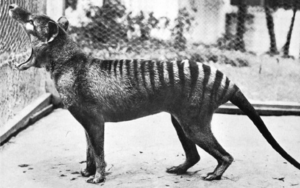
The thylacine could open its jaws really wide:
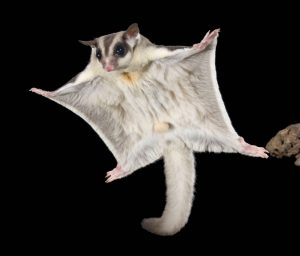
A sugar glider, gliding [photo from this page]:
A happy quokka and a happy person:

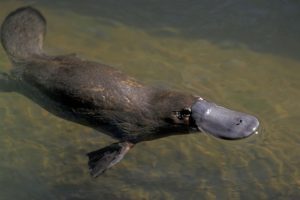
A swimming platypus:
Show transcript:

Welcome to Strange Animals Podcast. I’m your host, Kate Shaw.

This week we’re going to learn about some marsupial mammals suggested by Erin, Weller, and Stella, and a bonus non-marsupial from Australia suggested by Viki.

Marsupials are mammals that give birth to babies that aren’t fully formed yet, and the babies then finish developing in the mother’s pouch. Not all female marsupials actually have a pouch, although most do. Marsupials are extremely common in Australia, but they’re also found in other places around the world.

Let’s start with Weller’s suggestion, the Tasmanian tiger. We’ve talked about it before, but not recently. We talked about it in our very first episode, in fact! Despite its name, it isn’t related to the tiger at all. Tigers are placental mammals, and the Tasmanian tiger is a marsupial. It’s also called the thylacine to make things less confusing.

The thylacine was declared extinct after the last known individual died in captivity in 1936, but sightings have continued ever since. It’s not likely that a population is still around these days, but the thylacine is such a great animal that people hold out hope that it has survived and will one day be rediscovered.

It got the name Tasmanian tiger because when European colonizers arrived in Tasmania, they saw a striped animal the size of a big dog, about two feet high at the shoulder, or 61 cm, and over six feet long if you included the long tail, or 1.8 meters. It was yellowish-brown with black stripes on the back half of its body and down its tail, with a doglike head and rounded ears.

The thylacine was a nocturnal marsupial native to mainland Australia and the Australian island of Tasmania, but around 4,000 years ago, climate change caused more and longer droughts in eastern Australia and the thylacine population there went extinct. By 3,000 years ago, all the mainland thylacines had gone extinct, leaving just the Tasmanian population. The Tasmanian thylacines underwent a population crash around the same time that the mainland Australia populations went extinct—but the Tasmanian population had recovered and was actually increasing when Europeans showed up and started shooting them.

The thylacine mostly ate small animals like ducks, water rats, and bandicoots. Its skull was very similar in shape to the wolf, which it wasn’t related to at all, but its muzzle was longer and its jaws were comparatively much weaker. Its jaws could open incredibly wide, which usually indicates an animal that attacks prey much larger than it is, but studies of the thylacine’s jaws and teeth show that they weren’t strong enough for the stresses of attacking large animals.

Next, Stella wanted to learn about the sugar glider, and I was surprised that we haven’t talked about it before. It’s a nocturnal marsupial native to the forests of New Guinea and parts of Australia, with various subspecies kept as exotic pets in some parts of the world. It’s called a glider because of the animal’s ability to glide. It has a flap of skin between its front and back legs, called a patagium, and when it stretches its legs out, the patagia tighten and act as a parachute. This is similar to other gliding animals, like the flying squirrel.

The sugar glider resembles a rodent, but it isn’t. It’s actually a type of possum. It lives in trees and has a partially prehensile tail that helps it climb around more easily, and of course it can glide from tree to tree. It’s an omnivore that eats insects, spiders, and other small animals, along with plant material, mainly sap. It will gnaw little holes in a tree to get at the sap or gum that oozes out. It will also eat fruit, nectar, pollen, and seeds, but most of the time it prefers to hang around flowers and wait for insects to approach. Then it grabs and eats the insect without having to chase it.

The sugar glider is gray with black and white markings, big eyes that allow it to see well in darkness, rounded ears, and a really long, thick, furry tail. It’s a social animal that lives in family groups in small territories. Both males and females help take care of the joeys when they’re out of the mother’s pouch, mainly by helping them stay warm when it’s cold.

Our last marsupial of this episode is Erin’s suggestion, the quokka. It’s about the size of a domestic cat, related to wallabies and kangaroos. It’s shaped roughly like a chonky little wallaby but with a smaller tail and with rounded ears, and it’s grey-brown in color.

The quokka is considered incredibly cute because of the way its muzzle and mouth are shaped, which makes it look like it’s smiling. If you take a picture of a quokka’s face, it looks like it has a happy smile and that, of course, makes the people who look at it happy too.

This has caused some problems, unfortunately. People who want to take selfies with a quokka sometimes forget that they’re wild animals. While quokkas aren’t very aggressive and are curious animals who aren’t usually afraid of people, they can and will bite when frightened. Touching a quokka or giving it food or drink is strictly prohibited, since it’s a protected animal.

The quokka is most active at night. It sleeps during most of the day, usually hidden in a type of prickly plant that helps keep predators from bothering it. It gets most of its water needs from the plants it eats, and while it mostly hops around like a teensy kangaroo, it can also climb trees.

Let’s finish with our non-marsupial animal. Viki wanted to learn about the platypus, which we haven’t really talked about since way back in episode 45. It’s native to Australia and is very weird-looking, so it’s easy to think it’s another marsupial, but the platypus is even weirder than that. It’s not a marsupial and it’s not a placental mammal. Instead, it’s an extremely rare third type of mammal called a monotreme.

There are only two kinds of monotremes alive today, the echidna and the platypus. Monotremes retain a lot of traits that are considered primitive in mammals. Instead of giving birth to live babies, a monotreme mother lays eggs. The eggs have soft, leathery shells, but when they hatch, the babies look like marsupial newborns.

The platypus is sometimes called the duck-billed platypus, because its snout does kind of look like a duck’s bill, but instead of being hard, the snout is soft and rubbery, and it’s packed with electroreceptors that allow the platypus to sense the tiny electrical fields generated by muscle contractions in its prey. I bet that was not what you expected from what looks like a small beaver with a duck bill!

The platypus grows not quite two feet long, or 50 cm, and has short, dense, brown fur. It spends a lot of its time in the water, and has a flattened tail that acts as a rudder when it swims, along with its hind feet. It propels itself through the water with its front feet, which are large and have webbed toes. It lives in eastern Australia along rivers and streams, and digs a short burrow in the riverbank to sleep in. The female digs a deeper burrow before she lays her eggs, and she makes them a nest out of leaves.

Baby platypuses are called puggles, and while the mother doesn’t have a pouch, she keeps her babies warm by tucking them against her tummy with her tail. Monotremes don’t have teats, but they do produce milk from what are called milk patches. The puggles lick the milk up. Until scientists figured out that monotremes have these milk patches, in 1824, they thought monotremes weren’t mammals at all but something more closely related to reptiles.

Monotremes were much more common throughout the world until about 60 to 70 million years ago, when marsupials started outcompeting them. Marsupials don’t spend much time in water, though, because if they did their joeys would drown. The platypus and echidna both survived to the present day because they’re adapted for the water. The platypus mainly navigates in the water using its electrolocation abilities, and eats worms, fish, insects, crustaceans, and anything else it can catch.

It’s easy to think, “Oh, that mammal is so primitive, it must not have evolved much since the common ancestor of mammals, birds, and reptiles was alive 315 million years ago,” but of course that’s not the case. It’s just that the monotremes that survived did just fine with the basic structures they evolved a long time ago, and they’re still going strong today.

You can find Strange Animals Podcast at strangeanimalspodcast.blubrry.net. That’s blueberry without any E’s. If you have questions, comments, or suggestions for future episodes, email us at strangeanimalspodcast@gmail.com. We also have a Patreon at patreon.com/strangeanimalspodcast if you’d like to support us for as little as one dollar a month and get monthly bonus episodes.

Thanks for listening!
Episode 373: The Tasmanian Devil and the Thylacine

Thanks to Carson, Mia, Eli, and Pranav for their suggestions this week!

Further reading:

RNA for the first time recovered from an extinct species

Study finds ongoing evolution in Tasmanian Devils’ response to transmissible cancer

Tasmanian devil research offers new insights for tackling cancer in humans

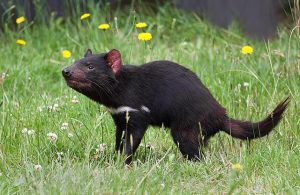
The Tasmanian devil looks really cute but fights all the time [picture by JJ Harrison (https://www.jjharrison.com.au/) – Own work, CC BY-SA 3.0]:

The Thylacine could opens its jaws verrrrrrry wide:

Show transcript:

Welcome to Strange Animals Podcast. I’m your host, Kate Shaw.

This week we’re going to cover two animals that a lot of people have suggested. Carson and Mia both want to learn about the Tasmanian tiger, and Eli and Pranav both want to hear about the Tasmanian devil. We talked about the Tasmanian tiger, AKA the thylacine, in episode 1, and I thought we’d had a Tasmanian devil episode too but it turns out I was thinking of a March 2019 Patreon bonus episode. So it’s definitely time to learn about both!

The thylacine was a nocturnal marsupial native to New Guinea, mainland Australia, and the Australian island of Tasmania, and the last known individual died in captivity in 1936. But thylacine sightings have continued ever since it was declared extinct. It was a shy, nervous animal that didn’t do well in captivity, so if the animal survives in remote areas of Tasmania, it’s obviously keeping a low profile.

The thylacine was yellowish-brown with black stripes on the back half of its body and down its tail. It was the size of a big dog, some two feet high at the shoulder, or 61 cm, and over six feet long if you included the long tail, or 1.8 meters. It had a doglike head with rounded ears and could open its long jaws extremely wide. Some accounts say that it would sometimes hop instead of run when it needed to move faster, but this seems to be a myth. It was also a quiet animal, rarely making noise except while hunting, when it would give frequent double yips.

A 2017 study discovered that the thylacine population split into two around 25,000 years ago, with the two groups living in eastern and western Australia. Around 4,000 years ago, climate change caused more and longer droughts in eastern Australia and the thylacine population there went extinct. By 3,000 years ago, all the mainland thylacines had gone extinct, leaving just the Tasmanian population. The Tasmanian thylacines underwent a population crash around the same time that the mainland Australia populations went extinct—but the Tasmanian population had recovered and was actually increasing when Europeans showed up and started shooting them.

Because the thylacine went extinct so recently and scientists have access to preserved specimens less than a hundred years old, and since the thylacine’s former habitat is still in place, it’s a good candidate for de-extinction. As a result, it’s been the subject of many genetic studies recently, to learn as much about it as possible. It’ll probably be quite a while before we have the technology to successfully clone a thylacine, but in the meantime people in Australia keep claiming to see thylacines in the wild. Maybe they really aren’t extinct.

The Tasmanian devil is related to the thylacine. It’s about the size of a small to average dog, maybe a bulldog, which it resembles in some ways. It’s compact and muscular with a broad head, relatively short snout, and a big mouth with prominent lower fangs. It’s not related to canids at all, of course, and if you just glanced at a Tasmanian devil, your first thought wouldn’t be “dog” or “thylacine,” it would probably be “giant mouse.”

The Tasmanian devil is black or grayish-brown, usually with patches of white on the chest and rump. It also has rounded pinkish ears, long whiskers, paws with relatively long toes, and a long tail. Since the devil stores fat in its tail, a fat-tailed devil is a happy, healthy devil.

It’s mainly a scavenger and will eat roadkill and other dead animals, although it will also kill and eat small or even large animals, and will also eat plant material and insects. It often eats every trace of a carcass, including bones and fur. This is good for other animals and for ranchers, since it reduces the presence of insects attracted to dead animals and reduces the spread of disease. Its digestion is extremely fast and efficient, and its jaws are extremely strong.

The Tasmanian devil is usually solitary, but it does get together with other devils to socialize and fight while eating. When a devil finds a carcass, it will make extremely loud calls to alert other devils to come share its meal. Then, because they’re called devils and not angels for a reason, the animals will fight over the food.

Tasmanian devils fight a lot. Researchers think the white markings help direct other devils to attack parts of the body that are less vulnerable to injury. The white fur is more visible in the dark, giving other devils a target. The white markings are usually on the devil’s chest, sides, and rump, with none on the face or legs. Males fight each other during breeding season, and the females pick the winners to mate with. If a female doesn’t like a male, she’ll fight him.

Devils are marsupials, which means babies are born very early and finish developing in their mother’s pouch. The Tasmanian devil’s pouch is rear-facing and contains four teats. The problem is, the mother has 20 or even 30 babies at a time. They’re born about the size of a jellybean and the only part that’s developed at that point is the forelegs so it can crawl into the mother’s pouch. The legs have claws and—you guessed it—the little squidge babies fight for a teat. Once one gets to a teat, it clamps on and doesn’t let go for the next three months. Babies that don’t get a teat die.

Like the thylacine, the Tasmanian devil once lived on mainland Australia but is now restricted to the island of Tasmania. Also like the thylacine, it shows low genetic diversity and was once killed for bounty by early settlers. It’s affected by habitat loss like many other animals, and it’s especially vulnerable to being run over by cars because it eats so much roadkill.

But the devil’s biggest issue today is a disease called devil facial tumor disease, or DFTD. DFTD is spread when an infected animal bites another one, which causes cancerous growths in and around the mouth. After a few months the tumors get so big that the devil can no longer eat and starves to death. Since devils bite each other all the time, the disease spreads quickly throughout a population.

In 2019 some researchers predicted the Tasmanian devil would be extinct by 2024. But here it is 2024 and not only is the devil not extinct, it’s actually doing a lot better now than it was just a few years ago.

Part of that is due to conservation efforts, where healthy devils are quarantined from infected ones in captive breeding programs. But part of it is natural. In 2018 a small population of devils was discovered that appeared to have developed a natural resistance to DFTD. Genetic studies done since then revealed some surprises. Not only are younger devils showing a genetic resistance to DFTD, there’s evidence that resistance to other transmissible cancers has developed in the past. Researchers think the Tasmanian devil might be especially prone to transmissible cancers but is also able to develop resistance relatively quickly. The devils with this resistance start growing tumors, but then the tumors stop growing and soon just disappear. Naturally, scientists are looking at the genetics of this trait to see if it can be applied to humans with certain types of cancer.

While Tasmanian devils fight each other, they don’t actually fight humans. Scientists report that it’s actually quite easy to work with. This makes it a lot easier to check the health of a captured animal. Hopefully it won’t be long before the entire population of Tasmanian devils is healthy and its numbers start to increase again.

You can find Strange Animals Podcast at strangeanimalspodcast.blubrry.net. That’s blueberry without any E’s. If you have questions, comments, or suggestions for future episodes, email us at strangeanimalspodcast@gmail.com. We also have a Patreon at patreon.com/strangeanimalspodcast if you’d like to support us for as little as one dollar a month and get monthly bonus episodes.

Thanks for listening!
Episode 001: The Thylacine and the Quagga

Re-recorded after two years, yesss! Episode one now has decent audio quality and has been slightly updated to reflect new findings about the thylacine.

The Thylacine (commonly called the Tasmanian tiger) and the quagga, a type of zebra, have two important things in common. They’re both partially striped and they’re both extinct. Sort of. The first episode of Strange Animals Podcast discusses what sort of animals both were, and why we can’t say with 100% certainty that they’re extinct. Even though we know the date the last individuals died.

The Thylacine. Look at those jaws! How does it open its mouth that wide?

Watch the 2008 thylacine (maybe) video for yourself.

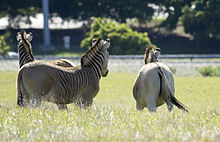
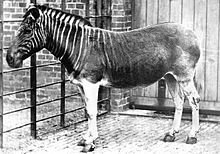
The Quagga, old and new:

Show transcript:

Welcome to Strange Animals Podcast. I’m your host, Kate Shaw.

If you’re wondering why episode one is suddenly appearing in your feed after more than two years, it’s because I’ve rerecorded it. Quite often people who are interested in a podcast download the first episode to check it out, and our first episode sounded TERRIBLE. So here’s a fresh new version with a little bit of extra information included.

If you’re already a Strange Animals Podcast listener, I hope you don’t mind this redone episode showing up in your feed. Don’t worry, there will be a new episode next Monday as usual! If you’re a new listener, I hope you like the podcast and stick around!

The first episode of Strange Animals Podcast is about the thylacine and the quagga. Both animals are kinda-sorta extinct and both are partially striped. So they go together!

You may know the thylacine as the Tasmanian tiger or wolf, or you may be confused and think I’m talking about the Tasmanian devil. The Tasmanian devil is a different animal although it does live in the same part of the world.

The thylacine was a nocturnal marsupial native to Australia, New Guinea, and Tasmania, but it went extinct early in the 20th century. The last known individual died in captivity in 1936. But in 2008, footage of a long-tailed doglike animal was caught on film near Perth in Western Australia.

Thylacine sightings have been going on for years—basically ever since it was declared extinct. It was a shy, nervous animal that didn’t do well in captivity and sometimes died of shock when captured, so if the animal survives in remote areas of Australia or Tasmania, it’s obviously keeping a low profile.

The thylacine was as big as a good-sized dog, some two feet high at the shoulder, or 61 cm, and over six feet long if you included the tail, or 1.8 meters. It wasn’t very fast, seldom traveling faster than a stiff trot or an awkward canter. I’ve read accounts that it would sometimes hop instead of run when it needed to move faster, but this seems to be a myth. If thylacines are wandering around outside of Perth or anywhere else, it’s surprising no one has accidentally hit one with a car. The Tasmanian devil is in such steep decline that it’s projected to be extinct in the wild by 2024 at the latest, and in 2014 over 400 of them were killed by cars.

No other animal in Australia and Tasmania looks like the thylacine. It was yellowish-brown with black stripes on the back half of its body and ringing the length of its tail. Its head was heavy and doglike, with long jaws and erect, rounded ears. Its legs were relatively short while the body and especially the tail were long. It could open its jaws startlingly wide although it didn’t have a very strong bite. It was also a quiet animal, rarely making noise except while hunting, when it would give frequent double yips.

Not a lot is known of the thylacine in the wild. Tasmanian Aborigines would build little structures over thylacine bones, since letting the bones get rained on was supposed to bring on bad weather. I still love this so much.

The thylacine was killed by British colonists who thought it preyed on livestock, but it was actually a weak hunter that probably couldn’t kill prey much larger than a chicken. In fact, some researchers think the thylacine’s primary source of food was the native hen, and once that bird went extinct in the mid-19th century, thylacine numbers started to decline. It certainly didn’t help that bounties for dead adults were as much as a pound—big money in the 19th century. Captive animals were prone to a distemper-like disease and only one pair successfully bred in captivity.

So what about all those sightings? Is it possible that small populations of the thylacine survived loss of both habitat and prey animals, bounty hunting, and competition with introduced dingos? There have been numerous organized searches for signs of the thylacine, with nothing to show except blurry photos and grainy film footage. But we don’t have anything concrete: no bodies, no clear photos, not even any good footprints.

As for the 2008 video, the Thylacine Awareness Group of Australia released it in September of 2016, eight years after it was recorded. The person who took the footage states that she had seen the animal repeatedly over a matter of weeks, and had also seen a female with two pups. She says they were all striped and did not look anything like foxes.

The footage isn’t very clear, but it shows a foxlike animal with a long tail. The recording is too grainy to make out any markings. Certainly the animal doesn’t appear to have the vivid stripes seen in old photos taken before the thylacine went extinct.

To me, the animal in the footage looks a lot like a fox with an injured leg or paw, which makes its gait seem odd. Its legs are much too long for a thylacine, the body is too short, and the hocks are too far up the leg. As for the long tail, I’ve seen foxes with mange and the tails look just like this one’s.

There’s another issue against the survival of the thylacine too. According to a 2012 study conducted by Andrew Pask of the University of Connecticut, the thylacine had a very low genetic diversity to start with. Isolated breeding populations would further limit the gene pool and eventually lead to a population that couldn’t survive due to physical issues associated with inbreeding.

That study only sampled from 14 different skins and skeletons, so it’s possible the situation wasn’t as bad as its results suggest. On the other hand, the Tasmanian devil is another species with low genetic diversity, and its numbers are declining steeply despite conservation efforts.

Since this original episode one went live in February 2017, there’s been a more comprehensive DNA study of thylacines that changes what we know about their past. A September 2017 study conducted by the University of Adelaide generated 51 DNA sequences from thylacine fossils and museum specimens.

The study discovered that the thylacine population split into two around 25,000 years ago, with the two groups living in eastern and western Australia. Around 4,000 years ago, climate change caused more and longer droughts in eastern Australia and the thylacine population there went extinct. By 3,000 years ago, all the mainland thylacines had gone extinct, leaving just the Tasmanian population. The Tasmanian thylacines underwent a population crash around the same time that the mainland Australia populations went extinct—but the Tasmanian population had recovered and was actually increasing when Europeans showed up and started shooting them.

It would be fantastic if a population of thylacines was discovered still alive somewhere. But it doesn’t look good right now. On the other hand, you can still see the Tasmanian devil. Just please try not to run over one. There aren’t many left.

[goat call, because why not]

When I was maybe twelve years old I read about the quagga for the first time, probably in a library book about animals. I remember being so moved at the thought of this fascinating zebra driven to extinction that I wrote a poem about it. Unfortunately for all of us, I remember the first two lines of the poem. Yes, I’m going to recite it again. I’m sorry.

“Dear quagga, once running

O’er field and o’er plain…”

It went on and on for two entire pages of notebook paper. Thank goodness I don’t remember any more of it.

Ever since that awful, awful poem, I’ve had a soft spot for the quagga. It really was an interesting-looking creature. The head and forequarters were striped and clearly those of a zebra, but if you were to see only its hindquarters you’d swear you were looking at a regular old donkey.

The quagga was a subspecies of plains zebra, and was common in south Africa until white settlers decided they didn’t want any wild animals eating up their cattle’s grass. By 1878 the quagga was extinct in the wild; the last captive individual died in 1883. Thanks a bunch, white settlers. You made twelve-year-old me cry, and I didn’t even know about Apartheid yet.

Locals in some areas still refer to all zebras as quaggas, supposedly as an imitation of the zebra’s call. I don’t know what variety of zebra this call is from, but I’m going to guess that all zebras kind of sound the same.

[zebra call]

That really is awesome.

It’s interesting to note that still-living plains zebras show less and less striping the farther south they live. The quagga lived in the southernmost tip of Africa, south of the Orange River in South Africa’s Western Cape region, an even more southerly range than the plains zebra’s. And as a reminder, the quagga was a subspecies of the plains zebra—so closely related that it’s sometimes impossible to tell stuffed specimens of the two varieties apart. Where their ranges overlapped, researchers think plains zebras and quaggas frequently interbred.

You can see where this is going, I hope.

In 1987, the Quagga Project in South Africa started with 19 plains zebras that showed reduced striping and had genetic markers most like quaggas. After five generations of selective breeding, the project has produced six foals as of 2016 that look like the extinct quaggas. The project calls them Rau Quaggas after Reinhold Rau, the project’s founder. Rau was inspired by the work of Lutz Heck, who was the guy responsible for breeding the heck horse to imitate the extinct tarpan. If you want to know more about the tarpan and the heck horse, check out episode 47 about mystery horses.

Eventually the group hopes to have 50 Rau quaggas that will live as a herd on reserve land in South Africa. Eric Harley, a genetics professor at Cape Town University and one of the founding members of the project, points out that while the Rau quagga isn’t an exact genetic match for the extinct quagga, it’s pretty darn close.

Of course there are people who criticize the group’s efforts for various reasons. Some say that since it’s impossible to reproduce the extinct quagga exactly, there’s no point in even trying. Others say that the resources spent trying to reproduce the quagga should be spent on conserving endangered animals instead.

But the Quagga Project is actually doing something useful for South Africa: working to reintroduce a type of zebra adapted to the colder environment, which can live in groups with ostriches and other animals that typically herd with zebras. When the Dutch exterminated the quagga, they messed up the balance of species in the area. Whether or not you think the Rau quaggas are analogous to actual quaggas, they’re going to be a good addition to the wildlife preserve.

And look, here’s the thing. Everyone gets to participate in the project they love, whether or not someone else thinks that project is worth it. We all have limited time in this world. One person wants to spend their energy recreating the quagga in South Africa, another wants to set trail cams up in Tasmania to look for thylacines, and a third person might happen to want to record a podcast about those people instead of washing the dishes. And that is OKAY.

Do what you love.

You can find Strange Animals Podcast online at strangeanimalspodcast.com. We’re on Twitter at strangebeasties and have a Facebook page at facebook.com/strangeanimalspodcast. If you have questions, comments, or suggestions for future episodes, email us at strangeanimalspodcast@gmail.com. We also have a Patreon if you’d like to support us that way.

Thanks for listening!