Episode 509: Two Big Weird Heavy Animals

Welcome to Strange Animals Podcast. I’m your host, Kate Shaw.

It’s taking forever to shake this cold. I feel fine now, but I still sound pretty bad. I apologize for my voice this time, but hopefully it’s not too bad. Rather than postpone this episode until my voice recovers, let’s just have a short but info-packed episode about some weird big animals from the past.

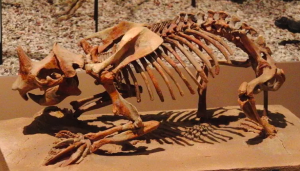
I think Llewelly alerted me to Neoparadoxia cecilialina, which appears in the fossil record between about 32 to 10 million years ago. It lived along the coast of the northern Pacific Ocean. It grew to around 8 feet long, or just under 2.5 meters, although the only specimen found so far wasn’t fully grown so it may have been a bit larger as an adult. It was a heavy animal with long legs, big feet, a big wide snout with eyes near the top of its head, and a tiny tail. In fact, it probably looked superficially like a weird hippopotamus. Like the hippo, it ate water plants. It was probably fully aquatic, meaning it lived its entire life in water.

Neoparadoxia was a member of the order Desmostylia, which were all marine herbivores that probably mostly ate kelp. They all looked sort of like weird hippos but acted more like dugongs. Some researchers think Desmostylians went extinct when dugongs evolved and outcompeted them.

Despite its strong-looking leg bones, many species of Desmostylia had spongy bones. This made the bones less dense but also weakened them. Weaker bones are not a problem for an ocean animal whose weight is supported by the water, but it does mean that it probably couldn’t support its weight on land. Whales and other cetaceans have a similar type of spongy bone.

Desmostylus was a Desmostylian genus. It probably spent most of its time near the surface of shallow water. It may have preferred to live around the mouths of rivers and spent part of its time in fresh water, part in brackish water where the ocean and river mixed. It grew around 6 feet long, or 1.8 meters, and it had toenails that were the remnants of hooves from when its ancestors lived on the land. It had two pairs of tusks that jutted forward from its long jaws, which it probably used to help dig up plants.

Some species of Desmostylia had teeth that are similar to elephant teeth, which may have helped it deal with sand and grit when eating a diet of sea grass. Species that didn’t have spongy bones may have actually walked across the sea floor to eat plants, only surfacing to take breaths.

So are Desmostylians more closely related to elephants or hippos or whales or dugongs? How about none of the above. Scientists are still trying to figure out how the Desmostylians were related to each other and to other animals, but so far they seem to be not very closely related to anything alive today. One suggestion is that they’re basal odd-toed ungulates that completely died out around 10 million years ago, leaving no living descendants.

Another group of big heavy weird animals that went extinct around 28 million years ago was an order called Embrithopoda. Instead of looking sort of like hippos, Embrithopods looked more like rhinoceroses. They were land animals that probably evolved in Africa, although they also lived in parts of Eurasia, and they were probably about as closely related to Desmostylians as Desmostylians were to elephants and dugongs—and, in fact, Embrithopods were probably also distantly related to elephants and dugongs. They probably weren’t actually related to rhinos.

This is weird at first glance, because Embrithopods look a lot like rhinos. Some species even had nose horns. For instance, Arsinoitherium lived in the rainforests of northern Africa around 30 million years ago, and stood around 6 feet tall at the shoulder, or 1.8 meters, and had a pair of huge horns on the nose with another small pair over the eyes. But the nose horns were much different from the rhino’s horn. For one thing, both were side by side. For another, they weren’t made out of keratin fibers like the rhino’s horn. Instead, the horn cores were made of bone and were probably covered with keratinized skin something like giraffe ossicones. Either way, they were probably pretty darn impressive, especially if they were pointed at you.

Embrithopods ate plants, especially tough plants. Some species may have been semiaquatic, living in swampy areas and in lakes. And that is pretty much all we know about them. I kind of want one as a pet after looking at pictures of its skeleton, but let’s just chalk that up to the cough medicine I’ve been taking.

Thanks for your support, and thanks for listening!
Episode 483: Animals with Nose Horns

The horned gopher:

Show transcript:

Welcome to Strange Animals Podcast. I’m your host, Kate Shaw.

This time we’re going to learn about some mammals with weird horns. Specifically, weird nose horns. Nose horns are properly called rostral horns, but that’s not as funny.

We’ll start with a family of extinct rodents called horned gophers, or more properly, mylagaulids. The horned gopher wasn’t a gopher, but it probably looked similar to ground squirrels like prairie dogs and marmots. It lived in what is now North America around twenty million years ago, and it had a pair of short, broad horns that pointed upwards between the nose and eyes, like a rhino’s horns but side by side and made of bone, not keratin. It was big for a rodent, about a foot long, or 30 cm, and ate plants.

So what did the horned gopher use its horns for? Both males and females had the horns and they’re too short and placed too far back for males to use them to fight each other. Horned gophers had poor eyesight so males probably weren’t trying to look and act flashy to attract females anyway.

At first researchers thought the horns helped in digging burrows. The horned gopher primarily used what’s called the head-lift method of digging, which means it pushed its nose into the dirt, then lifted its head with powerful neck muscles to remove a chunk of soil—basically using its nose as a shovel. But its horns pointed straight up and were set too far back on the nose to help with digging. Most researchers today think the horns were used for defense. If a predator tried to grab the animal by the neck, it could snap its head back and stab the predator right in the face.

The horned gopher had tiny eyes and front feet that resembled a mole’s, with long claws. Researchers think its ancestors probably spent most of the time underground, but that as it evolved to become larger, it also spent more time foraging above-ground. That led to more predators being able to attack it, so evolving horns as a defensive weapon helped it survive.

While the horned gopher was distantly related to modern squirrels, its family is completely extinct these days. But it’s still the smallest known horned mammal that ever lived.

The horned gopher is also the only horned mammal known that lived mostly underground in burrows. Almost. There was once a type of armadillo, naturally called the horned armadillo but more properly referred to as Peltephilus [pelta-FEElus], that had a pair of horns over its eyes but a little in front of them, close to where the horned gopher’s horns were. The horned armadillo’s horns developed from scutes on its head, and if you remember, scutes are bony plates embedded in the skin as armor. It might also have had a smaller pair of horns over its nostrils. It lived in what is now South America and went extinct around 11 million years ago.

The horned armadillo dug burrows liked the horned gopher did, but it was much bigger than the horned gopher, with some species as much as five feet long, or 1.5 meters. Despite its size, it probably resembled the pink fairy armadillo in overall shape rather than the more common nine-banded armadillo that lives in parts of North America. It had a short tail and its rump was squared off instead of rounded. It also had big sharp teeth. It may have eaten insects, possibly digging up ant nests, but more likely it mostly ate roots and other plant parts.

Arsinoitherium was another animal with nose horns, this one from Africa. It lived around 30 million years ago and was related to modern-day elephants, but it lived in swampy areas and tropical rainforests and ate plants. It probably looked a little like a rhinoceros and a little like a small elephant without a trunk. Different species were different sizes, but they were all pretty big, probably no smaller than about six feet tall at the shoulder, or 1.75 meters. And they had two pairs of horns, a little pair more like bumps over the eyes and two side-by-side forward-pointing giant nose horns that looked a lot like rhino horns but thicker. But they were real horns made of bone, not keratin, although they may have been covered in skin and hair like ossicones. You know, ossicones are those hornlike structures giraffes have.

Brontotherium looked a lot like a rhinoceros too, but that’s because it was distantly related to the rhino, although it was more closely related to the horse. It lived in North America around 35 million years ago and was enormous, standing around 8 feet tall at the shoulder, or 2.5 meters. It was a selective browser, probably preferring tender leaves to tough grass. It carried its massive head low like modern rhinos and buffalo do, and had a humped shoulder like both those animals where its massive neck muscles attached. And it had a pair of nose horns.

Both males and females had the nose horns, but the males’ horns were much larger. The horns were blunt and shaped sort of like a V, and researchers are pretty sure males used them to fight each other. We have fossilized brontotherium rib bones that show an injury shaped just like the nose horns. The horns were probably also useful to fight predators. Even though brontotherium was related to the rhino, its horns were bone, not keratin.

Our last nose horn animal lived in North America up to about five million years ago. The various species of Protoceratidae [pro-TOSS-e-rated-die] were hoofed animals that looked sort of like deer, but were more closely related to a living ungulate called the chevrotain, or mouse deer. Protoceratid probably ate grass and other plants and may have lived in herds. Males had a pair of ordinary horns that looked a lot like cow horns, and in some species females had the horns too, although they were smaller. But males also had a horn on the nose. And it was weird.

Once again, the nose horn wasn’t like a rhino’s horn, which as we have established by now is made of keratin. And maybe I should have reminded you before now that keratin is the same protein that makes hair, fingernails, hooves, and things like that. Keratin also doesn’t fossilize. This nose horn was an actual horn made of bone, but researchers think it may have been covered with skin and fur like an ossicone.

Different Protoceratidae had different nose horns. Syndyoceras had a pair of nose horns that were fused at the base, then split apart to form a V shape. It may also have had large nasal passages that made its muzzle look much bigger than the skull would suggest at first glance. Synthetoceras had a long nose horn that grew up and slightly forward but split into a Y at the tip. Kyptoceras had a pair of nose horns that pointed forward. Researchers think the males used these nose horns to fight each other, much like deer fight with their antlers today.

One older Protoceratid that lived up to around 20 million years ago was called Protoceras, and males had three pairs of horns, although they probably resembled ossicones and were all covered in skin and hair. A small pair grew between the ears, another pair between the eyes and nose, and the largest pair grew on the nose. Females only had one smaller pair of horns between the ears, so the extra horns males had were probably for display.

Some Protoceratidae also had a pair of fanglike canine teeth that they may have used to root around in dead leaves for plant material. Male chevrotains have fangs like this too, but they use them to fight each other since they don’t have horns.

So basically, this is what we’ve learned from this episode: There used to be a lot more nose-horned animals than we have now, most of them lived in the Americas for some reason, and they were all awesome. Also, even though the first animal we think of when someone mentions nose horns is the rhino, the rhino’s keratin horns are actually unusual. Just be glad you’re not an intelligent birdlike creature from the far future trying to figure out what a rhinoceros actually looked like when it was alive.

Thanks for your support, and thanks for listening!