Episode 071: The Not-Elephants

Not-Elephants! They’re like elephants but WEIRD! Let’s take a look at a lot of extinct proboscidea this week.

Oh, and the Casual Birder Podcast episode where I talk about indigo buntings should be released this week, not last week. Oops.

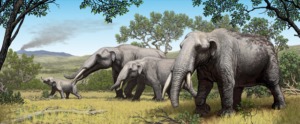
Gomphotheres, looking deceptively normal at first glance:
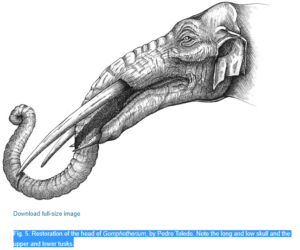
THEIR FACES AAAHHHH art by Pedro Toledo:

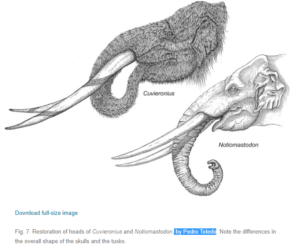
Cuvieronius and Notiomastodon, art also by Pedro Toledo. Note the spiral on Cuvieronius’s tusks:
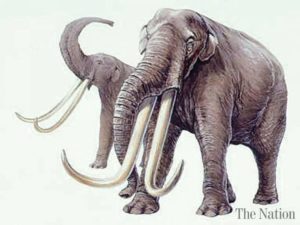
Stegodon:
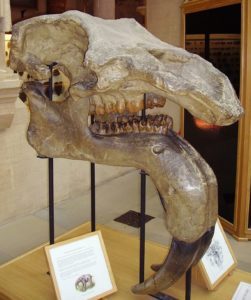
Deinotherium, just going totally weird with the tusks and chin:
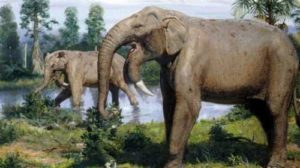
It might have looked a little something like this when alive. What the actual heck:
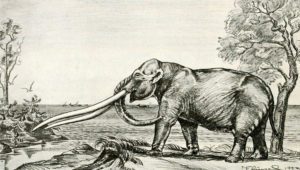
Anancidae tusks were just out of control:
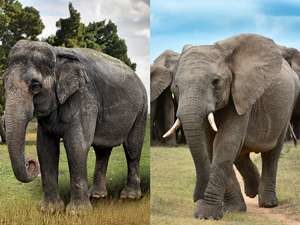
Guess what! These two proboscidae are still alive! Hooray for Asian elephants (left) and African elephants (right)!
Okay, what the heck is going on in these genealogy sites, pretty sure elephants don’t use them:

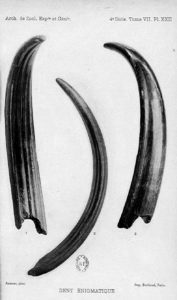
And finally, I swiped this picture of the Mystery Tusk from Karl Shuker’s blog, specifically this post.
Show transcript:

Welcome to Strange Animals Podcast. I’m your host, Kate Shaw.

We haven’t had an episode about Pleistocene megafauna in a while, so this week we’re covering some interesting mammals that are related to elephants and mammoths, but aren’t elephants or mammoths. Oh, and I jumped the gun last week with our mystery birds episode. The Casual Birder podcast is running the finch episode this week, where I have a little spot talking about the indigo bunting. I’ll make sure to put a link in the show notes so you won’t miss it if you don’t already listen to the Casual Birder podcast.

We’ll start off this week with an elephant that…isn’t an elephant. Just wait till you hear about the gomphothere, oh man. I’ve been saving this one for a while.

Gomphothere is the name for a family of animals that lived throughout much of the world, except for Antarctica and Australia. Researchers aren’t sure yet whether it eventually gave rise to elephants and mammoths or whether gomphotheres and mammoths were just cousins with a shared ancestor. The first gomphotheres evolved in Africa and spread into Asia and Europe around 22 million years ago. From there they moved into North America and eventually even into South America during the Pleistocene, shortly before they all went extinct.

So what did gomphotheres look like, and how did they differ from elephants? I’m SO glad you asked. A big part of why gomphotheres would have looked weird to us today is because their bodies were very elephantine. But their faces…were just wrong.

For instance, several species of Gomphotherium had a relatively short trunk and four tusks. The upper two tusks were on the upper jaw and jutted forward and downward. Not too unusual. The other pair of tusks were in the lower jaw. They jutted forward side by side and were flattened to form a sort of shovel. For a long time researchers thought it lived in swamps and used its shovel jaw to scoop up water plants, but more recent research suggests it used its lower tusks to cut through tough vegetation. Some species may have used the shovel to gouge bark off trees, for instance. Its head was elongated as a result of the long lower jaw, so while its body looked like a pretty average elephant, size and all, its face would have been long and flattened compared to the elephants we’re used to. I’m picturing the big reveal in an elephant horror movie where the mysterious character in the shadows turns its head and the music goes BWAHHHH and all the elephants in the audience scream.

Cuvieronius and Notiomastodon are the only gomphotheres that lived in South America. Despite its name, Notiomastodon was not closely related to actual mastodons. Both Cuvieronius and Notiomastodon evolved in North America just over 5 million years ago, then migrated into South America around 3 million years ago. Cuvieronius preferred cooler environments and lived along the Andes Mountains, and may have had thick hair to keep it warm, while Notiomastodon lived in open forests in the lowlands and along the coast, and probably had very little hair, much like modern elephants. Both stood over 8 feet tall at the shoulder, or 2.5 meters. Both also probably looked pretty normal compared to elephants, and probably acted a lot like modern elephants too. Both had a single pair of tusks. But while Notiomastodon’s tusks were relatively ordinary and usually curved upward like a modern elephant’s, Cuvieronius’s grew in a spiral—although not a tight spiral like narwhal tusks. A band of enamel spiraled along the tusk’s length, and the tusk could be over eleven feet long, or 3.5 meters. Some other gomphothere tusks have enamel coverings, unlike elephant and mammoth tusks, which do not contain enamel.

Notimastodon died out in South America about the time humans migrated into the area, or maybe a little before, but it lived longer in parts of North America, as recently as 28,000 years ago in Mexico. Cuvieronius lived even longer before going extinct, with fossils dated to only about 11,500 years ago found in Chile.

Researchers are still working out the relationships between various gomphotheres and their relations. Gomphotheres, elephants, and some other relations are all in the same order, proboscidea, but different families.

Let’s jerk everything to a halt for a second while I explain the scientific classification system for those of you who aren’t familiar with it. Every living creature that has been described scientifically is assigned a place in the classification system so other researchers can get an idea of what the organism is most closely related to. Classifications can and do change as more information is learned.

The top tier is kingdom, extremely broad groups. All mammals, reptiles, amphibians, fish, birds, insects, sponges, worms, jellyfish, and basically anything else that could possibly be called an animal is part of the kingdom Animalia. Kingdoms are divided into phyla, which is the plural of phylum. You may remember me talking at length about phyla in the Cambrian explosion episode a few weeks ago, and I probably should have put this explanation in that episode. Any animal with a backbone or notochord or some similar structure is in the Chordate phylum. The next section under phylum is class, and that’s where we separate mammals from birds from reptiles from fish, and so forth. Elephants, Gomphotheres, and humans are all part of the class Mammalia. But when we reach the next big section down, Order, we separate humans from elephants and gomphotheres, because those are part of the order Proboscidea while humans are in the order Primate. Under Order is family, then genus, then species. The genus and species give an organism its scientific name, such as Homo sapiens or Stegodon zdansky. There are finer gradations, like subfamily and subspecies and clade and so forth, but we won’t go over those here. Let’s get back to the not-elephants.

So, what’s Stegodon zdansky? It’s in the proboscidea order along with elephants and gomphotheres, but it’s not either. And the reason I bring it up is because it was really, really big. It could stand some 13 feet high at the shoulder, or 4 meters, and its tusks were similarly enormous—not just long, although they were over ten feet long, or more than three meters, but so big and close together that it had to drape its trunk to one side or the other of the tusks, not in between like most other proboscideans. Stegodon zdansky lived in China. Other species of Stegodon also lived in Asia, mostly in forested areas, and like zdansky they all had long tusks set close together.

Remember the island of Flores, where the Flores little people lived, Homo floresiensis? We learned about them in episode 26. Popular articles about the Floes little people often say they hunted a dwarf elephant, but it wasn’t an elephant at all. It was a Stegodon that had adapted to life on an island by becoming smaller, not much bigger than a cow. But it’s not clear if it was actually hunted by the Flores little people or if it went extinct before they arrived.

There are more proboscideans, believe me. Deinotherium, for instance, which was simply enormous. It could stand more than 13 feet tall, or 4 meters, but some big males may have stood nearly 16 feet tall, or 5 meters. Only paraceratherium, which you may remember from our tallest animals episode, was taller and heavier.

It had such weird tusks that researchers aren’t sure what it used them for. It had one pair on the lower jaw. Not only did the tusks grow almost straight downward, its lower jaw also curved downward. Some researchers think it dug up plants with the tusks, while others think it used its tusks to pull branches down so it could strip leaves off with its trunk. But no one knows for sure. Researchers also think it had a strong trunk, although we don’t know whether it was a long trunk or a short one. It lived in parts of Asia, Africa, and Europe, and went extinct around a million years ago.

Amebelodontidae was a family that paleontologists thought for a long time were gomphotheres, but new research has separated them into their own family. Like many Gomphotheres, the lower jaw is elongated with a pair of flat, short tusks at the end. The upper tusks are straight and reach only to the end of the jaw, or not as far as the end of the jaw in some species. Reseachers think it used its tusks to cut through tough plants. Similarly, Anancidae were once thought to be Gomphotheres but are now considered their own family. It looked a lot like modern elephants, although its legs were relatively short. Even so, it stood around ten feet tall, or three meters, and lived in forests. It had one pair of tusks…but that’s where the resemblance to modern elephants ends, because its tusks were ridiculously long: 13 feet long, or four meters, and they just pointed straight ahead. Researchers think the Anancidae used their tusks for defense and to dig up plants.

All the proboscidea are extinct now except for Asian and African elephants. It’s a shame so many amazing animals are gone, but just think about how sad it would be if we didn’t have elephants at all. We’re lucky they’re still around.

In 1904 a couple of French zoologists noticed part of a strange tusk in a market stall in Ethiopia. The tusk was darker than regular elephant ivory, oddly shaped with a single groove along its length, and only a couple of feet long, or around 60 cm. The seller didn’t know where it was from. The zoologists bought it to study, and in 1907 published a paper on the tusk. It wasn’t a complete tusk and had apparently been broken off, not sawed off. Their conclusion was that it was from a proboscidean that was not yet known to science. Unfortunately the tusk has been lost, possibly gathering dust in the depths of the National Museum of Natural History in Paris where it was donated.

While the zoologists stated that the tusk wasn’t fossilized and that they thought it might have been almost semicircular when complete, it’s possible they were wrong on both counts. It might have been a walrus tusk, possibly a fossilized one, which could explain its dark brown patina. It might have been a fossilized deinotherium tusk. But the zoologists learned something interesting soon after they bought the tusk. Some Somali hunters told them that there were hippo-like animals that lived in large lakes of East Africa, and that the animals had tusks like the one they’d bought. If you’ve listened to episode 18, where we talk about mystery elephants, you might remember the water elephant reportedly seen in East Africa prior to 1912. Could the water elephant be a real animal, and the source of the mystery tusk? Until the tusk actually turns up so it can be tested, we can’t know for sure what animal it’s from. But it’s sure fun to think about.

You can find Strange Animals Podcast online at strangeanimalspodcast.com. We’re on Twitter at strangebeasties and have a facebook page at facebook.com/strangeanimalspodcast. If you have questions, comments, or suggestions for future episodes, email us at strangeanimalspodcast@gmail.com. If you like the podcast and want to help us out, leave us a rating and review on Apple Podcasts or whatever platform you listen on. We also have a Patreon if you’d like to support us that way.

Thanks for listening!
Episode 023: Nonhuman Musicians

This week’s episode is about nonhuman musicians. It’s rarer than you’d think.

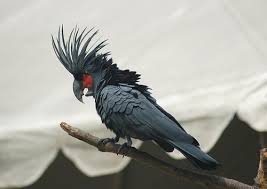
The palm cockatoo. Nature’s drummer. In possibly related news, I know what my next tattoo is going to be.

Snowball the Dancing Cockatoo.

Members of the Thai Elephant Orchestra at the Thai Elephant Conservation Center:

Further reading:

Kinship with Animals by Dave Soldier

Show transcript:

Welcome to Strange Animals Podcast. I’m your host, Kate Shaw.

This week’s episode about nonhuman musicians was inspired by an article about palm cockatoos. The male cockatoos drum on tree trunks or hollow logs as part of their courtship display, which doesn’t sound all that unusual until you learn that they use special crafted sticks to drum. A male will select a stick, trim it down the way he wants it, and hold it in his claw to drum. Sometimes he’ll use a hard seedpod instead. The resulting beats are not only consistently in rhythm, each individual has a personal style. Some drum quickly, some slowly, some throw in little flourishes. Sometimes females will drum too, and if a female likes a male’s drumming, she may imitate him or join in.

Here’s a little clip of a male drumming. He’s also whistling.

[palm cockatoo drumming]

The palm cockatoo is an awesome-looking bird. It looks like a drummer. It’s up to two feet long, or 61 cm, smoky gray or gray-black with a heavy gray beak, red cheek patches that flush when the bird is upset or excited, and a messy crest of feathers. It’s native to Papua New Guinea, Indonesia, and the very northern tip of Australia, Cape York Peninsula. Only the Australian birds are known to drum. Unfortunately, the Australian birds are the ones most threatened in the wild due to habitat loss.

The palm cockatoo eats nuts and seeds, and like all parrots it can live a long time. And yes, you can get them as pets—and now I’m desperate for one even though the last thing I need is a pet cockatoo. I have a coworker with a pet parrot who she says is incredibly neurotic. He tends to get overexcited and starts screaming, and she has to put him in his cage and cover it so he’ll shut up. Her kids found the parrot when they were young. He plopped down in her yard when they were playing outside, and they put an empty laundry basket over him to trap him. No one claimed him, so my coworker has now been stuck with a neurotic parrot for over twenty years. She’s pretty sure he survived in the wild by hanging out with crows, because one of the things that will set off his excited screaming is hearing crows outside. And while cockatoos and parrots in general are typically affectionate and make good pets, palm cockatoos are not. They’re considered “difficult.” When parrot fanciers call a type of bird difficult, it’s difficult.

Anyway, the really unusual thing about the palm cockatoo’s drumming isn’t its tool use, which is well known among many types of birds, especially parrots and their relations. It’s the rhythm.

Most animals can’t keep a beat. Synchronization to an external rhythm is called rhythmic entrainment. Humans are really good at it and recognize a beat automatically, but responding in time to a rhythm is a learned skill. Small children have to learn to keep a beat by moving their bodies, speaking, or singing, and they learn it best in social settings. That’s why music, dance, and rhythmic play activities are so important to preschool children. And as a drummer myself, I promise you, humans of any age can learn to improve their rhythm.

But most animals don’t seem to have the ability to distinguish rhythmic beats, although it hasn’t been studied all that much until fairly recently. Some researchers think it may have something to do with the ability to mimic vocal sounds.

That would explain why many birds show rhythmic entrainment, varying from species to species. A sulfur-crested cockatoo named Snowball was internet-famous for a while in clips where the bird danced to music. As a result, Snowball became the subject of a rhythmic entrainment study that shows he can adapt his dancing to changing tempos.

But not all animals who show rhythmic entrainment can mimic vocally. California sea lions aren’t exactly the parrots of the sea animal world, but they can be trained to move to a beat. On the other hand, closely related seals are vocal learners. In fact, one famous harbor seal who was raised by a fisherman who found the orphaned pup could imitate the fisherman so well he was known as “Hoover the Talking Seal.”

Here’s the only clip I would find of Hoover. The first time I listened to it, I couldn’t figure out when the seal was talking. All I could hear was some gruff-sounding guy talking really fast. Well, that’s Hoover.

[Hoover the talking seal]

That is Hoover the talking seal talking. It’s creepy as heck.

It’s possible that sea lions still retain neural pathways that allow vocal mimicking even if they no longer use them. Then again, some researchers now believe that vocal mimicking ability may only be a skill related to rhythmic entrainment, not the source of the ability, and that the neural pathways for rhythmic entrainment may be very old. Some species can express entrainment, others appear to have lost it.

Studies on human brains show that when music plays, pretty much the entire brain lights up in response. That’s because we have special neural connections that help coordinate motor planning, speech, and other skills with the perceived beat. Brains of parrots and other birds are very similar. But monkeys are not. Monkeys can’t dance. Poor monkeys.

One study with rhesus monkeys who were trained to tap in rhythm with a metronome determined that they couldn’t anticipate the beat but could tap just after it, responding to it, even after years of training. Many rhythmic entrainment studies focus on great apes, since it’s reasonable to suppose that humans’ close cousins might share our rhythmic ability.

Patricia Grey, a bio-music researcher at the University of North Carolina at Greensboro, taught a group of captive bonobo apes to play a drum along with a beat. But it wasn’t as simple as showing a bonobo how a drum worked and seeing if it could keep a beat. She had to encourage the apes in a social setting, just like with human children. Also, she had to design a drum that could take a whole lot of abuse. I love that she went to Remo, a company that manufactures drums and drumheads, to have the drum made.

Her experiment started by accident. In 2010, Grey was at the Great Ape Research Center in Des Moines waiting for an experiment to be set up, and while she waited she idly tapped the glass on the bonobo enclosure. A bonobo named Kanzi came over and tapped her hand on the glass in response, matching Grey’s tempo. Intrigued, Grey continued tapping to see how long Kanzi would keep it up. Kanzi didn’t stop, even when her snack time came. She ate her snack lying on her back so she could continue to tap with her feet.

Wild chimpanzees and bonobos drum on logs and their own bodies to make rhythmic noise during play and dominance activities. Dominant male chimps do a particularly exaggerated slow display when thunderstorms approach, called a rain dance by researchers, that involves drumming. A variation of the rain dance has been seen when wildfires are approaching a troupe of chimps. Naturally it’s called a fire dance, and it includes a vocalization heard at no other time.

Chimps are pretty chill when it comes to fire, by the way. They understand how it spreads and how to avoid it without panicking.

Another animal that can keep the beat? Elephants! Asian elephants are vocal mimics and their ability to keep a beat is extremely precise. In 2000, the Thai Elephant Orchestra was created with elephants at a conservation center in Thailand, who learned to play oversized versions of traditional Thai percussion instruments.

The elephants learned the instruments easily, taking to it so quickly and so well that the orchestra’s founders were astonished. The great thing is, the elephants actually create much of the music themselves. The orchestra’s founders, neuroscientist Dave Soldier and elephant conservationist Richard Lair, wanted the elephants to have fun and enjoy making music. So for most songs, the animals are only signaled when to start and stop playing. Occasionally human musicians play along.

The orchestra released three albums between 2002 and 2011, which were all well received—not as novelty albums, but as actual improvisational compositions. Some of the songs are arranged, with the elephants trained to play traditional Thai music. The orchestra performs live for visitors at the conservation center.

The orchestra varies in size from five to fourteen elephants. One particularly talented drummer, Luk Kop, could play three drums at the same time and set up complex rhythms. Unfortunately he was also a dangerous elephant, and that’s not good for a band or an elephant orchestra, so he had to drop out.

The elephants prefer non-dissonant tones and learn to strike the properly resonant parts of their instruments without even being taught. The elephants at the center also enjoy playing harmonicas. The tip of an elephant’s trunk has a fingerlike projection, so an elephant can hold a harmonica and blow through it with its trunk. Soldier reports that one morning he arrived at the center early when the elephants were heading down to the river for their morning bath. Almost all the elephants had brought their harmonicas and were playing together as they walked.

Most of the elephants at the center are former logging animals, and many of their handlers, known as mahouts, once worked with them when they were logging. Mahouts traditionally sing to their elephants, which is supposed to keep them calm. So the elephants in the orchestra are familiar with traditional Thai music.

Locals who have heard the orchestra play say the music sounds like the music in Buddhist temples. Soldier, a musician and composer himself, transcribed an original elephant piece which was then played by a human orchestra in New York. The audience didn’t know it was composed by elephants. Some guesses as to who the composer might be included John Cage, Dvorak, and Charles Ives.

Whether or not you like improvisational Thai music played by elephants, or you think it’s just a stupid gimmick, it’s clear the elephants are having a lot of fun. Here’s a clip of some of their music recorded at the conservation center. That’s some mighty fine percussion for animals who don’t even have hands.

[elephant orchestra]

You can find Strange Animals Podcast online at strangeanimalspodcast.blubrry.net. That’s blueberry without any E’s. If you have questions, comments, or suggestions for future episodes, email us at strangeanimalspodcast@gmail.com. We also have a Patreon at patreon.com/strangeanimalspodcast if you’d like to support us and get twice-monthly bonus episodes for as little as one dollar a month.

Thanks for listening!

Episode 018: Some mystery elephants and the tapir

This week’s episode is about a couple of mystery elephants and a non-mysterious animal, the tapir…but there might be some mystery associated with that little-trunked cutie too.

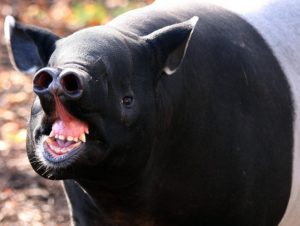
The tapir and its weird snoot:

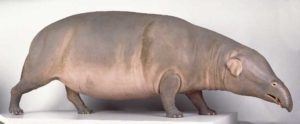
The Moeritherium probably looked something like this:

Some super cute Borneo elephants with super long tails:

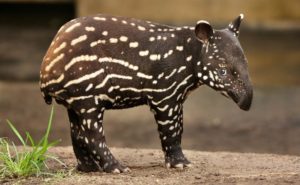
A baby tapir omgimgoingtodieofcuteomg

Show transcript:

Welcome to Strange Animals Podcast. I’m your host, Kate Shaw.

This week we’re looking at some animals with snoots. Specifically, a couple of mysterious elephants, and the tapir, which looks like what you might get if a pig and an elephant had a baby.

Usually I start episodes with the facts about a known animal and finish up with a mystery, but this week we’re starting with a strange and mysterious animal called a water elephant.

There’s only been one reported sighting of a water elephant and it’s not a recent one. In 1912, an article appeared in the Journal of the East Africa and Uganda Natural History Society. It was written by R.J. Cuninghame but concerned a Mr. Le Petit.

Now, before I go on to discuss the water elephant, let me just say that I have a great big problem with someone named M. Le Petit. No pun intended. Going by the name, and the secondhand nature of the account, and the fact that a lot of stories about strange African animals from this era are hoaxes of one variety or another, I’m taking this whole thing with a grain of salt. But it’s an interesting story, and if there really was a guy saddled with the name of little mister man, I can see why he spent a lot of time exploring the Congo instead of becoming a Shakespearian actor or something.

Anyway, I was able to find the original article, which has been digitized. It’s quite short, so instead of paraphrasing it I’ll just read the whole thing. It’s from the July 1912 issue of the journal, volume two number four, pages 97 through 98.

[read article]

There is no known animal that precisely fits Le Petit’s description. The closest is possibly the tapir. You can pronounce it taper if you want. It’s spelled T-A-P-I-R and no one seems to know how it’s supposed to be pronounced. Anyway, there are five species of tapir still around, four in Central and South America and one in Asia.

While the different species vary in size and coloring, generally a tapir is about 3 feet high at the shoulder and up to 8 feet long with short fur. The ears are oval-shaped with white tips. Its body is rounded with a pronounced rump, a stubby little tail, and a long head with a short but prehensile trunk. Superficially the tapir looks kind of like a piggy but it’s actually much more closely related to horses and rhinos. It has four toes on its front legs, three on its hind legs, and each toe has a little hoof. Depending on the species, the tapir may be gray, reddish-brown, black and white, or if it’s a baby, stripey. Females have a single pair of teats and males have a remarkably long, somewhat prehensile penis with flaps on the end that helps make a seal so it can mate underwater. You won’t get this information on National Geographic Kids, no sirree.

The tapir is a shy, largely solitary, mostly nocturnal animal that prefers forests near rivers or streams. It can bite like heck if it needs to, but it much prefers to run away from danger. Its favorite method of hiding is to submerge in water. It spends a lot of time in water, in fact, eating water plants and cooling off when it’s hot. It swims well and can use its snoot as a snorkel.

Technically its snoot is called a proboscis. It’s like a short elephant trunk although tapirs and elephants aren’t closely related. When it’s not snorkeling, the tapir uses its snoot to help gather plants. I just like saying snoot.

Tapir fossils have been discovered in Europe, China, and North America, but not Africa. So whatever M. Le Peti saw, assuming the account wasn’t a hoax or a mistaken identity, it probably wasn’t a tapir. So what else might fit the water elephant’s description?

There is an extinct animal that fits the description pretty well as far as we know. The Moeritherium lived about 35 million years ago and its fossils have been found in many parts of Africa. It was related to modern elephants although it wasn’t a direct ancestor, just an offshoot that as far as we know died out without descendants.

It wasn’t a very big animal—like the tapir, it looked more like a pig than an elephant. It stood between 2 and 3 feet high at the shoulder but was long-bodied, almost 10 feet long. Its legs were short, it may have had a tapir-like trunk, and it had small tusks more like those of a hippo, nothing like elephant tusks. Studies of its teeth indicate it ate a lot of aquatic plants, so it probably lived a lot like a hippo.

So could the water elephant be a descendant of Moeritherium? It sure sounds like a possibility, but there are two important facts to keep in mind.

First of all, the hippo evolved about 16 million years ago. If the Moeritherium had lived and continued to evolve, it’s possible it would have ended up looking a lot like the modern hippo. But the hippo is most closely related to whales—I’m not even kidding, and somehow I always manage to bring up whales no matter what animal I’m researching, huh?—and the hippo wouldn’t have become so wide-spread if the Moeritherium had a lock on the big aquatic freshwater herbivore niche.

Second, the date of the article is suspicious if you look at the discoveries of Moeritherium fossils. The Moeritherium was first described in 1901 from fossils found in Egypt. More fossils were discovered in 1902 and 1904. In 1911 the fossils were examined more closely and divided into two species. During this time, discoveries in palaeontology were popular subjects in magazines and newspapers. Dinosaurs and other extinct animals were even more a part of popular culture as they are now. Arthur Conan Doyle’s book The Lost World was published in 1912, continuing a tradition already well established by Jules Verne of science fiction stories where people discover supposedly extinct animals in remote areas. Scientists and explorers were still hopeful that living dinosaurs or ice age megafauna would be found alive and well. So it’s not a bit outlandish to suggest that the author of the water elephant story made it up with the best possible intentions—perhaps he expected to find the Moeritherium living in the Congo and wanted to excite interest in more expeditions. Or perhaps he was hoaxed by someone who’d read about the Moeritherium and thought it would make a plausible subject of a tall tale.

Clearly, I’m skeptical about the water elephant being a real animal, although I’d love to be proven wrong. But there is another definitely real elephant that might be a mystery that’s been hiding in plain sight for hundreds of years.

In 1750 or thereabouts, according to locals, a pair of elephants was given to the Sultan of Sulu who brought them to Borneo. At some point the elephants were released into the wild and their descendants now live throughout the western and northern parts of the island. This story sounds straightforward and interesting, but there are a lot of confusing details that make it less certain. Supposedly, the Raja of Java gave a pair of elephants to Raja Baginda of Sulu, but that was around 1395. We do know that in 1521, tame elephants were part of the palace’s wonders, but by the 1770s there were no tame elephants, only feral ones. Supposedly, the elephants were released into the wild at some point to keep them from being captured for use in war in the event of an invasion.

Whenever and however it happened, it sounds plausible that the elephants still living in Borneo are descendants of elephants gifted to a local ruler. Elephants have long been considered appropriate royal gifts. The story is given more weight by the fact that no elephant fossils have ever been found in Borneo, which suggests the elephants were introduced recently. The Bornean elephants have a very low genetic diversity, which would be the case if they were descendants of a single pair.

But here’s why these smallish, rather tame elephants in Borneo are such a big deal. Locals, and some researchers, think they’re the only surviving members of an otherwise extinct subspecies of Asian elephant, called the Java elephant. And they are different in appearance and behavior from other Asian elephant subspecies. They’re slightly smaller, although they’re not actually pygmy elephants as they’re sometimes called. A big male Borneo elephant may stand about eight feet tall at the shoulder while a big male Asian elephant may reach close to 10 feet. The Borneo elephant’s tusks are straighter than other Asian elephants—some males don’t have tusks at all—and their tails are so long that in some individuals, they actually touch the ground. Roughly 2,000 Borneo elephants remain on the island, although their habitat is increasingly being lost to palm oil plantations. Poaching is also a problem.

Borneo and Java are both part of the Malay Archipelago in southeast Asia, which is full of islands and nations I’ve mostly only ever heard about in songs and stories, like Singapore and Sumatra, Indonesia and Papua New Guinea. I bet it’s beautiful out there, wow. Java is over 800 miles south of Borneo, so it’s not like the elephants could get there without human help. And the Java elephant was extinct by the 1800s.

In 2003, DNA testing on the Borneo elephants indicated they were not related to other Asian subspecies of elephant and were either from Java or native to Borneo. Since Borneo was cut off from the Asian mainland and the rest of the Malay Archipelago around 18,000 years ago, when sea levels rose due to melting glaciers, that means the elephants must have been on the island for at least 18,000 years if they truly are a native subspecies. But if that’s the case, where are the fossil and subfossil remains? Why do the locals insist that the elephants were introduced only hundreds of years ago?

I tried very hard to find information about DNA testing supposedly underway in 2015, but without luck. It could be that the results haven’t yet been analyzed or that the analysis hasn’t yet been published. But my bet is that the locals are right and these are Java elephants, once owned by kings.

To bring things back around to where we started, more or less, in November of 1975 a young tapir was supposedly captured in Borneo. Unfortunately, no one knew what they’d caught—the papers were described as a mixture of various types of animals, such as a tiger’s body, an elephant’s trunk, a goat’s legs but claws like a chicken’s, and so forth. Put that way it sounds absurd and made up. The papers dubbed it a tigelboat. But as zoologist Karl Shuker points out in his blog, everything about the tigelboat fits the characteristics of a young Malayan tapir. Tapir babies are stripey, and while tapirs have hooves, they do have a claw-like appearance since the toes are widely spread and the hooves pointed.

Unfortunately, no one in the scientific community followed up on the animal’s capture and it’s not known what happened to it. It was kept at a prison but wasn’t cared for and eventually disappeared. Someone probably ate it, that’s my guess. But it’s possible that tapirs still live in the swamps and rainforests of Borneo. We know they lived on the island during the Pleistocene.

Finally, one last mystery tapir was supposedly seen in New Guinea in 1906, when two New Guinea natives were employed as scouts for an expedition. The two were sent ahead to check on a trail but had to be rescued after a terrifying encounter with what they called devil-pigs. There were two of the animals, and the description sounds exactly like dark gray or black tapirs. But tapirs don’t live in New Guinea—as far as we know.

Papua and Papua New Guinea make up an island about 1,900 miles away from Borneo, so it’s not a close neighbor by any means, but it is part of the same archipelago. During the ice ages of the Pleistocene, when so much of the world’s water was locked up in glacial sheets and the sea levels were therefore much lower, the 25,000 or so islands that make up the Malay Archipelago were connected to each other and to the Asian mainland. When the oceans rose again some 18,000 years ago animals were stranded on the islands and have since either died out or adapted to their smaller territories. Who knows what secrets these little pockets of the ancient world may still hide?

You can find Strange Animals Podcast online at strangeanimalspodcast.com. We’re on Twitter at strangebeasties and have a facebook page at facebook.com/strangeanimalspodcast. If you have questions, comments, or suggestions for future episodes, email us at strangeanimalspodcast@gmail.com. If you like the podcast and want to help us out, give us a rating and review on iTunes or whatever platform you listen on. We also have a PAYtreon if you’d like to support us that way. Rewards include exclusive twice-monthly episodes and stickers.

Thanks for listening!