Episode 121: Cave Dwelling Animals

This week let’s learn about some animals that live in caves!

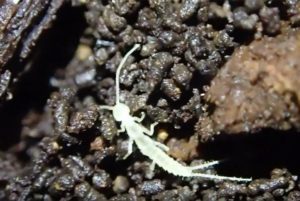
The dipluran Haplocampa:
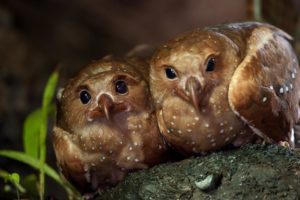
Oilbirds and their big black eyes:
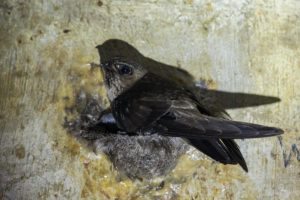
A swiftlet:
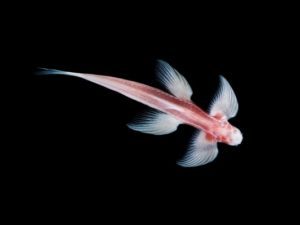
The angel cave fish that can walk on its fins like a salamander walks on its feet:
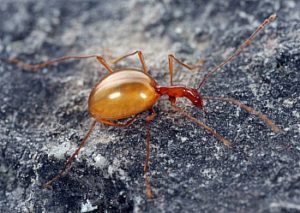
Leptodirus, carrying around some air in its abdomen in case it needs some air:
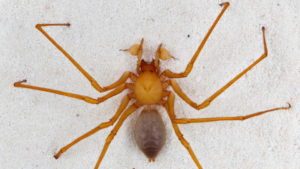
The cave robber spider and its teeny hooked feet:
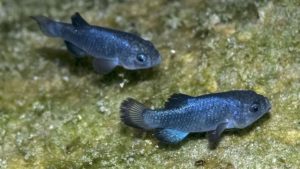
The devils hole pupfish:
Show transcript:

Welcome to Strange Animals Podcast. I’m your host, Kate Shaw.

Way back in episode 27 we learned about some animals that live deep in caves. Cave dwelling animals are always interesting because of the way they’ve adapted to an unusual environment, so let’s learn about some of them!

We’ll start with an invertebrate. Diplurans are common animals that are related to insects but aren’t insects. They live all over the world, with hundreds of species known to science, but most people have never seen one because of where they live. They like moist, dark areas like soil, dead leaves, and caves. They’re also small, usually only a few millimeters long, although a few species grow larger, up to two inches long, or five cm.

Diplurans have long bodies with a number of segments, six legs, long antennae, and a pair of tail appendages called cerci. Depending on the species, the cerci may just be a pair of straight filaments like an extra pair of antennae, or they may look like pincers. Diplurans with pincer-like cerci use them to help capture prey, while ones with antennae-like cerci eat fungi and plant material.

Diplurans also don’t have eyes. They don’t need eyes because they live underground where there’s little or no light. A lot of species are pale in color or lack pigment completely.

Diplurans have been around for something like 350 million years, although we don’t have very many fossil diplurans. But recently, a new species of dipluran was discovered in North America that has raised some interesting questions.

Vancouver Island is a large island on the west coast of Canada, near the city of Vancouver. It’s prone to earthquakes and contains a lot of caves, and last summer, in June of 2018, a party of cavers and scientists explored two of the caves and found a new dipluran, which has been named Haplocampa wagnelli. This dipluran is chunkier than most other known diplurans, with shorter antennae, which researchers think points to a more primitive body plan. Since the dipluran is so different from most other diplurans known, and because the caves where it was found were under a thick ice sheet until around 18,000 years ago, researchers are trying to figure out if it found its way into the caves after the ice sheet melted or if it survived in the caves while they were buried under ice.

Haplocampa seems to be most closely related to a few diplurans found in Asia. Asia was connected to western North America during the Pleistocene when sea levels were much lower, since so much of the world’s water was frozen, so it’s possible the ancestors of Haplocampa migrated from Asia after the ice sheets started to melt but before the Bering Land Bridge was completely submerged. Possibly its eggs were accidentally transported by birds who foraged in leaf litter where its ancestor lived.

A lot of animals that live in caves are only found in one particular cave system. This happens when a species of animal that lives near a cave moves into the cave, either full-time or part-time. As its descendants grow up, they become more and more adapted to cave life, until eventually they couldn’t live outside of the cave. Since there’s no way for them to travel from one cave system to another, they are confined to that single cave. And since caves are largely difficult for humans to explore, that means there are lots and lots and lots of animals unknown to science living out their quiet lives deep within caves where humans have never visited. Every so often a group of adventurous and brave scientists explore a cave and discover new animals, usually with the help of experienced cavers.

Animals that are endemic to a specific cave system are rare to start with and vulnerable to any changes in the cave environment. The Tumbling Creek cave snail is only found in a single stream in Tumbling Creek Cave in Missouri, in the United States. It lives its whole life in the water and is only about 2 millimeters in size, with a pale yellowish shell. When it was first discovered in 1971 it was common. Thirty years later, researchers could only find about forty of the snails due to water pollution.

Caves aren’t very friendly environments. Most of the animals that live in caves are very small as a result. Lots of insects and spiders live in caves, some snails, lots of fish, lots of crustaceans that live in fresh water, like crawdads and amphipods, and some salamanders. But the only mammals and birds that live in caves leave the cave to hunt or forage outside of it, like bats. There just isn’t enough food inside a typical cave to sustain a population of larger animals.

So what do cave animals eat? Obviously they eat each other, but without plants a cave system is definitely lacking in organic matter that can sustain populations of animals. Nutrients enter a cave primarily in two ways. Water flowing into a cave brings nutrients from outside, and animals that mainly live outside but sleep in caves also bring nutrients in. In the case of animals, their poop is a major source of organic material, with dead animals also contributing to the cave’s ecosystem. Bats in particular support a lot of cave animals with their poop, which is called guano, but bears, hyenas, and various other animals, birds, and insects also spend time in caves, either to sleep or to hibernate, and bring nutrients in from outside in one way or another.

There are two birds that spend time in caves, and I’m going to talk about both of them briefly even though technically they don’t live in caves, because they’re so interesting. Both birds are nocturnal and can echolocate like bats. The oilbird lives in parts of northern South America and is related to nightjars. I have a whole episode planned about nightjars and their relatives, but the oilbird is the only one that echolocates (as far as we know). The other bird that echolocates is the swiftlet.

The oilbird nests in caves and also roosts in caves during the day, then flies out at night and eats fruit. Some oilbirds roost in trees during the day instead. Its wings have evolved to allow it to hover and to navigate through tight areas, which helps it fly through caves. It sees well in darkness, with eyes that are arranged more like those of deep-sea fish rather than typical bird eyes.

Several species of swiflet echolocate. These are the birds that make their nests from saliva, and which humans gather to make bird’s nest soup from. They mostly live in Asia. They nest in caves and roost in caves at night, then fly out during the day to catch insects.

Researchers don’t know a lot yet about either bird’s echolocation. It’s audible to human ears, unlike most bat echolocating, and some researchers think it’s less sophisticated than bats’. It’s always possible there are other birds that echolocate, but we don’t know about them yet because maybe we can’t hear their echolocating.

This is what oilbirds sound like. The clicking noises are the echolocation calls.

[oilbird calls]

Cave fish are especially interesting. There isn’t one kind of cave fish but hundreds, mostly evolved from ordinary fish species that ended up in a cave’s water system and stayed. Sometimes the species of fish that gave rise to cave fish are still around, living outside the cave, but most cave fish species have evolved so much that they’re no longer very closely related to their outside ancestors.

Cave fish are considered extremophiles and they tend to have similar characteristics. They usually have no pigment, no scales, and often have no eyes at all, or tiny eyes that no longer function. They’re usually only a few inches long, or maybe 10 cm, and have low metabolic rates. They typically eat anything they can find.

Some cave fish have evolved in unusual ways to better fit their specific habitats. The cave angel fish lives in a single large cave system in Thailand, in fast-moving water. It’s about an inch long, or not quite 3 cm, and gets its name from its four broad fins, which look feathery like angel wings.

It was discovered in 1985 but it wasn’t until 2016 that researchers verified a persistent rumor about the fish, which is that it can WALK on its fins. It has a robust pelvis and vertebral column, and strong fin muscles that allow it to climb rocks to navigate waterfalls.

Other fish navigate waterfalls and other obstacles by squirming and wriggling, using their fins to push them along. But the cave angel fish walks like a salamander. Scientists are studying the way it walks to learn more about how the ancestors of four-legged animals evolved.

The largest cave dwelling animal is the blind cave eel, which grows up to 16 inches long, or 40 cm, although it’s very slender. Since it appears pink due to a lack of pigment in its skin and it has no eyes or fins, it looks a lot like a really long worm. But it’s actually a fish. Not much is known about it, but it’s widespread throughout western Australia and is sometimes found in wells. It lives in caves or underground waterways that are connected to the ocean.

The first insect that was recognized as living only in caves is a beetle called Leptodirus hochenwartii. It was discovered in 1831 deep in a cave in Slovenia, and researchers of the time found it so intriguing that they invented a whole new discipline to study it and other cave animals, known as biospeleology.

Leptodirus has some interesting adaptations to cave living. It has no wings and no eyes, its antennae and legs are long, but the real surprise is its body. Its head is small and the thorax, the middle section of an insect, is slender. But the abdomen is relatively large and round, and the insect uses it to store moist air. Caves tend to be humid environments and Leptodirus has evolved to need plenty of moisture in the air it breathes. But some parts of a cave can be dry, so not only does Leptodirus keep a supply of breathable air in its abdomen, its antennae can sense humidity levels with a receptor called the Hamann organ.

Some spiders live in caves and like other cave dwellers, they’ve evolved to look strange compared to ordinary spiders. The cave robber spider was only discovered in 2010 in a few caves in Oregon. Researchers suspect there are more species of cave robber spider in other cave systems that haven’t been explored yet by scientists.

The cave robber spider is so different from other spiders that it’s been placed in its own family, Trogloraptoridae, which means cave robber. It has hook-like claws on the ends of its legs which it probably uses to capture prey. It spins small, simple webs on the roofs of caves and researchers think it probably hangs upside down from its web and grabs its prey as it passes by. But since no one knows what the cave robber spider eats, it’s anyone’s guess. Researchers have even tried raising the spider in captivity to learn more about it, but it wouldn’t eat any of the insects or other small invertebrates it was offered as food. It starved to death without ever eating anything, so it’s possible it only eats specific prey. It’s a yellowish-brown spider with two rows of teeth, called serrula in spiders, which researchers say is unique among spiders.

It’s also pretty big for a cave dweller. Its body is up to 10 millimeters long, or about a third of an inch, and it has a legspan of about 3 inches, or 7.6 cm. But it’s very shy and rare, and of course it’s not going to hurt you. It literally wouldn’t even hurt a fly to keep itself from starving.

One of the scientists who discovered the spider and is studying it, Charles Griswold, points out that there are stories in the area of giant spiders living in caves. He suggests the cave robber spider might be the source of the stories, since a three inch spider looks much bigger when it’s hanging down from the roof of a cave right in your face, with hooked claws.

Let’s finish with a remarkable cave fish known as the devil’s hole pupfish. Devil’s hole is a geothermal pool inside a cavern in the Amargosa Desert in Nevada, which is in the southwestern United States. It’s not far from Death Valley. The cavern is more than 500 feet deep, or 150 meters, with water that stays at about 92 degrees Fahrenheit, or 33 degrees Celsius. There’s a single small opening into the cavern at the surface, which geologists estimate opened about 60,000 years ago. The cavern and cave system are more than half a million years old.

The geothermal pool is home to the devils hole pupfish, which is barely an inch long, or 25 millimeters, and looks pretty ordinary. It mostly stays around the opening to the surface, where there’s a limestone shelf just below the water’s surface that measures about 6 ½ by 13 feet, or 2 by 4 meters. While the pupfish does swim deeper into the cavern at times, it mostly eats algae that live on and around the shelf, and tiny animals that live within the algae. It also depends on the shelf for laying eggs and spawning.

So the shelf is really important. But it’s also really small and close to the surface. It can only support so many pupfish, so the average devil’s hole pupfish population is about 200 or 300 fish, although this fluctuates naturally depending on many factors. In the 1960s, a farming corporation drilled wells in the area and pumped water out for irrigation, and the water in devil’s hole started to drop and drop. Devil’s hole is part of Death Valley National Monument, and conservationists were well aware of how fragile the pupfish’s environment was. As the water level dropped, threatening to expose the limestone shelf that the pupfish depended on for their entire lives, conservation groups sued to stop the pumping of groundwater in the area. After a series of court cases that went all the way up to the Supreme Court, the water rights were acknowledged to be part of the national monument status. Pumping of groundwater was limited and the pupfish was saved.

The water level in devil’s hole is monitored daily, which has led to a lot of information about how the water is affected by seismic events. Earthquakes as far away as Alaska, Japan, and South America have all affected the water level.

Researchers aren’t sure how long the pupfish have lived in devil’s hole. Some researchers think they’ve been there for 20,000 years, others think it’s more like a few hundred. Researchers aren’t sure how such a small population of fish has stayed healthy for so long, since such a restricted number of individuals should be so inbred they’re no longer viable. The most recent genetic analysis of the pupfish suggests they became isolated from other pupfish species in the area less than a thousand years ago. But if that’s the case, no one’s sure how they got into devil’s hole in the first place. Flooding of the area hasn’t happened in the last thousand years.

Because the pupfish’s habitat is so fragile, the U.S. Fish and Wildlife Service has moved some of the fish into captive populations that mimic the fish’s original habitat. It’s nice to think that these tiny silvery-blue fish with big eyes have so many people working to keep them safe.

You can find Strange Animals Podcast online at strangeanimalspodcast.com. We’re on Twitter at strangebeasties and have a facebook page at facebook.com/strangeanimalspodcast. If you have questions, comments, or suggestions for future episodes, email us at strangeanimalspodcast@gmail.com. We also have a Patreon if you’d like to support us that way.

Thanks for listening!
Episode 099: Island Life

Those of us in the northern hemisphere are thinking a lot about island life right about now, where it’s warm and sunny. But there are islands everywhere, not just the tropics, and the animals on islands often evolve to look strange and different from their mainland cousins. Thanks to Richard E. and Lucy for their suggestions this week!

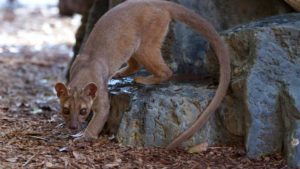
A fossa:

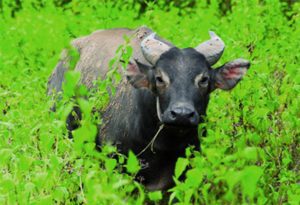
A tamaraw, miniature water buffalo:

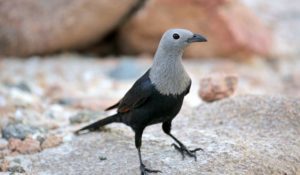
A Socotra starling, my new favorite bird:

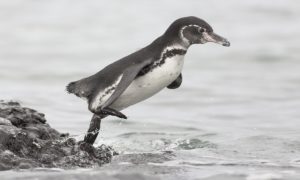
Adorable little Galapagos penguin:

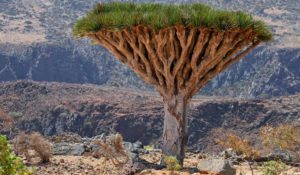
A dragonblood tree, good grief!

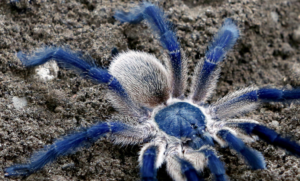
A blue baboon. It’s not a baboon but it is blue:

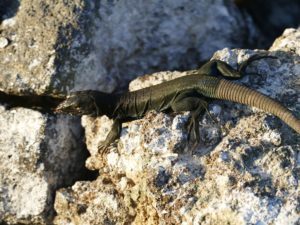
A ground dragon:

Further listening:

The unlocked Patreon bonus episode about vampire finches on the Galapagos Islands

Show transcript:

Welcome to Strange Animals Podcast. I’m your host, Kate Shaw.

In a lot of episodes, we talk about animals from islands like the Galapagos and the Canaries. There’s a reason why islands give rise to strange animals. This week we’ll focus on island life—how island habitats lead to unique animals and how introduced animals can destroy an entire island ecosystem in a matter of a few years. Massive thanks to listener Richard E., who suggested the topics of introduced animals and island life!

Islands, of course, are surrounded by water and isolated from larger landmasses as a result. Some are close to the mainland so it’s easy for animals to swim or float across to the island. In cold areas, animals can sometimes walk across ice to islands. But other islands are more remote, or used to be close to the mainland but were pushed farther away by tectonic forces.

Once a piece of land is cut off from the mainland, the animals and plants on that piece of land start to evolve independently of the larger population of animals and plants on the mainland. If the island is isolated enough that potential predators can’t get to it, the animals already living on the island start to adapt to life with no or few predators. As a result, they may appear tame when humans arrive.

And that is where the problems start. Humans don’t just arrive alone. We bring other animals with us, either on purpose, like dogs, cats, and livestock, or by accident, like rats and mice. And these animals, along with humans, can destroy an entire island habitat really easily.

I’ll use one of Richard’s examples, since it’s a good one and not one you’d think of when thinking of islands. The red squirrel is native to Europe and parts of Asia, but it also lives in the UK and Ireland. It’s usually red-brown in color, although some populations can be brown, gray, or even black. The belly is white. It has long ear tufts and a poofy tail. It lives in trees and eats seeds, nuts, berries, fungi, and occasionally eggs or baby birds.

But remember, Ireland and the UK are islands. And in the 1870s, someone thought it would be really great to import eastern gray squirrels from North America and release them in parks in the UK. In Ireland, in 1911 someone gave a bunch of gray squirrels as a wedding gift, which is not a great gift, honestly, and they got loose because of course they did. They’re squirrels.

Grey squirrels are larger than red squirrels and don’t have ear tufts. They eat the same foods red squirrels do. They also carry a disease called squirrel parapoxvirus that doesn’t bother them but which kills red squirrels. The population of red squirrels has dropped substantially as introduced gray squirrel populations climb in the UK and Ireland. The red squirrel is now protected, with conservation efforts in place that are making a difference. But that just goes to show how easy it is to lose even a well-established species on large islands when an outside species is introduced.

On islands, especially smaller islands, small animals tend to grow larger overall and big animals tend to grow smaller overall. This is called Foster’s rule. It comes about partly because there are fewer predators but limited resources. Small animals don’t need to hide as carefully from predators, large animals may not be able to get enough to eat, but medium-sized animals are able to survive short famines without starving and can take advantage of some resources smaller or larger animals couldn’t use.

One example of island gigantism is the fossa, a predator from Madagascar. If you’ve seen the Madagascar movies, you might remember the fossa as a scary predator that looks something like a big cat. Well, the fossa is a real animal, but it’s not related to cats. It’s related to the mongoose, which is a weasel-like animal, but the fossa is generally much larger than a mongoose. It grows some five feet long, or 1.5 meters, including its tail, although its legs are short compared to those of a similarly-sized cat. It spends a lot of time in trees, where it uses its long tail to help it balance. It’s reddish-brown with a paler belly and eats lemurs and other mammals, birds, insects, crabs, lizards, and even fruit.

An example of island dwarfism is the tamaraw from the island of Mindoro in the Philippines, also called a Mindoro dwarf buffalo. It looks like its close relative, the water buffalo, but is much smaller, only about three and a half feet tall at the shoulder, or 105 cm. It’s like a pocket-sized water buffalo. It has V-shaped horns and is black with some white markings on the legs. It prefers to live in mountainous forested areas with water nearby, and it eats grass, young bamboo shoots, and wild sugarcane. It’s a solitary, shy animal.

Famously, Charles Darwin worked out the theory of evolution after examining the differences in finches living on the various Galapagos Islands. He had actually already started thinking along these lines before he’d really examined the finches, but they supported his ideas and helped him work out the details. Basically, as Darwin eventually determined, a type of finch had colonized the islands at some point in the far distant past. Each island had slightly different ecology, so although the finches could fly, over the years populations living on separate islands began to adapt to better fit the resources available on those islands. For instance, the large ground finch has developed a short, heavy bill to crack nuts, while the closely related vampire ground finch has a thinner, sharper bill that it uses to eat insects, seeds, and the BLOOD OF OTHER BIRDS. I am totally not making this up. In fact, I covered the vampire finch in a patreon bonus episode earlier this year. It’s already unlocked for anyone to listen to, so if you haven’t listened to it and want to, I’ll put a link in the show notes.

Remember that squirrel disease I mentioned earlier? There’s a bird disease called avipoxvirus, or avian pox, that has affected the Galapagos finches since 1898. Researchers think it was probably spread by humans who brought infected domestic birds with them on ships. Fortunately, it hasn’t driven any finches or other birds to extinction.

Another problem brought to the Galapagos Islands by humans, this one spread more recently by tourist boats, is a parasitic nest fly that kills baby birds. Researchers have started leaving cotton balls treated with a mild insecticide where the flies are known to attack endangered finches. The parent finches use the cotton balls to line their nests, which helps protect the babies once they hatch. The nest flies lay their eggs in the nests, and the larvae bite babies and mother birds and drink their blood, which can kill the babies. So far the treatment has helped reduce the number of larvae that hatch.

There’s another bird that lives on the Galapagos that is unique to the islands, and that’s the Galapagos penguin. Thanks to Lucy, who suggested it as a topic, and a shout-out to Lucy’s sister Willa too!

Lucy also wanted to hear about King and Gentoo penguins, so let’s start with them. Both species mostly nest on islands.

The King penguin is almost as big as the Emperor penguin and looks very similar, not surprising since they’re closely related. It stands over three feet tall, or 100 cm. It eats small fish, squid, and krill. Females lay one egg at a time and after the egg hatches, the baby spends its first month or so of life sitting on one parent’s feet while the other parent forages. After that both parents leave the baby in a communal nest, called a crèche, while both go foraging. A young king penguin won’t be able to fish for itself until it’s more than a year old.

The Gentoo penguin lives off the southern tip of South America, and it’s almost as tall as the king penguin, but it’s not closely related to the king and emperor penguins. The Gentoo penguin has a reddish bill and a white stripe on its head above its eyes. The female usually lays two eggs in a nest made of round stones. Gentoo penguins value good nesting stones, and a male may court a female by offering her high-quality stones. Sometimes he has stolen those good stones from other penguin nests. Watch out, ladies. The Gentoo penguin eats krill and other small crustaceans for the bulk of the diet, and also eats fish and squid.

So that gives us a sort of baseline of ordinary penguins to compare to the Galapagos penguin. All other penguins all live in the southern hemisphere, usually not all that far from Antarctica. Part of the Galapagos Islands are in the northern hemisphere, although just barely. Penguins are adapted to severe cold, so how do Galapagos penguins thrive near the equator? As it happens, the waters around the Galapagos are actually quite cold, with various oceanic currents bringing cold water north from the Antarctic and bringing cold water from the depths to the surface in the area. Unlike other penguin species, which often travel widely to find food, the Galapagos penguin stays near the islands where the water is comfortably cool and there’s enough food. On hot days, penguins go into the water to stay cool.

The Galapagos penguin is only about 19 inches tall, or 49 cm. It’s almost the smallest penguin and is definitely the rarest penguin, with only about 1,000 breeding pairs. It mates for life and females lay one or two eggs, making sure to lay eggs in the shade so they won’t get too hot in the sun. If both eggs hatch, the weaker baby usually dies as the parents concentrate on feeding the stronger one. Then again, in good years, grown babies who have moved out of the nest may continue to beg their parents for food and sometimes get fed. I know some people like that. In addition to ordinary predators like seals and hawks, the Galapagos penguin is also vulnerable to introduced predators like cats.

We’ve talked a lot about the Galapagos Islands, but every island has its own unique ecosystem. For example, the island of Socotra lies in the Arabian Sea off the coast of Yemen. It’s only 82 miles long, or 132 km, and 31 miles wide, or 50 km. There are three other, smaller islands nearby. It’s been so isolated for so long that even its trees are bizarre-looking, like the dragon’s blood tree that has dense branches with leaves sticking up at the very top so that it looks like grass growing on top of a weird tree-shaped cliff. The tree also has red sap that has been traditionally used as a dye or varnish.

Humans have lived on the Socotra for 2,000 years, so many endemic species have gone extinct due to habitat loss, hunting, and competition or predation by introduced animals like cats and cattle. But there are still a lot of unusual animals that are found nowhere else in the world. The island has only one native mammal species, a bat, and no amphibians, but it has lots of reptiles and some birds found nowhere else in the world. For instance, the Socotra starling. It’s a large, beautiful songbird with a black body and soft gray head and neck, a heavy black bill, and a black eye with a thin white eye ring. It eats insects and fruit. Socotra is also surrounded by coral reefs with lots of unique fish and crabs.

One interesting animal that lives on Socotra Island is called the blue baboon. But it’s not a baboon or any other kind of primate. It’s not even a mammal. It’s a tarantula, and it’s beautiful! It’s a lovely indigo blue in color with white hairs on the abdomen and the top joints of the legs. Its legspan is about five inches across, or 12 cm, and males are smaller than females. Unlike most other tarantula species, it tolerates others instead of being solitary, so people often keep them as pets. Fortunately, it’s become so popular in captivity that there are lots of captive-bred blue baboons readily available, so the market for illegally collected wild specimens has diminished.

I’ve talked a lot about how animals in island habitats can be driven to extinction very easily, but there are success stories too. For instance, the island of Redonda. It’s a tiny island in the Caribbean, only about a mile long, or 1.6 km, with no source of fresh water and land that’s basically just rock. For centuries no one bothered Redonda because no one wanted to live there, but in the late 19th century it was mined for bird guano, or bird poop, which was used as fertilizer. This went on until 1914, and then in 1929 a hurricane destroyed what was left of the mining equipment. The few people who lived there left, but there were still rats and feral goats that ate everything they could find.

Redonda might have become a wasteland with nothing but rats, goats, and a few birds, but an ambitious conservation effort is paying off. First, the rats and goats were trapped and removed from the island. The rats were mostly killed, but the goats were taken to nearby Antigua where they’ve found homes. Then—and this is important—people left the island alone. Without introduced species and without human interference, the population of endemic animals have begun to rebound. Native plants and trees have started growing back. Rare seabirds nest there again. Instead of a big rock, the island now appears green again.

And the population of lizards on the island is rebounding like crazy. In just a year, the number of ground dragons has almost doubled. Ground dragons are lizards only found on the island. They’re shiny black with long tails and eat pretty much anything they can catch, including young ground dragons.

Sometimes all it takes for nature to be set right is to just leave it alone to do what it does best. Sometimes humans have to help by restoring keystone species to a habitat. This has happened with giant Aldabra tortoises, which were once common on the island of Mauritius, the same island where the dodo once lived. A species of ebony tree had nearly been driven extinct by logging, but even after logging was stopped in the 1980s, the trees hadn’t rebounded. Researchers determined that giant tortoises had once eaten the ebony tree fruit and pooped out the seeds, much like the dodo and the rare dodo tree palm. When giant tortoises were reintroduced to Mauritius, new ebony trees started to sprout.

You can find Strange Animals Podcast online at strangeanimalspodcast.com. We’re on Twitter at strangebeasties and have a facebook page at facebook.com/strangeanimalspodcast. If you have questions, comments, or suggestions for future episodes, email us at strangeanimalspodcast@gmail.com. We also have a Patreon if you’d like to support us that way.

Thanks for listening!
Episode 090: Spiders! NO COME BACK, IT’S SAFE TO LISTEN

As we get closer and closer to Halloween, the monsters get scarier and scarier! Okay, spiders are not technically monsters, but some people think they are. Don’t worry, I keep descriptions to a minimum so arachnophobes should be okay! This week we learn about some spider friends and some spider mysteries.

I stole the above cartoon from here. I am sorry, Science World.

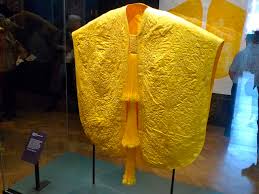
A cape made from golden silk orbweaver silk:

Further reading and listening:

Blue spiders

Varmints! Podcast scorpions episode

Show transcript:

Welcome to Strange Animals Podcast. I’m your host, Kate Shaw.

It’s almost Halloween! I’m on the third bag of gummi spiders, although they’ve changed the flavor from last year so I only eat the orange and yellow ones. The purple and green ones are in the bucket to give out to unsuspecting children.

Speaking of spiders…yes, I’m going there. I realize a lot of people are scared of spiders, but they’re beautiful, fascinating animals that are associated with Halloween. Don’t worry, I will try hard not to say anything that will set off anyone’s arachnophobia. Besides, there are some mysterious spiders out there that I think you’ll find really interesting.

First off, you don’t have to worry about gigantic spiders like in the movies. Spiders have an exoskeleton like other arthropods, and if a spider got too big, some researchers think its exoskeleton would weigh so much the spider wouldn’t be able to move. Not only that, spiders have a respiratory system that isn’t nearly as efficient as that of most vertebrates, so giant spiders couldn’t exist because they wouldn’t be able to get enough oxygen to function.

Specifically, some spiders have a tracheal system of breathing, like most insects and other arthropods also have. These are breathing tubes that allow air to pass through the exoskeleton and into the body, but it’s a passive process and spiders don’t actually breathe in and out. Other spiders have what are called book lungs. The book lung is made up of a stack of soft plates sort of like the pages of a book. Oxygen passes through the plates and is absorbed into the blood, which by the way is pale blue. This is also a passive process.

In other words, that picture that’s forever popping up on facebook of the enormous spider on the side of someone’s house, it’s photoshopped. In fact, pretty much any photo you see of a gigantic spider or insect or other arthropod is either photoshopped or made to look bigger by forced perspective. Also, spiders with wings are photoshopped, because no spider has ever had wings, even fossil spiders all the way back to the dawn of spider history, over 300 million years ago. So that’s one less thing to worry about.

Spiders live all over the world, everywhere except in the ocean and in Antarctica. The smallest spider known is .37 mm, so basically microscopic. It lives in Colombia and basically lives out its whole life not knowing most things about the world, like what whales are and how to operate a smart phone. On the other hand, the largest spider in the world is a tarantula called the goliath birdeater, and it probably also doesn’t know what whales are and how to use a smartphone. The goliath birdeater is the heaviest spider at a bit over 6 ounces, or 175 g, and has a legspan of 11inches, or 28 cm. Despite its name, it mostly eats insects but it will occasionally eat frogs, small rodents, small snakes, and worms. It lives in swampy areas in the rainforests of northeastern South America.

The spider with the biggest legspan—yes, I know, some of you are freaking out but I can’t do an episode about spiders and not talk about the biggest spiders. The spider with the biggest legspan is the giant huntsman, which lives around cave entrances in Laos, a country in southeast Asia. And it’s not much bigger than the goliath birdeater, with a legspan of one foot, or 30 cm.

All spiders produce silk but not all of them make webs. I won’t go into the process of how a spider generates silk, because it’s complicated and I just read about it and have already forgotten all the details, but spiders use silk to wrap up their eggs safely, line the walls of burrows to make a comfortable home, wrap up prey so it can’t escape, and of course make webs and get around without falling off tall things.

Most spider silk appears white, but the golden silk orb-weaver produces golden silk. The spider itself is gorgeous, with striped legs and a body that can be yellow, red, greenish, or brown, often with white spots and delicate patterns. It lives all over the world in warm climates, especially Australia. It builds webs that can be several feet across, or over a meter, and it occasionally catches and eats small birds as well as insects. One was even spotted eating a small snake that had been caught in its web. Its silk has occasionally been used to make cloth, but spider silk is difficult to collect in the quantities needed for textiles.

Most spiders eat insects, although one spider eats plants. Just one. It lives in Central America. Some baby spiders eat nectar until they get big enough to catch prey. Some spiders will scavenge on dead insects, some will eat fruit as well as insects, many eat pollen that gets caught on their webs, and some eat each other. Some spiders are adapted to swim in freshwater, and while they mostly eat aquatic insects, they will catch and eat small fish. Some spiders also catch and eat small birds and bats.

Basically, there are too many spiders to cover everything about them in one episode. Besides, what we all really want to know about are the mystery spiders. Because it’s almost Halloween!

Our first mystery spider is from Africa, specifically the jungles of central Africa. In 1938, an English couple, Reginald and Margurite Lloyd, were driving through the jungle when what looked like a monkey or cat stepped onto the dirt road. They stopped the car so it could cross the road, at which point they saw it was a spider. It looked like a tarantula but was huge, with a legspan of up to three feet, or almost a meter. Before Reginald Lloyd could grab his camera, the spider disappeared into the undergrowth.

Supposedly, the same giant spider was reported in the 1890s by a British missionary named Arthur John Simes. Some of his men got tangled in a huge web and a pair of spiders came out and attacked them. The larger of the spiders, presumably the female, was four feet across, or 1.2 meters. Simes was bitten but shot one of the spiders and was able to escape. He ultimately died of the bite.

This seems less than believable, to put it gently. The largest spider that catches prey with a web is our friend the golden silk orbweaver, but its legspan is only five inches across, or 12 cm. The biggest spiders in the world are tarantulas and other spiders that hunt actively, none of which build webs.

A more believable giant-spider mystery is called the up-island spider, which is supposed to be an extra-large variety of wolf spider from parts of Maine in the United States. Its legspan is supposed to be as much as 8 inches across, or 20 cm. Wolf spiders are common throughout the world, and while they look scary, they bite people very rarely and their venom is weak, no worse than a bee sting. The wolf spider with the biggest legspan is Hogna ingens, with a legspan less than 5 inches, or 12 cm. Hogna ingens lives on one island in the Maderia archipelago, and is a beautiful soft grey with white stripes on the legs. It’s critically endangered, but Bristol Zoo in England has a successful captive breeding program underway so it won’t go extinct. The species of wolf spider most commonly found in Maine is probably Tigrosa helluo, but it’s not very big, only a couple of inches across at most, or maybe five cm. It’s likely that the up-island spider is actually the Carolina wolf spider, which can have a legspan of four inches, or 10 cm, but I can tell you from personal experience that they look a whole lot bigger if you see one in your garage or basement when you flip on the light. The Carolina wolf spider does live in Maine, but it’s not very common in the area.

Zoologist Karl Shuker has a blog post from 2010, with some later updates, about spiders that are normal sized except for being blue, in species that aren’t normally blue. It’s an interesting post and I’ll link to it in the show notes if you want to read it and look at the pictures he posts. He discusses a number of blue spiders readers have reported to him, and while one seems to have been spraypainted blue, the rest appear naturally colored blue.

As it happens, there are lots of reports of blue spiders out there—and other blue invertebrates like woodlice. According Shuker’s post, some of these have been studied and found to be suffering from a virus called invertebrate iridovirus, or IIV. This infects invertebrates and sometimes is so highly concentrated in the animal’s tissues that it forms crystalline aggregations that emit blue iridescence and make the animal look blue. I should stress that you can’t catch IIV if you are a mammal, bird, reptile, fish, or anything else with a backbone, which I am assuming is most of my listeners.

The ancestors of spiders evolved around 380 million years ago, although those animals probably couldn’t generate silk. They did have eight legs, though. True spiders date to around 300 million years ago. Those spiders had silk spinnerets in the middle of the abdomen instead of at the end, and modern spiders appeared around 250 million years ago. We have fossil spiders and we also have spiders preserved in amber, the resin of certain trees that later fossilizes but remains at least partly transparent. We even have a spider web preserved in amber and dated to 110 million years ago, along with several insects that had been trapped in the web.

Spiders are closely related to whip scorpions, also called whip spiders because they look superficially similar to spiders in some ways except that they are HORRIFYING and I cannot look at pictures of them right now, I just can’t. While whip scorpions have eight legs, they only walk on six of them. The front pair are more like feelers and are elongated. Other whip scorpions have long, thin tails and are sometimes called vinegaroons, because if they’re disturbed they squirt a liquid that smells like vinegar. Some whip scorpions look a lot like scorpions. I don’t want to talk about scorpions. In fact, I’m just going to stop talking entirely, because while spiders don’t bother me, scorpions do and I cannot look at these pictures anymore, okay? If you want to learn about scorpions, Varmints! Podcast just released a scorpions episode. I’ll put a link in the show notes. Eventually I’ll manage to listen to it myself.

Happy Halloween?

You can find Strange Animals Podcast online at strangeanimalspodcast.com. We’re on Twitter at strangebeasties and have a facebook page at facebook.com/strangeanimalspodcast. If you have questions, comments, or suggestions for future episodes, email us at strangeanimalspodcast@gmail.com. If you like the podcast and want to help us out, leave us a rating and review on Apple Podcasts or whatever platform you listen on. We also have a Patreon if you’d like to support us that way.

Thanks for listening!