Podcast: Play in new window | Download (Duration: 8:50 — 9.1MB)
This week we’ll learn about a long-forgotten animal of folklore!
Further reading:
The Pictish Beast:
A dragonesque brooch:
Show transcript:
Welcome to Strange Animals Podcast. I’m your host, Kate Shaw.
The Picts were a population of Celtic people who lived in what is now northern and eastern Scotland between around the third and tenth centuries. They had their own language, which is lost to time except for a handful of place-names, and made beautiful rock carvings and metal art, but we know very little about them even though their descendants still live in Scotland today. Vikings conquered the area, which led to upheavals among the many small kingdoms, so that by the 11th century, all the Picts had been absorbed into the greater Scottish population and had completely forgotten their heritage.
The carvings are what we’re interested in today. The Picts carved lots of different animals along with more abstract designs, and although the carvings are often stylized, we generally know what animals they represent. There are roe deer, red deer, dogs, boars, horses, cattle, salmon and other fish, otters, eagles, and more. But there’s one animal no one can identify, referred to as the Pictish Beast.
The Pictish Beast isn’t rare, either. One estimate is that 40% of all the animal carvings depict the Pictish beast, so it was obviously important. That makes it even more baffling that we don’t know what it is.
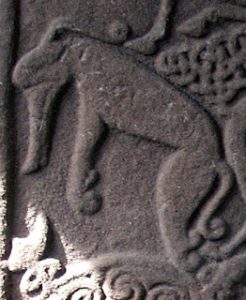
There are variations, but generally the Pictish Beast has a long snout or beak with a line showing that the mouth was long too. There’s a horn-like design that emerges from the top or rear of the head and bends backwards, with a little curl at the end. The body looks superficially doglike, with a little curled dog tail, but the legs don’t resemble any real animal’s legs. They appear stiff, not jointed, and often bend backwards slightly. The feet are simplified designs that curl backwards in a little spiral. The head is usually bent as though it’s staring downward. It has no ears or nostrils.
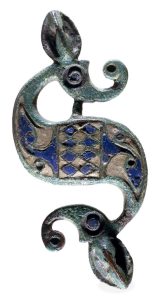
Naturally there are lots of theories as to what the Pictish Beast represents. One theory is that it’s not a real animal at all but a type of dragon. Specifically, some experts consider it to be a version of a design called dragonesque brooches. These were pieces of jewelry made throughout southern Scotland and northern England during the first and second century. They were roughly S-shaped, made to look like a double-headed animal with a curly nose and distinctive round ears. Instead of dragons, though, the dragonesque brooch animals were probably actually stylized rabbits or hares. They were also popular at least 200 years before the Pictish Beast started being carved so often, so while there is a superficial resemblance, it’s not a perfect match by any means.
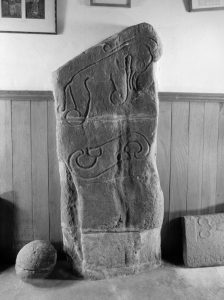
Then again, there is one stone, called the Mortlach 2 stone, that depicts both a Pictish Beast and what seems to be a simplified version of the dragonesque brooch design. Some researchers think the artist was depicting what was at the time the modern Pictish Beast and the old-timey dragonesque brooch that inspired it.
One suggestion is that the beast was inspired by the dragonesque brooch, but isn’t otherwise related. Remember that the brooches would have been considered super old at the time and were probably rare even then as a result. Think about how many pieces of jewelry you own that are several hundred years old. If an artist saw one of the brooches and thought it looked neat, but had no idea what it was supposed to represent, they might have recreated it with details that made sense to them, trying to imitate what they saw. But that doesn’t explain why the design became so incredibly popular.
There are other suggestions, of course. Sometimes the beast is depicted vertically, which makes it look superficially like a weird seahorse. Seahorses do live off the coast of Scotland, but that doesn’t explain why the Pictish Beast has large legs and such a little tail. Most of the time the beast is shown horizontally, legs down.
Sometimes the beast is referred to as an elephant, but knowledge of elephants in the British Isles over a thousand years ago was unlikely at best. And the beast has zero resemblance to an elephant so I don’t know who came up with that idea but let’s just set it aside and move on.
Because of the horn-like appendage on its head, some people suggest the beast might depict a stylized deer. That’s more likely than an elephant but Pictish carvings of deer exist and are obviously deer. That doesn’t mean the beast couldn’t have started out as a deer that took on more and more stylized and exaggerated components until no one remembered it was actually a deer, but that could be said about any animal, not just a deer.
Another suggestion is that it’s supposed to be a water animal of folklore, possibly a kelpie, or water horse, or a water bull. Both creatures were supposed to lure people into the water by posing as a lost pony or bull, but as soon as the person touched the animal, it would drag them under the water and drown them.
Other people suggest the Pictish Beast represents a dolphin or beaked whale, and that the horn-like appendage isn’t a horn at all but a representation of the dolphin spouting. When a dolphin or whale comes to the surface to take a breath, it first has to let out the last breath it took. It does so really fast, expelling the warm, moist air from its lungs so that it looks like a spray of mist or water. The beast’s long beak does look like a dolphin’s rostrum, and crucially, its mouth even curves upward slightly like a dolphin’s mouth.
The front legs could possibly be explained as stylized fins. But what about the hind legs? Dolphins don’t have rear fins. Even if you accept that the hind legs are supposed to represent the dolphin’s tail, it already has a little doglike tail.
That’s where some people have gotten frustrated and said, “Okay, fine. It’s the Loch Ness Monster.” But the Pictish Beast doesn’t fit the general description of Nessie either. Nessie is supposed to have a long neck and a very long body, often with humps or bumps that appear above the surface of the water, and a long tail. The beast doesn’t have a long neck or a long tail.
Personally, I like the idea that the Pictish Beast represents a mythical water creature like a kelpie, but that it was given dolphin characteristics to make it more frightening and exotic. Since we know so little about the Picts, it’s possible the beast stood for some important quality in their society, the same way we use a lion to represent courage or a dog to represent loyalty.
It’s one of those mysteries that we’ll probably never solve, unless someone invents a time machine and we can go back and ask some Picts. But frankly, if I had access to a time machine, I’d use it to go back and look at dinosaurs. So I guess we may never know what the Pictish Beast really is.
Thanks for your support, and thanks for listening!