Episode 466: Lots of Invertebrates!

Here’s the big invertebrate episode I’ve been promising people! Thanks to Sam, warbrlwatchr, Jayson, Richard from NC, Holly, Kabir, Stewie, Thaddeus, and Trech for their suggestions this week!

Further reading:

Does the Spiral Siphonophore Reign as the Longest Animal in the World?

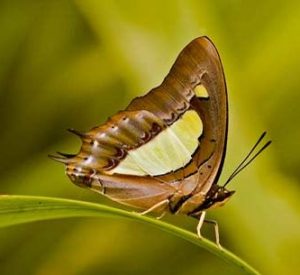
The common nawab butterfly:
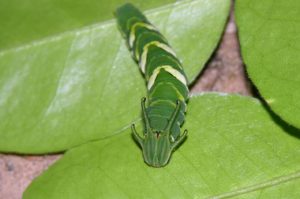
The common nawab caterpillar:
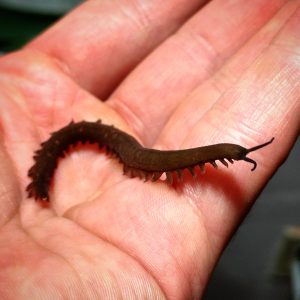
A velvet worm:
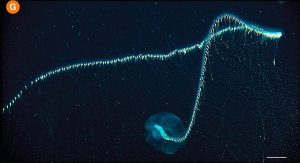
A giant siphonophore [photo by Catriona Munro, Stefan Siebert, Felipe Zapata, Mark Howison, Alejandro Damian-Serrano, Samuel H. Church, Freya E.Goetz, Philip R. Pugh, Steven H.D.Haddock, Casey W.Dunn – https://www.sciencedirect.com/science/article/pii/S1055790318300460#f0030]:
Show transcript:

Welcome to Strange Animals Podcast. I’m your host, Kate Shaw.

Hello to 2026! This is usually where I announce that I’m going to do a series of themed episodes throughout the coming year, and usually I forget all about it after a few months. This year I have a different announcement. After our nine-year anniversary next month, which is episode 470, instead of new episodes I’m going to be switching to old Patreon episodes. I closed the Patreon permanently at the end of December but all the best episodes will now run in the main feed until our ten-year anniversary in February 2027. That’s episode 523, when we’ll have a big new episode that will also be the very last one ever.

I thought this was the best way to close out the podcast instead of just stopping one day. The only problem is the big list of suggestions. During January I’m going to cover as many suggestions as I possibly can. This week’s episode is about invertebrates, and in the next few weeks we’ll have an episode about mammals, one about reptiles and birds, and one about amphibians and fish, although I don’t know what order they’ll be in yet. Episode 470 will be about animals discovered in 2025, along with some corrections and updates.

I hope no one is sad about the podcast ending! You have a whole year to get used to it, and the old episodes will remain forever on the website so you can listen whenever you like.

All that out of the way, let’s start 2026 right with a whole lot of invertebrates! Thanks to Sam, warbrlwatchr, Jayson, Richard from NC, Holly, Kabir, Stewie, Thaddeus, and Trech for their suggestions this week!

Let’s start with Trech’s suggestion, a humble ant called the weaver ant. It’s also called the green ant even though not all species are green, because a species found in Australia is partially green. Most species are red, brown, or yellowish, and they’re found in parts of northern and western Australia, southern Asia, and on most islands in between the two areas, and in parts of central Africa. The weaver ant lives in trees in tropical areas, and gets the name weaver ant because of the way it makes its nest.

The nests are made out of leaves, but the leaves are still growing on the tree. Worker ants grab the edge of a leaf in their mandibles, then pull the leaf toward another leaf or sometimes double the leaf over. Sometimes ants have to make a chain to reach another leaf, with each ant grabbing the next ant around the middle until the ant at the end of the chain can grab the edge of a leaf. While the leaf is being pulled into place alongside the edge of another leaf, or the opposite edge of the same leaf, other workers bring larvae from an established part of the nest. The larvae secrete silk to make cocoons, but a worker ant holds a larva at the edge of the leaf, taps its little head, and the larva secretes silk that the workers use to bind the leaf edges together. A single colony has multiple nests, often in more than one tree, and are constantly constructing new ones as the old leaves are damaged by weather or just die off naturally.

The weaver ant mainly eats insects, which is good for the trees because many of the insects the ants kill and eat are ones that can damage trees. This is one reason why farmers in some places like seeing weaver ants, especially fruit farmers, and sometimes farmers will even buy a weaver ant colony starter pack to place in their trees deliberately. The farmer doesn’t have to use pesticides, and the weaver ants even cause some fruit- and leaf-eating animals to stay away, because the ants can give a painful bite. People in many areas also eat the weaver ant larvae, which is considered a delicacy.

Our next suggestion is by Holly, the zombie snail. I actually covered this in a Patreon episode, but I didn’t schedule it for next year because I thought I’d used the information already in a regular episode, but now I can’t find it. So let’s talk about it now!

In August of 2019, hikers in Taiwan came across a snail that looked like it was on its way to a rave. It had what looked like flashing neon decorations in its head, pulsing in green and orange. Strobing colors are just not something you’d expect to find on an animal, or if you did it would be a deep-sea animal. The situation is not good for the snail, let me tell you. It’s due to a parasitic flatworm called the green-banded broodsac.

The flatworm infects birds, but to get into the bird, first it has to get into a snail. To get into a snail, it has to be in a bird, though, because it lives in the cloaca of a bird and attaches its eggs to the bird’s droppings. When a snail eats a yummy bird dropping, it also eats the eggs. The eggs hatch in the snail’s body instead of being digested, where eventually they develop into sporocysts. That’s a branched structure that spreads throughout the snail’s body, including into its head and eyestalks.

The sporocyst branches that are in the snail’s eyestalks further develop into broodsacs, which look like little worms or caterpillars banded with green and orange or green and yellow, sometimes with black or brown bands too—it depends on the species. About the time the broodsacs are ready for the next stage of life, the parasite takes control of the snail’s brain. The snail goes out in daylight and sits somewhere conspicuous, and its body, or sometimes just its head or eyestalks, becomes semi-translucent so that the broodsacs show through it. Then the broodsacs swell up and start to pulse.

The colors and movement resemble a caterpillar enough that it attracts birds that eat caterpillars. A bird will fly up, grab what it thinks is a caterpillar, and eat it up. The broodsac develops into a mature flatworm in the bird’s digestive system, and sticks itself to the walls of the cloaca with two suckers, and the whole process starts again.

The snail gets the worst part of this bargain, naturally, but it doesn’t necessarily die. It can survive for a year or more even with the parasite living in it, and it can still use its eyes. When it’s bird time, the bird isn’t interested in the snail itself. It just wants what it thinks is a caterpillar, and a lot of times it just snips the broodsac out of the snail’s eyestalk without doing a lot of damage to the snail.

If a bird doesn’t show up right away, sometimes the broodsac will burst out of the eyestalk anyway. It can survive for up to an hour outside the snail and continues to pulsate, so it will sometimes still get eaten by a bird.

Okay, that was disgusting. Let’s move on quickly to the tiger beetle, suggested by both Sam and warblrwatchr.

There are thousands of tiger beetle species known and they live all over the world, except for Antarctica. Because there are so many different species in so many different habitats, they don’t all look the same, but many common species are reddish-orange with black stripes, which is where the name tiger beetle comes from. Others are plain black or gray, shiny blue, dark or pale brown, spotted, mottled, iridescent, bumpy, plain, bulky, or lightly built. They vary a lot, but one thing they all share are long legs.

That’s because the tiger beetle is famous for its running speed. Not all species can fly, but even in the ones that can, its wings are small and it can’t fly far. But it can run so fast that scientists have discovered that its simple eyes can’t gather enough photons for the brain to process an image of its surroundings while it runs. That’s why the beetle will run extremely fast, then stop for a moment before running again. Its brain needs a moment to catch up.

The tiger beetle eats insects and other small animals, which it runs after to catch. The fastest species known lives around the shores of Lake Eyre in South Australia, Rivacindela hudsoni. It grows around 20 mm long, and can run as much as 5.6 mph, or 9 km/hour, not that it’s going to be running for an entire hour at a time. Still, that’s incredibly fast for something with little teeny legs.

Another insect that is really fast is called the common nawab, suggested by Jayson. It’s a butterfly that lives in tropical forests and rainforests in South Asia and many islands. Its wings are mainly brown or black with a big yellow or greenish spot in the middle and some little white spots along the edges, and the hind wings have two little tails that look like spikes. It’s really pretty and has a wingspan more than three inches across, or about 8.5 cm.

The common nawab spends most of its time in the forest canopy, flying quickly from flower to flower. Females will travel long distances, but when a female is ready to lay her eggs, she returns to where she hatched. The male stays in his territory, and will chase away other common nawab males if they approach.

The common nawab caterpillar is green with pale yellow stripes, and it has four horn-like projections on its head, which is why it’s called the dragon-headed caterpillar. It’s really awesome-looking and I put it on the list to cover years ago, then forgot it until Jayson recommended it. But it turns out there’s not a lot known about the common nawab, so there’s not a lot to say about it.

Next, Richard from NC suggested the velvet worm. It’s not a worm and it’s not made of velvet, although its body is soft and velvety to the touch. It’s long and fairly thin, sort of like a caterpillar in shape but with lots of stubby little legs. There are hundreds of species known in two families. Most species of velvet worm are found in South America and Australia.

Some species of velvet worm can grow up to 8 and a half inches long, or 22 cm, but most are much smaller. The smallest lives in New Zealand on the South Island, and only grows up to 10 mm long, with 13 pairs of legs. The largest lives in Costa Rica in Central America and was only discovered in 2010. It has up to 41 pairs of legs, although males only have 34 pairs.

Various species of velvet worm are different colors, although a lot of them are reddish, brown, or orangey-brown. Most species have simple eyes, although some have no eyes at all. Its legs are stubby, hollow, and very simple, with a pair of tiny chitin claws at the ends. The claws are retractable and help it climb around. It likes humid, dark places like mossy rocks, leaf litter, fallen logs, caves, and similar habitats. Some species are solitary but others live in social groups of closely related individuals.

The velvet worm is an ambush predator, and it hunts in a really weird way. It’s nocturnal and its eyes are not only very simple, but the velvet worm can’t even see ahead of it because its eyes are behind a pair of fleshy antennae that it uses to feel its way delicately forward. It walks so softly on its little legs that the small insects and other invertebrates that it preys on often don’t even notice it. When it comes across an animal, it uses its antennae to very carefully touch it and decide whether it’s worth attacking.

When it decides to attack, it squirts slime that acts like glue. It has a gland on either side of its head that squirts slime quite accurately. Once the prey is immobilized, the velvet worm may give smaller squirts of slime at dangerous parts, like the fangs of spiders. Then it punctures the body of its prey with its jaws and injects saliva, which kills the animal and starts to liquefy its insides. While the velvet worm is waiting for this to happen, it eats up its slime to reuse it, then sucks the liquid out of the prey. This can take a long time depending on the size of the animal—more than an hour.

A huge number of invertebrates, including all insects and crustaceans, are arthropods, and velvet worms look like they should belong to the phylum Arthropoda. But arthropods always have jointed legs. Velvet worm legs don’t have joints.

Velvet worms aren’t arthropods, although they’re closely related. A modern-day velvet worm looks surprisingly like an animal that lived half a billion years ago, Antennacanthopodia, although it lived in the ocean and all velvet worms live on land. Scientists think that the velvet worm’s closest living relative is a very small invertebrate called the tardigrade, or water bear, which is Stewie’s suggestion.

The water bear isn’t a bear but a tiny eight-legged animal that barely ever grows larger than 1.5 millimeters. Some species are microscopic. There are about 1,300 known species of water bear and they all look pretty similar, like a plump eight-legged stuffed animal with a tubular mouth that looks a little like a pig’s snout. It uses six of its fat little legs for walking and the hind two to cling to the moss and other plant material where it lives. Each leg has four to eight long hooked claws. Like the velvet worm, the tardigrade’s legs don’t have joints. They can bend wherever they want.

Tardigrades have the reputation of being extremophiles, able to withstand incredible heat, cold, radiation, space, and anything else scientists can think of. In reality, it’s just a little guy that mostly lives in moss and eats tiny animals or plant material. It is tough, and some species can indeed withstand extreme heat, cold, and so forth, but only for short amounts of time.

The tardigrade’s success is mainly due to its ability to suspend its metabolism, during which time the water in its body is replaced with a type of protein that protects its cells from damage. It retracts its legs and rearranges its internal organs so it can curl up into a teeny barrel shape, at which point it’s called a tun. It needs a moist environment, and if its environment dries out too much, the water bear will automatically go into this suspended state, called cryptobiosis. When conditions improve, the tardigrade returns to normal.

Another animal has a similar ability, and it’s a suggestion by Thaddeus, the immortal jellyfish. It’s barely more than 4 mm across as an adult, and lives throughout much of the world’s oceans, especially where it’s warm. It eats tiny food, including plankton and fish eggs, which it grabs with its tiny tentacles. Small as it is, the immortal jellyfish has stinging cells in its tentacles. It’s mostly transparent, although its stomach is red and an adult jelly has up to 90 white tentacles.

The immortal jellyfish starts life as a larva called a planula, which can swim, but when it finds a place it likes, it sticks itself to a rock or shell, or just onto the sea floor. There it develops into a polyp colony, and this colony buds new polyps that are clones of the original. These polyps swim away and grow into jellyfish, which spawn and develop eggs, and those eggs hatch into new planulae.

Polyps can live for years, while adult jellies, called medusae, usually only live a few months. But if an adult immortal jellyfish is injured, starving, sick, or otherwise under stress, it can transform back into a polyp. It forms a new polyp colony and buds clones of itself that then grow into adult jellies.

It’s the only organism known that can revert to an earlier stage of life after reaching sexual maturity–but only an individual at the adult stage, called the medusa stage, can revert to an earlier stage of development, and an individual can only achieve the medusa stage once after it buds from the polyp colony. If it reverts to the polyp stage, it will remain a polyp until it eventually dies, so it’s not really immortal but it’s still very cool.

All the animals we’ve talked about today have been quite small. Let’s finish with a suggestion from Kabir, a deep-sea animal that’s really big! It’s the giant siphonophore, Praya dubia, which lives in cold ocean water around many parts of the world. It’s one of the longest creatures known to exist, but it’s not a single animal. Each siphonophore is a colony of tiny animals called zooids, all clones although they perform different functions so the whole colony can thrive. Some zooids help the colony swim, while others have tiny tentacles that grab prey, and others digest the food and disperse the nutrients to the zooids around it.

Some siphonophores are small but some can grow quite large. The Portuguese man o’ war, which looks like a floating jellyfish, is actually a type of siphonophore. Its stinging tentacles can be 100 feet long, or 30 m. Other siphonophores are long, transparent, gelatinous strings that float through the depths of the sea, and that’s the kind the giant siphonophore is.

The giant siphonophore can definitely grow longer than 160 feet, or 50 meters, and may grow considerably longer. Siphonophores are delicate, and if they get washed too close to shore or the surface, waves and currents can tear them into pieces. Other than that, and maybe the occasional whale or big fish swimming right through them and breaking them up, there’s really no reason why a siphonophore can’t just keep on growing and growing and growing…

You can find Strange Animals Podcast at strangeanimalspodcast.blubrry.net. That’s blueberry without any E’s. If you have questions, comments, corrections, or suggestions, email us at strangeanimalspodcast@gmail.com.

Thanks for listening!
Episode 422: Two Tiny, Tiny Animals

Thanks to Tim and Mia who suggested one of this week’s animals!

Further reading:

Genomic insights into the evolutionary origin of Myxozoa within Cnidaria

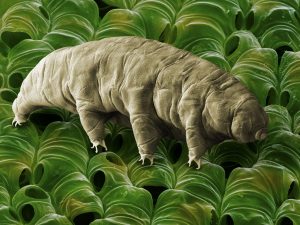
A tardigrade, photo taken with an electron microscope because these little guys are incredibly tiny:

Show transcript:

Welcome to Strange Animals Podcast. I’m your host, Kate Shaw.

This week we’re going to talk about two microscopic or almost microscopic animals, one suggested by Mia and Tim, the other one I just learned about myself.

We’ll start with Mia and Tim’s suggestion, the water bear, also known as the tardigrade. We’ve talked about it before but there’s always more to learn about an animal.

The water bear isn’t a bear at all but a tiny eight-legged animal that barely ever grows larger than 1.5 millimeters. Some species are microscopic. There are about 1,300 known species of water bear and they all look pretty similar. It looks for all the world like a plump eight-legged stuffed animal made out of couch upholstery. It uses six of its fat little legs for walking and the hind two to cling to the moss and other plant material where it lives. Each leg has four to eight long hooked claws. It has a tubular mouth that looks a little like a pig’s snout.

An extremophile is an organism adapted to live in a particular environment that’s considered extreme, like undersea volcanic vents or inside rocks deep below the ocean floor. Tardigrades aren’t technically extremophiles, but they are incredibly tough. Researchers have found tardigrades in environments such as the gloppy ooze at the bottom of the ocean and the icy peaks of the Himalayas. It can survive massive amounts of radiation, dehydration for up to five years, pressures even more intense than at the bottom of the Mariana Trench, temperatures as low as -450 Fahrenheit, or -270 Celsius, heat up to 300 degrees Fahrenheit, or 150 Celsius, and even outer space. It’s survived on Earth for at least half a billion years. Mostly, though, it just lives in moss.

Not every tardigrade is able to do everything we just talked about. They’re tough, but they’re not invulnerable, and different species of tardigrade are good at withstanding different extreme environments. Many species can withstand incredible heat, but only for half an hour or less. Long-term temperature increases, even if only a little warmer than what it’s used to, can cause the tardigrade to die.

Most species of tardigrade eat plant material or bacteria, but a few eat smaller species of tardigrade. It has no lungs since it just absorbs air directly into its body by gas exchange. It has a teeny brain, teeny eyes, and teeny sensory bristles on its body. Its legs have no joints. Its tubular mouth contains tube-like structures called stylets that are secreted from glands on either side of the mouth. Every time the tardigrade molts its cuticle, or body covering, it loses the stylets too and has to regrow them. In some species, the only time the tardigrade poops is when it molts. The poop is left behind in the molted cuticle.

The tardigrade’s success is largely due to its ability to suspend its metabolism, during which time the water in its body is replaced with a type of protein that protects its cells from damage. It retracts its legs and rearranges its internal organs so it can curl up into a teeny barrel shape, at which point it’s called a tun. It needs a moist environment, and if its environment dries out too much, the water bear will automatically go into this suspended state, called cryptobiosis.

Tests in 2007 and 2011 that exposed tardigrades to outer space led to some speculation that tardigrades might actually be from outer space, and that they, or organisms that gave rise to them, might have hitched a ride on a comet or some other heavenly body and ended up on earth. But this isn’t actually the case, since genetic studies show that tardigrades fit neatly into what we know of animal development and evolution. In other words, tardigrades are weird, but they’re Earth weird.

Our other tiny animal today is one that lacks pretty much everything animals usually have. Myxozoa are parasites that can’t live outside of the host’s body, a condition called obligate parasitism. They’re found in both freshwater and ocean water animals but evolved from an animal similar to a jellyfish that would have just swum around happily in the ocean. Now they’re microscopic parasites with the smallest genomes of any animals studied. Most only measure 300 micrometers at most, or 1/3 of a millimeter, although the largest known grows a humongous 2 mm long.

Different myxozoa have different life cycles, some of them complex. Because they’re so small, we naturally don’t know that much about them, and there are undoubtedly a whole lot of species that haven’t been discovered by science. They’re so numerous, and so different from other animals, that they’ve been placed into their own subphylum, classified in the Phylum Cnidaria. Cnidarians include jellyfish, corals, sea anemones, and many other aquatic invertebrates that show radial symmetry–but not comb jellies which have their own phylum.

In general, this is how a myxozoan spreads to a new host. A myxozoan secretes tiny capsules called myxospores that contain polar filaments. The myxopores are eaten by worms, at which point the capsule opens and the polar filaments uncoil and attach to the worm’s gut, where it develops into a sporoplasm and eventually detaches from the worm. The sporoplasm floats around in the water until it touches a fish, especially a fish’s gills, at which point it digs into the fish’s body and continues to develop.

When scientists identified the first myxozoans, they were classified as protozoans, single-celled animals. Many protozoans are parasitic. But as genetic testing became more refined and easier to do, and some myxozoans had their DNA sequenced, it became obvious that they were something else. Scientists just weren’t sure what. Finally scientists realized that they were similar genetically to jellyfish and their close relations, although they estimate it’s been about 600 million years since they shared a common ancestor.

Many myxozoans no longer have genes that allow communication between cells, multicellular development, body coordination, or even respiration in some species. Most are only a few cells in size and the most complex cell is the one that contains what’s called a polar capsule. This probably developed from its ancestor’s nematocysts, which are the cells that sting you if you touch a jellyfish, which is why you should never touch a jellyfish no matter how pretty it is.

Most myxozoa infect fish, but they’ve also been discovered in other animals. This includes a few frogs, turtles, aquatic birds, and octopuses. But they’ve also been discovered in two mammals, both of them shrews. Even though we already know about more than 2,000 species of myxozoa, scientists think there are probably hundreds, if not thousands more, but no one’s noticed them yet because they’re so small.

If you remember the Dr. Seuss book Horton Hears a Who, consider that the Whos might have actually been tardigrades. But probably not myxozoa, which wouldn’t have been able to build a Who city.

You can find Strange Animals Podcast at strangeanimalspodcast.blubrry.net. That’s blueberry without any E’s. If you have questions, comments, or suggestions for future episodes, email us at strangeanimalspodcast@gmail.com. We also have a Patreon at patreon.com/strangeanimalspodcast if you’d like to support us for as little as one dollar a month and get monthly bonus episodes.

Thanks for listening!

Episode 259: Indestructible Animals

Sign up for our mailing list! We also have t-shirts and mugs with our logo!

Thanks to Nicholas and Emma for their suggestions this week as we learn about some (nearly) indestructible animals!

Further listening:

Patreon episode about Metal Animals (unlocked, no login required)

Further reading:

Even a car can’t kill this beetle. Here’s why

The scaly-foot snail’s shell is made of actual iron – and it’s magnetic

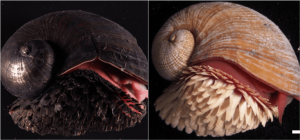
The scaly-foot gastropod (pictures from article linked above):

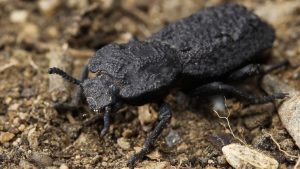
The diabolical ironclad beetle is virtually unsquishable:

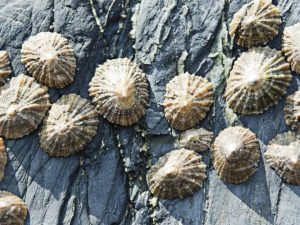
Limpet shells:

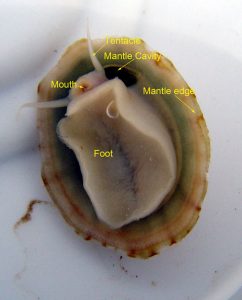
The business side of a limpet:

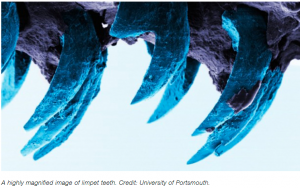
Highly magnified limpet teeth:

Show transcript:

Welcome to Strange Animals Podcast. I’m your host, Kate Shaw.

This week we’re going to learn about some indestructible animals, or at least animals that are incredibly tough. You may be surprised to learn that they’re all invertebrates. It’s a suggestion by Nicholas, and one of the animals Nicholas suggested was also suggested by Emma.

We’ll start with that one, the scaly-foot gastropod, a deep-sea snail. We actually covered this one a few years ago but only in a Patreon episode. I went ahead and unlocked that episode so that anyone can listen to it, since I haven’t done that in a while, so the first part of this episode will sound familiar if you just listened to that one.

The scaly-foot gastropod lives around three hydrothermal vents in the Indian Ocean, about 1 ¾ miles below the surface, or about 2,800 meters. The water around these vents, referred to as black smokers, can be more than 350 degrees Celsius. That’s 660 degrees F, if you even need to know that that’s too hot to live.

The scaly-foot gastropod was discovered in 2001 but not formally described until 2015. The color of its shell varies from almost black to golden to white, depending on which population it’s from, and it grows to almost 2 inches long, or nearly 5 cm. It doesn’t have eyes, and while it does have a small mouth, it doesn’t use it for eating. Instead, the snail contains symbiotic bacteria in a gland in its esophagus. The bacteria convert toxic hydrogen sulfide from the water around the hydrothermal vents into energy the snail uses to live. It’s a process called chemosynthesis. In return, the bacteria get a safe place to live.

The snail’s shell contains an outer layer made of iron sulfides. Not only that, the bottom of the snail’s foot is covered with sclerites, or spiky scales, that are also mineralized with iron sulfides. While the snail can’t pull itself entirely into its shell, if something attacks it, the bottom of its foot is heavily armored and its shell is similarly tough.

Researchers are studying the scaly-foot gastropod’s shell to possibly make a similar composite material for protective gear and other items. The inner layer of the shell is made of a type of calcium carbonate, common in mollusk shells and some corals. The middle layer of the shell is regular snail shell material, organic periostracum, [perry-OSS-trickum] which helps dissipate heat as well as pressure from squeezing attacks, like from crab claws. And the outer layer, of course, is iron sulfides like pyrite and greigite. Oh, and since greigite is magnetic, the snails stick to magnets.

Unfortunately, the scaly-foot gastropod is endangered due to deep-sea mining around its small, fragile habitat. Hopefully conservationists can get laws passed to protect the thermal vents and all the animals that live around them.

The scaly-foot gastropod is the only animal known that incorporates iron sulfide into its skeleton or exoskeleton, although our next indestructible animal, the diabolical ironclad beetle, has iron in its name.

The diabolical ironclad beetle lives in western North America, especially in dry areas. It grows up to an inch long, or 25 mm, and is a dull black or dark gray in color with bumps and ridges that make it look like a piece of tree bark. Since it lives on trees, that’s not a coincidence. It spends most of its time eating fungus that grows on and under tree bark.

Like a lot of beetles, it’s flattened in shape. This helps it slide under tree bark and helps it keep a low profile to avoid predators like birds and lizards. But if a predator does grab it and try to crunch it up to eat, the diabolical ironclad beetle is un-crunchable. Its exoskeleton is so tough that it can withstand being run over by a car. When researchers want to mount a dead beetle to display, they can’t just stick a pin through the exoskeleton. It bends pins, even strong steel ones. They have to get a tiny drill to make a hole in the exoskeleton first.

The beetle’s exoskeleton is so strong because of the way it’s constructed. In a late 2020 article in Nature, a team studying the beetle discovered that the exoskeleton is made up of multiple layers that fit together like a jigsaw puzzle. Each layer contains twisted fibers made of proteins that help distribute weight evenly across the beetle’s body and stop potential cracking. At the same time, the arrangement of the exoskeleton’s sections allows for enough give to make it just flexible enough to keep from cracking under extreme pressure. Of course, this means the beetle can’t fly because its wing covers can’t move, but if it falls from a tree it doesn’t need to worry about hurting itself.

Engineers are studying the beetle to see if they can adapt the same type of structures to make airplanes and cars safer.

Nicholas also suggested the limpet, another mollusk. It’s a type of snail but it doesn’t look like the scaly-foot gastropod or like most other snails. Its shell is shaped like a little cone with ridges that run from the cone’s tip to the bottom, sort of like a tiny ice-cream cone that you don’t want to eat. There are lots of species and while a few live in fresh water, most live in the ocean. The limpets we’re talking about today are those in the family Patellidae.

If you think about a typical snail, whose body is mostly protected by a shell and who moves around on a wide flat part of its body called a foot, you’ll understand how the limpet is a snail even though it looks so different superficially. The conical shell protects the body, and the limpet does indeed move around on a so-called foot, gliding along very slowly on a thin layer of mucus.

The limpet lives on rocks in the intertidal zone and is famous for being able to stick to a rock incredibly tightly. It has to be able to do so because otherwise it would get washed off its rock by waves, plus it needs to be safe when the tide is out and its rock is above water. The limpet makes a little dimple in the rock that exactly matches its shell, called a home scar, and as the tide goes out the limpet returns to its home scar, seals the edges of its shell tight to the rock, and waits for the water to return. It traps water inside its shell so its gills won’t dry out while it waits. If the rock is too hard for it to grind down to match its shell, it grinds the edges of its shell to match the rock. It makes its home scar by rubbing its shell against one spot in the rock until both are perfectly matched.

The limpet mostly eats algae. It has a tiny mouth above its foot and in the mouth is a teensy tongue-like structure called a radula, which is studded with very hard teeth. It uses the radula to rasp algae off of the rocks. Other snails do this too, but the limpet has much harder teeth than other snails. Much, much harder teeth. In fact, the teeth of some limpet species may be the hardest natural material ever studied.

The teeth are mostly chitin, a hard material that’s common in invertebrates, but the surface is coated with goethite [GO-thite] nanofibers. Goethite is a type of of iron, so while the limpet does have iron teeth, it still doesn’t topple the scaly-foot gastropod as the only animal known with iron in its skeleton. Not only does the goethite help make the teeth incredibly strong, which is good for an animal that is scraping those teeth over rocks constantly, the dense chitin fibers in the teeth make them resistant to cracking.

The limpet replaces its teeth all the time. They grow on a sort of conveyer belt and move forward until the teeth in front, at the business end of the radula, are ready to use. It takes about two days for a new tooth to fully form and move to the end of the radula, where it’s quickly worn down and drops off.

Meanwhile, even though the limpet’s shell doesn’t contain any iron, its shape and the limpet’s strong foot muscles mean that once a limpet is stuck to its rock, it’s incredibly hard to remove it. It just sits there being more or less impervious to predation. Humans eat them, although they have to be cooked thoroughly because they’re tough otherwise, naturally.

Finally, one animal that Nicholas suggested is probably the royalty of indestructible animals, the water bear or tardigrade. Because we talked about it recently, in episode 234, I won’t go over it again. I’ll just leave you with an interesting note that I missed when researching that episode.

In April of 2019, an Israeli spacecraft was launched that had dormant tardigrades onboard as part of an experiment about tardigrades in space. There were no people onboard, fortunately, because the craft actually crashed on the moon instead of landing properly. The ship was destroyed but the case where the tardigrades were stored appears to be intact.

It’s not exactly easy to run up to the moon and check on the tardigrades, so we don’t know if they survived the crash landing. Studies since then suggest they probably didn’t, but until we can actually land on the moon and send a rover or an astronaut out to check, we don’t know for sure. Tardigrades can survive incredibly cold, dry conditions while dormant. It’s not exactly the experiment researchers intended, but it’s definitely an interesting one.

You can find Strange Animals Podcast at strangeanimalspodcast.blubrry.net. That’s blueberry without any E’s. If you have questions, comments, or suggestions for future episodes, email us at strangeanimalspodcast@gmail.com. If you like the podcast and want to help us out, leave us a rating and review on Apple Podcasts or Podchaser, or just tell a friend. We also have a Patreon at patreon.com/strangeanimalspodcast if you’d like to support us for as little as one dollar a month and get monthly bonus episodes. There are links in the show notes to join our mailing list and to our merch store.

Thanks for listening!

Episode 234: Sun Bears, Water Bears

Sign up for our mailing list! We also have t-shirts and mugs with our logo!

Thanks to Enzo and Lux for their suggestions! Let’s learn about the sun bear and the water bear this week!

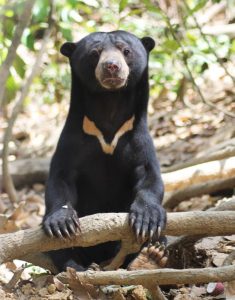
Sun bear just chillin:

Sun bears got long tongues:

The water bear, AKA tardigrade, is not actually a bear. For one thing, it has twice the number of legs as bears have:

Show transcript:

Welcome to Strange Animals Podcast. I’m your host, Kate Shaw.

It’s summer in the northern hemisphere, which means hot weather and sunshine and, if you’re lucky, a trip to the lake or ocean. To celebrate summertime, let’s talk about two animals suggested by Enzo and his sister Lux. They wanted to hear about the sun bear and the water bear. Get it? Sun and water?

Enzo’s suggestion is the sun bear, which we talked about a little bit way back in episode 76, but which is a fascinating animal that deserves a lot more attention.

The sun bear lives in southeast Asia in tropical forests and is most closely related to the black bear. It has silky black fur, although some are gray or reddish, and a roughly U-shaped patch of fur on its chest that varies in color from gold to almost white to reddish-orange. Its muzzle is short and is lighter in color than the rest of its face, usually gray. It has small ears too. It’s the world’s smallest bear, only around three feet long from head to tail, or 150 cm, and four feet tall when standing on its hind legs, or 1.2 meters. Researchers think its chest spot acts as a threat display. When a sun bear stands on its hind legs, the chest spot is really obvious, which may warn potential predators away. Even so, tigers and leopards will attack and eat sun bears.

The sun bear spends a lot of time in trees, more than any other bear. It has long claws that it uses for climbing and to tear open logs to get at insect larvae. It eats a lot of termites and especially loves honey, which it licks from the hive with its long tongue–up to 10 inches long, or 25 cm. It also eats a lot of plant material, especially fruit and acorns. It will catch and eat birds and small animals, or sometimes larger animals like deer, but it mostly eats insects and fruit.

The female sun bear makes her den in a hollow tree to give birth. She has one or two cubs at a time, and like other bear cubs they’re born extremely small and with their eyes and ears sealed shut. This is the case with animals like dogs and cats too, but newborn bears are tiny compared to how big the mother bear is. The eyes and ears continue developing after the cub is born, but it’s a few months before it can see and hear properly. A cub remains with its mother for almost three years.

Other than mothers and babies, the sun bear is solitary. Adults don’t typically interact except to mate, although adult sun bears kept in captivity will play together. A 2019 study of sun bears came to a surprising conclusion that they communicate with each other by mimicking facial expressions. This is something humans do all the time, of course, and apes do too. Dogs also mimic facial expressions. Humans, apes, and dogs are all intensely social animals, so researchers have always assumed that the mimicking of facial expressions is important because of that sociability. I mean, that just makes sense. If you see a friend approaching and they have a big smile on their face, naturally you’re going to smile too. But here are these solitary bears with facial communication just as well-developed as in apes. Researchers think it may be a trait that’s so important to mammals as a whole that it develops even in species that don’t spend a lot of time interacting.

The sun bear is threatened by habitat loss and hunting, but it does well in captivity and is popular in zoos. Conservation efforts are in place to protect the sun bear in the wild as well as continue a healthy captive breeding program around the world.

Lux wanted to hear about the water bear, which is also called the tardigrade or the moss piglet. I can’t believe we haven’t covered the tardigrade before—we even have one in our new logo! Patrons may remember parts of this section from a Patreon bonus episode from 2017, but I’ve updated it a lot.

The water bear isn’t a bear at all but a tiny eight-legged animal that barely ever grows larger than 1.5 millimeters. Some species are microscopic. Pictures of the water bear are taken with an electron microscope because otherwise they just look like a teensy little dot.

There are about 1,300 known species of water bear and they all look pretty similar. It looks for all the world like a plump eight-legged stuffed animal made out of couch upholstery. It uses six of its fat little legs for walking and the hind two to cling to the moss and other plant material where it lives. Each leg has four to eight long hooked claws. It has a tubular mouth that looks a little like a pig’s snout or a bear’s snout.

An extremophile is an organism adapted to live in a particular environment that’s considered extreme, like undersea volcanic vents or inside rocks deep below the ocean floor. Tardigrades aren’t technically extremophiles, but they are incredibly tough. Researchers have found tardigrades in environments such as the gloppy ooze at the bottom of the ocean to the icy peaks of the Himalayas. It can survive massive amounts of radiation, dehydration for up to five years, pressures even more intense than at the bottom of the Mariana Trench, temperatures as low as -450 Fahrenheit, or -270 Celsius, heat up to 300 degrees Fahrenheit, or 150 Celsius, and even outer space. It’s survived on Earth for at least half a billion years. Mostly, though, it just lives in moss.

One thing to remember is that different species of tardigrade are good at withstanding different extreme environments. Not every tardigrade is able to do everything we just talked about. They’re tough, but they’re not invulnerable. Many species can withstand incredible heat, but only for half an hour or less. Long-term temperature increases, even if only a little warmer than it’s used to, can cause the tardigrade to die.

Most species of tardigrade eat plant material or bacteria, but a few eat smaller species of tardigrade. It has no lungs since it just absorbs air directly into its body by gas exchange. It has a teeny brain, teeny eyes, and teeny sensory bristles on its body. Its legs have no joints. Its tubular mouth contains tube-like structures called stylets that are secreted from glands on either side of the mouth. Every time the tardigrade molts its cuticle, or body covering, it loses the stylets too and has to regrow them. In some species, the only time the tardigrade poops is when it molts. The poop is left behind in the molted cuticle.

The tardigrade’s success is largely due to its ability to suspend its metabolism, during which time the water in its body is replaced with a type of protein that protects its cells from damage. It retracts its legs and rearranges its internal organs so it can curl up into a teeny barrel shape, at which point it’s called a tun. It needs a moist environment, and if its environment dries out too much, the water bear will automatically go into this suspended state, called cryptobiosis.

The tardigrade’s DNA gets fractured during dehydration but it’s incredibly successful at repairing its DNA upon rehydration, which explains a big part of its success. In 2016, Japanese researchers sequenced the genome of the species of tardigrade that best resists radiation. In the process, they discovered a new protein in the tardigrade’s genome, which they named DSUP, short for damage suppressor. Even more interesting, when cultured human cells were given the ability to create DSUP, after exposure to X-rays, they showed half the DNA damage that non-DSUP cells showed.

Tests in 2007 and 2011 that exposed tardigrades to outer space led to some speculation that tardigrades might actually be from outer space, and that they, or organisms that gave rise to them, might have hitched a ride on a comet or some other heavenly body and ended up on earth. But this isn’t actually the case, since genetic studies show that tardigrades fit neatly into what we know of animal development and evolution.

The tardigrade is probably most closely related to arthropods, like insects and spiders. Their closest relatives were probably lobopodians, extinct wormlike organisms with stubby legs. The famous Hallucigenia creature is a lobopodian, which we talked about in episode 69 about the Cambrian explosion. There’s still a lot we don’t know about the tardigrade’s ancestry, since we have so few fossilized water bears, but many researchers think their oldest ancestors were probably much bigger than the microscopic or nearly microscopic living animals. In other words, maybe once there were water bears you could pick up and hug. Well, they probably weren’t that big, but I like to imagine it. I think that if you hugged a water bear too hard, it would make this noise: [little prrrt sound]

You can find Strange Animals Podcast at strangeanimalspodcast.blubrry.net. That’s blueberry without any E’s. If you have questions, comments, or suggestions for future episodes, email us at strangeanimalspodcast@gmail.com. If you like the podcast and want to help us out, leave us a rating and review on Apple Podcasts or Podchaser, or just tell a friend. We also have a Patreon at patreon.com/strangeanimalspodcast if you’d like to support us that way, and don’t forget to join our mailing list. There’s a link in the show notes.

Thanks for listening!