Episode 474: The Button Quail Mystery

DRAMA! Bird drama! Here are some further-reading links if you want to verify that I’m not vilifying anyone:

Buff-breasted Buttonquail: An image claimed to be of this species revealed

Buff-breasted Buttonquail: Smoke & Mirrors

A review of specimens of Buff-breasted Button-quail Turnix olivii suggests serious concern for its conservation outlook

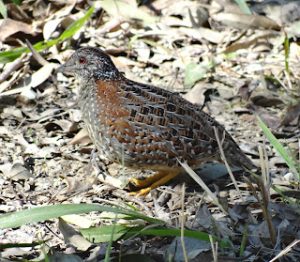
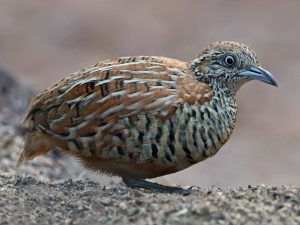
A painted button quail:

Show transcript:

Welcome to Strange Animals Podcast. I’m your host, Kate Shaw.

Back in episode 136 we talked about the button quail, because that episode was about tiny animals and the button quail is really tiny. But let’s revisit the button quail this month, because we have a mystery associated with a particular species of button quail.

Button quails generally live in grasslands and are actually more closely related to shore and ocean birds like sandpipers and gulls than to actual quails, but it’s not very closely related to any other living birds. It can fly but it mostly doesn’t. Instead it depends on its coloring to hide it in the grass where it lives. It’s mostly brown with darker and lighter speckled markings, relatively large feet, and a short little tail. It eats seeds and insects along with other small invertebrates.

The button quail is especially interesting because the female is more brightly colored than the male, although not by much. In some species the female may have bright white markings, while in others her speckled markings are crisper than the males. The female is the one who calls to attract a male and who defends her territory from other females. The female even has a special bulb in her throat that she can inflate to make a loud booming call.

The male incubates the eggs and takes care of the chicks when they hatch. Baby button quails are fuzzy and active like domestic chicken babies but they’re only about the size of a bumblebee. In many species, as soon as the female has laid her eggs, she leaves them and the male and goes on to attract another male for her next clutch of eggs.

The various species of button quail live in different areas, including Africa, Asia, and Australia. The species we’re talking about today is the buff-breasted button quail, which is native to one small area of Queensland, Australia. It grows about 9 inches long, or 23 cm, which is big for a button quail, most of which are closer to the size of sparrows, and it’s reddish-brown with darker and lighter speckles. It’s critically endangered due to habitat loss and introduced animals like cats and cattle. There are only an estimated 50 individuals alive today.

But that’s only an estimate, because no one has actually for sure seen a buff-breasted button quail since 1922. Also, I’m going to call it the BBBQ from now on because that name is hard to say.

The 1922 specimen was shot by a naturalist who was collecting specimens for a museum, which was regrettably common at the time and led to a lot of endangered species being driven to extinction. The bird was already rare in 1922 and that was the last anyone saw of it until 1985, when someone reported seeing one. People flocked to the area in hopes of spotting it, but while there were lots of sightings, no one got a good picture of a BBBQ. All the pictures, and all the recordings of its calls, turned out to be of another species of button quail, a very similar bird called the painted button quail.

It’s been 100 years since the bird was last seen, so while we have lots of museum specimens, we don’t have any modern sightings. That means two things. Either the buff-breasted button quail is probably extinct…or it never actually existed in the first place.

There are two other species of button quail that live in the same areas where the BBBQ is found, the painted button quail and the brown quail. They’re smaller but otherwise look very similar, especially the painted button quail. Maybe people were mistaking larger individuals of painted button quails as a different species.

In 2018, a team of scientists from the University of Queensland conducted a search for the BBBQ. All they found were painted button quails. But they discovered something surprising that had never been documented before. During the breeding season, the female painted button quail’s feathers are much more reddish-brown, while the rest of the year the feathers on her back are more gray-brown.

The team also studied as many BBBQ skins as they could track down from museums, where they learned something else surprising. It turns out that it’s not any larger than the painted button quail, which grows up to 8 inches long, or 20 cm. So the birds are the same size and during part of the year, they have almost identical plumage. Hmm.

That doesn’t mean the buff-breasted button quail never existed. One very distinctive difference between the painted and the buff-breasted species is eye color, with the former having red eyes and the latter having yellow. As far as I know a genetic study hasn’t been carried out on the museum specimens, but it’s likely that at least some of the specimens—maybe all of them—really are BBBQs. Scientists and bird enthusiasts are still looking for the bird, and that has led to a strange controversy.

In early 2022, a naturalist named John Young published a photo on Facebook of what he said was a male buff-breasted button quail on a nest, a photo taken by a camera trap in a secret location. The location had to be secret so that no one would try to find the birds and scare them away or damage a nest. Young said he had 16 other photos of BBBQs but wasn’t going to share them until he was ready to publish his findings. He was also raising money to continue his studies at the site.

Another naturalist thought there was something fishy about the photo. He discovered that the picture is actually a cropped and flipped photo of a painted button quail bird and nest reportedly taken at a different site—published in 2018 by John Young himself and labeled by him as a painted button quail. Young had reused one of his own photos and assumed no one would notice.

But it gets worse. Back in 2013, Young got photographs of another extremely rare Australian bird, the night parrot. One day we’ll have an episode about it. It was such a big deal that he was offered a job by the Australian Wildlife Conservancy, or AWC, to study the night parrot and the buff-breasted button quail. He documented sightings and produced photos of both birds, but he didn’t stay in that job too long. That’s because some people started getting suspicious of his parrot photos. After an inquiry into the night parrot photos, the AWC concluded that the eggs in a photo of a night parrot nest were probably fake.

And Young’s dubious photos go back even farther. In 2006 he claimed to have discovered a new species of parrot in Queensland, but while initially the Queensland government supported learning about the new species, it withdrew its support when the photo turned out to be…suspicious. It looked like Young had altered the coloration of a bird to make it look like a new species. When an expert requested the original photographs, Young said he’d deleted them.

More recently, the 2018 painted button quail photo and the supposed 2022 BBBQ photo were examined by a forensic photography expert. Young had removed the metadata from both so no one could tell where they were taken, but there’s a little white stone in both pictures that’s identical, along with many other identical details.

The problem with fake sightings and photographs is that it’s actually making things worse for the buff-breasted button quail. The AWC and other conservation groups are trying to get the bird listed as endangered, which means funding for research and conservation. Now all that is in jeopardy because it’s not clear if there have actually been any sightings of the bird at all.

Hopefully the buff-breasted button quail is still around and someone will get genuine photos of it soon so it can be protected and studied. That’s assuming it’s a real bird in the first place.

Thanks for your support, and thanks for listening!
Episode 136: Smallest of the Small

Last week we learned about the smallest species of animals not typically thought of as small, like snakes and cetaceans. This week let’s look at some of the tiniest animals in the world, the smallest of the small!

Further watching:

A short video about jerboas. Really interesting and well-made!

A button quail:

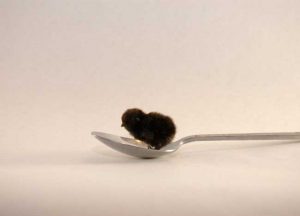
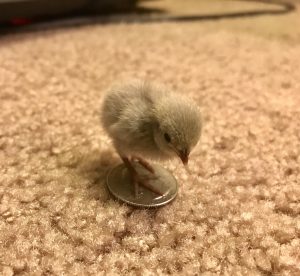
Baby button quails are the size of BEES:

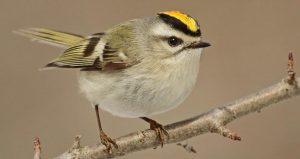
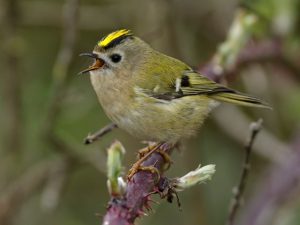
Kinglets are teeny birds even when grown up. Left, the golden-crowned kinglet. Right, the goldcrest. These birds MAY BE RELATED, you think?

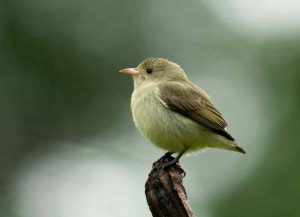
The pale-billed flowerpecker, also teeny and with a cute name:

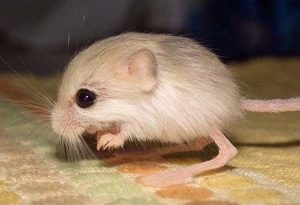
Moving on from birds, the pygmy jerboa is one of the smallest rodents in the world:

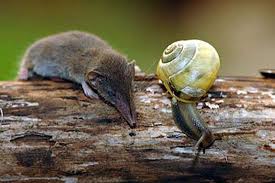
The Etruscan pygmy shrew is even tinier, probably the smallest known mammal alive today. Shown here with friend/lunch:

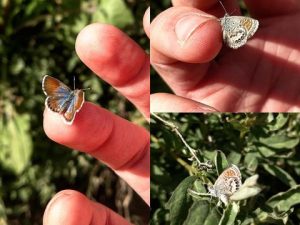
The Western pygmy blue butterfly is probably the smallest butterfly known:

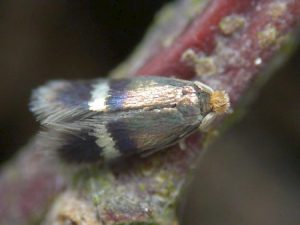
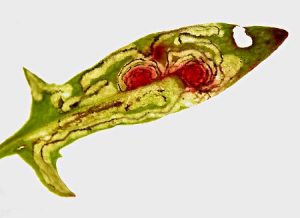
But the pygmy sorrel moth is even smaller. Right: red marks left behind on a sorrel leaf eaten by its larvae:

One of the world’s teeniest frogs:

Show transcript:

Welcome to Strange Animals Podcast. I’m your host, Kate Shaw.

Last week we learned about the smallest species of animals that aren’t typically thought of as small. But this week let’s learn about the smallest of the small animals. It’s like saying they’re the cutest of the cute animals. We’ll start with the bigger ones and get smaller and smaller as we go.

Let’s start with a bird. The smallest bird is the bee hummingbird, which we’ve talked about before. But there’s another bird that’s really small, the button quail. It’s about the size of a sparrow.

The button quail isn’t actually a quail, but it looks like one due to convergent evolution. There are a number of species in parts of Asia and Africa and throughout Australia. It generally lives in grasslands and is actually more closely related to shore and ocean birds like sandpipers and gulls than to actual quails, but it’s not very closely related to any other living birds. It can fly but it mostly doesn’t. Instead it depends on its coloring to hide it in the grass where it lives. It’s mostly brown with darker and lighter speckled markings, relatively large feet, and a little stubby nothing of a tail. It mostly eats seeds and other plant parts as well as insects and other invertebrates.

The button quail is especially interesting because the female is more brightly colored than the male, although not by much. In some species the female may have bright white markings, in some their speckled markings are crisper than the males. The female is the one who calls to attract a male and who defends her territory from other females. The female even has a special bulb in her throat that she can inflate with air to make a loud booming call.

The male incubates the eggs and takes care of the chicks when they hatch. Baby button quails are fuzzy and active like domestic chicken babies but they’re only about the size of a bumblebee. In many species, as soon as the female has laid her eggs, she leaves them and the male and goes on to attract another male for her next clutch of eggs.

People sometimes keep button quails as pets, specifically a species called the painted buttonquail or the Chinese painted quail. It’s about five inches long, or 12 cm. The female has black and white stripes on her face and throat. The birds can become quite tame and can live several years.

Button quails make a lot of different noises. This is what a button quail sounds like:

[button quail calls]

One of the smallest birds in the world that isn’t a hummingbird is the kinglet, with several species that live in North America and Eurasia. The goldcrest is a type of kinglet and the smallest European bird. It’s only 3.3 inches long, or 8.5 cm, although some individuals are larger. It looks a lot like the North American bird the golden-crowned kinglet, which is just a shade smaller at 3.1 inches, or 8 cm. Both species have a golden patch on the top of the head. The male also has an orangey spot in the middle of the golden patch. Both live in coniferous forests and eat insects and spiders.

Because kinglets are so small and active, they can starve to death quickly—in only an hour in some cases. Females lay up to 12 eggs at a time. TWELVE EGGS. That is a lot of eggs. The nest is too small to hold a dozen eggs in one layer so they end up in a pile. The female keeps all of them warm by pushing her legs down into the pile of eggs. Since her legs have a lot of blood vessels near the surface, they’re much warmer than most birds’ legs.

When the babies hatch, they stay in a pile. The ones on the top of the pile get fed first, naturally, but then they burrow down into the pile and push their siblings up toward the top. They’re not just being nice, though, since birds in the bottom of the pile stay warmer.

This is what a golden-crowned kinglet sounds like:

[bird call]

The pale-billed flowerpecker is even smaller than the kinglets and are among the smallest birds in Asia. It lives in parts of India and nearby areas and mostly eats berries, although it also eats flower nectar. It grows to only 3 inches long, or 8 cm, and is plain brownish-green in color with a short tail and shiny black eyes. It lives in forests but often visits gardens. It doesn’t lay a dozen eggs at a time, just an ordinary two or three.

This is what a pale-billed flowerpecker sounds like. These are some teeny sounds from teeny birds:

[bird call]

There are several rodents that are considered the smallest rodent, but we’re only going to learn about one of them today, the pygmy jerboa. On average it’s only 1.7 inches long, or 4.4 cm, not counting its extremely long tail.

The pygmy jerboa lives in the deserts of Pakistan and possibly in nearby areas too. It has very long hind legs and very short front legs so it hops like a tiny kangaroo, using its long tail as a way to balance and maneuver at high speeds. Its tail is twice as long as its body. Its large hind feet and the end of its tail are very furry to give it more surface area so it can easily maneuver through loose sand.

It mostly eats seeds and leaves, and it gets all the moisture it needs from the food it eats. It’s nocturnal and spends its days in the burrow it usually digs under bushes. Like many other tiny animals, when it rests it slows its metabolism drastically so it won’t starve to death while it’s asleep. Life is rough for tiny animals.

We don’t know a whole lot about the pygmy jerboa except that it’s endangered due to habitat loss, so let’s move on to an even smaller mammal.

The Etruscan shrew grows to about 1.6 inches long, or 4 cm, on average, not counting its short tail. The tail is about a third of the length of its body. It lives in southern Europe, parts of Asia, parts of the Arabian Peninsula, and northern Africa and prefers warm, moist climates. It’s the same size and weight as the bumblebee bat we talked about last week, so it’s one of the smallest mammals known.

The Etruscan pygmy shrew is pale brown with a lighter colored belly, a long nose, and short whiskers around its mouth that it uses to help it find its prey. It’s incredibly active and makes clicking noises almost constantly, as a way to alert other shrews that it’s there and is willing to defend its territory. It makes its nest among rocks and in the abandoned burrows of other animals.

Like the kinglets and other highly active, tiny animals, it has to eat a lot to keep its metabolism going—up to twice its own weight in food every day. It can also enter a torpid state where it reduces its body temperature and metabolism the same way the pygmy jerboa does, in order to not starve while it sleeps. But the Etruscan shrew doesn’t rest very often.

It mostly eats insects and other invertebrates like earthworms, but it will eat anything it can kill. This includes lizards, small rodents, and frogs. It especially likes grasshoppers and crickets, which are often as large as it is. In order to kill prey its own size, the shrew is incredibly fast. If you remember episode 82 where we talked about the star-nosed mole, the Etruscan shrew primarily hunts by touch and can react in barely 25 milliseconds when it touches something it wants to eat. It takes something like 300 milliseconds for a human to blink their eyes, if that gives you an idea of how fast the shrew is. It can touch a cricket and kill it in less time than it takes to blink.

So that’s as small as mammals get, as far as we know. What’s the smallest amphibian?

Well, it’s really, really small. The smallest known frog is only 7.7 mm long. Paedophryne amauensis isn’t just the smallest frog, it’s the smallest vertebrate known. It was only discovered in 2009 in Papua New Guinea.

It sounds like an insect and lives in the damp leaf litter on the forest floor, and it’s dark brown and black in color to blend in with dead leaves, so it was hard to find. Researchers only found it by using sensitive microphones to triangulate on its call, then quickly scooping up lots of leaf litter and stuffing it into plastic bags so anything living in the leaves couldn’t escape. Its eggs hatch into tiny froglets instead of tadpoles.

The tiniest frog is just about the same length as the tiniest fish, the stout infantfish that lives in a few coral reefs near Australia, including the Great Barrier Reef. It also grows 7.7 mm long on average, although females are typically longer and it can grow as much as 10 mm long. But the smallest known fish is the male of an anglerfish species that only grow 6.2 mm long. This doesn’t really count, though, since females grow up to two inches long, or 50 mm. Like other deep-sea anglerfish species, when a male of Photocorynus spiniceps finds a female, he bites her and stays there. Eventually his mouth actually fuses to her body and he lives the rest of his life as a sort of parasitic extension of the female. He supplies her with sperm to fertilize her eggs before she lays them, and she supplies him with nutrition and oxygen since he’s basically part of her body at that point. A female can have more than one male fused to her.

So, we seem to have reached the smallest vertebrates. What about the smallest insects and other invertebrates?

Butterflies are generally pretty small, but the smallest butterfly known is really, really small. The Western pygmy blue butterfly only has a wingspan of 20 mm at most but usually more like 12 mm across. That’s less than an inch. It lives in western North America and parts of the middle east, and has even been found on Hawaii. Its wings are a pretty coppery brown color with rows of black and white spots. It likes deserts and waste places where you wouldn’t expect to find anything as delicate as a tiny butterfly. Its caterpillars eat various types of weed plants.

That is pretty much it. There’s not much to this tiny butterfly. The real mystery is why it’s called the western pygmy blue when it’s not actually blue.

Compared to the smallest moth known, the western pygmy blue butterfly is a giant. The smallest moth is the pygmy sorrel moth and its wingspan is barely four millimeters. Its wings shade from silvery with a metallic bronze tint to purply with a white stripe, and gray along the ends. It’s really pretty but so tiny that it’s hard to spot. It lives in much of Europe and its larvae leave distinctive spiral shapes on sorrel leaves as it eats.

We’ll come back to insects in a minute or two, but let’s look at a few snails first. The smallest land snail is the Borneo snail. Its shell is only .7 of a mm high. It was only discovered in 2015. We don’t know a lot of about it yet, but it probably eats bacterial film growing on limestone in caves. So far researchers haven’t even found a living Borneo snail, though, just its shells.

The smallest water snail is even smaller than the Borneo snail. It’s from North America and its shell is only half a millimeter across at the most. Some individuals are only .3 mm across. Ammonicera minortalis lives in shallow water off the coast of southern Florida and around Cuba and other islands in that area. And that’s pretty much all we know about it. It’s a lot easier to study bigger animals just because they’re easier to find.

Small as that is, on average the smallest beetle is smaller than the smallest snail. It’s a type of featherwing beetle only described in 1999, and on average it’s .338 mm long. So far it’s only been found in Central America and it eats fungus. It’s yellowish-brown in color but that doesn’t really matter because it’s so small that you need a magnifying glass to really see it.

Once you start dividing millimeters, you’re getting into ridiculously tiny territory. But the smallest insect is a type of wasp known as a fairyfly. Kikiki huna is so small it’s measured in micrometers, sometimes called microns, and is smaller than some single-celled organisms. It’s only 150 micrometers long, which is shorter than an ordinary piece of printer paper is thick. It’s been found on Hawaii, Costa Rica, and Trinidad but it probably lives in other places but just hasn’t been found yet. Some researchers suspect that it’s as small as a flying animal can become without losing the ability to fly under its own power instead of just floating on the wind.

At this point anything smaller than Kikiki huna and its close relatives are made up largely of bacteria, which are frankly not as cute or as interesting as, say, button quail. So let’s finish with what may be the very smallest living organism ever found. Or it may not be. Because researchers are literally not even sure if the nanobe is even alive.

In 1996 researchers found what looked like filiments growing among rock samples collected from wells off the Australian coast. Some of them were only 20 nanometers in diameter. To put that into perspective, a nanometer is one billionth of a meter. That’s billion with a B. It’s one thousandth of a micrometer. A nanobe is a tenth of the size of the smallest known bacteria.

The researchers weren’t sure what they’d found so they did a lot of tests. They thought they might have discovered a new kind of crystal, but when they stained the nanobes with a type of dye that binds to DNA, the results indicated the nanobes might be living organisms. But no DNA has been successfully recovered from nanobes.

There’s still a lot of research to be done to determine what they are and if they’re actually alive, though. The main problem is that nanobes appear to be too small to contain all the things that living organisms need. But they do resemble fungi in some ways, just much, much smaller. If nanobes are alive, they’re extremely different from any living animal ever known and presumably live and reproduce in ways completely unlike all other life.

But here’s an interesting note. In 1996 researchers found structures inside a meteorite from Mars that look a lot like nanobes.

You can find Strange Animals Podcast online at strangeanimalspodcast.blubrry.net. That’s blueberry without any E’s. If you have questions, comments, or suggestions for future episodes, email us at strangeanimalspodcast@gmail.com. We also have a Patreon if you’d like to support us that way.

Thanks for listening!