Episode 504: The Mystery Roar

Further reading:

Wolves on rise in France as bears wreak mountain havoc

Can Brown Bears Survive in the Pyrenees?

Show transcript:

Welcome to Strange Animals Podcast. I’m your host, Kate Shaw.

On the evening of August 4, 2019, two hikers set up camp in the Pyrenees Mountains. Laurent and Frédéric were familiar with the area and had plenty of experience hiking and camping. Once their camp was ready for the night, they took off their boots and socks and sat down to eat dinner and relax at a small campfire. If you’ve ever camped after a long hike, you’ll know that this is the best time of the day, when you can rest and air out your boots.

After only a few minutes, though, the two heard grunts and growls in the darkness not far from their camp. They were concerned, but they had a fire and most animals won’t approach a fire. But the sounds got closer and closer.

Then the animal roared—and it sounded like it was much closer than before. Laurent and Frédéric remembered that bears have become more common in the Pyrenees in the last few decades, and rather than take their chances with a hungry bear, they decided it was time to go. They shoved their bare feet into their boots, left everything behind, and raced back down the trail.

It was late when they made it to the village of Germ so the hikers took refuge in a church where they spent the night. In the morning they hiked back up to their campsite to retrieve their belongings, expecting it to be trashed by a bear hunting for food. But everything was where they’d left it.

Some people assumed the hikers had panicked over nothing, but the men were adamant that they’d heard something roaring as it came closer. In a news interview they said the final roar, the one that made them grab their boots and run, lasted several seconds and was so loud they could actually feel it in their chests.

Brown bears were once fairly common in the Pyrenees but by 1991 they had all been killed, mostly by hunters. Habitat loss was also a factor as people built more roads and houses in the mountains. In 1995 a conservation program brought three bears from Slovenia to start a reintroduction program, and the way people acted, you’d think someone had released a thousand rabid weasels into their homes.

Sheep and cattle farmers, and people who think the wilderness belongs to humans and humans only, protested the reintroduction of the bears, and one of the bears was shot and killed. This is despite the fact that farmers whose livestock are killed by bears get paid a lot of money by the French government. Approximately 1,000 sheep a year are killed in the Pyrenees—not by bears, but by pet dogs running loose.

Conservation efforts continued despite protests and finally, by 2020, there were 64 bears living in the Pyrenees Mountains. The number may be a little larger—some estimates are as high as 100—but conservationists have difficulty counting the bears properly because protesters threaten them and in one case actually set a conservationist’s car on fire.

The Pyrenees mountain range more or less divides France from Spain. It’s older than the Alps and especially known for its spectacular waterfalls. Many plants and animals that live in the Pyrenees are found nowhere else in the world, but unfortunately hunting and habitat loss have driven many of them to extinction. The Pyrenean ibex, a type of wild goat, went extinct in the year 2000.

Conservationists have introduced a related animal, the western Spanish ibex, to help keep the mountain ecosystems healthy. The bears now living in the mountains are similarly important to the ecosystems. Conservationists are frustrated by protesters who don’t want bears in the mountains at all, especially considering that the Great Pyrenees dog was developed in the area to protect livestock from bears and other predators. Some shepherds in British Columbia, Canada, where both black bears and grizzlies live, successfully use Great Pyrenees dogs to guard their flocks from bears. Grizzlies are a subspecies of brown bear.

But let’s go back to Laurent and Frédéric’s scary camping trip. Did they really encounter a bear or could it be something else?

Bears are generally quite shy animals who avoid people when they can. Unlike black bears, which don’t growl, brown bears do make growling and grunting sounds occasionally. Males will growl or even roar at other males during mating season in spring and early summer, signaling aggression and the willingness to fight. A brown bear will sometimes growl or roar at a person to warn them away too. So it’s possible the hikers heard a bear who wasn’t interested in their food but just wanted them out of its territory.

There’s another possibility, though, and it’s an animal that’s much more common in the Pyrenees Mountains than bears are. The wild boar lives throughout the Pyrenees, especially in forested areas and meadows. It’s mostly nocturnal and is usually shy of humans, and its numbers have increased considerably since its main predator, the wolf, was driven to extinction in the mountains and elsewhere in the 1930s.

An estimated two million wild boars live in France, including the Pyrenees. The most common time for people to encounter wild boars is at dusk, which is exactly when the hikers heard the growling. But wild boars are just pigs, right? Pigs oink, right?

This is what an aggressive wild boar sounds like:

[boar growl]

A boar will growl to warn other boars that there’s danger nearby and to signal aggression. That would explain why the hikers heard grunts and growls, which finished in a loud, angry roar. It would also explain why the campsite was undisturbed. Wild boars mostly eat plants, including roots, nuts, and fruit, although they’ll also eat carrion and the occasional small animal if they can catch it. Unlike a bear, which almost always wants to eat people food when it can, a wild boar is a lot less interested in people food. If the hikers did hear a boar instead of a bear, once they ran away the boar was probably satisfied and just went around finding its natural food in the area as usual.

Wild boars have been introduced to parts of North and South America, Australia, and other places where they’ve become an invasive species. The wild boar is native to Europe and Asia, though, so the ones in the Pyrenees are right where they belong. The only real issue is the lack of natural predators to keep the boar population at a healthy level.

The good news is that wild boars aren’t usually as aggressive as they can sound, as long as they’re not cornered. The two hikers were probably not in any danger after all. Still, it’s better to be safe than sorry when you get roared at by a large creature in the dark.

Thanks for your support and thanks for listening!
Episode 503: The Mystery of Typhloesus

Further reading:

A possible home for a bizarre Carboniferous animal: is Typhloesus a pelagic gastropod?

Typhloesus

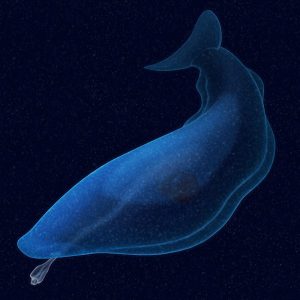
An artist’s rendition of what Typhloesus might have looked like [pic taken from the Nix Illustration link above]:

Show transcript:

Welcome to Strange Animals Podcast. I’m your host, Kate Shaw.

I recently discovered the excellent Nix Illustration blog, which is about scientific illustration and palaeontology. I’m finding so many fun topics that I keep going back to it, so I hope you don’t mind another invertebrate mystery I learned about from the site. There are links in the show notes if you want to read the original blog posts.

This month’s mystery is Typhloesus wellsi, sometimes referred to as the “alien goldfish” because of its shape and its peculiar anatomy. It definitely wasn’t a fish. It lived around 324 million years ago and was first discovered in the early 1970s in Montana, in the middle of North America. It grew up to four inches long, or 10 cm, and was shaped not like a real goldfish but kind of like a goldfish cracker. Its body was roughly cylinder-shaped, and it had a vertical tail fin and a pair of fin-like lobes on its sides that are referred to as keels. But it didn’t have eyes or, as far as scientists can determine, an anus. It did have a mouth and gut cavity–but it also had something truly unexpected and mysterious in its body, a pair of disc-shaped organs that contained a lot of iron but whose function is completely unknown and unlike anything scientists have ever seen.

Those initial specimens also contained lots of conodont teeth, which led scientists to hope they’d finally discovered the conodont animal. We’ve talked about conodont teeth before, but it’s been quite a while ago. Conodont animals were incredibly common for around 300 million years, and their teeth are found throughout the world. Technically they’re not teeth but tooth-like structures called conodont elements, some of them microscopic, some of them almost an inch long, or 2 cm. Each animal had three types of conodont elements, and they interacted in a way that we don’t fully understand since they were completely different from modern animal mouthparts.

Until the 1980s, no one knew what the conodont animal looked like. The only fossils we had were the tiny teeth. Then some body impressions of the conodont animal were discovered. Now we know it was shaped like an eel and grew up to 20 inches long, or 50 cm. We also know it had large eyes, a notochord (or primitive spine), and fins on the tail end. It was probably related to hagfish and lampreys and may have looked similar, although not everyone agrees with this classification.

Whatever the conodont animal was related to, Typhloesus definitely wasn’t one. It turns out that the conodont teeth associated with Typhloesus fossils were actually in its gut, after the alien goldfish ate a conodont animal.

So scientists were back to square one. What was Typhloesus?

In 2022, a study of several specimens revealed a clue. Typhloesus had a radula. That’s a mouthpart that resembles a tooth-studded tongue. Snails, for instance, use tiny radulas to scrape algae and other food off of rocks. True radulas are a trait of mollusks, which means Typhloesus was most likely an early mollusk, maybe even a gastropod like snails and slugs.

That’s a start to classifying Typhloesus, but it doesn’t explain the pair of weird disc-shaped organs. It’s called a ferrodiscus and we still don’t know what it was for. Because of its placement just under the midgut and its high concentration of iron, which would have made it quite hard in comparison to most of the rest of its body, the ferrodiscus might have had something to do with digestion. Then again, it might have had something to do with chemoreception, which is probably how Typhloesus found its food. Some modern mollusks have a chemoreceptor organ under the radula, but it’s mainly a bundle of nerve cells and not any kind of weird iron discs. We just don’t know what the ferrodiscus was.

Typhloesus probably swam around until it encountered a small animal like a conodont, and then it would stick its radula out like a spiky tongue and use it to grab the animal. Typhloesus had no anus, so after it digested its meal it just spat out the indigestible parts. It might also have been a scavenger that used its radula to pull pieces off of a dead animal to eat.

Not every scientist agrees that Typhloesus was a mollusk. Only mollusks have true radulas, although not all mollusks have them, but other animals have evolved similar structures. Typhloesus is so different from known mollusks, living and extinct, that scientists can’t definitively determine what it was related to. It had no gills and no notochord, so we know it had to be an invertebrate. Some cnidarians, which include jellyfish and sea anemones, have no anus, but Typhloesus has even less in common with that phylum of animals than it has with mollusks. Some flatworms have no anus, but again, Typhloesus doesn’t seem to have a lot of other traits in common with flatworms.

Until we learn more about it from studying well-preserved fossils, we can only speculate about where Typhloesus fits in the tree of life and what the ferrodiscus actually was. Mysteries like this are part of the challenge of science, and part of the fun too.

Thanks for your support, and thanks for listening!

Episode 502: Back to the Ocean

Show transcript:

Welcome to Strange Animals Podcast. I’m your host, Kate Shaw.

Life arose in the oceans and only much later spread to the land. But some land animals returned to the ocean and eventually became fully marine animals. That’s our topic this month, animals that returned to the sea.

Vertebrates that evolved on land are called tetrapods, meaning four-footed. It applies even to animals like birds that have two legs and two wings, and snakes that have no legs, because all the ancestors of tetrapods had four legs.

Returning to marine life as a tetrapod eventually results in an animal developing certain characteristics. Even animals like sea turtles become more streamlined, which helps the animal swim more easily, and arms and legs develop into flippers for the same reason. Sometimes limbs are lost completely, like the rear legs of cetaceans and sirenians, because they’re not needed. One interesting note is that as far as we know, all marine tetrapods still have to breathe air, which requires them to come to the surface of the water periodically.

The ancestors of marine tetrapods probably all started out as partially aquatic and gradually became more and more at home in the water. That’s true even for animals as well adapted to marine life as whales.

Some of the earliest whale ancestors were the ambulocetids, which probably looked sort of like a cross between a hippopotamus and a crocodile. Ambulocetid means “walking whale,” but there’s some evidence that it might have already evolved to be fully aquatic 49 million years ago. It had short legs that might not have been strong enough to support it out of water. It might have been covered with short fur like a seal but it might have had little to no fur, more like a hippopotamus. Either way, it had long toothy jaws, strong legs with webbed toes that it used to propel itself through the water, and a tail that probably resembled that of an otter. It grew about ten feet long, or 3 meters.

Ambulocetids lived in shallow coastal areas where the land was swampy, and it may have spent part of its time in fresh water. It wouldn’t have looked or acted much like a whale to us, but it was already developing features now found only in whales.

By around 41 million years ago, the basilosaurids and their close relations had evolved, and were definitely fully aquatic. Their nostrils had moved almost to the location of modern whales’ blowholes. Their forelegs were basically flippers with little fingers, their hind legs had almost disappeared, and they had tail flukes. They were also much bigger than their ancestors. Basilosaurus could grow up to 60 feet long, or 18 meters, and probably looked more like a gigantic eel than a modern whale. It was long and relatively thin, and may have mostly lived at the ocean’s surface instead of diving for food.

Dakosaurus wasn’t a dinosaur despite its name, although it lived at the same time as the dinosaurs, about 145 million years ago. It was a crocodylomorph that grew up to about 16 feet long, or 5 meters, and looked kind of like a shark with legs—but also a lot like a crocodile wearing a shark costume. Its tail had a fin near the end that made it resemble a shark’s tail, and its legs were flipper-like but still obviously legs. It had a whole lot of big serrated teeth in a deep skull with strong jaws. Because its jaws and teeth were so strong, in fact, scientists think Dakosaurus probably ate other marine reptiles instead of just fish.

While Dakosaurus was streamlined and well adapted to life in the ocean, we don’t know if it left the water to lay its eggs on land the way sea turtles still do or if it gave birth in the water. We don’t have any nest sites or young specimens one way or another.

Other marine reptiles definitely gave birth in the water, including ichthyosaurs. Ichthyosaurs and their close relations were incredibly successful, first appearing in the fossil record around 250 million years ago and last appearing around 90 million years ago. Most ichthyosaurs grew around 6 and a half to 11 feet long, or 2 to 3.3 meters, depending on species, so while they were pretty big animals, they weren’t enormous. They would have been fast, though, and looked a lot like fish or dolphins, with four flippers, a dorsal fin, a long tail with fins, and a long thin rostrum with lots of little teeth. We know they gave birth to live young because we have fossils of female ichthyosaurs who died in the process of giving birth, with the baby’s tail outside of its mother but the rest of it still in the birth canal. We have other fossils of ichthyosaurs with partially developed young in what would have been the mother’s uterus.

We also have lots of ichthyosaur coprolites that show us what it ate, since the coprolites fossilized with pieces of undigested food in them. This includes fish scales and squid beaks.

Of course, if you want to talk about big marine reptiles, you have to talk about mosasaurs. They lived in the late Cretaceous and went extinct at the same time as the non-avian dinosaurs. The earlier species of mosasaur are pretty small, but after ichthyosaurs went extinct, mosasaurs got really really big. Some estimates for the largest species range up to almost 50 feet long, or 15 meters, and maybe even longer. Mosasaurs looked kind of like streamlined iguanas, with four flippers, a shark-like tail, but a very lizard-like head. They probably ate other marine reptiles, including smaller species of mosasaur, along with sharks and other fish, dinosaurs that made the mistake of getting in the water, and sea turtles. Honestly, mosasaurs could eat whatever they could catch, and they could probably catch just about anything. Their jaws were double-hinged, which allowed them to swallow prey whole like snakes do.

We even have some skin impressions of mosasaurs that show smooth scales similar to those of snakes, and one study suggests that mosasaurs might have had forked tongues too. Mosasaurs were distantly related to snakes, but they were more closely related to monitor lizards that also have forked tongues.

Speaking of snakes, we’ll finish with an animal that people don’t usually remember when they think of animals that have returned to the ocean: sea snakes.

Not all sea snakes are fully marine. One genus spends part of its time on land and still lays eggs, but fully marine sea snakes give birth to live young. Researchers aren’t sure if the sea snakes that are fully marine were able to completely stop returning to the land because they already gave birth to live young or if that developed after the snakes started spending part of the time in the water.

The sea snake has a single lung, like most snakes, but unlike snakes that live on land this lung extends almost the length of the whole body (but not the tail). The snake’s nostrils are at the top of its snout so it can breathe without sticking too much of its head above water, and its extra-long lung can store lots of air so the snake doesn’t have to breathe too often. Some sea snakes can stay underwater for up to about two hours, partly because of the air stored in the lung, but also because they can absorb some oxygen from the water through their skin. Studies have shown that a sea snake can absorb almost 25% of the oxygen it needs through its skin.

Sea snakes are pretty big, with the largest growing up to 10 feet long, or 3 meters. Most are about half that length. They live in warm tropical oceans, usually in shallow water, and eat fish and other small animals. The sea snake’s body is slightly flattened side to side and its tail is much more flattened like a paddle, which is how it swims. In most cases, if a sea snake is washed ashore, it’s unable to crawl and is pretty much helpless. Terrestrial snakes have enlarged ventral scales that the snake can move up and down, allowing the edges of the scales to grab dirt or leaves or whatever the snake is moving over. This gives it a purchase, and as the scales move they push the body forward. Most sea snakes don’t have these specialized ventral scales and have regular smooth scales instead.

But while most sea snakes can’t move on land, if you see one stranded, don’t try to pick it up to help it. All sea snakes are extremely venomous. (Use a long paddle to push the sea snake back into the water, or better yet, call an expert who can safely return the snake to the water.) Most sea snakes are brightly colored as a result, to warn potential predators away. Many have stripes and are absolutely gorgeous.

Generally, if you encounter a sea snake while you’re swimming, the snake isn’t going to bite you. You’re too big for it to swallow and it doesn’t want to waste its venom on you. Don’t bother it and it won’t bother you unless it feels threatened. Just swim calmly away and be glad it’s not a mosasaur.

Thanks for your support, and thanks for listening!

Episode 501: The Wee Waa Monster and Tupandactylus

Further reading:

Pterosaur melanosomes support signalling functions for early feathers

Show transcript:

Welcome to Strange Animals Podcast. I’m your host, Kate Shaw.

This month we have a small mystery from Australia, which as far as I can find is still unsolved.

In 1950, a man named George Gray started hearing bellowing from the gum swamp near his house. His adult son, Ted, heard it too and reported it was loud enough to hear half a mile away, or about 800 meters.

The bellowing sounded like a crocodile. The problem is, the Grays lived just outside of the small town of Wee Waa in New South Wales, Australia. Very, very rarely a saltwater crocodile wanders down the coast as far as New South Wales, but Wee Waa is a five or six hour drive inland. It’s not crocodile country. It gets cold in winter and it’s surrounded by farmland.

Ted Gray found tracks in the swamp where a large animal had flattened tall grass, although the footprints didn’t have claw marks. He estimated that if the animal was a crocodile, it was only about 6 feet long, or 1.8 meters, although he did note that none of the trails seemed to lead to the water. The bellowing mostly occurred in early morning and around sundown and continued for several months.

Attempts to search the wetlands were unsuccessful, mostly because of heavy rain that spring and summer. The water was ordinarily no more than 3 feet deep, or about a meter [actually about 92 cm, got this wrong], but was much deeper that year. Hundreds of people came to listen to the bellowing, though, and one constable perched in a tree for most of a day hoping to shoot the animal. He never saw it.

Seven years earlier, during World War II, an armored division of troops stayed in the area. The troops had been based in northwest Australia for a time and were supposed to have brought some baby crocodiles with them as mascots. The soldiers were told to kill the crocodiles, but newspapers in 1950 suggested they’d been released instead and that one had found its way to George Gray’s swamp. That doesn’t explain how it survived seven winters or why no one had seen or heard it until then.

Then again, one man named Ross Tuckey claimed he’d seen a crocodile several years before about 20 miles away, or 32 kilometers. He’d first thought it was a goanna, which is a type of monitor lizard that lives in Australia. Some species of goanna can grow more than 8 feet long, or about 2.5 meters. When Tuckey’s dog rushed at the animal, it bowled the dog away with its tail and slid into a dammed stream. Tuckey watched it float in the water with only its nostrils visible.

The Wee Waa monster was never identified.

That’s all there is! I tried to find out more but if anyone ever found what animal was bellowing in George Gray’s swamp, the newspapers didn’t report about it. I actually only learned about this animal mystery when I was searching for something else, which is always a lot of fun.

***

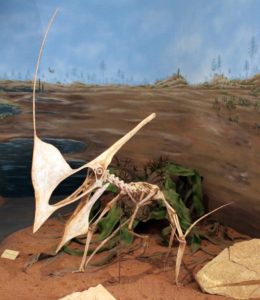
115 million years ago a colony of strange flying animals lived in what is now northeastern Brazil in South America. It was a reptile that lived at the same time as dinosaurs, but it wasn’t a dinosaur. It wasn’t a bird either. Its wingspan might have been as much as 13 feet across, or 4 meters, which was big for a pterosaur, which of course is what it was. Specifically, it’s Tupandactylus imperator [too-pan-DAK-tillus imper-AH-ter], and it is a complete weirdo.

Tupandactylus was only described in 1997, but we have several really well preserved specimens, including nearly complete skulls. And it’s the skull that makes it so bizarre. Many pterosaurs had large crests that were probably brightly colored and probably used to attract mates, but Tupandactylus had what may be the largest crest ever found. It was just ridiculously large, nearly as big as its whole body, not counting its wings, of course.

Tupandactylus’s skull is hard to describe. I’m going to do my best, but you might want to click through to the show notes and look at the picture.

First, imagine a pelican’s bill. It’s long and has a pouch underneath. But in your mental picture, push that pouch forward so that it’s at the base of the lower jaw like a chin, and made of bone instead of soft tissue. Tupandactylus had a sort of keel on the underside of the end of its lower jaw that was probably for display.

Next, the upper jaw is tall but narrow. Maybe it will help to picture a toucan’s bill, but unlike a toucan, Tupandactylus’s upper jaw had a projection at the top that formed the base of the crest. This projection is a big triangular piece of bone that tops the upper jaw, and at the upper point of the triangle there’s a long, thin spur of bone that points upward and bends back. It’s ridiculously long.

Finally, the rear of the skull has another projection that points straight back to form the back of the crest. The tall rod of bone on top of the upper jaw forms the front of the crest. The crest itself was mostly made of soft tissue and keratin stretched between the two bony rods.

To finish our description of the skull, Tupandactylus had no teeth and probably also had a keratin beak at the very tips of its jaws, especially its lower jaw. We don’t know what it ate, but some paleontologists hypothesize it might have mostly eaten fruit and other plant material. It probably spent a lot of time on the ground looking for food and hanging out in its flock, sort of like geese do today.

We have a pretty good idea of what the crest looked like because a few specimens have soft tissue impressions left by the crest when the animal died and fell into mud. The complete crest was like a big sail, although there’s no evidence that it helped the animal fly.

What we don’t know is what color the crest was, but researchers have long assumed it was brightly colored and probably patterned to attract a mate.

In an article published in Nature in April of 2022, a team of paleontologists from Brazil and Belgium announced that they’ve found some amazing details in a newly discovered Tupandactylus skull. Tupandactylus had feathers.

They discovered the feathers at the bottom of the crest, some of them fluffy and some of them longer and more like modern bird feathers. And that’s not all. The feathers are so well preserved that under electron microscopes, the team found preserved melanosomes, which are pigment granules. We still don’t know what colors the feathers were, but they were definitely different colors because the melanosomes are different shapes, and in bird feathers different melanosome shapes correspond to different colors. Simple feather fibers have also been found on the jaws, which suggests that Tupandactylus might have had feathers over much of its body. That means other pterosaurs probably did too.

There are actually two species of Tupandactylus known, T. imperator and T. navigans. T. navigans is smaller and has a smaller, less extravagant crest. Some researchers suggest the two species might actually be the same species, with sexually dimorphic males and females (meaning they look different). Maybe one day we’ll find out for sure.

Thanks for your support, and thanks for listening!