Episode 496 Two Mystery Invertebrates

Further reading:

How did a tiny bee get to French Polynesia? Eight new species help solve a scientific mystery

Secrets in the canopy: Scientists discover 8 striking new bee species in the Pacific

Canopy specialist Hylaeus bees highlight sampling biases and resolve Michener’s mystery

Scientists discover endoparasitic marine tapeworm trapped in Cretaceous amber

Show transcript:

Welcome to the Patreon bonus episode of Strange Animals Podcast for August 2024!

It’s the start of Invertebrate August, so we have two invertebrate mysteries to discuss today, one mostly solved and one not.

Let’s start with the solved mystery, about a tiny bee. In 1934, three tiny bee specimens were collected in French Polynesia, specifically on a particular type of flower in the Tuamotu Archipelago. The bees really were tiny, only 4 mm long. They weren’t described until 1965, when they were placed in the genus Hylaeus. This is a really big genus with over 500 species that live throughout the world, but the species most closely related to the newly described Tuamotu’s masked bee lives in Australia, New Guinea, and New Zealand.

In case you’re kind of hazy on geography, like me, Australia, New Guinea, and New Zealand are part of what’s called Oceania, a giant chunk of the Pacific Ocean where there’s not a whole lot of land. I mean, except for Australia, which is big. The Tuamotu Archipelago is also part of Oceania, and part of French Polynesia, but it’s really remote. It consists of a spread-out collection of 78 low islands, many of them too tiny to support humans, none of them with a source of fresh water except for rain. They’re tropical and quite beautiful, with many unique animals and plants living on and around them. They’re also almost 2,500 miles, or 4,000 km away from the places where the tiny bee’s closest relatives live.

Even in 1965, scientists had questions about the tiny bee. How did 4mm bees get to such remote islands, and were they even still around? The bees hadn’t been seen in the wild since 1934. Since the Tuamotu Archipelago has suffered from European explorers and missionaries bringing invasive species to some islands, colonization by France, and nuclear weapons testing, scientists worried the bee had gone extinct and that they would never solve the mystery of how it got there in the first place.

Bees are attracted to flowers, and the three 1934 specimens were discovered on flowers, so naturally scientists had been looking for the bees on flowers. But it turns out that in the Polynesian islands, bees mostly hang out in the treetops. Once scientists figured this out, they began discovering new species of bee—eight of them in fact, collected between 2014 and 2019 from various islands in Fiji, Micronesia, and French Polynesia.

All eight species are closely related to Tuamotu’s masked bee, so scientists now have a pretty good idea of how it traveled thousands of miles to get to its French Polynesian home. Its ancestors island-hopped. There are more than 1,700 islands in the Pacific Ocean, many of them barely known to humans.

Researchers think there are probably a lot more species of bee to be discovered in the treetops of Pacific islands, now that they know where to look. With luck, they’ll be able to find Tuamotu’s masked bee too, quietly living out its bee life above the scientists’ heads.

Next, let’s discuss our unsolved mystery. Amber, which is fossilized tree resin, is the gift that just keeps on giving to the scientific world, and our mystery involves a flatworm found in amber.

The amber comes from Myanmar and dates to about 99 million years ago. In addition to bits of inorganic matter like tiny pebbles and sand grains, most organisms found in amber from this site are insects and roundworms, animals you’d expect to find on and around trees. The team examining this particular piece of amber found lots of interesting things, but then they discovered this one.

The flatworm is about 10mm long and it’s beautifully preserved, which means the scientists were able to compare it to modern flatworms to see what it might be most closely related to. It’s most similar to a parasitic flatworm found in shark intestines. You know, an animal not typically found in trees. (I stole that joke from paleontologist Kenneth De Baets, by the way. Credit where credit’s due.) It isn’t a complete worm but a partial one, basically a tentacle with little hooks to keep it in place in the host animal’s digestive system.

The modern worm is classified as a type of tapeworm, and tapeworms are distressingly common parasites. If you’ve ever adopted a rescue cat or dog, you’ve probably had to have it treated for a tapeworm infestation. Luckily, tapeworms are also very specific about which species they parasitize, so you can’t get tapeworms from a pet. (It’s still icky.) Fish get tapeworms too, after eating marine invertebrates carrying various kinds of tapeworm larvae.

The question is, how did a parasitic worm found in fish end up in amber? Occasionally there is rare amber found that fell into water and trapped water organisms, but this particular amber wasn’t associated with water. Other items found in the same piece of amber included sand grains, tiny hairlike structures found on some ferns, and the nymph of a scale insect. The team suggests that the tree where the amber came from grew near a beach and that a dead shark washed ashore. While scavengers were picking through the carcass, a piece of worm somehow got separated from the body and ended up in a tree. Possibly a scavenger grabbed a big yummy mouthful of rotting shark guts and either climbed or flew up into a tree to eat it, and part of the worm fell out and landed in a blob of amber.

Because tapeworms are endoparasites, meaning they live inside their hosts, and because they’re soft-bodied and fragile, it’s very rare that one is preserved. Pretty much the only other preserved tapeworm specimen we have isn’t a tapeworm itself but some eggs found in fossilized shark dung, dated to 270 million year ago. Scientists aren’t even completely sure the eggs are from a flatworm since they’re not that well preserved. So it’s fantastic that this particular specimen was so well preserved, and that it made its way into the hands of scientists!

Thanks for your support, and thanks for listening!
Episode 046: The Other Loch Ness Monsters

There’s more in Loch Ness than one big mystery animal. This week we look at a few smaller mystery animals lurking in the cold depths of the lake.

Further reading:

Here’s Nessie: A Monstrous Compendium from Loch Ness by Karl P.N. Shuker

The goliath frog:

The Wels catfish (also, River Monsters is the best):

An amphipod:

Show transcript:

Welcome to Strange Animals Podcast. I’m your host, Kate Shaw.

Back in episode 29, I dismissed Nessie, the Loch Ness monster, as probably not a real animal. But this week we’re heading back to Loch Ness to see what other monsters might lurk in its murky depths.

WHAAAAA? Other Loch Ness monsters???

Yes, really! See, ever since the first sightings of Nessie in the 1930s, Loch Ness has been studied and examined so closely that it would be more surprising if no one had ever spotted other mystery animals.

The source of most of the information in this episode is from zoologist Karl Shuker’s book Here’s Nessie! A Monstrous Compendium from Loch Ness. Check the show notes for a link if you’re interested in buying your own copy of the book.

Our first non-Nessie mystery dates from 1934, but it happened, supposedly, sometime in the 1880s. It appeared in the Northern Chronicle, an Inverness newspaper, on January 31, 1934. The article relates that a ship in Loch Ness hit a submerged reef called Johnnie’s Point and sank one night. Luckily no one died. The next day a local diving expert named Duncan Macdonald was hired to determine if the wreck could be raised, but he couldn’t spot the wreck during his dive.

Later that evening, some of the ship’s crew who had heard stories about strange creatures living in Loch Ness asked Macdonald whether he’d seen anything unusual. After some urging, Macdonald finally admitted that he had seen a frog-like creature the size of a good-sized goat sitting on a rock ledge some 30 feet, or 9 meters, underwater. It didn’t bother him so he didn’t bother it.

There are a lot of problems with this account, of course. For one thing, we don’t know who wrote it—the article has no byline. It’s also a secondhand account. In fact, the article ends with this line: quote “The story, exactly as given, was told by Mr Donald Fraser, lock-keeper, Fort Augustus, who often heard the diver (his own grand-uncle) tell it many years ago.” unquote

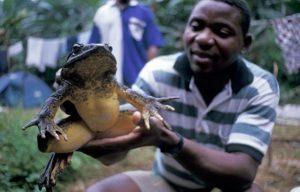
Plus, of course, frogs don’t grow as big as goats. The biggest frog is the goliath frog, which can grow over a foot, or 32 cm, in length nose to tail, or butt I guess since frogs don’t have tails, which is pretty darn big but not anywhere near as big as a goat. The goliath frog also only lives in fast-moving rivers in a few small parts of Africa, not cold, murky lakes in Scotland, and its tadpoles only feed one one type of plant. In other words, even if someone did release a goliath frog into Loch Ness in the 1880s—which is pretty farfetched—it wouldn’t have survived for long.

The biggest frog that ever lived, as far as we know, lived about 65 million years ago and wasn’t all that much bigger than the goliath frog, only 16 inches long, or 41 cm. It had little horns above its eyes, which gives it its name, devil frog. Its descendants, South American horned frogs, also have little horns but are much smaller.

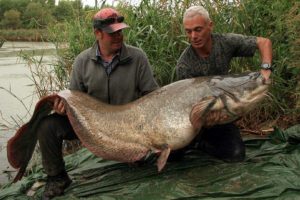
So what might Mr. Macdonald have seen, assuming he didn’t just make it all up? Some species of catfish can grow really big, but catfish aren’t native to Scotland. It’s always possible that a few Wels catfish, native to parts of Europe, were introduced into Loch Ness as a sport fish but didn’t survive long enough to establish a breeding population in the cold waters. Catfish have wide mouths, although their eyes are small, and might be mistaken for a frog if seen head-on in poor light. Plus, the Wels catfish can grow to 16 feet long, or 5 meters.

Then again, since the article was published during the height of the first Loch Ness monster frenzy, it might all have been fabricated from beginning to end.

A 1972 search for Nessie by the same team that announced that famous underwater photograph of a flipper, which later turned out to be mostly painted on, filmed something in the loch that wasn’t just paint. They were small, pale blobs on the grainy film. The team called them bumblebees from their shape.

Then in July of 1981, a different company searching not for Nessie but for a shipwreck from 1952 filmed some strange white creatures at the bottom of the loch. One of the searchers described them as giant white tadpoles, two or three inches long, or about 5 to 7 cm. Another searcher described them as resembling white mice but moving jerkily.

The search for the wreck lasted three weeks and the white mystery animals were spotted more than once, but not frequently. Afterwards, the company sent video of them to Dr. P Humphrey Greenwood, an ichthyologist at the Natural History Museum in London. Since this was the 1980s, of course, the film was videotape, not digital, but Dr. Greenwood got some of the frames computer enhanced. Probably on a computer that had less actual computing power than my phone. Anyway, the enhancement showed that the animals seemed to have three pairs of limbs. Dr. Greenwood tentatively identified them as bottom-dwelling crustaceans, but not ones native to Loch Ness.

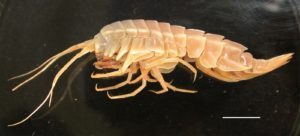
Over the years many people have made suggestions as to what these mystery crustaceans might be. I’m going out on a limb here and declaring that they are not baby Loch Ness monsters. Karl Shuker suggests the white mice footage, at least, might be some kind of amphipod.

We’ve met amphipods before in a couple of episodes, mostly because some species exhibit deep-sea gigantism. Amphipods are shrimp-like crustaceans that live throughout the world in both the ocean and fresh water, and most species are quite small. While they do have more than three pairs of legs—eight pairs, in fact, plus two pairs of antennae—the 1981 videotape wasn’t of high quality and details might easily have been lost. Some of the almost 10,000 known species of amphipod are white or pale in color and grow to the right size to be the ones filmed in Loch Ness. But no amphipods of that description have ever been caught in Loch Ness.

New amphipods are discovered all the time, of course. They’re simply everywhere, and the smallest species are only a millimeter long. But because they’re so common, it’s also easy to transport them from one body of water to another. A rare amphipod discovered in Alpine lakes only a few years ago is already threatened by a different, more common species of amphipod introduced to one of the lakes by accident. So it’s possible that the white mice crustaceans in Loch Ness traveled there on someone’s boat.

That’s certainly the case with another creature found in Loch Ness in 1981, but we know exactly what this one is. It’s a flatworm native to North America, a bit over an inch long, or 3 cm, and only about 5 millimeters wide. It attaches its cocoons to boat bottoms, and in this case it was brought to Loch Ness by equipment used to hunt for Nessie. Spoiler alert: they didn’t find her.

You can find Strange Animals Podcast online at strangeanimalspodcast.com. We’re on Twitter at strangebeasties and have a facebook page at facebook.com/strangeanimalspodcast. If you have questions, comments, or suggestions for future episodes, email us at strangeanimalspodcast@gmail.com. If you like the podcast and want to help us out, leave us a rating and review on Apple Podcasts or whatever platform you listen on. We also have a Patreon if you’d like to support us that way.

Thanks for listening!