Podcast: Play in new window | Download (Duration: 9:46 — 11.0MB)
Further reading:
https://sharonahill.substack.com/
https://metazoan.net/54-octlantis/
https://metazoan.net/109-octopolis-and-octlantis/
Scientists discover an underwater city full of gloomy octopuses
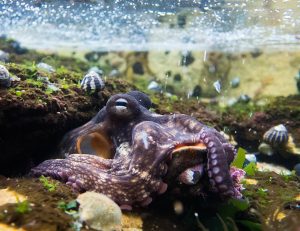
The gloomy octopus [photo by Niki Hubbard – https://www.inaturalist.org/photos/118664956, CC BY 4.0, https://commons.wikimedia.org/w/index.php?curid=123044473]:
Show transcript:
Welcome to Strange Animals Podcast. I’m your host, Kate Shaw.
As I’ve mentioned before, I really don’t like April Fools Day, which is April first. I especially don’t like it when someone makes an April fools day post online and just leaves it there afterwards. It’s too easy for other people to stumble across it and think it’s real. This goes double for strange animal and cryptid reports.
I subscribe to geologist Sharon Hill’s Pop Goes the Cryptid articles, and on March 31 she talked about a hoax called the North American Pine Squid. It got popular around Halloween of 2024. It’s said to be a black squid or octopus that lives in pine trees in remote, heavily forested places like the Pacific northwest and the Appalachian mountains. Most of the time it eats small animals like birds and squirrels, along with pine cones, but if someone walks underneath its tree, the pine squid grabs the person, pulls them up into the tree, and they’re never seen again.
But you don’t have to worry, because the pine squid isn’t a real animal. It’s also not even a new story. It’s based on another hoax called the Pacific Northwest tree octopus, which dates back to 1998. In the case of the tree octopus, it wasn’t created as a hoax or an April fool’s joke but as a study about whether children can tell if a website is reliable or not. The researchers made a page with information about a type of octopus that lived in the ocean but that also climbed trees. Then they asked several classrooms of children around age 11, from different schools in different countries, to read the page, look at the pictures provided, and answer some questions.
The study found that most of the children thought the page contained reliable information. Only a few figured out that the tree octopus wasn’t real. The study has been used repeatedly to argue that children need more lessons in how to evaluate a website to know if it contains reliable information, and of course that’s always a good thing. But it makes me a little angry too, because how were the kids supposed to know that octopuses can’t climb trees? There are so many amazing and strange animals out there, a tree octopus sounds perfectly normal if you don’t know very much about octopuses. So I argue that kids should be taught about everything, and taught in as interesting a way as possible so that they remember it better. The same goes for adults.
But this episode isn’t actually about April fools day, tree octopuses, or pine squids. It is about a type of octopus, and what I’m going to tell you is so weird that I have to reassure you that it’s actually true. It’s not a hoax or an April fools joke or anything like that. It’s about the gloomy octopus and the underwater cities some populations have created, referred to as Octopolis and Octlantis. I swear I’m not making this up!
The gloomy octopus lives off the eastern coast of Australia and the northern coast of New Zealand. It’s mainly brown and gray, but it has orange on the undersides of its arms, and it’s covered in little bumps that help camouflage it. Its eyes are white. On average, it has an armspan of about 6 ½ feet, or 2 meters, with females generally larger than males. Like many other octopuses, when the female lays her eggs, she stops eating completely and protects the eggs until they hatch. After they hatch, she dies.
The gloomy octopus lives in shallow warm water and especially likes places with lots of rocks, seagrass, reefs, and other places where it can hide. It spends a lot of time in a den it digs into the sea floor, only coming out at night to hunt. It especially likes scallops, but it will eat pretty much anything it can catch, including sea snails, crabs, seahorses, and even other gloomy octopuses. It usually brings its food back to its den to eat.
The gloomy octopus was thought to be a solitary animal until 2009. That’s when a biologist named Matt Lawrence was exploring Jervis Bay in New South Wales. In this particular part of the bay, the sand is silty and there are a lot of predators, so it’s not great for the gloomy octopus. But not only did Lawrence find a gloomy octopus there, he found 16 of them living in close proximity.
The octopuses’ dens were very close to each other, surrounding a human-made object that’s so encrusted with sea life that it can’t be identified. Scientists think it was a piece that fell off a boat at some point. Even more interesting, there are so many shells around, especially scallop shells, that instead of making dens in the sand, the octopuses are basically making dens in huge piles of scallop shells. The octopuses spend time moving the shells to improve their dens.
In other words, Lawrence had found an octopus city. Admittedly, it’s a very small city by human standards, with only 16 residents identified at any given time, but for a supposedly solitary animal, that’s pretty amazing.
The site was nicknamed Octopolis, and scientists think the presence of the piece of boat actually started the site. When it fell into the sand, it provided a great place for a gloomy octopus to hide. Since gloomy octopuses bring mollusks back to the den to eat, naturally they discard the shells near their dens. Once enough discarded shells had piled up, it provided better building material for another den. Another octopus moved in as the first one’s neighbor, which meant twice as many shells being discarded. Pretty soon another octopus joined the first ones, and eventually there were 16 separate dens in a little community.
Then, in 2017, another octopus city was discovered not far from Octopolis. Instead of a human-made object at its center, it has a few rocks sticking up in the middle of the city, which has been nicknamed Octlantis.
Observations of the octopuses living in these communities are surprising. The octopuses come out during the day even though ordinarily the gloomy octopus is most active at night, especially around dawn and dusk. They interact with each other in various ways, sometimes fighting, sometimes pairing off to mate, sometimes sneaking into another octopus’s den and trying to take it over. It might not be full of underwater skyscrapers and underwater scallop vendors on busy corners, but there’s a lot of hustle and bustle in these cities.
When biologists revisited Octopolis in 2023, they only found three octopuses. Octlantis had a little more activity and a few more octopuses, but nothing like its busy 2017 numbers. But this doesn’t mean that the cities are deserted. Low Octopolis populations were also discovered in 2010 and 2013, but a high population in between. The biologists also noted that the presence of sharks caused the octopuses to move, and in 2023 a shark was hanging around Octopolis.
Another reason for the changing population sizes at the sites is that gloomy octopuses don’t live very long. A three-year-old gloomy octopus is really old, since most die before they reach their first birthday. The octopuses spotted in Octopolis and Octlantis in 2023 might be as much as 14 generations removed from the ones seen in 2009. Young octopuses have to continually repopulate the cities as the older ones die off, and that might take longer some years than others.
Just because we know about Octopolis and Octlantis doesn’t mean those are the only two octopus cities in existence. There are probably a lot more. Scientists just haven’t noticed them yet. In years where sharks are spending too much time in Octopolis, the octopuses might just move to a city we don’t know about. Octopolis and Octlantis might even be really small in comparison to some cities. If you’re a diver around Australia or New Zealand, keep a sharp eye out for an octopus city. You might be the first human to visit New Octleans.
Thanks for your support, and thanks for listening!