Episode 502: Back to the Ocean

Show transcript:

Welcome to Strange Animals Podcast. I’m your host, Kate Shaw.

Life arose in the oceans and only much later spread to the land. But some land animals returned to the ocean and eventually became fully marine animals. That’s our topic this month, animals that returned to the sea.

Vertebrates that evolved on land are called tetrapods, meaning four-footed. It applies even to animals like birds that have two legs and two wings, and snakes that have no legs, because all the ancestors of tetrapods had four legs.

Returning to marine life as a tetrapod eventually results in an animal developing certain characteristics. Even animals like sea turtles become more streamlined, which helps the animal swim more easily, and arms and legs develop into flippers for the same reason. Sometimes limbs are lost completely, like the rear legs of cetaceans and sirenians, because they’re not needed. One interesting note is that as far as we know, all marine tetrapods still have to breathe air, which requires them to come to the surface of the water periodically.

The ancestors of marine tetrapods probably all started out as partially aquatic and gradually became more and more at home in the water. That’s true even for animals as well adapted to marine life as whales.

Some of the earliest whale ancestors were the ambulocetids, which probably looked sort of like a cross between a hippopotamus and a crocodile. Ambulocetid means “walking whale,” but there’s some evidence that it might have already evolved to be fully aquatic 49 million years ago. It had short legs that might not have been strong enough to support it out of water. It might have been covered with short fur like a seal but it might have had little to no fur, more like a hippopotamus. Either way, it had long toothy jaws, strong legs with webbed toes that it used to propel itself through the water, and a tail that probably resembled that of an otter. It grew about ten feet long, or 3 meters.

Ambulocetids lived in shallow coastal areas where the land was swampy, and it may have spent part of its time in fresh water. It wouldn’t have looked or acted much like a whale to us, but it was already developing features now found only in whales.

By around 41 million years ago, the basilosaurids and their close relations had evolved, and were definitely fully aquatic. Their nostrils had moved almost to the location of modern whales’ blowholes. Their forelegs were basically flippers with little fingers, their hind legs had almost disappeared, and they had tail flukes. They were also much bigger than their ancestors. Basilosaurus could grow up to 60 feet long, or 18 meters, and probably looked more like a gigantic eel than a modern whale. It was long and relatively thin, and may have mostly lived at the ocean’s surface instead of diving for food.

Dakosaurus wasn’t a dinosaur despite its name, although it lived at the same time as the dinosaurs, about 145 million years ago. It was a crocodylomorph that grew up to about 16 feet long, or 5 meters, and looked kind of like a shark with legs—but also a lot like a crocodile wearing a shark costume. Its tail had a fin near the end that made it resemble a shark’s tail, and its legs were flipper-like but still obviously legs. It had a whole lot of big serrated teeth in a deep skull with strong jaws. Because its jaws and teeth were so strong, in fact, scientists think Dakosaurus probably ate other marine reptiles instead of just fish.

While Dakosaurus was streamlined and well adapted to life in the ocean, we don’t know if it left the water to lay its eggs on land the way sea turtles still do or if it gave birth in the water. We don’t have any nest sites or young specimens one way or another.

Other marine reptiles definitely gave birth in the water, including ichthyosaurs. Ichthyosaurs and their close relations were incredibly successful, first appearing in the fossil record around 250 million years ago and last appearing around 90 million years ago. Most ichthyosaurs grew around 6 and a half to 11 feet long, or 2 to 3.3 meters, depending on species, so while they were pretty big animals, they weren’t enormous. They would have been fast, though, and looked a lot like fish or dolphins, with four flippers, a dorsal fin, a long tail with fins, and a long thin rostrum with lots of little teeth. We know they gave birth to live young because we have fossils of female ichthyosaurs who died in the process of giving birth, with the baby’s tail outside of its mother but the rest of it still in the birth canal. We have other fossils of ichthyosaurs with partially developed young in what would have been the mother’s uterus.

We also have lots of ichthyosaur coprolites that show us what it ate, since the coprolites fossilized with pieces of undigested food in them. This includes fish scales and squid beaks.

Of course, if you want to talk about big marine reptiles, you have to talk about mosasaurs. They lived in the late Cretaceous and went extinct at the same time as the non-avian dinosaurs. The earlier species of mosasaur are pretty small, but after ichthyosaurs went extinct, mosasaurs got really really big. Some estimates for the largest species range up to almost 50 feet long, or 15 meters, and maybe even longer. Mosasaurs looked kind of like streamlined iguanas, with four flippers, a shark-like tail, but a very lizard-like head. They probably ate other marine reptiles, including smaller species of mosasaur, along with sharks and other fish, dinosaurs that made the mistake of getting in the water, and sea turtles. Honestly, mosasaurs could eat whatever they could catch, and they could probably catch just about anything. Their jaws were double-hinged, which allowed them to swallow prey whole like snakes do.

We even have some skin impressions of mosasaurs that show smooth scales similar to those of snakes, and one study suggests that mosasaurs might have had forked tongues too. Mosasaurs were distantly related to snakes, but they were more closely related to monitor lizards that also have forked tongues.

Speaking of snakes, we’ll finish with an animal that people don’t usually remember when they think of animals that have returned to the ocean: sea snakes.

Not all sea snakes are fully marine. One genus spends part of its time on land and still lays eggs, but fully marine sea snakes give birth to live young. Researchers aren’t sure if the sea snakes that are fully marine were able to completely stop returning to the land because they already gave birth to live young or if that developed after the snakes started spending part of the time in the water.

The sea snake has a single lung, like most snakes, but unlike snakes that live on land this lung extends almost the length of the whole body (but not the tail). The snake’s nostrils are at the top of its snout so it can breathe without sticking too much of its head above water, and its extra-long lung can store lots of air so the snake doesn’t have to breathe too often. Some sea snakes can stay underwater for up to about two hours, partly because of the air stored in the lung, but also because they can absorb some oxygen from the water through their skin. Studies have shown that a sea snake can absorb almost 25% of the oxygen it needs through its skin.

Sea snakes are pretty big, with the largest growing up to 10 feet long, or 3 meters. Most are about half that length. They live in warm tropical oceans, usually in shallow water, and eat fish and other small animals. The sea snake’s body is slightly flattened side to side and its tail is much more flattened like a paddle, which is how it swims. In most cases, if a sea snake is washed ashore, it’s unable to crawl and is pretty much helpless. Terrestrial snakes have enlarged ventral scales that the snake can move up and down, allowing the edges of the scales to grab dirt or leaves or whatever the snake is moving over. This gives it a purchase, and as the scales move they push the body forward. Most sea snakes don’t have these specialized ventral scales and have regular smooth scales instead.

But while most sea snakes can’t move on land, if you see one stranded, don’t try to pick it up to help it. All sea snakes are extremely venomous. (Use a long paddle to push the sea snake back into the water, or better yet, call an expert who can safely return the snake to the water.) Most sea snakes are brightly colored as a result, to warn potential predators away. Many have stripes and are absolutely gorgeous.

Generally, if you encounter a sea snake while you’re swimming, the snake isn’t going to bite you. You’re too big for it to swallow and it doesn’t want to waste its venom on you. Don’t bother it and it won’t bother you unless it feels threatened. Just swim calmly away and be glad it’s not a mosasaur.

Thanks for your support, and thanks for listening!
Episode 056: Strange Snakes

This week we’re going to learn about some strange snakes. Snakes in the air! Snakes in the water! Snakes on a pla–NO I am not going there

Thanks to sirfinnhayes and Mackin for the topic suggestions! Mackin is host of the podcast Species, which you should listen to.

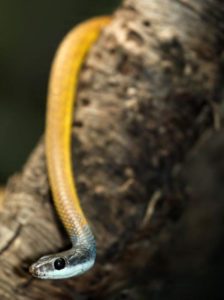
A golden tree snake:

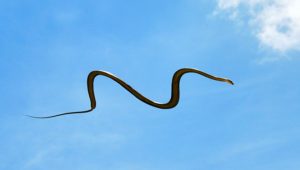
A snake flying, or rather gliding with style:

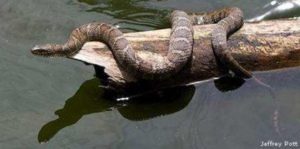
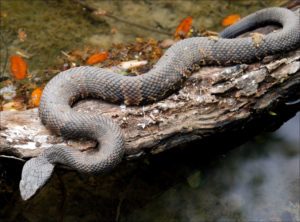
Northern water snake (left) and water moccasin (right). Note the head and neck differences:

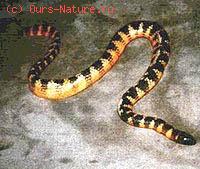
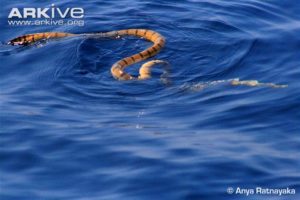
The yellow sea snake (Hydrophis spiralis):

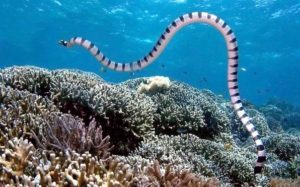
Belcher’s sea snake. Have I mentioned how much I love stripey animals? I do love them, I do:

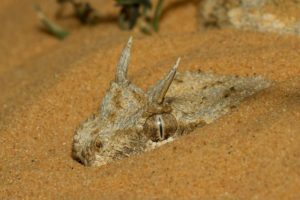
Horned viper. Do not step:

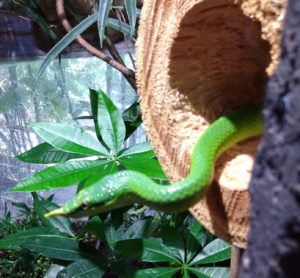
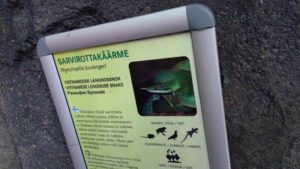
The Vietnamese longnosed snake. I TOOK THESE PHOTOS MYSELF AT HELSINKI ZOO!

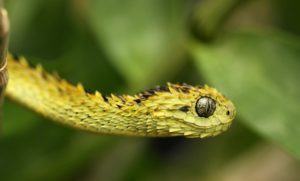
The spiny bush viper. I’m sorry, all other snakes, this one is now my favorite:

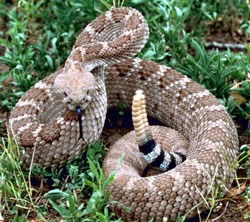
A rattlesnake showing off its rattle:

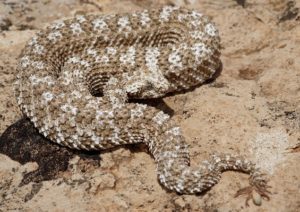
The spider-tailed horned viper:

LOOKIT THAT SPIDER TAIL:

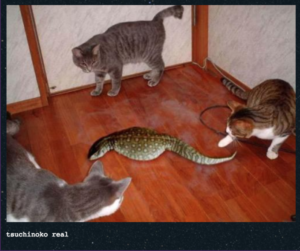
Tsuchinoko real:

Okay that is just way too many pictures.

Show Transcript:

Welcome to Strange Animals Podcast. I’m your host, Kate Shaw.

This week we’re going to find out about some strange snakes. This is a request from two different people, sirfinnhayes and Macken of the podcast Species. Sirfinnhayes is also the person who corrected my incomplete information on the definition of a subspecies, so thank you! Podbean still won’t let me reply to comments, but at least I can see who sent them now. If you don’t already listen to the Species podcast, I highly recommend it. It’s new, family friendly, and really interesting. The first episode of Species I listened to was about flying snakes, and I was already wondering if I could sneak in an episode of my own about flying snakes or if that would be really obvious and not cool, when the host, Macken, contacted me and said I ought to do an episode on flying snakes. Now I don’t have to feel guilty for copying!

So let’s start with flying snakes. You may be picturing Quetzalcoatl, the feathered snake god of the Aztecs. But flesh and blood flying snakes, as opposed to divine ones, don’t have wings or feathers. The god did lend his name to one of the biggest flying reptiles ever known, by the way, and even though Quetzalcoatlus isn’t a snake, I have to tell you about it. It was a type of pterosaur that lived around 68 million years ago, and its wingspan was almost 40 feet, or 12 meters. It could probably fly extremely fast and far, but spent most of its time hunting small dinosaurs and other animals on land like a monster stork.

We’re not three minutes into this episode and I’m already off topic. Back to flying snakes.

Flying snakes don’t really fly, they glide, but they’re very good at it. There are five species of flying snake, all from India and the Indonesian archipelago. The longest is the golden tree snake that can grow four feet long, or a little over 1.2 meters. All flying snakes are venomous, but their venom is weak and not dangerous to humans. Besides, you’re not likely to encounter a flying snake since they spend most of their time far up in the rainforest tree canopy chasing small animals.

So how does such a slender snake glide? When a flying snake drops off a branch to glide to another, it flattens its body, actually pushing its ribs apart to make a broader surface to catch the air. As Macken describes it, when gliding, its body somewhat resembles the shape of a long, thin Frisbee. It wriggles as it glides, pointing its head in the direction it wants to go. It can even change direction midair if necessary.

If some snakes can fly, surely some snakes can swim, right? Definitely! Water snakes are actually pretty common. When I was a kid, everyone panicked whenever they saw a snake in the lake or a creek where we were always playing. We thought all water snakes were venomous water moccasins, but as I found out much later, water moccasins don’t even live in East Tennessee. Most freshwater snakes are harmless, but people kill them anyway out of fear.

The Northern water snake is common throughout much of eastern and central North America, for instance. It can grow more than four feet long, or about 135 cm, and varies in color from brown or reddish to gray or black. Sometimes it has a darker pattern, banding or splotches, and its belly is usually lighter in color. It resembles a water moccasin in many ways but it’s completely harmless to humans unless cornered, in which case it can give a bad bite but not a venomous one. It will also poop all over you if you try to pick it up. It eats small fish, frogs, leeches, crawdads, salamanders, and other small animals.

The easiest way to tell a Northern water snake from a water moccasin is the head and neck. A water moccasin hasd a broad, roughly arrow-shaped head with a much thinner neck just behind it. A Northern water snake has a head that’s barely wider than its neck.

The water moccasin is a type of pit viper, the only species of pit viper that spends time in the water, in fact. It lives in the American South and can grow as long as six feet, or 180 cm, although most are much shorter. It’s a bulky snake with a broad, blunt head, and in color and markings it usually resembles the Northern water snake. When it feels threatened, it will raise its head and gape its jaws wide, showing the white tissue inside its mouth as a warning. Keep in mind that like all snakes, it really doesn’t want to bite you. It needs to save its venom for the frogs, birds, rats and mice, and other snakes it eats. It just wants you to go away and not scare it.

Young water moccasins have a yellowish or greenish tail tip. The snake will lie perfectly still in shallow water, twitching its tail. When a frog or lizard or some other animal comes to investigate that worm moving around in the water, the snake strikes.

Freshwater snakes spend at least part of their time on land every day. Sea snakes are another thing. Some species of sea snake can’t even move on land. If they’re washed up, they’re as helpless as a fish. And they’re almost all venomous.

All species of true sea snakes have a tail that’s flattened at the end like a paddle to help it swim better, and its nostrils are on the top of its snout so it can breathe without raising its head out of the water. When it’s underwater, the nostrils close automatically. It has to breathe air, but its left lung is enormously large, almost the full length of its body, which allows it to stay underwater for over an hour at a time. It also has a special gland under the tongue that filters extra salt from its blood, and every time the snake flicks its tongue, it releases some of the salt back into the ocean. In fact, sea snakes in general are so well adapted to living in the ocean for a formerly terrestrial animal that only whales are better adapted.

As an example, let’s learn about the yellow sea snake, because it can grow nine feet long, or 2.75 meters, the longest of all the sea snakes. It lives in shallow, warm water in the Indian Ocean and is yellow or yellow-green in color with narrow black bands all down its body. It’s really pretty. It gives birth to live babies who are fully developed and able to swim as soon as they’re born. Young snakes have a black head with a U-shaped yellow marking.

The yellow sea snake eats fish and eels that live among coral reefs and sea grasses. Its venom is fast-acting and not only kills its prey, it starts breaking down the prey’s tissues so that the snake can digest it faster. Occasionally a diver or fisher gets bitten, but most of the time the snake doesn’t inject venom when it bites a human.

The faint-banded sea snake, also called Belcher’s sea snake, also rarely injects venom into humans, and rarely bites humans at all. It even has the reputation as being kind of a friendly snake. At one time its venom was thought to be the most potent of any snake’s, but that honor actually belongs to three different snakes. The reef shallows sea snake is one. The others are the inland taipan, which is a land snake that lives in Australia, and the Eastern brown snake, which also lives in Australia as well as in southern New Guinea. Pretty much if you’re in Australia, don’t bother any snakes if you can possibly help it. Not that you need me to tell you that.

A lot of snakes have interesting facial decorations. The horned viper has a pointed horn over each eye that sticks almost straight up. It’s not really a horn, of course, but a modified scale. It lives in the desert in parts of the Middle East and northern Africa, is roughly the color of sand, and grows not quite three feet max, or 85 cm. Other snakes have nose horns, including the nose-horned viper, the rhinoceros viper, and many others. No one’s sure why some snakes have these decorations, but the best hypothesis is that they’re for display. In some species only the males have decorations, or the decorations are larger than in females; but in other species, females have larger or more decorations. One thing we do know, the horns are not used for fighting other snakes. They look sharp, but they’re actually relatively soft and flexible.

The spiny bush viper goes the extra step and has pointy spines all over its body that make it look bristly. It lives in central Africa and eats frogs, lizards, and small mammals. It’s not a big snake, not much more than two feet long, or around 60 cm, although males are usually a few inches longer than females. It’s typically yellowish in color with large dark eyes and black markings. It mostly stays in the trees and sometimes suns itself on top of big flowers, which is THE best thing I have heard all week.

The rattlesnake lives throughout North and South America, and just like in the cartoons, it has a rattle at the tip of its tail that it shakes to scare away potential predators. The rattle is made of keratin. Each segment of the rattle is hollow and vibrates against the rattles above and below it when the snake vibrates its tail. A rattlesnake has special muscles in the tail used just for this, and the muscles are incredibly fast. A snake can vibrate its tail as much as 50 times per second. Baby rattlesnakes only have a little button at the tip of their tail, but each time the snake sheds its skin, it grows a new segment of its rattle.

This is what a rattlesnake’s tail vibration sounds like.

[rattlesnake sound]

Both the Eastern and Western diamondback rattlesnakes can grow about eight feet long, or almost 2.5 meters. Other rattlesnake species are smaller.

The rattlesnake isn’t the only snake species with an interesting tail. The spider-tailed horned viper not only has horns above its eyes, the tip of its tail actually resembles a spider. Those of you who were already not real happy about a snake episode probably just threw your phone down in horror right about now. Sorry about that. The very tip of the snake’s tail ends in a little bulb like a spider’s round body, and the scales in front of it are elongated like a spider’s legs. It’s not just coincidence, either. The spider-tailed horned viper eats birds that eat spiders. Like a young water moccasin twitching its tail-tip like a worm, the spider-tailed horned viper twitches its tail around like a spider. When a bird comes close to grab the spider, chomp!

The spider-tailed horned viper, and I legit will never get tired of saying that, was discovered in 1968 but only recognized as a new species in 2006. It lives in western Iran but we don’t know a whole lot about it yet.

If people in the area had told stories about a snake with a tail that looked like a spider, probably no one would have believed it, but there it is. So what about actual mystery snakes?

In Croatia there are stories of a snake called the poskok, which is gray to reddish-brown in color, two or three feet long, or 60 to 90 cm, slender, aggressive, and venomous. But its real claim to fame is its ability to jump farther and higher than it is long.

Snakes can jump by making a striking motion and lunging forward, but while some snakes may actually leave the ground that way, notably the jumping viper, a small snake from Central America, no snake can jump very high.

If you search online for the poskok, you’ll get a lot of hits about the nose-horned viper. It spends at least part of the time in trees and shrubs hunting birds. If someone saw a nose-horned viper leaping after a bird, they might think it had jumped from the ground instead of a branch. But the poskok isn’t described as having a horn on its nose. Another suggestion for the poskok’s identity is one of various species of whip snake, which are slender, aggressive snakes that can move very fast, although they’re not venomous.

The tsuchinoko of Japan is supposed to be a short but wide-bodied snake with horns above its eyes, a broad head with sensory pits, and a thinner neck. Its pronounced dorsal ridge makes it seem somewhat triangular in shape instead of rounded like most snakes. It’s also said to be able to jump long distances. Some cryptozoologists suggest it might either be an unknown species of pit viper or a rare mutant individual of a known pit viper species. Stories of tsuchinoko sightings go back centuries, although more recent accounts describe it as a more ordinary-looking snake with a big bulge in its middle as though it has just swallowed something that it hasn’t digested yet. In 2017, a Tumblr post inspired a meme about the tsuchinoko. It’s a picture of three cats staring at a fat lizard with the legs photoshopped out and the caption “tsuchinoko real,” which I’m sure you can agree is meme GOLD.

Many cultures around the world believe some snakes have a magical stone in their heads that can cure poison or heal wounds. There are similar beliefs about toad-stones. In India some people believe some cobras have a glowing brown stone in their hood that heals snake bites, while in Sri Lanka it’s said that rarely, a cobra has a beautiful precious gem inside its belly that it pukes up and hides before it eats, then swallows again later. The ancient Celts believed that an adder-stone neutralized poison. But the adder-stone, it turns out, was just a fossilized sea urchin, while other snake stones were either semi-precious stones like agates with the value jacked up with a tall tale, or gastroliths.

And finally, to wrap things around to where we started, many cultures incorporate flying or winged snakes in various aspects of religion or folklore, but sometimes people report seeing snakes with wings flying overhead. These are probably all misidentifications of known animals since no snake has ever been found, alive or fossilized, with appendages that could be described as wings. Old newspaper accounts of flying snakes are probably all hoaxes. But new species of snake are discovered all the time. You wouldn’t think there’s anything big to be discovered in England, for instance, but a new species of snake was discovered there in 2017. It’s called the barred grass snake, although it actually spends a lot of its time hunting frogs and other amphibians in water. And it’s not small—it grows three feet long, or over a meter. So if a three-foot adder can hide in a country full of naturalists, maybe a snake with wings can hide in plain sight too.

You can find Strange Animals Podcast online at strangeanimalspodcast.com. We’re on Twitter at strangebeasties and have a facebook page at facebook.com/strangeanimalspodcast. If you have questions, comments, or suggestions for future episodes, email us at strangeanimalspodcast@gmail.com. If you like the podcast and want to help us out, leave us a rating and review on Apple Podcasts or whatever platform you listen on. We also have a Patreon if you’d like to support us that way.

Thanks for listening!