Episode 502: Back to the Ocean

Show transcript:

Welcome to Strange Animals Podcast. I’m your host, Kate Shaw.

Life arose in the oceans and only much later spread to the land. But some land animals returned to the ocean and eventually became fully marine animals. That’s our topic this month, animals that returned to the sea.

Vertebrates that evolved on land are called tetrapods, meaning four-footed. It applies even to animals like birds that have two legs and two wings, and snakes that have no legs, because all the ancestors of tetrapods had four legs.

Returning to marine life as a tetrapod eventually results in an animal developing certain characteristics. Even animals like sea turtles become more streamlined, which helps the animal swim more easily, and arms and legs develop into flippers for the same reason. Sometimes limbs are lost completely, like the rear legs of cetaceans and sirenians, because they’re not needed. One interesting note is that as far as we know, all marine tetrapods still have to breathe air, which requires them to come to the surface of the water periodically.

The ancestors of marine tetrapods probably all started out as partially aquatic and gradually became more and more at home in the water. That’s true even for animals as well adapted to marine life as whales.

Some of the earliest whale ancestors were the ambulocetids, which probably looked sort of like a cross between a hippopotamus and a crocodile. Ambulocetid means “walking whale,” but there’s some evidence that it might have already evolved to be fully aquatic 49 million years ago. It had short legs that might not have been strong enough to support it out of water. It might have been covered with short fur like a seal but it might have had little to no fur, more like a hippopotamus. Either way, it had long toothy jaws, strong legs with webbed toes that it used to propel itself through the water, and a tail that probably resembled that of an otter. It grew about ten feet long, or 3 meters.

Ambulocetids lived in shallow coastal areas where the land was swampy, and it may have spent part of its time in fresh water. It wouldn’t have looked or acted much like a whale to us, but it was already developing features now found only in whales.

By around 41 million years ago, the basilosaurids and their close relations had evolved, and were definitely fully aquatic. Their nostrils had moved almost to the location of modern whales’ blowholes. Their forelegs were basically flippers with little fingers, their hind legs had almost disappeared, and they had tail flukes. They were also much bigger than their ancestors. Basilosaurus could grow up to 60 feet long, or 18 meters, and probably looked more like a gigantic eel than a modern whale. It was long and relatively thin, and may have mostly lived at the ocean’s surface instead of diving for food.

Dakosaurus wasn’t a dinosaur despite its name, although it lived at the same time as the dinosaurs, about 145 million years ago. It was a crocodylomorph that grew up to about 16 feet long, or 5 meters, and looked kind of like a shark with legs—but also a lot like a crocodile wearing a shark costume. Its tail had a fin near the end that made it resemble a shark’s tail, and its legs were flipper-like but still obviously legs. It had a whole lot of big serrated teeth in a deep skull with strong jaws. Because its jaws and teeth were so strong, in fact, scientists think Dakosaurus probably ate other marine reptiles instead of just fish.

While Dakosaurus was streamlined and well adapted to life in the ocean, we don’t know if it left the water to lay its eggs on land the way sea turtles still do or if it gave birth in the water. We don’t have any nest sites or young specimens one way or another.

Other marine reptiles definitely gave birth in the water, including ichthyosaurs. Ichthyosaurs and their close relations were incredibly successful, first appearing in the fossil record around 250 million years ago and last appearing around 90 million years ago. Most ichthyosaurs grew around 6 and a half to 11 feet long, or 2 to 3.3 meters, depending on species, so while they were pretty big animals, they weren’t enormous. They would have been fast, though, and looked a lot like fish or dolphins, with four flippers, a dorsal fin, a long tail with fins, and a long thin rostrum with lots of little teeth. We know they gave birth to live young because we have fossils of female ichthyosaurs who died in the process of giving birth, with the baby’s tail outside of its mother but the rest of it still in the birth canal. We have other fossils of ichthyosaurs with partially developed young in what would have been the mother’s uterus.

We also have lots of ichthyosaur coprolites that show us what it ate, since the coprolites fossilized with pieces of undigested food in them. This includes fish scales and squid beaks.

Of course, if you want to talk about big marine reptiles, you have to talk about mosasaurs. They lived in the late Cretaceous and went extinct at the same time as the non-avian dinosaurs. The earlier species of mosasaur are pretty small, but after ichthyosaurs went extinct, mosasaurs got really really big. Some estimates for the largest species range up to almost 50 feet long, or 15 meters, and maybe even longer. Mosasaurs looked kind of like streamlined iguanas, with four flippers, a shark-like tail, but a very lizard-like head. They probably ate other marine reptiles, including smaller species of mosasaur, along with sharks and other fish, dinosaurs that made the mistake of getting in the water, and sea turtles. Honestly, mosasaurs could eat whatever they could catch, and they could probably catch just about anything. Their jaws were double-hinged, which allowed them to swallow prey whole like snakes do.

We even have some skin impressions of mosasaurs that show smooth scales similar to those of snakes, and one study suggests that mosasaurs might have had forked tongues too. Mosasaurs were distantly related to snakes, but they were more closely related to monitor lizards that also have forked tongues.

Speaking of snakes, we’ll finish with an animal that people don’t usually remember when they think of animals that have returned to the ocean: sea snakes.

Not all sea snakes are fully marine. One genus spends part of its time on land and still lays eggs, but fully marine sea snakes give birth to live young. Researchers aren’t sure if the sea snakes that are fully marine were able to completely stop returning to the land because they already gave birth to live young or if that developed after the snakes started spending part of the time in the water.

The sea snake has a single lung, like most snakes, but unlike snakes that live on land this lung extends almost the length of the whole body (but not the tail). The snake’s nostrils are at the top of its snout so it can breathe without sticking too much of its head above water, and its extra-long lung can store lots of air so the snake doesn’t have to breathe too often. Some sea snakes can stay underwater for up to about two hours, partly because of the air stored in the lung, but also because they can absorb some oxygen from the water through their skin. Studies have shown that a sea snake can absorb almost 25% of the oxygen it needs through its skin.

Sea snakes are pretty big, with the largest growing up to 10 feet long, or 3 meters. Most are about half that length. They live in warm tropical oceans, usually in shallow water, and eat fish and other small animals. The sea snake’s body is slightly flattened side to side and its tail is much more flattened like a paddle, which is how it swims. In most cases, if a sea snake is washed ashore, it’s unable to crawl and is pretty much helpless. Terrestrial snakes have enlarged ventral scales that the snake can move up and down, allowing the edges of the scales to grab dirt or leaves or whatever the snake is moving over. This gives it a purchase, and as the scales move they push the body forward. Most sea snakes don’t have these specialized ventral scales and have regular smooth scales instead.

But while most sea snakes can’t move on land, if you see one stranded, don’t try to pick it up to help it. All sea snakes are extremely venomous. (Use a long paddle to push the sea snake back into the water, or better yet, call an expert who can safely return the snake to the water.) Most sea snakes are brightly colored as a result, to warn potential predators away. Many have stripes and are absolutely gorgeous.

Generally, if you encounter a sea snake while you’re swimming, the snake isn’t going to bite you. You’re too big for it to swallow and it doesn’t want to waste its venom on you. Don’t bother it and it won’t bother you unless it feels threatened. Just swim calmly away and be glad it’s not a mosasaur.

Thanks for your support, and thanks for listening!
Episode 092: Marine Reptiles

This week we return to the sea to learn about some marine reptiles, both living and extinct!

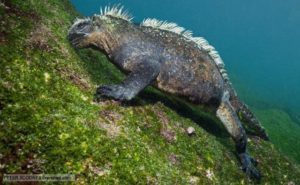
A marine iguana, eatin:

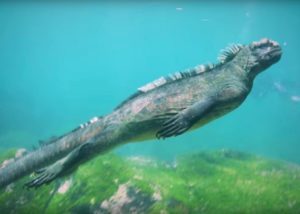
Another marine iguana, swimmin:

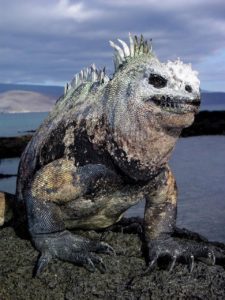
Maybe Darwin was right about the marine iguana looking like imps of darkness:

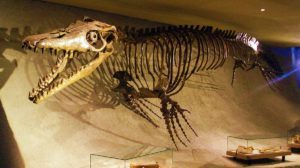
A mosasaurus skeleton:

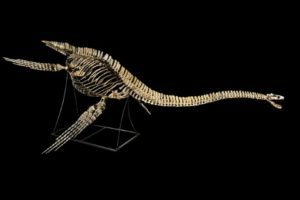
A plesiosaur skeleton:

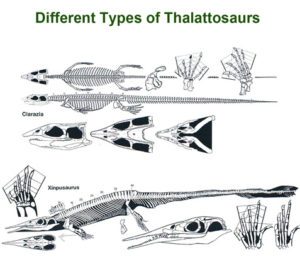
Thalattosaurs:

Show transcript:

Welcome to Strange Animals Podcast. I’m your host, Kate Shaw.

It’s been a while since we had an episode about the ocean, and I thought it would be interesting to learn about reptiles that evolved to live in a marine environment. Some marine reptiles we’ve already covered in previous episodes, including saltwater crocodiles, sea turtles, and sea snakes. But we haven’t talked much about extinct marine reptiles, and I don’t think we’ve ever had an episode about the marine iguana.

The marine iguana is only found on the Galapagos Islands. It eats seaweed and algae that grow in shallow water around the islands, so it swims and dives to find its food. It’s a large, strong iguana that can grow up to five feet long, or 1.5 meters, with short legs, a short snout, and a row of spines along its back. It’s black or gray in color, which absorbs heat from the sun and keeps the iguana warmer. Many have colorful markings, especially males during the breeding season. The markings might be red or pink, blue-green, yellow, or off-white, depending on subspecies. Some researchers think the kinds of algae eaten by the various subspecies of marine iguana also contributes to the colors of their markings. Males are larger than females.

The marine iguana is well adapted to swimming, although it’s not a fast swimmer. It uses its flattened tail and partially webbed toes to propel itself through the water, and the spines on its back keep it stable in the water. It has long claws that it uses to hold onto rocks to keep from being swept away. Newly hatched babies can swim immediately, but they stay out of the water whenever possible until they’re at least a year or two old. The water around the islands is cold, so the marine iguana will forage in the water for a short time, then come back on land to bask in the sun and warm up.

Only the biggest marine iguanas, mostly adult males, will dive for their food. Females and smaller males usually stay in shallow water, especially at low tide when the algae is easier to reach. A marine iguana can dive up to almost 100 feet, or 30 meters, and stay underwater for half an hour. During bad weather, the iguanas stay on shore, often gathered together to conserve body heat.

Researchers used to think the marine iguana evolved from land iguanas that were swept from Central or South America by storms and floated to the Galapagos islands on rafts of vegetation. Then genetic studies showed that the marine iguana started evolving separately from land iguanas around 8 to 10 million years ago. The Galapagos islands are of varying ages, formed by volcanic activity, but the oldest is only about 3.2 million years old. So obviously the two groups of iguana were separated long before the Galapagos formed. Researchers then speculated that there may have been other, older islands in the Galapagos or nearby that are now submerged, which were where the marine iguanas first started to evolve separately from land iguanas. Then new genetic studies indicated that marine and land iguanas actually separated about 4.5 million years ago, which is not that much of a difference from the oldest islands of the Galapagos, so researchers are back to the original hypothesis. As I’ve said before, science isn’t wrong or right, scientists learn new things and adapt their theories to account for the new information.

For instance, at the moment researchers aren’t sure how marine iguanas shrink during years when weather conditions keep them from finding as much food as they need. I don’t mean they lose weight, I mean they actually shrink. Results of a study published in the journal Nature say marine iguanas shrank up to 2.7 inches, or 6.8 cm, during years with El Nino weather patterns, which brings stormy weather. The iguanas’ bones actually shrunk, making them both shorter and smaller. Not only that, after weather patterns returned to normal and the iguanas were able to find more and better food, the shrinking reversed and they grew larger again. Shrinking reduces the iguanas’ dietary requirements, making them able to survive on less food without long-term health issues.

Because the marine iguana eats algae and other plants that grow in the ocean, it ingests a lot of salt. It has a special gland on the nose that filters excess salt from the blood, which the iguana then expels by sneezing. Many times marine iguanas look like they have white markings on the head, but in actuality it’s just dried salt that they’ve sneezed out.

Like most of the animals that live on the Galapagos Islands, the marine iguana is found nowhere else in the world. It would have been easy for early visitors to the islands to have eaten them to extinction the way they did so many other species. But sailors considered marine iguanas so ugly that they refused to eat them. Even Charles Darwin called them disgusting imps of darkness. That’s harsh, especially since I think they’re cute, but it kept them safe until people understood the need for conservation.

Many marine reptiles are extinct, including the ichthyosaurs we talked about in episode 63. These days the top predators in the ocean are sharks and whales, but mosasaurs and plesiosaurs used to fill those ecological niches.

Mosasaurs looked a lot like sharks in some ways, and like whales in other ways, but they were reptiles. There were a lot of them, from one barely more than three feet long, or 1 meter, up to some species that grew some 50 feet long or more, or up to 17 meters.

All species of mosasaur had four flippers, long powerful tails, and small heads with short necks. Its skull resembled a snake’s in that it was flexible, allowing the mosasaur to swallow prey larger than its head. It also had double-hinged jaws that could open extremely wide. It’s also possible that the mosasaur had a forked tongue. We have skin impressions of mosasaurs, so we know at least some species had finely scaled skins like snakes. Some species had fluked tails shaped like a shark’s tail. The mosasaur used its tail to propel itself through the water, with its flippers only helping it maneuver. Some researchers think the closest living relative of the mosasaur is the Komodo dragon and other monitor lizards, but others think the mosasaur was more closely related to snakes.

The mosasaur came to the surface to breathe every so often like other marine reptiles. It also gave birth to live young. It probably swallowed its prey whole, although some species had specialized teeth that allowed them to crush mollusk shells, such as ammonites. Some studies suggest the mosasaur may even have been warm-blooded. It went extinct at the same time as the dinosaurs.

The plesiosaur looks similar to the mosasaur in many ways, including overall shape and size, but was probably more closely related to turtles than to the mosasaur. Most plesiosaurs had a broad body, a very long neck and small head, and a fairly short tail. It propelled itself with its four long flippers like sea turtles do and was probably relatively slow. Some plesiosaurs, known as pliosaurs, had shorter necks and much larger heads, and swam much faster.

Like the mosasaur, the plesiosaur may have been warm-blooded, and gave birth to live babies instead of laying eggs. The longest plesiosaur was called elasmosaur, which had an extremely long neck. Some elasmosaur species had as many as 76 neck vertebrae. This is your reminder that almost all mammals have seven neck vertebrae. While the elasmosaur could grow up to 50 feet long, or 15 meters, much of its length was neck. Researchers used to think plesiosaur necks were flexible like a goose or swan’s neck, but new findings indicate that it was probably fairly stiff and could mostly just move side to side. Skin impressions show slightly wrinkled skin and some species may have had a tail fluke.

Long-necked plesiosaurs had large eyes and probably hunted by sight. Researchers hypothesize that the long neck might have allowed it to sneak up on fish before they could sense the movement of water from the plesiosaur’s approaching body.

At least one elasmosaur was a filter feeder, with interlocking teeth that it used to filter small prey from either the water or sand, or possibly both. It shows many similarities in skull shape to early baleen whales, too. Researchers think it had a valve at the base of the nostrils that closed them while the animal was feeding, since plesiosaurs and some other marine reptiles have nostrils that open into the mouth.

Like mosasaurs, plesiosaurs died out at the same time as the dinosaurs. They did not live on as the Loch Ness Monster, okay?

While mosasaurs and plesiosaurs lived throughout the world’s oceans, the various species of thalattosaur lived around what is now North America, western Europe, and parts of China. They lived during the mid-Triassic period, up to about 250 million years ago, and we don’t know a whole lot about them because we don’t have all that many fossils. We’re not even really sure where they fit in the reptile family tree.

The thalattosaur hunted in warm, shallow water but otherwise probably lived on land. It resembled a lizard, but with some interesting adaptations to the water. It had four short legs, probably had webbed toes, its body was slender and flexible, and its long tail widened at the end to form a paddle. Some species grew up to 13 feet long, or 4 meters. Some species had nostrils near the eyes, some had snouts that point downward, some had snouts that point upward. Some probably ate jellyfish and other soft foods, others probably ate fish, and a few had teeth that could crush mollusk shells—and had teeth on the roof of its mouth.

This actually isn’t unusual in reptiles and some amphibians. Most snakes have a double row of teeth in the upper jaw, one row growing from the jaw like normal, the other row growing from the roof of the mouth. Some lizards have small teeth that grow from the roof of the mouth, as do many frogs. These help the animal grasp its prey and keep it from escaping while it’s being swallowed whole. This is pretty neat, but it’s not as neat as shrinking iguanas. Nothing beats that.

You can find Strange Animals Podcast online at strangeanimalspodcast.com. We’re on Twitter at strangebeasties and have a facebook page at facebook.com/strangeanimalspodcast. If you have questions, comments, or suggestions for future episodes, email us at strangeanimalspodcast@gmail.com. If you like the podcast and want to help us out, leave us a rating and review on Apple Podcasts or whatever platform you listen on. We also have a Patreon if you’d like to support us that way.

Thanks for listening!