Podcast: Play in new window | Download (Duration: 8:58 — 10.1MB)
Further reading:
The “Tresco” Sea Serpent of 1903
Show transcript:
Welcome to Strange Animals Podcast. I’m your host, Kate Shaw.
I have a fun episode for you this month, about the Sea Serpent of the Tresco, a sighting that occurred in 1903.
The Tresco was a merchant marine steam ship, and a detailed account of its encounter with a sea monster was reported by the second officer, Joseph Ostens Grey, who wrote about it for “The Wide World Magazine” soon after it happened. The account appeared in the October 1903 issue.
According to Grey, the ship left Philadelphia, Pennsylvania on May 28, 1903, reached Cuba on June 5, and returned to Philadelphia on June 14. On the return trip the ship was near Cape Hatteras, a barrier island off the coast of North Carolina, when Grey spotted a disturbance in the otherwise calm water. At first he thought it was porpoises playing around, but as they approached the ship, he realized he was watching a large group of sharks traveling together very quickly. He thought they were bottle-nosed sharks, which is an old name for the porbeagle shark.
The porbeagle is a common shark in that part of the Atlantic. It’s silvery-gray and white in color, and grows around 8 feet long, or 2.5 meters. It mainly eats fish and squid, and while Grey was confused as to why the sharks were in a group, it sometimes gathers in groups. It’s a fast-moving, energetic shark that can thermoregulate, which is something we talked about in episode 353, about warm-blooded fish.
Grey estimated there were about 40 sharks in the school, and he described them as “swimming shoulder to shoulder, closely packed together.” They passed out of sight and an hour later he saw something else approaching from the same direction that the sharks had traveled from. At first he thought it was a derelict boat floating low in the water, and in fact was so convinced that’s what it was that he ordered the Tresco to steer for it to check for survivors.
But in the 20 minutes or so that they traveled toward the big black thing in the water, Grey got more and more confused. It looked like the thing wasn’t just drifting on the current, but was actually traveling toward the Tresco. Then, when the ship came close, a big head raised out of the water.
Grey described it as dragon-like, and he stared at it in shock for a few seconds. Then he and the crew member steering the ship hid in the wheel-house, which allowed them to steer away from the monster without it being able to see them.
Grey went over to a porthole to get another look at the monster. The body was motionless but the snake-like tail was out of the water and lashing, while the head was still reared up. Grey estimated it was about 100 feet long, or a bit over 30 meters, and about 8 feet in diameter at the widest, or 2.5 meters. The ship itself was about 300 feet long, or 90 meters or so. The back was humped up toward the neck and sloped down to the tail end, and also sloped down toward the neck. The neck was thick but looked slender compared to the head, which was about 5 feet long, or 1.5 meters.
Grey got a good look at the head. Its mouth was open and he saw a pair of fangs curving backward like walrus tusks. He didn’t see a tongue or nostrils, but did notice a pouch or drooping skin under the jaw and discolored saliva dripping from the corners of the mouth. Its eyes were reddish and set near the top of the head.
Grey also saw scales on the body, looking like big rough plates like an alligator’s hide, not like fish scales. The body looked bronze in color but oddly enough, it appeared darker underneath, more of a green color as far as he could see. It also had pectoral fins.
But as he watched, a dorsal fin raised along its back and a webbed crest raised on the head. He estimated the head crest was about a foot high, or 30 cm, at the front where it was tallest, which was a point with a webbing of skin stretched taut behind it.
As the ship passed by, the monster suddenly turned as though pivoting, its long tail trailing behind, and lowered its head. Grey had been terrified that the monster would attack the ship, and now that the danger seemed to be past, he remembered he needed to alert the ship’s captain. He rushed out to the state-room and burst in, where the captain was lying down to take a nap. Grey brought him on deck where the sailors had gathered to watch the monster as it swam away.
At this point the monster’s head seemed to be resting on its back or shoulders, and Grey thought it had folded its neck like a resting swan. By the time it was a quarter mile away it looked more or less like a derelict boat again. The captain was astonished, but mentioned that earlier he had heard a snorting or hooting sound nearby that made him thing of a tug-whistle, but higher in pitch, and the sailors wondered if that had been the monster. Grey hadn’t heard the sound himself.
And that was the last they saw of the sea monster. Five days later the ship returned to Philadelphia and Grey prepared his report. He included a copy of the ship’s log for the day, which included the note “10am passed school of sharks followed by a huge sea monster.”
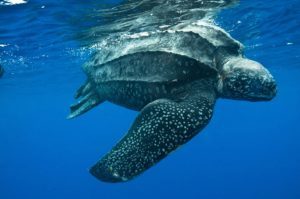
So, what on earth could this monster really be? I’m assuming it’s not actually a real monster, since it doesn’t really resemble anything known to science, living or extinct. Grey reported its length as that of the blue whale, the largest animal ever known to live on earth, but in shape it sounds a lot more like a humongous leatherback sea turtle.
We talked about the leatherback most recently in episode 406. It’s the largest turtle alive today, and can grow some nine feet long, or 3 meters. Instead of having a hard shell like other sea turtles, its carapace is covered with tough, leathery skin studded with tiny osteoderms. Seven raised ridges on the carapace run from head to tail and make the turtle more stable in the water. Not only is the leatherback the biggest and heaviest turtle alive today by far, it’s the heaviest living reptile that isn’t a crocodile. It has huge front flippers, is much more streamlined even than other sea turtles, and has a number of adaptations to life in the open ocean.
The leatherback lives throughout the world, from warm tropical oceans up into the Arctic Circle. It mostly eats jellyfish, so it goes where the jellyfish go, which is everywhere. But even the biggest leatherback that ever lived can’t be mistaken for a hundred-foot-long monster.
Assuming the report wasn’t a hoax, it’s possible that the sailors saw a big leatherback or some other animal tangled in a lot of floating debris. When the ship approached it, the animal thrashed around in a panic before managing to turn around and swim away. That would explain why Grey said the monster pivoted around. That would also explain why from a distance the monster looked like a derelict vessel of some kind. It might actually have been a derelict, and the shock of seeing a head rise out of the debris made the sailors think the whole thing was a gigantic monster instead of a distressed animal all tangled up in old rigging.
Then again, maybe it was actually a monster unknown to science, but if that’s the case, no one has seen anything like it since.
Thanks for your support, and thanks for listening!