Episode 380: Woodpeckers

Thanks to Joel and Mary for suggesting some really interesting woodpeckers this week!

Further watching:

Rare woodpecker thought extinct spotted in Ohio

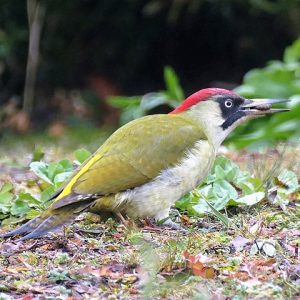
The green woodpecker really likes to eat ants [picture by Remyymer – Own work, CC BY-SA 4.0, https://commons.wikimedia.org/w/index.php?curid=65008314]:
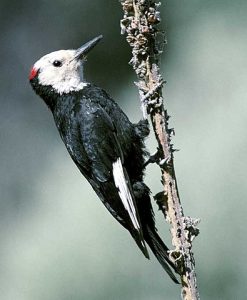
The white-headed woodpecker looks like its face got splashed with paint:
The red-headed woodpecker has the prettiest shade of red [picture by colleen – originally posted to Flickr as Red Headed Woodpecker, CC BY-SA 2.0, https://commons.wikimedia.org/w/index.php?curid=6639146]:

The acorn woodpecker looks like it got its face splashed with white paint and then dipped its beak in black paint [picture by Charles J. Sharp – Own work, from Sharp Photography, sharpphotography.co.uk, CC BY-SA 4.0, https://commons.wikimedia.org/w/index.php?curid=136903489]:

Show transcript:

Welcome to Strange Animals Podcast. I’m your host, Kate Shaw.

This week we’re going to talk about a type of bird that several people have suggested, the woodpecker! Thanks to Joel and Mary for their suggestions, and I could swear someone else suggested woodpeckers a while back. If that was you, thank you and I’m sorry I didn’t write it down!

It’s funny that we haven’t talked about woodpeckers very often, because they are definitely strange animals. How many animals use their head to hammer holes in wood? The woodpecker has a strong, heavy bill that it uses to drill holes in trees to find hidden insects and other invertebrates. A lot of insects dig little burrows in wood, and the woodpecker hammers away at the wood until it exposes the burrow. Then it has to get the insect or grub out of the burrow without it getting away, so it has a long, sticky tongue with barbs at the end. It can stick its tongue into the burrow and use it to drag the insect out and eat it.

When I say woodpeckers have long tongues, I mean their tongues are way longer than you think. The woodpecker’s skull contains a special cavity that wraps all the way around the brain and back down to the right nostril, and this cavity is where the main part of the tongue is when the woodpecker isn’t actually using it. It also helps cushion the brain and keep it from moving too much while the woodpecker is pecking. The skull itself is lined with spongy bone to soften impacts too.

The woodpecker also has a lot of other adaptations to using its entire head like a hammer. To protect its eyes from debris and pressure damage, it has a thick membrane that it uses to cover the eye, like built-in safety goggles. It has tiny, tough feathers that protect the nostrils from debris, and its nostrils are usually very small and thin too. Even its skin is thicker than that of most birds.

Woodpeckers have weird feet too. Almost all species have four toes, two that point forward, two that point backward. This arrangement is called zygodactyly, and it’s a trait also found in parrots and some other birds, and in chameleons. It allows the woodpecker to climb trees and branches securely and easily. The woodpecker also has a relatively short tail with stiff feathers that it uses to prop itself up against a tree trunk while hammering.

The woodpecker doesn’t just use its hammering ability to find food. It also hammers to communicate with other woodpeckers, the same way other birds use song. Each species has its own pattern of drumming, and the sound can attract a mate or tell rivals that this territory is already taken. When it’s communicating, the woodpecker will drum on different surfaces than when it’s just looking for food. This might be a hollow tree that amplifies the sound, or even an artificial surface. The first time I observed this as a birdwatcher was when I noticed a red-breasted woodpecker hammering repeatedly on a metal light post.

Woodpeckers do make ordinary sounds, though. Mary suggested the European green woodpecker and pointed out that its old name is yaffle, which mimics its call. This is what the green woodpecker sounds like:

[green woodpecker call]

Birders still refer to the sound as yaffling, which is the funniest word I’ve said all day.

The green woodpecker is native to much of Europe and parts of Asia. It has a bright red head and a black mask on its face, and its body is mostly an olive green color with a yellow rump patch. It’s a large bird, with a wingspan up to 20 inches across, or 51 cm. It especially likes to eat ants and spends most of its time on the ground looking for them. When it finds an ant nest, it will use its bill to open the nest up and then it licks up all the yummy ants and larvae with its long sticky tongue. As an example of how long a woodpecker’s tongue is, the green woodpecker has a tongue 4 inches long, or 10 cm, while its entire body is 14 inches long, or 36 cm.

Unlike most woodpeckers, the green woodpecker doesn’t do a lot of drumming or woodpecking. When it does, it’s mostly on very soft or rotten wood, and it’s probably not looking for food but excavating a nest hole to lay eggs in. Its favorite habitat is open woodland, since it can nest and hide in the trees but find lots of ants on the ground.

Joel suggested we learn about the white-headed woodpecker. I’d never heard of that one before, probably because it only lives in mountainous pine forests in parts of the Pacific northwest of Canada and the United States. It’s a glossy black in color with a mostly white head and a streak of bright white on its wings. Males have a red head patch too. It mostly eats pine seeds, which are found in pine cones. The seeds are quite large and the white-headed woodpecker is relatively small, only about 9 inches long, or 23 cm.

It will take a pine seed, wedge it into a crevice in a tree, and break it into bite-sized pieces by hammering it. It also eats insects, but it mainly finds them under the bark of trees, and it will sometimes peck little holes into tree trunks and eat the sap that oozes out. Unlike pretty much every woodpecker known, the white-headed woodpecker’s tongue isn’t especially long, probably because it doesn’t need a long tongue to find pine seeds.

This is what the white-headed woodpecker sounds like:

[white-headed woodpecker call]

One of my favorite birds is the red-headed woodpecker, which has a vibrantly red head and a black and white body that almost looks checkered. It’s native to North America and lives year-round in much of the eastern and central United States, but for some reason it took me years as a birdwatcher before I saw one for the first time. I didn’t know just how beautiful it really is until I saw one in person. Red is my favorite color, and the red-headed woodpecker’s red head is my exact favorite shade of red.

The red-headed woodpecker is about the size of the white-headed woodpecker, or a little larger. It eats lots of insects but will also eat seeds, berries and other fruit, and even the eggs of other birds. It sometimes catches insects on the wing. It’s also one of only a few species of woodpecker that stores food, hiding it in crevices in trees or under the shingles of people’s houses. Occasionally when it catches too many grasshoppers to eat, it will wedge the living grasshoppers in crevices so tightly that the insect is stuck there until the bird comes back when it’s hungry. That’s disturbing.

Another bird that caches food is the acorn woodpecker, which lives in parts of southwestern North America down through Central America. It’s mostly black with white patches on the face and black and white streaks underneath. Males have a red patch on the back of the head too. As you probably guessed from its name, it eats a lot of acorns along with insects, fruit, and tree sap. Because acorns are seasonal foods, only available in the fall, the acorn woodpecker stores acorns to eat later in the year. It hides the acorns in holes and crevices, often pecking little holes in a tree specifically for storage, but as the acorns dry out they take up less space. The bird spends a lot of time throughout the year moving its acorns to better hiding spaces.

The acorn woodpecker lives in small flocks of up to about a dozen or 15 birds. All birds in the flock help raise any babies, and in years where there aren’t very many acorns, only a few of the females in the group will lay eggs. In years where there are lots of acorns, all of the females will usually lay eggs. They all lay their eggs in the same nesting cavity and the babies are raised together.

So why do so many woodpeckers have such bright colors and markings? Many are black and white, often with red or yellow markings on the head or neck. They look conspicuous to us, but the black and white patterning blends in with the pattern of light and shadow under trees. The bright spots of color help attract mates, since a bird with brightly colored feathers shows other birds that they’re healthy. In many species, only the male has a red patch, or the female’s red patch may be smaller than the male’s.

Way back in episode 9 we talked about the ivory-billed woodpecker and some of its close relations. The ivory-billed woodpecker was thought to be extinct but possible sightings and audio recordings indicate it may still be alive in remote areas of the southeastern United States. Most recently, video footage of a bird spotted in Ohio has the controversy starting up again. I’ve linked to the video in the show notes. The bird in the video is probably just the very similar-looking pileated woodpecker, but the light isn’t good so it’s hard to tell for sure. It’s just barely possible it might actually be an ivory-billed woodpecker. Let’s hope it is an ivory-billed.

You can find Strange Animals Podcast at strangeanimalspodcast.blubrry.net. That’s blueberry without any E’s. If you have questions, comments, or suggestions for future episodes, email us at strangeanimalspodcast@gmail.com. We also have a Patreon at patreon.com/strangeanimalspodcast if you’d like to support us for as little as one dollar a month and get monthly bonus episodes.

Thanks for listening!

Episode 379: Animals That Inspired Pokemon

Thanks to Pranav, Isaac, and an anonymous listener for their suggestions this week! Let’s learn about some animals that inspired three Pokemon.

Sandshrew:

Possible Sandshrew inspirations:

Drowzee:

Possible Drowzee inspiration:

Fennekin:

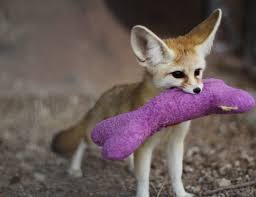
Undoubted Fennekin inspiration:

Show transcript:

Welcome to Strange Animals Podcast. I’m your host, Kate Shaw.

This week we’re going to do something slightly different. At least two people and probably a lot more have suggested that we talk about some animals that were the inspiration for Pokemon, so I picked three that you might not know about. Thanks to Pranav and Isaac for their suggestions, and if you suggested the same topic at some point and I didn’t write it down, thank you too! Thanks also to an anonymous listener who suggested three of the animals we’ll talk about in this episode. I didn’t intend to cover three animals suggested by the same listener but it worked out that way, which is kind of neat.

Some of you may not be familiar with what Pokemon are. The word is a shortened version of the term “pocket monsters,” and it started as a video game where players catch various monsters and store them in little round cages called pokeballs. A lot of Pokemon are so cute you can’t really call them monsters, but they all have different abilities and can evolve into even more powerful versions with enough training. My only real experience with Pokemon is the game Pokemon Go that came out in 2016, although I don’t play it anymore, but the franchise has had multiple games, including a trading card game that is still really popular, TV shows, movies, and of course lots of toys.

Sometimes it’s easy to figure out what animal inspired a Pokemon. Rhyhorn obviously looks like a rhinoceros, Magikarp looks like a goldfish, and so on. But sometimes it’s not so obvious. Let’s start with Sandshrew.

Sandshrew is a sandy-brown color on its back with a lighter belly and muzzle, and prominent claws. Its tail is big and its ears are small. It’s covered with armor plates, and in some versions of Sandshrew, most notably the Pokemon TV show, it can curl up into a ball. What does that remind you of?

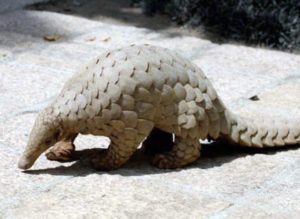
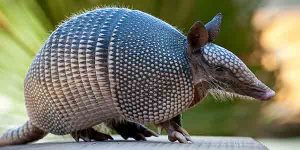
Some of you just said “armadillo” and others of you just said “pangolin.” Both were suggested a while back by an anonymous listener. The two animals aren’t related but they do share some physical similarities, like armored bodies and the ability to curl up into a ball to make their armor even more effective.

We talked about the pangolin in episode 65, about animals that eat ants. The pangolin is related to anteaters, and is sometimes even called the scaly anteater, but it’s not closely related to the armadillo. Their similarities are mainly due to convergent evolution.

The pangolin is a mammal, but it’s covered in scales except for its belly and face. The scales are made of keratin, the same protein that makes up fingernails, hair, hooves, and other hard parts in mammals. When it’s threatened, it rolls up into a ball with its tail over its face, and the sharp-edged, overlapping scales protect it from being bitten or clawed. It has a long, thick tail, short, strong legs with claws, a small head, and very small ears. Its muzzle is long with a nose pad at the end, it has a long sticky tongue, and it has no teeth. It’s nocturnal and lives in burrows, and it uses its big front claws to dig into termite mounds and ant colonies. It has poor vision but a good sense of smell. It’s a good fit for Sandshrew and some species are even the same color as Sandshrew. It lives in southern Asia and much of sub-Sahara Africa, and all species are critically endangered.

Meanwhile, the armadillo is also a mammal that’s covered in armor except for its belly, but its armor is much different from the pangolin’s scales. The armor is made up of bands of hardened, bone-like skin covered with scutes, which are tiny flattened knobs of keratin. Ordinary skin connects the bands so that the animal can move around more easily. Some species roll up when threatened, but others rarely do. Instead they just run into the most thorny, prickly plants they can find. The armadillo’s armor protects it from being hurt by the thorns. Like the pangolin, it has sharp claws and can dig well to get at termites and other invertebrates, and like the pangolin it has poor eyesight but a good sense of smell. Its ears are small, its legs are short, and its tail is long but not as thick as the pangolin’s. Most species are grayish, pinkish, or brownish. It looks less like Sandshrew than the pangolin does, but it might have contributed to Sandshrew’s appearance and habits.

The armadillo lives in the Americas, mostly in South America but also Central and parts of North America. Many species are endangered.

Whichever animal you think inspired Sandshrew, I think we can agree that Sandshrew doesn’t have anything to do with actual shrews.

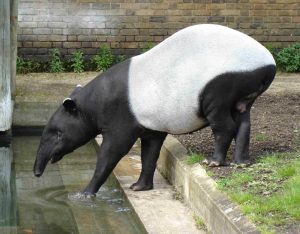
Our next Pokemon is Drowzee. Drowzee is a chonky, strong-looking monster who looks like it’s wearing gray pants but otherwise has ochre yellow skin. Its nose is drawn out into a short proboscis like a miniature elephant trunk, and it has three pointy toes on its hands and what look like cloven hooves on its feet. It doesn’t have a tail.

Drowzee is inspired by the tapir, probably the Asian tapir. The other tapirs alive today live in South and Central America, but the Asian tapir lives in lowland rainforests in parts of south Asia. It’s mostly white or pale gray with black or dark gray forequarters and legs. It’s also the largest species of tapir alive today, standing more than 3 and a half feet tall at the back, or 110 cm. Like other tapirs, it spends a lot of time in water, eating plants and staying cool.

The tapir looks kind of like a pig but it’s actually much more closely related to horses and rhinos. It has four toes on its front legs, three on its hind legs, and each toe has a large nail that looks like a little hoof. It also has a rounded body with a pronounced rump, a stubby little tail, and a long head with a short but prehensile trunk called a proboscis. It uses its proboscis to gather plants, and it can even use it as a snorkel when it’s underwater.

The Asian tapir isn’t a perfect match for Drowzee, but its two-part coloration and short proboscis are pretty close. As far as I know, the Asian tapir doesn’t make you fall asleep and then eat your dreams like Drowzee is supposed to do, but that’s an aspect of a monster in Japanese folklore. The baku is supposed to eat nightmares and traditionally it’s often described as being black and white like a panda, but often with tapir-like traits.

Our last Pokemon today is Fennekin, who is based on the fennec fox, also a suggestion by an anonymous listener. Fennekin is yellow-brown in color with white on its face, a red-orange tip to its tail and red-orange tufts in its gigantic ears.

The fennec fox lives in northern Africa and parts of Asia. Its fur is a pale sandy color with a black tip to the tail. Its eyes are dark and its ears are large. It stands only about 8 inches tall at the shoulder, or 20 cm, but its ears can be six inches long, or 15 cm. It eats rodents, birds and their eggs, insects, and other small animals, as well as fruit. It can jump really far, some four feet in one bound, or 120 cm. Because it lives in desert areas, it rarely needs to drink water. It gets most of its water through the food it eats, and researchers think it may also lap dew that gathers in the burrow where it spends the day.

Fennekin is a fire Pokemon, appropriate since it’s based on a desert animal. It’s also extra adorable, and so is the fennec fox.

You can find Strange Animals Podcast at strangeanimalspodcast.blubrry.net. That’s blueberry without any E’s. If you have questions, comments, or suggestions for future episodes, email us at strangeanimalspodcast@gmail.com. We also have a Patreon at patreon.com/strangeanimalspodcast if you’d like to support us for as little as one dollar a month and get monthly bonus episodes.

Thanks for listening!
Episode 376: The Horned Lizard AKA Horny Toad

Thanks to Khalil for suggesting the horny toad, also called the horned lizard or horned toad!

Further reading:

The Case of the Lost Lizard

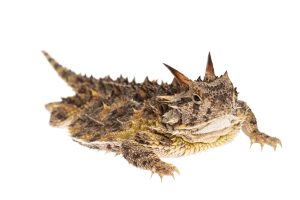
The Texas horned lizard:

Texas Horned Lizard (Phrynosoma cornutum)

The rock horned lizard [photo taken from article linked above]:

Show transcript:

Welcome to Strange Animals Podcast. I’m your host, Kate Shaw.

This week we’re going to learn about a reptile suggested by Khalil, who is Leo’s friend, so a big shout-out to both. Khalil wants to learn about the horny toad, also called the horned toad or horned lizard.

We talked about it briefly back in episode 299. The horny toad is actually a lizard that lives in various parts of North America, especially western North America, from Canada down through much of the United States and into Mexico. The largest species is the Texas horned lizard, with a big female growing about 5 inches long, or almost 13 cm, not counting its tail.

The horny toad does actually resemble a toad in some ways. Its body is broad and rounded and its face has a blunt, froglike snout. Its tail is quite short. It’s also kind of sluggish and spends a lot of time just sitting in the sun, relying on its mottled coloration to camouflage it. If it feels threatened, it will actually just freeze and hope the predator doesn’t notice it. It’s covered with little pointy scales, and if a predator does approach, it will puff up its body so that the scales stick out even more and it looks larger. It also has true horns on its head, little spikes that are formed by projections of its skull, and if a predator tries to bite it, the horny toad will jerk its head up to stab its horns into the predator’s mouth.

Horny toads mainly eat a type of red ant called the harvester ant. The harvester ant is venomous but the horny toad is resistant to the venom and is specialized to eat lots and lots of the ants. Its esophagus produces lots of mucus when it’s eating, which collects around the ants and stops them from being able to bite before they die.

Because it eats so many venomous ants, many scientists think the horny toad stores some of the toxins in its body, especially in its blood. Its blood tastes especially bad to canids like coyotes that are common in the areas where it lives. But it does the horny toad no good to have bad-tasting blood if a predator has to bite it to find out, so the horny toad has a way to give a predator a sample of its blood in the weirdest way you can imagine.

If a horny toad is cornered by a predator and can’t run away, and puffing up isn’t helping deter the predator, the lizard has one last trick up its sleeve. It increases the blood pressure in its head by restricting some of the blood vessels carrying blood back to the heart, and when the blood pressure increases enough, it causes tiny blood vessels around the eyelids to rupture. It doesn’t just release blood, it squirts blood up to five feet away, or 1.5 meters. As if that wasn’t metal enough, the horny toad can aim this stream of blood, and it aims it right at the predator’s eyes.

Imagine for a moment that you are a hungry coyote. You’re young and don’t know that horny toads taste bad, you just know you’ve found this plump-looking lizard that doesn’t move very fast. It keeps puffing up and looking spiky, but you’re hungry so you keep charging in to try and grab it with your teeth in a way that won’t hurt your tongue on those spikes. Then, suddenly, your eyes are full of lizard blood that stings and makes it hard to see, and the blood drips down into your mouth and it tastes TERRIBLE. It doesn’t matter how hungry you are, this fat little lizard is definitely off the menu. Meanwhile, the horny toad is fine.

Scientists aren’t sure if every species of horny toad can squirt blood. Some species probably can’t, while some do it very seldom. It also doesn’t help against some predators, like birds, who don’t have a great sense of taste and aren’t affected by the toxins in the horny toad’s blood.

The horny toad relies on the harvester ant for most of its specialized diet, although it does eat other insects too. It can’t survive without eating harvester ants. The problem is, the harvester ant is in decline after fire ants were introduced to North America from South America. The horny toad doesn’t eat fire ants, and the fire ants out-compete the local harvester ants, leaving the horny toad with less and less food.

Humans really don’t like fire ants, which can cause damage to homes when they dig their huge underground nests, and which inflict really painful bites. When people try to get rid of fire ants, sometimes the treatments also kill harvester ants. Incidentally, some animals that really love to eat fire ants include armadillos, black widow spiders, wolf spiders, and bobwhites.

The Texas horned lizard lives throughout a fairly large range, so although its numbers are in decline along with its ant food, it’s still doing okay for now. But not every horny toad is so lucky.

The rock horned lizard, also called Ditmars’ horned lizard, is only found in one small part of Sonora in northern Mexico. It was first discovered by science in 1891, when an archaeological expedition caught one. The lizard was described in 1906 but by then it hadn’t actually been seen in the wild since 1897, when two more were caught by a man who donated them to the New York Zoological Park. Those were the only three specimens that had ever been collected. Herpetologists worried that the rock horned lizard had gone extinct.

The main issue was that no one was exactly sure where those three specimens had been collected and no one knew exactly where the 1891 expedition had traveled. The man who caught the two lizards in 1897 didn’t say exactly where he’d caught them, just that it was in northern Sonora. But what a scientist named Vincent Roth realized when researching the lizard is that the three preserved specimens probably still contained undigested and partially digested food in their bodies, and that if the insects the lizards had eaten could be identified, it could give an important clue as to where the lizards had lived.

Dr. Roth requested that the gut contents be removed from the 1891 specimen for study, and also from one of the 1897 specimens. The third specimen had been taxidermied and the guts discarded. Dr. Roth cleaned the gut contents with alcohol and examined them microscopically, and found the remains of 14 insects, the seeds of three different species of grass, and some pebbles. All this happened in 1970, so instead of emailing a bunch of experts for help, Dr. Roth had to write physical letters to specialists throughout the world for help identifying the insects.

The specialists were happy to help, and they determined that the pebbles and grass seeds would have been eaten by accident when the lizard slurped up ants carrying them. The lizards had the remains of several different ants in their digestive tracts, including harvester ants, along with weevils, jumping spiders, grasshoppers, and other insects. These were identified, including some rare ones only ever found in certain areas of Sonora. Even the grass seeds and the pebbles were identified.

It all pointed to a particular mountain range in northern Sonora, and an expedition was arranged by Dr. Roth to search for the lizard. But they didn’t find it! They made plans to return, but asked the local people to keep an eye out for a specific type of horned lizard. In 1971 a report came of a rock horned lizard discovered by a local, followed soon by a few others. The lizard was safe, although it’s rare. Scientists had just been looking in the wrong place for it.

Since the rock horned lizard is only a few inches long and blends in so well with its surroundings, it’s no wonder it was hard to find. Fortunately it’s been rediscovered so that scientists can study it and keep it safe. The next step is to keep the harvester ants safe so that all the horny toads have plenty of yummy ants to eat.

You can find Strange Animals Podcast at strangeanimalspodcast.blubrry.net. That’s blueberry without any E’s. If you have questions, comments, or suggestions for future episodes, email us at strangeanimalspodcast@gmail.com. We also have a Patreon at patreon.com/strangeanimalspodcast if you’d like to support us for as little as one dollar a month and get monthly bonus episodes.

Thanks for listening!
Episode 368: The Bison

Thanks to Jason for suggesting this week’s topic, the bison!

Further reading:

New research documents domestic cattle genetics in modern bison herds

Higgs Bison: Mysterious Hybrid of Bison and Cattle Hidden in Ice Age Cave Art

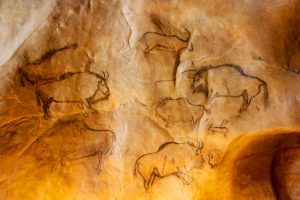
A cave painting of steppe bison and other animals:

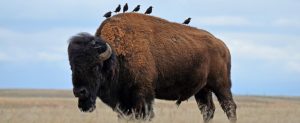
An American bison [photo by Kim Acker, taken from this site]:

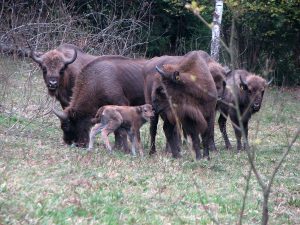
Some European bison [photo by Pryndak Vasyl, taken from this site]:

The bison sound in this episode came from this site.

Show transcript:

Welcome to Strange Animals Podcast. I’m your host, Kate Shaw.

This week we’re going to learn about the bison, a suggestion from Jason. There are two species of bison alive today, the American bison and the European bison. Both are sometimes called buffalo while the European bison is sometimes called the wisent. I’m mostly going to call it the wisent too in this episode so I only have to say the word bison 5,000 times instead of 10,000.

Bison are herd animals that can congregate in huge numbers, but these big herds are made up of numerous smaller groups. The smaller groups are made up of a lead female, called a cow, who is usually older, other cows, and all their offspring, called calves. Males, called bulls, live in small bachelor groups. The American bison mostly eats grass while the European bison eats a wider selection of plants in addition to grass.

The bison is a big animal with horns, a shaggy dark brown coat, and a humped shoulder. The American bison’s shoulder is especially humped, which allows for the attachment of strong neck muscles. This allows the animal to clear snow from the ground by swinging its head side to side. The European bison’s hump isn’t as pronounced and it carries its head higher. The bison looks slow and clumsy, but it can actually run up to 35 mph, or 55 km/hour, can swim well, and can jump obstacles that are 5 feet tall, or 1.5 meters.

The American bison can stand over six and a half feet high at the shoulder, or 2 meters, while the European bison stands almost 7 feet tall at the shoulder, or 2.1 meters. This is massively huge! Bison are definitely ice age megafauna that once lived alongside mammoths and woolly rhinos, so we’re lucky they’re still around. Both species almost went extinct in recent times and were only saved by a coordinated effort by early conservationists.

The American bison in particular has a sad story. Before European colonizers arrived, bison were widespread throughout North America. Bison live in herds that migrate sometimes long distances to find food, and many of the North American tribes were also migratory to follow the herds, because the bison was an important part of their diet and they also used its hide and other body parts to make items they needed. The colonizers knew that, and they knew that by killing off the bison, the people who depended on bison to live would starve to death. Since bison were also considered sacred, the emotional and societal impact of colonizers killing the animals was also considerable.

In the 19th century, colonizers killed an estimated 50 million bison. A lot of them weren’t even used for anything. People would shoot as many bison as possible from trains and just leave the bodies to rot, and this practice was actually encouraged by the railroads, who advertised these “hunting” trips. The United States government also encouraged the mass killing of bison and even had soldiers go out to kill as many bison as possible. Bison that escaped the coordinated slaughter often caught diseases spread by domestic cattle, and the increased plowing and fencing of prairie land reduced the food available to bison. By 1900, the number of American bison in the world was probably only about 300.

As early as the 1860s people started to sound the alarm about the bison’s impending extinction. Some ranchers kept bison, partly as meat animals and partly to just help stop them from all dying out. The Yellowstone National Park had been established in 1872, and 25 bison survived there, although many others were poached by hunters. Members of various Plains tribes, who had been forced onto reservations by the United States government so the government could give their land to colonizers, collected as many bison as they could to keep them safe.

These days the American bison is out of immediate danger, although its numbers are still very low. Because there were so few bison when conservation efforts started, the genetic diversity is also low. Bison will also hybridize with domestic cattle and the resulting female calves are fertile, so the main goal of modern conservationists is to genetically test herds to determine which bison have a larger percentage of cattle genes, and mainly only breed the ones that have the least. A 2022 study determined that there is no population of American bison alive today that doesn’t have at least a small percentage of cattle genes. Cattle are domesticated animals, and it’s never a good thing when a wild animal ends up with the DNA of a domestic counterpart. Bison need their wildness in order to survive and stay safe.

There are two living subspecies of American bison, the wood bison and the plains bison. I’m happy to report that the scientific name of the plains bison is Bison bison bison. The wood bison mainly lives in Canada, where it’s classified as threatened.

As for the European bison, or wisent, it was once common throughout much of Europe and Asia. As the human population increased after the ice age, the wisent’s numbers decreased until it was mostly restricted to a few areas of Russia, Transylvania, Poland, and Lithuania. Even as early as the 16th century, people were aware it was endangered. Local rulers declared it a protected animal in most of its range.

During World War I, German troops occupying Poland killed hundreds of wisents, and as the troops retreated at the end of the war, they shot as many of the bison as they could find and left them to rot. Only nine individuals remained alive and by 1921 they had died too. By 1927, the very last wisent in the wild was killed by a poacher.

But 12 animals remained, kept in various zoos. In 1923 a preservation society was set up, modeled after the one in the United States that had helped save the American bison from extinction. Poland in particular worked hard to increase the wisent’s numbers and re-introduce it to its forest home, although its efforts were interrupted by World War II. These days the wisent is out of danger of extinction, although like the American bison its numbers are still relatively low.

American and European bison are related and can crossbreed, but they’re not as closely related genetically as was once thought. Genetic studies are ongoing, but it appears that the wisent is most closely related to domestic cattle while the American bison is most closely related to the yak.

We recently talked about the steppe bison in episode 357, which is about mammoth meat. The steppe bison is an ancestor of the American bison and lived throughout Europe and Asia across to North America, during the Pleistocene when Asia and North America were connected by the land bridge Beringia. It only went extinct around 3,000 years ago. It had much larger horns than modern bison, with a horn spread of almost seven feet across, or over 2 meters.

About 17,000 years ago, in a cave in what is now France, an ancient artist picked up a stick of charcoal and made a drawing of a bison alongside many other bison drawings made by many artists over the years. According to a study published in 2016, there are two different types of bison depicted in the cave. One type is the steppe bison, but the other is distinctly different. After a genetics study of bison in Europe, researchers made a surprising discovery. The second type of bison depicted in the cave is actually a hybrid animal. Hybrids come about when two species of closely related animals interbreed. The more closely related the species are, the more likely they are to interbreed where their territories overlap, and the more likely that the offspring will be fertile. This is exactly what happened toward the end of the Pleistocene, when climate change made it harder for the steppe bison to survive. Instead, a hybrid of steppe bison and the aurochs, the wild ancestor of the domestic cow, not only became common throughout much of Europe, eventually the hybrid species was so numerous that it became a distinct species of its own.

This hybrid bison had small horns and a smaller hump than the steppe bison, although it was still a really big animal. Eventually it gave rise to the modern European bison while the steppe bison gave rise to the antique bison, which itself is the direct ancestor of the American bison. So many bison!

This is what a bison sounds like, specifically an American bison recorded in Yellowstone National Park:

[bison sound]

You can find Strange Animals Podcast at strangeanimalspodcast.blubrry.net. That’s blueberry without any E’s. If you have questions, comments, or suggestions for future episodes, email us at strangeanimalspodcast@gmail.com. We also have a Patreon at patreon.com/strangeanimalspodcast if you’d like to support us for as little as one dollar a month and get monthly bonus episodes.

Thanks for listening!

Episode 357: When Scientists Ate Mammoth Meat

This week we’re going to talk about stories of scientists, explorers, and other modern people eating meat from long-dead extinct animals. Did it ever really happen?

Check out the great new podcast Herbarium of the Bizarre! I highly recommend it even though they don’t eat any mammoth meat.

Further reading:

Was frozen mammoth or giant ground sloth served for dinner at The Explorers Club?

Study Proves the Explorers Club Didn’t Really Eat Mammoth at 1950s New York Dinner

Company Serves World’s First ‘Mammoth’ Meatball, but Nobody Is Allowed to Eat It

Don’t eat me bro:

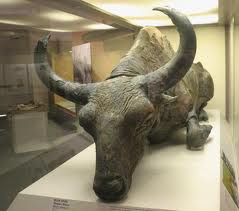
Blue Babe, a steppe bison mummy found in Alaska:

Show transcript:

Welcome to Strange Animals Podcast. I’m your host, Kate Shaw.

We’ve talked about mammoths and other ice age megafauna plenty of times before, but this week we’re going to learn something specific and really weird about these animals, although it’s more accurate to say we’re going to learn how weird humans are.

You may have heard this story before, or something similar to this story. A group of scientists in Siberia or Alaska have unearthed a mammoth carcass that’s been frozen in permafrost for at least 25,000 years. It’s in such good shape that the meat looks as fresh as a fancy restaurant steak that’s ready to go on the grill. At the end of a long day of using pickaxes to dig the mammoth out of ground frozen as solid as rock, the scientists are so hungry that when someone suggests they actually grill some mammoth meat, they all think it’s a good idea. The meat turns out to taste as good as it looks. Everyone has a big steak dinner, even the camp dogs, and when the expedition ends they not only have a mammoth to put on display in their museum, they have a great story to tell about a meal no human has eaten for thousands of years.

You may even have come across an event that inspired this particular story. The incredibly well preserved 44,000 year old Berezovsky mammoth was discovered in Russia in 1900 and excavated in 1901, and it’s now on display in the Zoological Museum in Saint Petersburg. Rumors persisted for years that the expedition members ate some of the mammoth meat, but while we don’t know exactly what happened, definitely no one actually sat down to have a yummy meal of mammoth steak.

It turns out that the meat did look appetizing when thawed, but stank like old roadkill. The expedition erected a big tent over the dig site as they excavated the carcass, which was a slow process in 1901, and the smell became so bad that the expedition members had to take frequent breaks and leave the tent for fresh air.

Apparently the scientists got drunk one night and dared each other to try a bite of the meat, but even after they practically covered it in pepper to disguise the taste, no one could force any down. One man might have managed to eat a single bite, but reports vary. They fed the meat to the camp dogs instead, who were just fine. Dogs and wolves have short, fast digestive tracts and can tolerate eating foods that would make humans very sick.

But that’s not the only story of modern humans eating meat from frozen mammoth carcasses. It supposedly happened on January 13, 1951 at the Roosevelt Hotel’s grand ballroom in New York City. A group called the Explorers Club met for their annual fancy dinner that evening, and as always, the menu contained lots of exotic foods. The main course has gone down in history as being slices of mammoth meat from a 250,000-year-old carcass found in Alaska.

That’s where things get confusing, though, because supposedly the main course was megatherium meat found in Alaska. Megatherium was a giant ground sloth that hasn’t ever been found frozen in permafrost at all, certainly not in Alaska. It lived in South America. However, the Christian Science Monitor magazine thought megatherium was another word for mammoth and reported that the group was served mammoth meat.

Some of the Explorers Club members genuinely thought they were dining on megatherium. Some may have thought it was mammoth. The club’s press release just said “prehistoric meat,” which doesn’t sound very appetizing.

An Explorers Club member who couldn’t attend the dinner asked that his portion be saved for him in a bottle of formaldehyde that he provided. This was done, and the promoter himself, Wendell Phillips Dodge, better known as Mae West’s one-time film agent, filled out the supplied specimen card as “megatherium meat.” The club member put his bottled meat on display at the Bruce Museum in Greenwich, Connecticut, where he worked.

There the bottle stayed until 2001, when it ended up at the Yale Peabody Museum of Natural History. In 2014, a couple of Yale students ran DNA tests on the meat.

As you may have already guessed, the meat wasn’t from a mammoth or a giant ground sloth. It’s meat from the decidedly not extinct green sea turtle, although the green sea turtle is endangered and protected these days, so don’t eat it. Since green sea turtle soup was also served at the meal, it’s probable that the leftover turtle meat was called megatherium meat as a sort of joke. Dodge even published a statement after the dinner that he’d discovered how to turn green sea turtle into giant sloth meat. But by then the story of mammoth meat being served at the dinner had already passed into history.

But while we don’t know if anyone in modern times has eaten frozen mammoth meat, we do know for certain that a group of scientists did eat the meat of a mummified steppe bison that died around 36,000 years ago.

The bison was discovered in 1979 in Alaska and was nicknamed Blue Babe, both from the folktales of the giant lumberjack Paul Bunyon and his pet, Babe the Blue Ox, and because the mummy was coated in crystals of vivianite, which turns blue when exposed to oxygen. Eventually Blue Babe was taxidermied and put on display in the University of Alaska Museum at Fairbanks.

At some point, the team in charge of the specimen decided to try some of its meat in a stew, which from all accounts turned out okay and didn’t make anyone sick. The scientists examined the meat carefully before deciding to cook and eat it, and decided that it was basically freezer-burned but not actually rotten.

Dale Guthrie was part of the Blue Babe excavation team. I’ll quote the relevant paragraph from page 29 of her booklet Blue Babe. The Bjorn Kjurten mentioned in the quote is the man who helped preserve the mummy, and he was also the guy who interviewed one of the Russian scientists who tried to eat mammoth meat with pepper.

“To celebrate Eirich’s work and the new Blue Babe, we decided to cook a bison stew. A marvelous bit of luck had brought Bjorn Kjurten to Fairbanks for guest lectures, and we invited other friends who were game enough to try the stew. Spring was underway. With a good burgundy to brave the rather muddy tone of the dish, we toasted the past and present in the long evening twilight, a taste of the Pleistocene with friends who shared and added to it with their talents and imagination. It was a special evening.”

Guthrie reported that the meat wasn’t very good, but that anything is edible if you use enough onions.

In March of 2023, a company that produces lab-grown meat for human consumption made a giant meatball grown from mammoth DNA. They displayed it as a way to advertise the possibilities of lab-grown meat, but because this particular meat hasn’t been tested to make sure it’s safe for people to eat, no one was allowed to eat it. But maybe in the future, you’ll be able to order a mammoth steak from your local restaurant. Let me know what it tastes like.

You can find Strange Animals Podcast at strangeanimalspodcast.blubrry.net. That’s blueberry without any E’s. If you have questions, comments, or suggestions for future episodes, email us at strangeanimalspodcast@gmail.com. We also have a Patreon at patreon.com/strangeanimalspodcast if you’d like to support us for as little as one dollar a month and get monthly bonus episodes.

Thanks for listening!
Episode 356: The Volcano Rabbit

Thanks to Eva for suggesting the adorable volcano rabbit this week!

Further watching:

American Pikas Calling Out

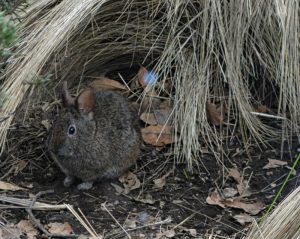
The volcano rabbit is not a volcano but it is a very small rabbit:

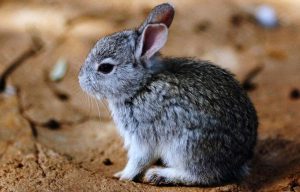
The volcano rabbit is SO CUTE:

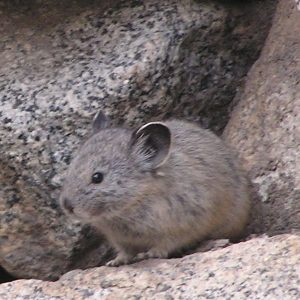
The American pika looks kind of like its rabbit cousin [photo by Justin Johnsen, CC BY-SA 3.0, https://commons.wikimedia.org/w/index.php?curid=91574]:

Show transcript:

Welcome to Strange Animals Podcast. I’m your host, Kate Shaw.

This week we have a suggestion from Eva, who wanted to learn about volcano rabbits! What are volcano rabbits? Do they shoot lava at their enemies? Let’s find out! (No, they don’t shoot lava. Sorry. That’d be awesome!)

The most important thing to know about the volcano rabbit is how small it is. It’s almost the smallest rabbit known. It typically only grows about 9 inches long, or 23 cm, and that’s when it’s stretched out. Rabbits usually sit more bunched up, which makes it look even smaller. Its ears are small and rounded, its tail is short even for a rabbit, and its legs are short. Its fur is also short and very thick, mostly grayish-tan in color.

The second most important thing to know about the volcano rabbit is how rare and endangered it is. That’s because it only lives in one small part of Mexico, specifically on the upper slopes of four volcanoes. Because people also live in this area, which isn’t far from Mexico City, the rabbits’ natural range is fragmented by human-made obstacles like highways that are dangerous for it to cross, along with habitat destruction from logging, livestock grazing, and the building of new houses. People even hunt the rabbit even though it’s a protected animal. We don’t know for sure how many of the volcano rabbits are left in the wild, but the best estimate is around 1,200 rabbits in small populations that are often widely separated. It’s even been declared extinct on another volcano where it used to live, although there may be a small population still hanging on.

The volcano rabbit prefers open woodland in higher elevations where there’s plenty of tall, dense grass native to the area. It makes rabbit-sized tunnels through the grass so it can move around undetected by predators. It also mostly eats this grass. It’s most active at dawn and dusk, which also helps it hide from predators.

When a volcano rabbit does feel threatened, it doesn’t thump its feet to alert other rabbits of danger. Instead, it gives a little alarm squeal. This is really unusual in a rabbit, but it’s something the pika does, and the pika is closely related to rabbits. The pika lives in parts of central Asia and western North America, especially in cold areas like mountaintops. It’s so well adapted to the cold that it can die if the temperature climbs over about 78 degrees Fahrenheit, or 25 Celsius.

The American pika actually looks a lot like the volcano rabbit in some ways, although it’s less rabbit-like in shape and more rodent-like, although it’s not a rodent. It’s a lagomorph. It’s about the same size or a little smaller than the volcano rabbit, with short legs and dense grayish-brown fur that grows longer in winter. It especially likes places with a lot of rocks, since it makes its home in little cracks and crevices between rocks. It prepares for winter by harvesting the plants it eats and storing them in little haypiles. Since it doesn’t hibernate, it needs plenty of food for times when snow and ice make it hard to find plants.

The pika is intensely territorial, because it doesn’t want any other pikas sneaking around eating up its hay, but it does communicate with other pikas. During breeding season the males will make a singing call to attract a female, and all pikas will call to warn others of a predator nearby. I couldn’t find any recordings of a volcano rabbit, but this is what an American pika sounds like:

(wait for it…)

[pika beeping]

Like other rabbits, the volcano rabbit eats grass and other plant parts. The problem is that most of the plants in its habitat are not very high in protein. The more fragmented its habitat is, the harder it is for the rabbits to find enough food to survive, much less to also reproduce. Every time someone decides to let cattle or other livestock graze on the local plants, the rabbits have that much less food.

Fortunately, conservationists in Mexico are working on educating people so they know this cute little rabbit is a protected species. Captive breeding programs are underway too, and parts of the volcanoes where the rabbit lives are within the bounds of a national park. There are plans to create safe corridors to link the rabbit’s fragmented habitats so it can come and go without getting squished by cars, and to restore its range with more native plants so it has plenty of food.

You might worry that the volcano rabbit, besides having all these issues with habitat loss and habitat fragmentation, is also in danger of its volcano home erupting. The volcanoes where it lives are active, but only one of the four poses any danger, and that volcano has erupted repeatedly in the last several hundred years without affecting the volcano rabbit. It actually even had a small eruption in May 2023. Schools in the area were closed for a few days, but no one was hurt, not even a rabbit.

You can find Strange Animals Podcast at strangeanimalspodcast.blubrry.net. That’s blueberry without any E’s. If you have questions, comments, or suggestions for future episodes, email us at strangeanimalspodcast@gmail.com. We also have a Patreon at patreon.com/strangeanimalspodcast if you’d like to support us for as little as one dollar a month and get monthly bonus episodes.

Thanks for listening!

Episode 355: Tiny Owls

This week we learn about two tiny owls! Thanks to Elizabeth and Alexandra for their suggestions!

Further reading:

Burrowing Owl

Elf Owl

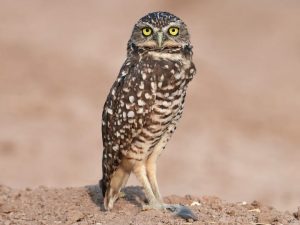
The burrowing owl is tiny but fierce [photo by Christopher Lindsey, taken from page linked above]:

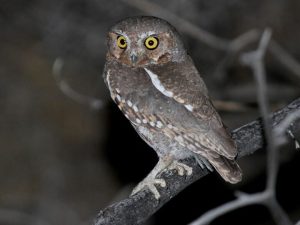
The elf owl is also tiny but fierce [photo by Matthew Grube, taken from page linked above]:

Show transcript:

Welcome to Strange Animals Podcast. I’m your host, Kate Shaw.

This week we’re going to learn about two tiny owls. Thanks to Elizabeth and Alexandra for their owl suggestions!

The burrowing owl is native to the Americas, especially the western part of North America, and most of Central and South America. It prefers grasslands and other open areas. It’s a small owl, not much bigger than the average songbird. It’s mostly brown with lighter underparts that are barred with a brown pattern.

You can tell a lot about an owl by the color of its eyes. In general, an owl with dark eyes is most active at night, an owl with orange or red eyes is likely to be most active at dawn and dusk, and an owl with yellow eyes is often active in the day. That’s not a hard and fast rule, but it can help you make a good guess about an owl’s behavior. The burrowing owl has yellow eyes, and it is indeed active in the day. The term for daytime activity is diurnal.

In past episodes I’ve said that owls have long legs that are usually hidden by feathers. In the case of the burrowing owl, its long legs are in plain sight because it spends a lot of the time running around on the ground. It will sometimes chase prey on foot, but other times it will perch on a fence post, tree branch, or some other high place to watch for a small animal to pass by. Then it will swoop down to grab it just like any other owl. It eats mice and other small rodents, lizards, small snakes, frogs, large insects and other invertebrates like scorpions and caterpillars, and birds. It especially likes termites and grasshoppers. Females are more likely to hunt during the daytime, while males are more likely to hunt at night or at dawn and dusk. Sometimes the burrowing owl will eat fruit and seeds too. When the burrowing owl has more food than it can eat, it will store some in underground larders.

The burrowing owl gets its name because it builds a nest in a burrow in the ground, often in burrows dug by other animals like prairie dogs and skunks. Some subspecies of burrowing owl will dig its own burrow, and all subspecies will enlarge an existing burrow until it’s happy with the size. It uses its beak to dig and kicks the dirt out with its feet. Both the male and female will work on the burrow together. Once it’s the right size and shape, the owl will bring in dried grass and other materials to line the burrow. One of its favorite materials is dried animal dung, especially from cattle. The dung releases moisture inside the burrow, making it more comfortable, and attracts insects that the owls eat. Win-win! It will also scatter animal dung around the entrance of its burrow and will sometimes also collect trash like bottle caps and pieces of foil to decorate the entrance.

The female lays her eggs in the burrow and spends most of her time incubating the eggs, only going outside briefly to stretch her legs. The male stands guard at the entrance to the burrow or nearby except when he’s out hunting. He brings food back for the female.

When the eggs hatch, both parents take care of the babies. At first the chicks stay in the burrow, but as they grow older they come out to play outside and start learning how to fly. Since burrowing owls usually nest in small colonies, there’s always an adult watching for danger somewhere nearby.

Most birds abandon their nests after their chicks are grown. The burrowing owl often uses its burrow year-round, although populations that migrate will usually make a new burrow when they return to their summer range. The burrow gives the owls a place to nap during the hottest part of the day, and it’s also a good place to hide if a predator approaches. Rattlesnakes also use burrows for the same purposes, and when a burrowing owl runs from a predator and hides in its burrow, it will mimic the rattling and hissing of an angry rattlesnake. A lot of times that’s enough to make a predator think twice about digging up the burrow.

This is what a burrowing owl sounds like when it’s not imitating an angry rattlesnake:

[burrowing owl call]

The burrowing owl is increasingly threatened by habitat loss and introduced predators likes cats and dogs. Luckily it’s an adaptive bird and is happy to use artificial burrows in protected areas. It’s a useful bird to have around since it eats a lot of insects, prairie dogs, and other animals that are considered pests by humans. Plus it’s an incredibly cute bird. I mean, it’s a tiny owl with long legs! How could you not find that cute?

Small as it is, the burrowing owl isn’t the smallest owl known. The elf owl is even smaller, about the size of a sparrow. It’s only about 5 inches tall, or 13 cm, with a wingspan of only 9 inches, or 22 cm. It lives in parts of the southwestern United States during the summer and parts of Mexico during the winter.

The elf owl is nocturnal like most other owls, and this is where our guideline of owl eye color breaks down, because the elf owl has yellow eyes. Its feathers are mostly gray or grayish-brown with white streaks. When it’s sitting on a twig, it kind of looks like a dead leaf or a broken-off branch.

It mostly eats insects, but it also likes scorpions, spiders, and centipedes. Occasionally it eats small reptiles or mammals. When it catches a scorpion, it removes the stinger before eating the scorpion, but it doesn’t seem to be hurt by actually being stung. It’s a fast, acrobatic flyer and catches insects on the wing, but it also hunts for insects on the ground and has long legs like the burrowing owl.

The elf owl nests in holes made by woodpeckers in trees or cacti, and the male brings the female food while she keeps the eggs warm. After the babies hatch, the male brings them food too and also continues to feed the female for another couple of weeks, until she starts to hunt again. The male will also catch a tiny snake called the western threadsnake, which looks a lot like an earthworm and only grows a foot long at most, or 30 cm, and is usually much smaller than that. It lives underground most of the time and while it has eyes, they don’t work except to sense light and dark. It eats insects, especially termites and ants. When an elf owl catches one of these little snakes, it doesn’t eat it. Instead, it brings the snake back to the nest and lets it go. The snake eats all the insects it can find, including parasites that might hurt the baby owls. Then again, sometimes the nest is inhabited by tree ants that do the same thing, cleaning up all the parasites and scraps of leftover food while not bothering the owls.

If a predator grabs an elf owl, or a scientist nets and handles one, the owl pretends to be dead. A lot of times this will cause the predator to relax its jaw muscles, which often allows the owl to wiggle free and fly away. The scientists are a little more careful about relaxing their hands, but when a scientist handles an elf owl, it’s usually to do a quick examination and maybe put a leg band on for identification purposes, and then they let the owl go again anyway.

This is what an elf owl sounds like:

[elf owl call]

You can find Strange Animals Podcast at strangeanimalspodcast.blubrry.net. That’s blueberry without any E’s. If you have questions, comments, or suggestions for future episodes, email us at strangeanimalspodcast@gmail.com. We also have a Patreon at patreon.com/strangeanimalspodcast if you’d like to support us for as little as one dollar a month and get monthly bonus episodes.

Thanks for listening!
Episode 352: The Not-Deer

Happy Halloween! We have a super spooky episode for you this week, a full five out of five bats on the spookiness scale, all about the not-deer of modern folklore!

Join our Patreon and get bonus episodes and other perks! You can also buy copies of the Beyond Bigfoot & Nessie book and Kate’s other books!

Further reading:

Not Deer, or a Deer?

Days before Halloween, creepy trail photo reveals deer standing on 2 legs in NC woods

Sharon A Hill’s Spooky Geology (not about the not-deer but a lot of fun even so)

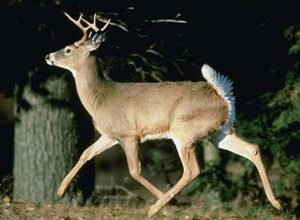
The white-tailed deer uses its bright white tail to warn other deer of danger:

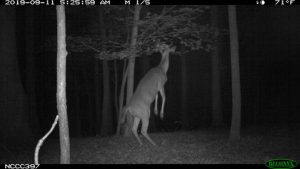
White-tailed deer sometimes stand on their hind legs to reach vegetation or fight:

Show transcript:

Welcome to Strange Animals Podcast. I’m your host, Kate Shaw.

Happy Halloween! It’s time for our spookiest episode of the year! It’s rated five out of five bats on our spookiness scale. If you like scary stories on Halloween, make some cocoa and popcorn and sit back to be spooked. If you’re not really a fan of the scarier stuff, you might want to skip this one. Some people also really don’t like hearing about diseases, and that’s one of the things we’ll be discussing. We’re going to talk about a really weird cryptid called the not-deer.

Before we get started, though, we have a little bit of housekeeping, as the big podcasters call it. First, I want to reassure everyone who has sent me suggestions that I’m trying to get to them as soon as possible. I love how many people listen and want to share their enthusiasm about animals, but I do feel bad that some people have been waiting a really long time for their suggestion to make it off of the massive humongous ever-growing ideas list into an episode.

At the same time, I’ve been thinking of ways to make money off the podcast without running ads. I make Strange Animals Podcast because I love helping people learn about animals and science, and I also really value the people who are able to support the podcast through Patreon. But I do put an awful lot of work into each episode, so much that it’s basically a second job. I thought about it, and decided to make a new Patreon tier that’s a little different from the others. It’s called the terror bird tier, and when I drew the art for it I forgot that terror birds didn’t have actual teeth, but we’ll call that artistic liberty. It’s a $25 a month tier, and not only do you get access to the bonus episodes that all patrons can listen to, after three months at that tier you can message me your episode idea AND tell me what week you’d like that episode to run. I’ve limited the new tier to 25 backers, to make it fair for people who don’t have the money for that, and honestly I don’t expect to get very many people at that level at all, because that’s a lot of money, but I thought I’d give it a try.

Finally, the Beyond Bigfoot & Nessie book is still available, as are my other books, and in 2024 I’m planning to attend some conventions again to sell copies of the book. I’ll let you know where I’ll be as I find out, in case you want to come say hi. I’m also very slowly working on a sequel to the book, tentatively titled Small Mysteries, which is all about mystery animals that are really small, like frogs and insects and teeny fish. It probably won’t be ready to publish for a few years, so I’m working hard to make sure it’s got a whole lot of footnotes with references. That’s one of the things I regret not doing for Beyond Bigfoot & Nessie.

Now, with all that out of the way, on to the spookiness!

The not-deer is a cryptid, or mystery creature, that’s mostly reported from the Appalachian region of the United States. I live in the southern Appalachians near the Smoky Mountains, but I’d never heard of the not-deer until a few months ago. I subscribe to Sharon Hill’s Strange Times newsletter, and also love her Spooky Geology website where you can learn all the science behind weird events like earthquake lights. There’s a link in the show notes, but you can search for https://spookygeology.com/ to find it. Sharon Hill wrote about the not-deer in mid-2023 in her newsletter, where she said the not-deer “looks like a deer until you REALLY look and find that it’s not a deer. It displays unsettling characteristics that scare the heck out of people.”

Reports vary, but in general, the not-deer is supposed to look like an ordinary deer at first glance, but then the witness realizes it’s really weird in some ways. Some people report that the deer appears to have extra joints in its legs, a misshapen or overly large head, an overly long neck or legs that are too long or too short, eyes that are close together on the front of its head instead of on the sides of its head as is normal with hoofed animals, and so on. It might walk on its hind legs like a human, and sometimes people say the creature appears to be unusually intelligent and not afraid of people.

The not-deer became popular online around the summer of 2020, especially on TikTok, with the term not-deer apparently coined in August 2019 on Tumblr, but the idea goes back several decades at least. According to Sharon Hill, Jerry Clark, the editor of Fate Magazine, collected two accounts of not-deer in 1971, although he didn’t call them not-deer because that term wasn’t invented yet.

To give you an idea of what we’re talking about, here are three accounts from a Reddit thread. I’ve reworded the stories to make them shorter and more appropriate for a general audience, but I haven’t changed any details.

First is a 2020 report from a Redditor in northern Georgia:

I live at the foothills of the Appalachian mountains halfway in between Chattanooga and Atlanta and sometimes my family takes trips to the mountains. One day up there me and my cousin drove around to just take in the views. At around 8pm we were headed back and were nearly at our cabin when we saw a deer on the side of the road. We slowed down but as we got close, it walked into the road. I hit the brakes and then it stood up and started walking around on its back legs. My cousin and I have been out in nature with animals our whole lives but we’d never seen anything like it. It just looked so wrong! Its joints didn’t move right and it had arms not front legs, and its upper half was like a human excluding the head.

The next story is from a Redditor in Virginia, who at the time of their encounter was riding a motorcycle slowly along the Skyline Drive in Shenandoah National Park at night, although when they encountered the deer they stopped to get a better look.

It was like a deer drawn by someone who had never seen a deer after someone else described it to them. It stood on the left side of the road on the mountainside, and I saw the eyes long before my headlight showed it fully. It was easily the biggest deer I’ve seen, and the lack of any antlers that time in the year suggested that it was a doe. The head was almost bovine in shape, the legs seemed too long in proportion to the body (think maned wolf proportions), and the body was extremely barrel chested.

As soon as I crossed into the other lane, it rose up onto its hind legs. It took two jerky, unnatural steps towards the center of the lane on 2 legs and froze again, staring directly at me. It suddenly shook its head wildly like a dog with a toy, took another short step, then HOPPED on two legs several times until it disappeared into the darkness on the right side of the road.

I turned the light towards the side of the road. On that side, there was a sheer drop off compared to the roadway, and the deer’s head was just peeking over the edge, still looking at me. The drop off was about 40 to 50 feet [that’s about 12 to 15 meters], so there’s no way it was standing at the base of the mountainside.”

Finally, in June of 2023 a Redditor wrote:

I believe I saw a not-deer 3 weeks ago on KY 10 just outside of Lenoxburg. I was driving home to Cincinnati and decided to take the back route. It was dusk and the deer were out and moving. I looked out to my driver’s side and saw a few deer in the field, however there was one closer to the road that was…off. It had small squatty hind legs and long almost ape-like front legs and its neck was too long. The second I laid eyes on it my stomach dropped and I felt a fear I’ve never experienced before. My dogs began to tremble and whine and the feeling didn’t go away until I got back across the river to Ohio.

The most common deer in the Appalachian Mountains is the white-tailed deer. It’s common throughout most of North and Central America down into northern South America. It’s also an invasive species in some parts of the world where people have introduced it as a game animal. Different populations and subspecies vary in size, but the Virginia subspecies found in Appalachia generally grows up to 4 feet tall at the shoulder at most, or about 1.2 meters. Males are larger than females on average. It’s crespuscular, meaning it’s most active at dawn and dusk.

In summer the white-tailed deer is reddish-brown, and in winter its coat is more gray-brown. It gets its name from the underside of its tail, which is bright white. When a deer feels threatened, it raises its tail to warn other deer to be alert, and to warn a potential predator that the deer has spotted it. Baby deer, called fawns, are born in spring and have white spots that help camouflage them in dappled sunlight and shade under trees.

The male white-tailed deer, called a buck or stag, starts growing a new set of antlers in the summer. Antlers are made of bone, but they grow faster than any other mammal bones. While they’re growing, they’re covered in a special type of highly vascularized skin called velvet. The velvet supplies nutrients and oxygen to the antler as it grows, and since the antlers grow so fast, they need a whole lot of nutrients. A deer in poor health or who can’t find enough to eat will grow small antlers, while a healthy deer who has lots to eat will grow larger antlers. Older males usually have bigger antlers than younger males too. The female deer, called a doe, is attracted to bucks with bigger antlers because she can be sure he’s healthy.

Once the antler has finished growing, it actually dies. The velvet dries up and the deer will rub his antlers on a branch or other object to help remove it. Because there are so many blood vessels in the velvet, sometimes a deer who is shedding the velvet has his antlers, head, and face splattered in blood, but he’s not hurt, just messy. Bucks use their antlers to fight each other, although they also use them to attack potential predators. Around the end of winter or early spring, the buck sheds his old antlers in preparation for growing a new set.

Many sightings of not-deer are probably due to people seeing diseased or injured deer. Two diseases that are especially hard on deer are Epizootic Hemorrhagic Disease, or EHD, and Chronic Wasting Disease, or CWD.

EHD is a virus spread by biting flies and midges, and while many species of deer can catch it, white-tailed deer are especially vulnerable to it. Humans can’t catch it, so don’t worry unless you are a deer. Symptoms of EHD include lameness, swelling of the head and neck, a lack of fear of humans, drooling and a runny nose, panting, and fever, which leads to sick deer sometimes lying down in water to cool off. Many deer who catch EHD eventually recover.

CWD is a more serious disease, sometimes called zombie deer disease. It’s related to the so-called mad cow disease found in cattle, and scrapie found in sheep and goats, and it can affect various species of deer. It’s always fatal but it can take a long time to develop, up to two years after exposure until the first symptoms. It’s caused when a protein in the animal’s nervous system is abnormally folded, a condition that spreads and causes neurodegeneration and holes in the brain. CWD is spread from animal to animal, but it can also spread through the environment in water and soil. So far the disease hasn’t been found to spread to humans.

Variations of CWD have been around for a very long time in various animals, but it was first identified in 1967 in a population of captive mule deer in Colorado. By 1981 it had spread to wild elk and it continues to spread in both wild and captive deer, although it’s still very rare. Symptoms include trembling and staggering, repetitive motions like walking in circles, grinding of teeth, drooling, confusion, and loss of fear of humans.

In addition to all this, perfectly healthy deer can have unusual behavior that isn’t witnessed by humans very often. Deer can and do stand and even walk short distances on their back legs, mostly to reach food growing up high. Does in particular will sometimes fight by standing on their hind legs and boxing each other with their front hooves. I own an amazing book called The Deer of North America by Leonard Lee Rue III, and here’s an interesting quote from that book:

“The oddest example of deer locomotion I ever heard of…was witnessed by five people. In July of 1967, the group had been out looking for deer when their trip was cut short by heavy rain. On the way home they saw two deer in a field of high weeds. Suddenly one of the deer raised both of his hind feet in the air, as if it were doing a handstand, balancing and walking on its forefeet. They thought the deer was injured and had to walk that way, but then the second deer did the same thing. Both deer walked on just their front legs for a distance of about 75 feet to where they could no longer be seen. […] We are constantly learning new things about deer.”

Leonard Lee Rue III suggested that the deer were just playing around and having fun.

Most people don’t know a whole lot about deer behavior. Most not-deer reports come from people who witnessed the creature while driving in the dark, so they didn’t get a very good look at it. Plus, as I’ve said over and over, people see what they expect to see. The not-deer has become popular online over the last few years, which means when someone is driving along and sees a deer behaving in what they think is an unusual manner, they remember the not-deer stories. Their brain automatically fills in details they can’t really see, leading to the person remembering things like a deer with human arms or six eyes.

In addition, people like telling spooky stories to scare each other. It’s probable that at least some of the scariest not-deer accounts are fiction. So if you see a deer, you don’t have to be scared. Just observe it and you might just learn something new about deer behavior. (Or something spooky will happen, in which case you have a great opportunity for a TikTok video.) Happy Halloween!

You can find Strange Animals Podcast at strangeanimalspodcast.blubrry.net. That’s blueberry without any E’s. If you have questions, comments, or suggestions for future episodes, email us at strangeanimalspodcast@gmail.com. We also have a Patreon at patreon.com/strangeanimalspodcast if you’d like to support us for as little as one dollar a month and get monthly bonus episodes.

Thanks for listening!
Episode 350: Bigfeet and Littlefeet

It’s another spooky episode (three out of five bats on this year’s spookiness scale), with suggestions from Will and Pranav!

Further reading:

Tracking the Swamp Monsters

Further watching:

The Harlan Ford Footage (Honey Island Swamp Monster)

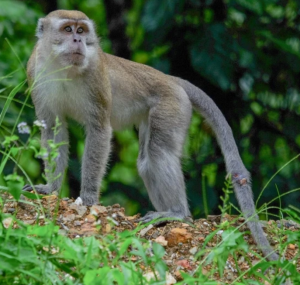
A crab-eating macaque:

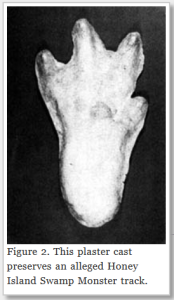
A plaster cast purportedly from the Honey Island Swamp Monster’s footprints [photo from article linked above]:

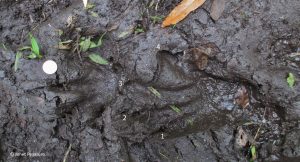
Alligator tracks in the mud [photo from this site]:

Show transcript:

Welcome to Strange Animals Podcast. I’m your host, Kate Shaw.

This week as monster month continues, we’ll learn about three more strange bipedal monsters suggested by Will and Pranav. This is another episode that I’ll give three out of five bats for spookiness. We’ve definitely got some spooky monsters this year (also you may be sensing a theme).

We’ll start with Will’s suggestion, the yara-ma-yha-who. We talked about it once before back in episode 219, but it’s such a strange monster that it definitely deserves more attention.

According to a 1932 book called Myths and Legends of the Australian Aboriginals, the yara-ma-yha-who is a little red goblin creature that stands about four feet tall, or 1.2 meters. It’s skinny all over except for its head and belly, and its mouth is especially big, like a frog’s mouth. It doesn’t have any teeth, but it can open its jaws incredibly wide like a snake, which allows it to swallow its food whole. And what is its food? People!

The yara-ma-yha-who was supposed to live in trees, especially the wild fig tree that has thick branches. In the summer when someone would stop under the tree for shade, or in the winter when it was rainy and someone would stop for shelter, the yara-ma-yha-who would drop down and grab the person.

The ends of the yara-ma-yha-who’s fingers were said to be cup-shaped suckers, and when the suckers fastened onto a person’s arm, they were able to suck blood right through the person’s skin. After the person became weak from blood loss and fainted, the yara-ma-yha-who was able to swallow them whole.

After that, the yara-ma-yha-who would drink a lot of water and fall asleep, and when it woke up it would vomit up its meal. If the person was still alive, they were supposed to lie still and pretend to be dead even while the yara-ma-yha-who poked at them to see if they responded. If the person moved, the yara-ma-yha-who would swallow them again and the whole thing would start over. But every time a person was swallowed by the little red goblin, when they were vomited up again they were shorter and redder, until after three or four times if they couldn’t get away, the person was transformed into another yara-ma-yha-who.

Some cryptozoologists speculate that the yara-ma-yha-who may be based on the tarsier, which is the subject of episode 219 and why we talked about this particular monster in that episode. The tarsier has never lived in Australia, although it does live in relatively nearby islands. Most tarsier species have toe pads that help them cling to branches, but so do many frogs that do live in Australia. It’s much more likely that the legend of the yara-ma-yha-who was inspired by frogs, snakes, monitor lizards, and other Australian animals. More importantly, the monster was used as a cautionary tale to warn children not to go off by themselves into the bush.

Unfortunately, the only information about the yara-ma-yha-who comes from this 1932 book. We don’t know which Aboriginal peoples this story was collected from, and we don’t know how much it was changed in translation to English. It’s still a fun story, though.

Next, we’ll talk about Pranav’s suggestions. Last week we talked about the monkey-man of New Delhi, and one of the monsters we’ll cover today is also a monkey-man from Asia, this time from Singapore. It’s the Bukit Timah Monkey-Man, said to mainly live in the Bukit Timah rainforest nature reserve but occasionally seen in the city surrounding the nature reserve.

The Bukit Timah Monkey-Man is supposed to look like a monkey the size of a human. It walks like a human on two legs and otherwise looks like a person, but is covered in gray hair and has a monkey-like face. It’s only ever seen at night and although people are scared when they see it, the monster has never attacked anyone and doesn’t seem to be interested in people at all. The oldest report possibly dates back to 1805, or to the 1940s according to other accounts, but sightings are rare.

One very common monkey that lives in Bukit Timah is the crab-eating macaque, also called the long-tailed macaque and I bet you can guess why. Its tail is longer than its body, although its arms and legs are shorter than in most monkeys. It mostly lives on the ground and eats pretty much anything, although most of its diet is fruit and other plant materials. It does sometimes eat crabs, and is good at swimming and diving to find them, but it also eats bird eggs and nestlings, lizards, frogs, insects, and other small animals. It even has a cheek pouch where it can store extra food to eat later.

Like the rhesus macaque we talked about last week, the crab-eating macaque is pretty small, with a big male weighing about 20 lbs, or 9 kg, at most. That’s about the size of a small dog. The fur on its back and head is a light golden brown, and its face, arms and legs, and underparts are gray with white markings. Its tail is usually darker brown. In other words, in the dark it might look like it’s pale gray all over but its tail is harder to see, and the monkey-man isn’t reported to have a tail.

The crab-eating macaque is common in the city of Bukit Timah, and in fact it’s common in a lot of cities and is even an invasive species in some parts of the world. People in Bukit Timah are used to seeing this particular type of monkey, but it’s so small that no one could mistake it for a human-sized monster. Then again, most of the stories about the monkey-man are friend-of-a-friend stories, often told by children to scare each other. It’s very likely that the Bukit Timah monkey-man is just an urban legend.

Our last monster this week is another suggestion by Pranav, the Honey Island Swamp monster. This one is from the United States, specifically the Honey Island Swamp in St. Tammany Parish, Louisiana.

In 1974, a couple of hunters claimed they found strange footprints in the swamp, and had seen the monster itself back in 1963. They said it stood seven feet tall, or over 2 meters, and was covered with long gray hair. Its eyes were a brilliant amber in color. The monster was on all fours at first, but when it heard the men talking it stood up to look at them, then ran away. Heavy rain later that day washed its tracks away.

When the men saw the same tracks in 1974, they used plaster to make copies of the footprints. But the footprints don’t look like plaster casts of other bigfoot-type tracks, which resemble giant human footprints. The swamp monster appears to have four toes that are spread widely apart, with one sticking out to the side like a thumb, and show the impression of webbing in between. It’s also not that big of a foot, not quite 10 inches long, or 25 cm.

Both the hunters were air traffic controllers, which is a job that requires people to make decisions carefully and remain calm in stressful situations, in order to keep airplanes from crashing into each other. These were the sort of people you’d trust if they told you they’d seen something really weird in the swamp. The two men were even interviewed for an episode of the TV show “In Search Of” that aired in 1978, which popularized the Honey Island Swamp monster outside of the local area. Both men continued to search for the monster, reporting that they’d caught at least one more glimpse of it and had even shot at it without apparently hitting it.

One of the men, Harlan Ford, died in 1980. He had taken up wildlife photography after his retirement and when his granddaughter was going through his belongings, she found some Super 8 film footage that showed something very peculiar. It was a brief video of the swamp, but if you look closely, a shadowy human-sized figure crosses behind trees from right to left, visible for maybe half a second. I put a link in the show notes if you want to look at the footage yourself. It took me two watches before I noticed the figure and to me it looks like the shadow of a human walking normally, but it’s so grainy it’s hard to tell.

It’s possible that the two men decided to have fun with a harmless prank about a monster in the swamp, but so many people took them seriously that it kind of got out of hand. Then again, maybe they did genuinely see something unusual. That doesn’t mean it was an actual monster, though. Black bears do live in the swamp, and my personal theory is that bears are responsible for a whole lot of bigfoot sightings.

The American alligator is also common in the area. The gator’s front feet have five toes, but the hind feet only have four. The toes are webbed to help the gator swim more easily, and the front foot’s pinkie toe usually sticks out to the side. Sometimes the first two toes of the front foot are held close enough together that they look like one big toe. Usually an alligator drags its tail as it walks, but it also has a gait called the high walk where its tail is completely off the ground. The plaster tracks found by the two hunters in 1974 look suspiciously like a really big alligator print, probably twice the size of an ordinary adult gator.

More importantly, people who have lived in the Honey Island swamp their entire lives, fishing and hunting and running boat tours, don’t report ever seeing an animal they don’t recognize. Maybe there is an incredibly rare monster that lives in the swamps and walks bipedally at least part of the time, but more likely the Honey Island Swamp Monster is a tall tale.

There are a lot of reasons why people tell stories about swamp monsters or monkey-men or murderous red goblins. It’s a good way to stop little kids from wandering around in dangerous places, and it’s fun to scare yourself and others with a story when you know you’re actually safe. There are plenty of dangerous animals in the world, many of which are completely unknown to science. I just don’t think these three are ones you need to worry about.

You can find Strange Animals Podcast at strangeanimalspodcast.blubrry.net. That’s blueberry without any E’s. If you have questions, comments, or suggestions for future episodes, email us at strangeanimalspodcast@gmail.com. We also have a Patreon at patreon.com/strangeanimalspodcast if you’d like to support us for as little as one dollar a month and get monthly bonus episodes.

Thanks for listening!
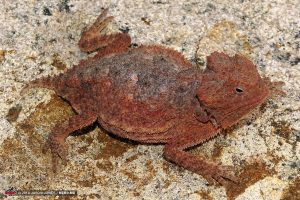
Episode 348: Australopithecus and Gigantopithecus

Thanks to Anbo for suggesting Australopithecus! We’ll also learn about Gigantopithecus and Bigfoot!

Further reading:

Ancient human relative, Australopithecus sediba, ‘walked like a human, but climbed like an ape’

Human shoulders and elbows first evolved as brakes for climbing apes

You Won’t Believe What Porcupines Eat

Past tropical forest changes drove megafauna and hominin extinctions

An Australopithecus skeleton [photo by Emőke Dénes – kindly granted by the author, CC BY-SA 4.0, https://commons.wikimedia.org/w/index.php?curid=78612761]:

Show transcript:

Welcome to Strange Animals Podcast. I’m your host, Kate Shaw.

It’s officially monster month, also known as October, so let’s jump right in with a topic suggested by Anbo! Anbo wanted to learn about Australopithecus, and while we’re at it we’re going to talk about Gigantopithecus and Bigfoot. On our spookiness rating scale of one to five bats, where one bat means it’s not a very spooky episode and five bats means it’s really spooky, this one is going to fall at about two bats, and only because we talk a little bit about the Yeti and Bigfoot at the end.

In 1924 in South Africa, the partial skull of a young primate was discovered. Primates include monkeys and apes along with humans, our very own family tree. This particular fossil was over a million years old and had features that suggested it was an early human ancestor, or otherwise very closely related to humans.

The fossil was named Australopithecus, which means “southern ape.” Since 1924 we’ve discovered more remains, enough that currently, seven species of Australopithecus are recognized. The oldest dates to a bit over 4 million years old and was discovered in eastern Africa.

Australopithecus was probably pretty short compared to most modern humans, although they were probably about the size of modern chimpanzees. A big male might have stood about 4 ½ feet tall, or 1.5 meters. They were bipedal, meaning they would have stood and walked upright all the time. That’s the biggest hint that they were closely related to humans. Other great apes can walk upright if they want, but only humans and our closest ancestors are fully bipedal.

In 2008 a palaeoanthropologist named Lee Rogers Berger took his nine-year-old son Matthew to Malapa Cave in South Africa. Dr. Berger was leading an excavation of the cave and Matthew wanted to see it. While he was there, Matthew noticed something that even his father had overlooked. It turned out to be a collarbone belonging to an Australopithecus boy who lived almost 2 million years ago. Later, Dr Berger’s team uncovered more of the skeleton and determined that the remains belonged to a new species of Australopithecus, which they named Australopithecus sediba. More remains of this species were discovered later, including a beautifully preserved lower back. That discovery was important because it allowed scientists to determine that this species of Australopithecus had already evolved the inward curve in the lower back that humans still have, which helps us walk on two legs more easily. That was a surprise, since A. sediba also still shows features that indicate they could still climb trees like a great ape.

It’s possible that Australopithecus, along with other species of early humans, climbed trees at night to stay safe from predators. In the morning, they climbed down to spend the day mostly on the ground. One study published only a few weeks ago as this episode goes live suggests that the flexible shoulders and elbows that humans share with our great ape cousins originally evolved to help apes climb down from trees safely. Monkeys don’t share our flexible shoulder and elbow joints because they’re much lighter weight than a human or ape, and don’t need as much flexibility to keep from falling while climbing down. Apes and hominins like humans can raise our arms straight up over our heads, and we can straighten our arms out completely flat. Australopithecus could do the same. The study suggests that when another human ancestor, Homo erectus, figured out how to use fire, they stopped needing to climb trees so often. They evolved broader shoulders that allowed them to throw spears and other weapons much more accurately.

Australopithecus probably mostly ate fruit and other plant materials like vegetables and nuts, along with small animals that they could catch fairly easily. This is similar to the diet of many great apes today. The big controversy, though, is whether Australopithecus made and used tools. Their hands would have been more like the hands of a bonobo or chimpanzee, which have a lot of dexterity, but not the really high-level dexterity of modern humans and our closest ancestors. Stone tools have been found in the same areas where Australopithecus fossils have been found, but we don’t have any definitive proof that they made or used the tools. There were other early hominins living in the area who might have made the tools instead.

We also don’t really know what Australopithecus looked like. Some scientists think they had a lot of body hair that would have made them look more like apes than early humans, while some scientists think they had already started losing a lot of body hair and would have looked more human-like as a result.

There’s no question these days that Australopithecus was an early human ancestor. We don’t have very many remains, but we do have several skulls and some nearly complete skeletons, which tells us a lot about how our distant ancestor lived. But we know a lot less about a fossil ape that lived as recently as 350,000 years ago, and it’s become confused with modern stories of Bigfoot.

Gigantopithecus first appears in the fossil record about 2 million years ago. It lived in what is now southern China, although it was probably also present in other parts of Asia. It was first discovered in 1935 when an anthropologist identified two teeth as belonging to an unknown species of ape, and since then scientists have found over a thousand teeth and four jawbones, more properly called mandibles.

The problem is that we don’t have any other Gigantopithecus bones. We don’t have a skull or any parts of the body. All we have are a few mandibles and lots and lots of teeth. The reason we have so many teeth is because Gigantopithecus had massive molars, the biggest of any known species of ape, with a protective layer of enamel that was as much as 6 mm thick. Some of the teeth were almost an inch across, or 22 mm. A lot of the remaining bones were probably eaten by porcupines, and in fact the mandibles discovered show evidence of being gnawed on. This sounds bizarre, but porcupines are well-known to eat old bones along with the shed antlers of deer, which supplies them with important nutrients. The teeth were too hard for the porcupines to eat.

We know that Gigantopithecus was a big ape just from the size of its mandible, but without any other bones we can only guess at how big it really was. It was potentially much bigger and taller than even the biggest gorilla, but maybe it had a great big jaw but short legs and it just sat around and ate plants all the time. We just don’t know.

What we do know is that its massive jaw and teeth were adapted for eating fibrous plant material, not meat. The thick enamel would help protect the teeth from grit and dirt, which suggested it ate tubers and roots that would have had a lot of dirt on them, although its diet was probably more varied. Scientists have even discovered traces of seeds from fruits belonging to the fig family stuck in some of the fossilized teeth, and evidence of tooth cavities that would have resulted from eating a lot of fruit long before toothpaste was invented.

Many scientists thought at first that Gigantopithecus was a human ancestor, but one that grew to gigantic size. It was even thought to be a close relation to Australopithecus. Other scientists argued that Gigantopithecus was more closely related to modern great apes like the orangutan. The debate on where Gigantopithecus should be classified in the ape and human family tree happened to overlap with another debate about a giant ape-like creature, the Yeti of Asia and the Bigfoot of North America.

We talked about the Yeti way back in episode 35, our very first monster month episode in 2017. Expeditions by European explorers to summit Mount Everest, which is on the border between China and Nepal, started in 1921. That first expedition found tracks in the snow resembling a bare human foot at an elevation of 20,000 feet, or 6,100 meters. They realized the tracks were probably made by wolves, with the front and rear tracks overlapping, which only looked human-like after the snow melted enough to obscure the paw pads. Expedition leader Charles Howard-Bury wrote in a London Times article that the expedition’s Sherpa guides claimed the tracks were made by a wild hairy man, but he also made it clear that this was just a superstition. But journalists loved the idea of a mysterious wild man living on Mount Everest. One journalist in particular, Henry Newman, interviewed the guides and specifically asked them about the creature. He wrote a sensational account of the wild man, but he mistranslated their term for it as the abominable snowman.

The word Yeti comes from a Sherpa term yeh-teh, meaning “animal of rocky places,” although it may be related to the term meh-teh, which means man-bear. But the peoples who live in and around the Himalayas belong to different cultures and speak a lot of different languages. There are lots of stories about the hairy wild man of the mountains, and lots of different words to describe the creature of those stories. And the idea of the Yeti that has become popular in Europe and North America doesn’t match up with the local stories. Locals describe the Yeti as brown, black, or even reddish in color, not white, and it doesn’t always have human-like characteristics. Sometimes it’s described as bear-like, panther-like, or just a general monster.

The abominable snowman, or Yeti, became popular in newspaper articles after the 1921 Mount Everest expedition, and it continued to be a topic of interest as expeditions kept attempting to summit the mountain. It wasn’t until May 26, 1953 that the first humans reached the tippy-top of Mount Everest, the New Zealand explorer Edmund Hillary and the Nepali Sherpa climber Tenzing Norgay. Many other successful expeditions followed, including some that were mounted specifically to search for the Yeti.

In the meantime, across the planet in North America, a Canadian schoolteacher and government agent named John W. Burns was collecting reports of hairy wild men and giants from the native peoples in British Columbia. He’s the one who coined the term Sasquatch in 1929. In the 1930s, a man in Washington state in the U.S, which is close to British Columbia, Canada, carved some giant feet out of wood and made tracks with them in a national forest to scare people, leading to a whole spate of big human-like tracks being faked in California and other places. But it wasn’t until 1982 that the hoaxes started to be revealed as the perpetrators got old and decided to clear up the mystery.

But in the 1920s and later, the popularity of the abominable snowman in popular media, giant gorillas like King Kong in the movies, the Yeti expeditions in the Himalayas, the mysterious giant footprints on the west coast of North America, and John Burns’s articles about the Sasquatch all combined to make Bigfoot, a catchall term for any giant human-like monster, a modern legend. People who believed that Bigfoot was a real creature started looking for evidence of its existence beyond footprints and reports of sightings. In 1960, a zoologist writing about a photograph of supposed Yeti tracks taken in 1951 suggested that the Yeti might be related to Gigantopithecus.

On the surface this actually makes sense. The Yeti, AKA the abominable snowman, is reported in the Himalayan Mountains of Asia. The mountain range started forming 40 to 50 million years ago when the Indian tectonic plate crashed into the Eurasian plate very slowly, pushing its way under the Eurasian plate and scrunching the land up into massively huge mountains. It’s still moving, by the way, and the Himalayas get about 5 mm taller every year. The eastern section of the Himalayas isn’t that far from where Gigantopithecus remains have been found in China, and we also know that at many times in the earth’s recent past, eastern Asia and western North America were connected by the land bridge Beringia. Humans and many animals crossed Beringia to reach North America, so why not Gigantopithecus or its descendants? That would explain why Bigfoot is so big, since in 1957 one scientist estimated that Gigantopithecus might have stood up to 12 feet tall, or 3.7 meters.

Some people still think Gigantopithecus was a cousin of Australopithecus, that it walked upright but was huge, and that its descendants are still around today, hiding in remote areas and only glimpsed occasionally. But people who believe such an idea are stuck in the past, because in the last 60 years we’ve learned a whole lot more about Gigantopithecus.

These days, more sophisticated study of Gigantopithecus fossils have allowed scientists to classify it as a great ape ancestor, not an early human. Gigantopithecus was probably most closely related to modern orangutans, in fact, and may have shared a lot of traits with orangutans. It probably could walk upright if it wanted to, but it wasn’t fully bipedal the way humans and human ancestors are. One theory prevalent in 2017 when we talked about the Yeti before was that Gigantopithecus mostly ate bamboo and might have gone extinct when the giant panda started competing with its food sources. This theory has already fallen out of favor, though, and we know that Gigantopithecus was eating a much more varied diet than just bamboo.

We also know that Gigantopithecus lived in tropical broadleaf forests common throughout southern Asia at the time. About a million years ago, though, many of these forests became grasslands. Gigantopithecus probably went extinct as a direct result of its forest home vanishing. It just couldn’t find enough food and shelter on open grasslands, and even though it held on for hundreds of thousands of years, by about 350,000 years ago it had gone extinct. Around 100,000 years ago the forests started reclaiming much of these grasslands, but by then it was too late for Gigantopithecus. Meanwhile, the oldest evidence we have of the land bridge Beringia joining Asia and North America was 70,000 years ago.

There is no evidence that any Gigantopithecus descendant survived to populate the Himalayas or migrated into North America. For that matter, there’s no evidence that Bigfoot actually exists. If a live or dead Bigfoot is discovered and studied by scientists, that would definitely change a lot of things, and would be really, really exciting. But even if that happened, I’m pretty sure we’d find that Bigfoot wasn’t related to Gigantopithecus. Whether it would be related to Australopithecus and us humans is another thing, and that would be pretty awesome. But first, we have to find evidence that isn’t just some footprints in the mud or snow.

Some Bigfoot enthusiasts suggest that the reason we haven’t found any Bigfoot remains is the same reason why we don’t have Gigantopithecus bones, because porcupines eat them. But while porcupines do eat old dry bones they find, they don’t eat fresh bones and they don’t eat all the bones they find. For any bone to fossilize is rare, so the more bones that are around, the more likely that one or more of them will end up preserved as fossils. Bones of modern animals are much easier to find, porcupines or no, but we don’t have any Bigfoot bones. We don’t even have any Bigfoot teeth, which porcupines don’t eat.

Porcupines can be blamed for a lot of things, like chewing on people’s cars and houses, but you can’t blame them for eating up all the evidence for Bigfoot.

You can find Strange Animals Podcast at strangeanimalspodcast.blubrry.net. That’s blueberry without any E’s. If you have questions, comments, or suggestions for future episodes, email us at strangeanimalspodcast@gmail.com. We also have a Patreon at patreon.com/strangeanimalspodcast if you’d like to support us for as little as one dollar a month and get monthly bonus episodes.

Thanks for listening!