Podcast: Play in new window | Download (Duration: 20:24 — 19.2MB)
If you look at this episode and think, “Oh, ho hum, think I’ll skip this one because snore, jellyfish,” you are so wrong! Jellies are fascinating, creepy, and often beautiful. Come learn all about our squishy friends in the sea!
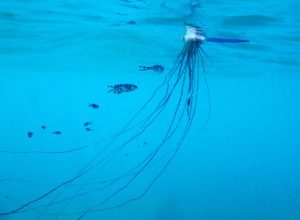
A Portuguese man o’war. Creepy as heck:
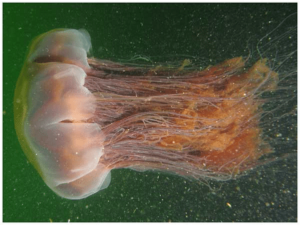
A lion’s mane jelly. You do not want this guy on your ship. Incidentally, a lot of the photos you find of divers with enormous lion’s mane jellies are fakes that make the jellies look gigantic.
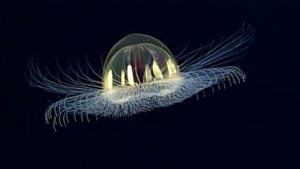
The cosmic jelly, a deep-sea creature:
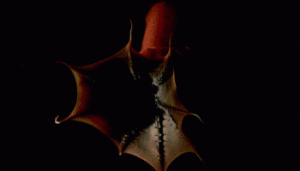
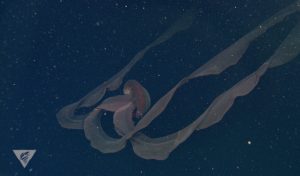
The creepy Stygiomedusa gigantea, guardian of the underworld:
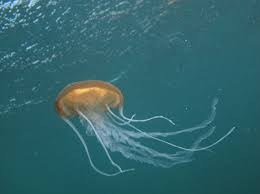
A newly discovered golden jelly.
Further reading:
Jelly Biologist (I’ve been enjoying browsing this site)
Show transcript:
Welcome to Strange Animals Podcast. I’m your host, Kate Shaw.
This week’s episode is about jellyfish—also called jellies, which is more accurate since they’re not fish at all.
Originally, I was going to focus on the Portuguese man o’war, another in the ongoing feature of “animals that scared me as a kid” and technically not even a jelly. But there’s so much to learn about jellies that we’re going to cover a whole lot more than that.
Jellies are interesting animals, to say the least. Their bodies have radial symmetry, meaning they’re the same in all directions. While the body shape varies, most jellies have a bell-like shape. The bell is generally rather thin, made up of an external covering, an internal covering, and an elastic gel-like material in between. Inside, the jelly has a digestive cavity with four to eight oral arms surrounding the mouth and long tentacles hanging beneath. The jelly also has a simple nerve net that can detect light and react to other stimuli, and which takes the place of a brain.
Jellies don’t have brains. They don’t have hearts, specialized sensory organs, or much of anything else. But they’ve been around for some 650 million years, possibly much longer, so clearly it all works.
The jelly’s life cycle is pretty weird. Most start out as polyps that stick to rocks or shells and use their little tentacles to catch microscopic organisms. A polyp can bud, producing new polyps that are clones of the original. Eventually, a polyp will constrict its body and develop into a stack of larvae. Each larva develops into a tiny jelly, which separates from the stack and swims away.
Once it’s grown, a jelly reproduces by releasing sperm, if it’s male, which the water carries to the female to fertilize her eggs. Some female jellies have brood pouches on the oral arms, some just carry the fertilized eggs inside the body while they develop. The embryos develop into swimming larvae called planula, which leave the female and attack themselves to something firm, where they transform into polyps.
This seems needlessly complicated, but again, it works for the jelly.
Polyps can live for years, while adult jellies, which I’m delighted to report are called medusas, usually only live a few months. The immortal jellyfish throws another step into this process. It can transform back into a polyp from any stage of its life if it needs to. As a polyp, the immortal jellyfish is tiny, only about a millimeter long. As a full-grown medusa it’s not all that much bigger, less than four millimeters in diameter. Because it can transform back into a polyp as many times as it needs to, apparently without any kind of degradation or injury, the immortal jellyfish is effectively, well, immortal.
Before you get too excited, though, keep in mind that there’s not a whole lot of research into the immortal jellyfish yet. It’s not even known if they will transform back into polyps in the wild, since it’s only ever been observed in captivity.
Almost all jellies have stinging cells, usually concentrated on the tentacles or oral arms, which they use to stun and kill prey. The stinging cells contain venom-filled nematocysts, which are coiled structures that uncoil and sting when touched. Humans are not jelly prey, but jelly stings can still be uncomfortable—and sometimes fatal—to humans.
You’ve probably heard of the infamous box jellyfish, the most dangerous species of which is common around Australia. Unlike most jellies, box jellyfish have true eyes and a relatively well-developed nervous system. They’re active, hard for humans to detect while swimming since they’re nearly transparent, and in the case of Chironex fleckeri, their venom can kill a human in as little as two minutes. Most fatalities occur in children, but most stings don’t result in death.
Another vicious and occasionally fatal stinger is the Portuguese man o’war, although it isn’t actually a jelly. It’s not even a single animal, it’s a colony. One member is the float, another the feeding polyps, and so forth. The man o’war takes its name from a type of ship, which the float somewhat resembles. The float is bluish or purplish, generally under a foot long [30 cm], and filled with gas. Underneath the float are feeding polyps from which hang purple tentacles, typically around 30 feet long [9 m] but sometimes up to 200 feet long [61 m]. If something attacks the man o’war, it can vent some of the gas in its bladder and submerge temporarily.
When I was a kid, my family occasionally went to the beach in North Carolina. Man o’wars are tropical animals but they do occasionally drift farther north. I was fully aware of this as a kid and did not want to get in the water farther than my waist. My grandfather and one of my aunts reassured me that they’d both been stung by a man o’war once, and it wasn’t any more painful than a wasp sting.
That did not make me feel any better. In fact, it made me even more scared because then I KNEW there were man o’wars out there. I wasn’t afraid of being stung, I was afraid of touching those creepy tentacles.
As it happens, my grandfather and Aunt Barbara probably had not encountered a Portuguese man o’war but a smaller animal called a by-the-wind sailor, which is now my favorite name of anything. It has a blue bladder float like the man o’war, but its sting is much milder, A man o’war sting is incredibly painful, more of a shock, that can lead to intense muscle and joint pain, open wounds on the skin at the sting site, headache, chills and fever, nausea, and can cause victims to faint and drown. Occasionally the venom travels to the lymph nodes and causes even more serious symptoms, including swelling of the larynx, an inability to breathe, and cardiac distress. Even a dead man o’war can sting if you touch its tentacles. Why would you touch its tentacles.
I’m not the only one who feels this way about man o’wars, clearly, because one of its other names if the floating terror. That sounds like the title of a pulp science fiction novel.
The bluebottle is a smaller related species found in the Indian and Pacific Oceans. The man o’war is found in those oceans and the Atlantic. A few weeks ago, in early May 2017, hundreds of man o’wars washed ashore in Georgia and South Carolina. Man o’wars are pretty common around Florida, especially in winter, and occasionally they wash ashore in the thousands.
The man o’war eats fish and other organisms that get caught in the stinging tentacles, but there are some fish that live among the tentacles, even feeding on them, like the man o’war fish and the clownfish. Not a lot of things eat Portuguese man o’wars, but the loggerhead turtle and ocean sunfish do. I like them both. The blanket octopus is immune to the man o’war’s venom and may carry broken-off tentacles to deter predators.
If you’re stung by a man o’war, treat the sting the same way you’d treat other jelly stings. Rinse with vinegar to remove any remaining bits of tentacle or nematocysts, then apply heat for 45 minutes, either with a hot pack or by immersing in hot water. Don’t rinse with urine or vodka; it can make the stings worse—and definitely don’t rinse with fresh water. If you don’t have vinegar, rinse with sea water, but keep in mind that you may be pouring nematocysts back onto the patient with the water. This treatment is from a very recent study conducted by researchers at the University of Hawaii at Manoa, released only a few weeks ago as this episode goes live, so if you’ve heard differing advice for jelly stings, it may be out of date.
Jellies are related to some surprising things: coral, sea anemones, a rare parasitic worm, the freshwater hydra—a ten mm long tubular animal with stinging tentacles at one end that it can stretch four or five times the length of the body to catch its tiny prey. Like jellies, the hydra can regenerate parts of its body if they’re injured or bitten off. And the hydra doesn’t appear to age, making it biologically immortal, although in a different way than the immortal jellyfish.
So what’s the largest jelly known, not counting ridiculously long tentacles like the man o’war’s? That would be the lion’s mane jellyfish. Its bell can have a diameter of over seven feet [2 m] and it has pretty darn long tentacles, too—sometimes over 120 feet long [36.5 m]. It likes cold water and the biggest individuals live where it’s coldest. While small individuals are brown or tan in color, the big ones are usually red or purple. The sting of a lion’s mane jellyfish isn’t usually that bad, but it has a lot of tentacles, so it can inflict thousands of stings upon contact.
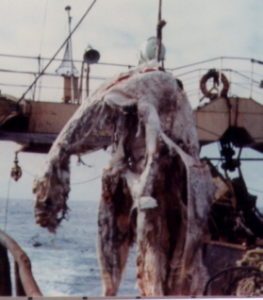
In 1973, the Australian ship Kuranda collided with a huge jelly in the South Pacific while traveling through a storm on her way to the Fiji Islands. The jelly was so enormous that the deck was covered in jellyfish goo and tentacles up to two feet deep [61 cm]. One crew member died after getting stung. The weight of the jelly was so great, an estimated 20 tons [18 metric tons] that it started to push the ship nose-down and the captain, Langley Smith, sent out an SOS. The salvage tug Hercules arrived and sprayed the Kuranda’s deck with a high-pressure hose, dislodging the jelly. Samples were sent to Sydney and tentatively identified as a lion’s mane jelly.
But remember, lion’s mane jellies don’t live in the warm waters near Fiji and Australia. There are other reports of lion’s mane jellies seen in the area, though, so it’s possible there’s a gargantuan warm-water variety that hasn’t been discovered yet.
Most jellies live near the surface of the ocean, but there are some deep-sea species known, with more being discovered every year. A gorgeous jelly, dubbed the cosmic jellyfish by the press, was spotted 9,800 feet [2987 m] below the surface near American Samoa this February. It has an umbrella-like bell with short tentacles that point both downward and upward. You may have seen it in the news described as looking like a flying saucer, which it does. A similar jelly was discovered in the Mariana Trench in 2016, almost two and a half miles underwater [4 km]. These are lovely jellies with translucent bells and glowing red and yellow innards, but there are less lovely ones down there.
The big red jellyfish discovered in 2002 is an ugly cuss. It lives in waters up to 4900 feet deep [1493 m] and is over a foot in diameter [30 cm]. It’s dull red in color and doesn’t have tentacles, just thick oral arms.
Stygiomedusa gigantea, also known as the guardian of the underworld by at least one website, and now by me, isn’t so much ugly as horrifying. Its bell is some three feet across [1 m], and while it doesn’t have tentacles or even stinging cells, it does have four 30-foot-long [9 m] oral arms that resemble dark brown or reddish strips of cloth that drift in the ocean currents.
Some deep-sea jellies don’t have tentacles or oral arms. Deepstaria enigmatica, a rare jelly described in 1967, basically just looks like a big mesh bag. Its close relative, Deepstaria reticulum, is very similar, but it’s reddish instead of whitish. The Deepstaria hangs motionless in the deep with its three-foot-wide [1 m] bell open, waiting for something to swim into it. When it does, the bell contracts like a bag, the fish or other organism is stung by nematocysts lining the bell, and the jelly pushes its stunned prey into its mouth with tiny cilia inside the bell.
Isopods, which are small crustaceans, frequently hitch rides inside Deepstaria bells. It’s not known if they’re parasites or confer some benefits to the jellies, but they don’t seem to be affected by the stings.
There are plenty of mysteries associated with enormous jellies, although the two most famous ones I dug into started to seem less and less likely once I got closer to the primary sources. According to Eric Frank Russell in his 1957 book Great World Mysteries, in 1953 a diver testing a new type of deep-sea diving suit in the South Pacific saw an enormous jelly-like monster kill a shark. The diver had been testing how deep he could dive in the suit and noticed a fifteen-foot [4.6 m] shark following him down. I’m going to quote the relevant section instead of paraphrasing, because it’s pretty amazing.
“The shark was still hanging around some 30 feet [9 m] from me and about 20 feet [6 m] higher, when I reached a ledge below which was a great black chasm of enormous depth. It being dangerous to venture farther, I stood looking into the chasm while the shark waited for my next move. Suddenly the water became distinctly colder. While the temperature continued to drop with surprising rapidity, I saw a black mass rising from the darkness of the chasm. It floated upwards very slowly. As at last light reached it I could see that it was of a dull brown color and tremendous size, a flat ragged-edged thing about one acre in extent. It pulsated sluggishly and I knew that it was alive despite its lack of visible limbs or eyes. Still pulsating, this frightful vision floated past my level, by which time the coldness had become most intense. The shark now hung completely motionless, paralyzed either by cold or fear. While I watched fascinated, the enormous brown thing reached the shark, contacted it with its upper surface. The shark gave a convulsive shiver and was drawn unresisting into the substance of the monster. I stood perfectly still, not daring to move while the brown thing sank back into the chasm as slowly as it had emerged. Darkness swallowed it and the water started to regain some warmth.”
I am skeptical, I admit. Eric Frank Russell was primarily a science fiction writer and this sounds like something from a novel, probably one called The Floating Terror. If he described the monster as 20 feet across or even 30 or 40 [6, 9, 12 m], I’d be going, “Hmm, but hey, the deep sea is full of amazing things.” But an acre? That’s 208 feet 9 inches across. 43,450 square feet. A lot of meters [4,046 square meters]. It’s three times the size of my yard, which takes me like an hour to mow. It’s just too big to believe, not without corroborating details—like a first-hand account of the actual diver. We don’t even know his name. And what about the diver’s buddy? Divers don’t go down alone, although maybe they did back in 1953. The whole story is just too thin, too fantastical to be believed.
The other promising mystery I looked into is a supposed legend from Chile, a sea monster that resembles a cow hide stretched flat but with eyes all around the edges and four big eyes in the middle. It rises to the ocean’s surface and swallows animals it encounters.
At first glance this sounds ridiculous, until you realize that many jellies have semi- or fully transparent bells and their internal organs, such as they are, may resemble eye-like blobs in the center of their bodies. Some jellies do have light-sensitive eye spots near their edges too. But the research I did to follow up this story, which I took from Karl Shuker’s blog, but which is originally from Jorge Luis Borges’ 1969 book called The Book of Imaginary Beings, indicated that the actual legend is much different and much less jelly-like.
El Cuero is a cowhide monster called Threquelhuecuvu among the Mapuche of Patagonia. It lives in rivers, lakes, and the ocean. It’s nearly circular, has claws around its edges, and one pair of red eyes. It also has tentacles on its head and a mouth in its middle, which it uses to suck bodily fluids from its prey. It’s supposed to come out of the water and come on land, and when an animal steps on it, it wraps its body around the animal and suffocates it. Then it drags its prey into the water to eat it. The only way to kill it is to throw cacti into the water. When the monster grabs the cacti, it’s pierced through with spines and dies.
It’s generally supposed that the monster is based on freshwater stingrays, although they’re not known to live in Patagonia. But in 1976, after a bus full of tourists ended up on the bottom of Lake Moreno, divers who retrieved the drowned victims reported enormous rays in the depths.
There is a freshwater stingray species in South America which has thorn-like denticles on its body and a closely related species, also with denticles, sometimes travels upriver from the ocean off the Chilean Patagonian coast. That might be the source of the cowhide monster.
So those two mysteries are almost certainly bust. But don’t feel discouraged. Not only was that 20-ton ship-sinking 1973 lion’s mane jelly a real, documented thing that happened [note from episode 248: sorry, it turns out it wasn’t real], there are lots of jelly species being discovered all the time.
Not all are deep-sea species. In 2013, a fisherman in northeast Italy hauled up a net full of golden jellies he’d never seen before. He contacted the local university, and a researcher came out and determined that the lovely golden jellies were completely unknown to science. In 2015, a 9-year-old boy caught a new species of box jelly that’s only around an inch long [3 cm].
There are freshwater jellies too, but not a lot is known about them. To add to the confusing and complex life cycle of marine jellies, many freshwater jellies also have a dormant stage where they basically turn into tiny jelly seeds, tough and capable of surviving even if dried out.
And back in the Cambrian era, some 500 million years ago, some jellies actually had skeletons. Fossil impressions show plates, spines, and spokes from comb jellies, which today are completely soft-bodied. Comb jellies are different from the kind of jellies I’ve mostly talked about in this episode, and not even closely related to them. I’d dig into them next, but we’re already pushing 20 minutes and there’s a limit to how much jellyfish information I can expect my listeners to tolerate in one sitting. We’ll save the comb jellies for another episode.
You can find Strange Animals Podcast online at strangeanimalspodcast.blubrry.net. That’s blueberry without any E’s. If you have questions, comments, or suggestions for future episodes, email us at strangeanimalspodcast@gmail.com. We also have a Patreon if you’d like to support us that way.
Thanks for listening!