Podcast: Play in new window | Download (Duration: 20:31 — 23.0MB)
It’s an episode just absolutely full of fish! Thanks to Arthur, Yuzu, Jayson, Kabir, Nora, Siya, Joel, Elizabeth, Mac, Ryder, Alyx, Dean, and Riley for their suggestions this week!
Further reading:
Study uncovers mechanics of machete-like ‘tail-whipping’ in thresher sharks
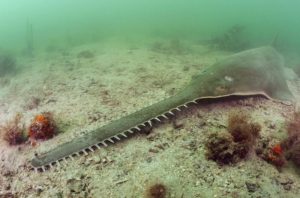
Business end of a sawfish:
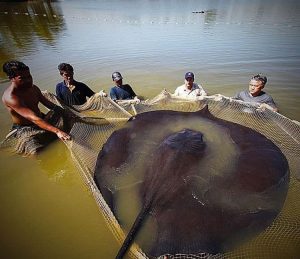
Giant freshwater stingray!
The frilled shark looks like an eel:

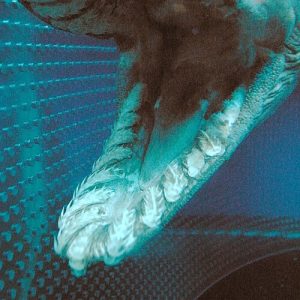
The frilled shark’s teeth:
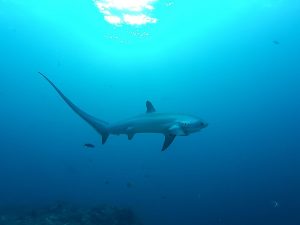
The thresher shark and its whip-like tail [photo by Thomas Alexander – Own work, CC BY-SA 4.0, https://commons.wikimedia.org/w/index.php?curid=50280277]:
The Halmahera epaulette shark, looking a little bit like a long skinny koi fish [photo by Mark Erdmann, California Academy of Sciences, Attribution, https://commons.wikimedia.org/w/index.php?curid=30260864]:

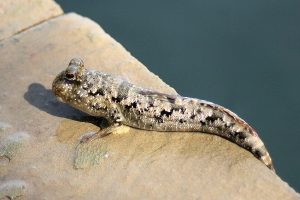
A mudskipper, which is a fish even though it kind of looks like a weird frog [photo by Heinonlein – Own work, CC BY-SA 4.0, https://commons.wikimedia.org/w/index.php?curid=44502355]:
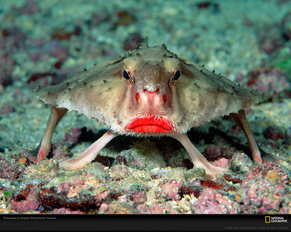
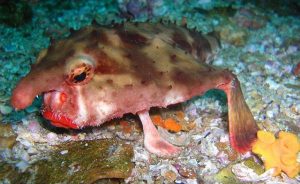
The red-lipped batfish wants a big kiss:
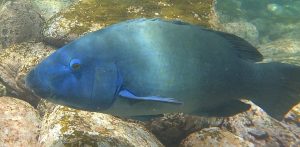
The male blue groper is very blue [photo by Andrew Harvey, some rights reserved (CC BY) – https://www.inaturalist.org/photos/62196538, CC BY 4.0, https://commons.wikimedia.org/w/index.php?curid=157789928]:
The giant oarfish is very long:

Show transcript:
Welcome to Strange Animals Podcast. I’m your host, Kate Shaw.
This week we have a big fish episode! I mean, it’s a big episode about a lot of different fish, not necessarily fish that are big—although some of them sure are! Thanks to Arthur, Yuzu, Jayson, Kabir, Nora, Siya, Joel, Elizabeth, Mac, Ryder, Alyx, Dean, and Riley. I told you this is a big fish episode.
Let’s jump right in with a fish suggested by Jayson, the sawfish. There are five species of sawfish alive today. The smallest can still grow over 10 feet long, or 3 meters, while the biggest species can grow over 20 feet long, or 6 meters. The largest sawfish ever reliably measured was 24 feet long, or 7.3 meters.
The sawfish lives mostly in warm, shallow ocean waters, usually where the bottom is muddy or sandy. It can also tolerate brackish and even freshwater, and will sometimes swim into rivers and live there just fine.
The sawfish is a type of ray, and rays are most closely related to sharks. Like sharks, rays have an internal skeleton made of cartilage instead of bone, but they also have bony teeth. You can definitely see the similarity between sharks and sawfish in the body shape, although the sawfish is flattened underneath, which allows it to lie on the ocean floor. There’s also another detail that helps you tell a sawfish from most sharks: the rostrum, or snout. It’s surprisingly long and studded with teeth on both sides, which makes it look like a saw.
The teeth on the sawfish’s saw are actual teeth. They’re called rostral teeth and the rostrum itself is part of the skull, not a beak or a mouth. It’s covered in skin just like the rest of the body. The sawfish’s mouth is located underneath the body quite a bit back from the rostrum’s base, and the mouth contains a lot of ordinary teeth that aren’t very sharp.
Since the sawfish has plenty of teeth in its mouth, you may be wondering how and why it also has extra teeth on both sides of its saw. It’s because the rostral teeth evolved from dermal denticles.
Dermal denticles look like scales but they’re literally teeth, they’re just not used for eating. Sharks have them too, along with some other fish. In the case of the sawfish, the rostral teeth grow much larger than an ordinary dermal denticle, and stick out sideways.
Both the rostrum and the head are packed with electroreceptors that allow the sawfish to sense tiny electrical charges that animals emit as they move. This might mean a school of fish swimming through muddy water, or it might mean a crustacean hiding in the sand. The sawfish sometimes uses its rostrum to dig prey out of the sand, but it also uses it to slash at fish or other animals. Then the sawfish can either grab the injured or dead animal with its mouth or pin it to the sea floor with its rostrum to maneuver it into its mouth. Its mouth is relatively small and it prefers to swallow its food whole, head-first, so it can only eat fish that are smaller than its mouth. That’s also why it doesn’t want to eat people. Its mouth is too small.
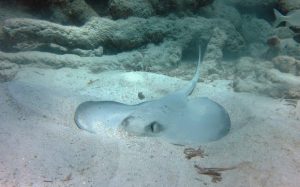
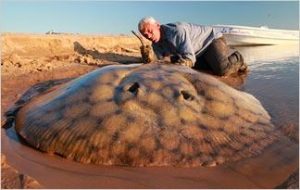
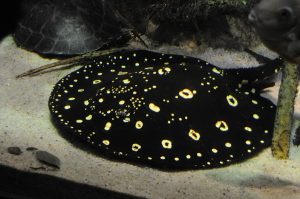
Yuzu wanted to learn about another shark relation, the giant freshwater stingray, which lives in rivers in southeast Asia. It’s dark gray-brown on its back and white underneath, and it has a little pointy nose at the front of its disc. It also has dermal denticles on its back.
The giant freshwater stingray has a rounded, flattened body, and it’s really big. A big female can grow over 7 feet across, or 2.2 meters. Its tail is long and thin with the largest spine of any stingray known, up to 15 inches long, or 38 cm. Its tail is so long that if you measure the giant freshwater stingray by length including its tail, instead of by width of its disc, it can be as much as 16 feet long, or about 5 meters. Some researchers think there might be individuals out there much larger than any ever measured, possibly up to 16 feet wide. The length and thinness of the tail gives the ray its other common name, the giant freshwater whipray, because its tail looks like a whip.
While we’re talking about shark relations, let’s go ahead and talk about a few actual sharks. Kabir wanted to learn about the frilled shark, which looks and acts more like an eel than a shark. A big female can grow up to 6 and a half feet long, or 2 meters. Males are a little shorter on average. The frilled shark has the same anatomy found in ancient sharks from the fossil record, dating back at least 95 million years. It’s found a body type that works for it.
The frilled shark lives on the continental shelf in many parts of the world, and while it technically lives near the sea floor, at night it migrates closer to the ocean surface to find fish, squid and other cephalopods, and other food. There are two species known, with the southern African frilled shark only discovered in 2009.
The frilled shark is dark brown or gray, and its jaws are long and contain clusters of teeth in little rows. Each tooth has three sharp points, and there are 300 teeth, so a frilled shark has 900 points in its mouth. The points are so sharp that scientists examining dead sharks have gotten cut on the teeth, which would be really embarrassing if you’re a shark expert that was bitten by a dead shark. The frilled shark can open its jaws extremely wide to swallow fish and other animals that are up to about half the size of the shark itself. It even eats other sharks.
Next, Joel wanted to learn about the thresher shark. It’s a truly big fish that can grow up to 20 feet long, or over 6 meters. It’s a fast, slender shark with a tail fin that can be as long as its body. It eats a lot of other animals, including birds and crustaceans, but it specializes in hunting fish that travel in schools, like tuna, sardines, and mackerel. It uses its incredibly long tail as a whip, slapping a fish to stun it so the shark can eat it. When it whips its tail, its body flexes so that its head points downward in the water with the tail snapping forward over it. A 2024 study determined that the thresher shark’s vertebral column is fortified to allow it to work like a catapult. The thresher shark can also use its long tail to help it leap out of the water completely, although scientists don’t know why it wants to do that.
There are three species of thresher shark known to science, but in 1995 a genetic analysis revealed the possible presence of a fourth species. Scientists think it lives in the eastern Pacific and may look similar to the bigeye thresher, enough that it gets misidentified as that species when it’s seen. The three known species of thresher shark are hard to tell apart at a distance as it is.
And for our last shark, Siya asked about the Halmahera epaulette shark. It’s light brown with darker and lighter spots, and is a slender shark that can grow a little over 2 feet long, or 68 cm. It lives around Indonesia, and it might live in other places too. We don’t know yet, because it was only discovered in 2013 and only two specimens have ever been found.
Epaulette sharks are also called walking sharks, because they use their fins to walk along the sea floor and explore crevices in rocks. Some species can even walk short distances on land to enter tidal pools and other places where they can find food. They live in warm, shallow water, usually near reefs or islands, and they eat whatever small animals they can find. There are nine species known, but there are undoubtedly more than haven’t yet been discovered by science. You might think this is strange for a shark that can walk on land, but walking sharks are nocturnal and not very big, so it’s easy to miss them when they’re out and about.
That brings us to Arthur’s suggestion, the mudskipper. The mudskipper also uses its fins to walk. Its pectoral fins are muscular and allow it to climb out of the water and onto land, climb into low branches, and even jump. Its pectoral fins look like little arms, complete with an elbow. The elbow is actually a joint between the actual fins and the radial bones, which in most fish are hidden within the body but which stick out of the mudskipper’s sides a short distance. This helps it move around on land more easily. Its pelvic fins are also shaped in such a way that they act as little suction cups on land.
The mudskipper is so good at living on land that it’s actually considered semi-aquatic. It lives in mudflats, mangrove swamps, the mouths of rivers where they empty into the ocean, and along the coast, although it prefers water that’s less salty than the ocean but more salty than ordinary freshwater. It only lives in tropical and subtropical areas because it needs high humidity to absorb oxygen through its skin and the lining of its mouth and throat.
The mudskipper is a fish, but it looks an awful lot like a frog in some ways, due to convergent evolution. It has a wide mouth and froglike eyes at the top of its head and will often float just under the water with its eyes above water, looking for insects it can catch. The largest species grows about a foot long, or 30 cm, and while it has some scales, its body is coated with a layer of mucus to help it retain moisture. It spends most of the day on land, hunting for insects and other small animals. Not only can it absorb oxygen through its skin, it keeps water in its gill chambers to keep the gills wet too. It even has a little dimple under its eye that holds water, that helps keep its eyes moist.
The mudskipper also takes a big mouthful of water with it when it climbs on land, but not to breathe. It uses the water to hunt with. When it encounters an insect or other small animal on land, it carefully rotates its mouth–yes, it can rotate its mouth, which has led to me trying to rotate my mouth, something humans can’t actually do–so that its mouth is just above the animal. Then it spits out the mouthful of water onto the insect and immediately sucks the water back into its mouth, carrying the insect with it. When it catches an animal underwater, it opens its big mouth quickly, causing suction that sucks the animal right into its mouth. It also has sharp teeth, so when an animal is in its mouth, it’s not getting out again.
Alyx, Dean, and Riley suggested we talk about the red-lipped batfish, a type of anglerfish only found around the Galapagos Islands in the Pacific Ocean. It lives on the ocean floor where the water is fairly shallow, and it grows about 8 inches long, or 20 cm. It’s usually a mottled brown, green, or grey with a white stomach, but its mouth is bright red. It looks like it’s wearing lipstick. It eats fish and other small animals, which it attracts using a lure on its head, a highly modified dorsal fin called an illicium.
The weirdest thing about the red-lipped batfish is actually its fins. It prefers to walk on the bottom of the ocean instead of swim, and it has modified pectoral fins called pseudolegs. The pseudolegs make it look a little bit like a weird frog with lipstick. Researchers think the red lips may be a way to attract potential mates, presumably ones who are hoping for a big smooch. At this rate I’m wondering if there are any fish that don’t walk on their fins.
Next, Mac wanted to learn about a fish called the payara. The problem is, there are two fish with that name, so let’s learn about them both!
The first payara is a pretty, silvery fish with a couple of small dark spots on its body. It’s found in the Amazon basin in South America and can grow at least 1 foot 8 inches long, or 51 cm. It’s sometimes kept in large aquariums, and is sometimes called the vampire tetra or the vampire fish because it has a pair of long fangs that it uses to stab other fish with before eating them. Its fangs stick up from its lower jaw, though, so if it’s a vampire fish, it’s an upside-down vampire.
As for the other payara, it’s related to the first kind and is also found in South America, but it’s even larger. It can grow a little over 3 feet long, or 3.3 meters. Its teeth are also large and sharp, including two big fangs sticking up from its lower jaw. In a big individual, its fangs may be 4 inches long, or 10 cm. This is not a fish you want to get bitten by! You are probably not in any danger of being bitten by this payara, though, unless you happen to spend a lot of your time swimming along the bottom of rivers in the Amazon.
Quite a while ago, Ryder suggested we learn about the pipe cichlid. I tried to find more about it and I think it’s actually a fish called the pike cichlid. Pike cichlids are popular freshwater aquarium fish that are native to tropical and subtropical parts of eastern South America, and there are about 45 species known so far. They’re typically quite small, with most species only growing a few inches long, or around 8 cm, although some species are more than twice that length. The pike part of their name comes from their shape, like a teeny-tiny pike, a predatory fish that can grow up to 5 feet long, or 1.5 meters. Pike and pike cichlids aren’t related, but pike cichlids are predatory. It’s just that instead of eating other fish, ducks, frogs, and even reptiles and mammals that end up in the water, the pike cichlid mostly eats insects.
Elizabeth wanted to learn about the blue groper, a fish found around Australia and nowhere else in the world. It lives around reefs and rocky areas near the coast, where it can find plenty of starfish, urchins, crustaceans, and other small animals to eat. It can grow almost six feet long, or 1.75 meters, and its teeth are peg-shaped to help it pick mollusks and other animals off of rocks before crushing them.
It’s called the blue groper because males are a beautiful blue color, while females are brown or reddish-brown and young fish are green. All young blue gropers are female, and as they grow up some change to become males while most remain females. The fish grow very slowly and can live to be at least 70 years old, so the fish don’t even reach maturity until they’re 15 or 20 years old. When a fish is around 30 or 35 years old, it will change gender again, this time becoming a male. But if the male of a group dies, the group’s dominant female will change into a male and turn blue. This is common in the family of fish that the blue groper belongs to, Labridae, also called wrasses.
Let’s finish with a suggestion from Nora, the oarfish. The giant oarfish and Russell’s oarfish can both grow at least 26 feet long, or 8 meters, and possibly much longer. Most of its length is tail, which often shows damage from being bitten. Since its organs are all close to the front of its body, and it doesn’t need its tail for swimming, if a predator takes a bite out of its tail, the fish is going to be fine. The oarfish can even detach pieces of its tail if it needs to, the same way some lizards can, to distract a potential predator. Like those lizards, the tail doesn’t grow back.
The oarfish is silvery in color with a red crest on its head and a mane-like fin down its back, although it’s actually an elongated dorsal fin. It has extremely long pelvic fins too.
The giant oarfish has a short, blunt snout and no teeth because it filters krill and other tiny animals from the water. It doesn’t have scales. Instead, its skin is soft with a delicate layer called ganoine that gives it a shimmery, almost metallic appearance. The long filaments of the crest on its head and its pelvic fins are also delicate. But although it’s long and slender like an eel, it actually swims vertically with its head pointing up and its tail down. We’re not sure why, although one theory is that this minimizes its profile to predators looking up from below. It can swim quickly straight up and down to avoid predators that mostly just swim forward.
We know so little about the oarfish, and what we know is so strange, that it’s the next best thing to a sea serpent. The first living giant oarfish was only filmed in 2001. Most oarfish are only seen when they’re dead or dying. It seems to live throughout the world’s oceans, except for the Arctic and Antarctic, and is a deep-sea fish but may migrate closer to the surface at night to find more food.
A Japanese legend says the oarfish predicts earthquakes. If an oarfish is seen near the surface or washes up on a beach, an earthquake is supposed to be imminent. That seems to be a coincidence, though.
The oarfish looks like a sea serpent, and some people think it might have given rise to some sea serpent sightings. This may or may not be the case, but it’s certainly a mysterious fish.
You can find Strange Animals Podcast at strangeanimalspodcast.blubrry.net. That’s blueberry without any E’s. If you have questions, comments, corrections, or suggestions, email us at strangeanimalspodcast@gmail.com.
Thanks for listening!